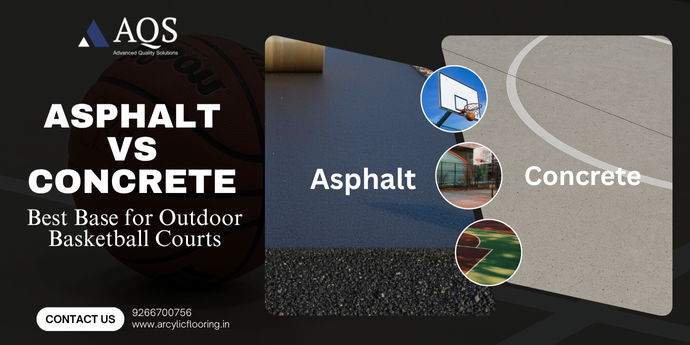
Choosing the right base for a basketball court – one of the absolute make-or-break decisions when it comes to basketball court construction – is something that’ll come back to haunt you if you get it wrong. Whether that court is going to be in a school, sports academy, residential area, private club, government project, or just a backyard, the long-term quality of the thing is going to depend entirely on what you put in place to support it – the synthetic surface that kids & players will be running around on isn’t going to magically fix itself.
In India, where the outdoor courts take a beating from the scorching heat, those monsoon rains that come in, soil that keeps shifting around, and of course the endless action on the court, getting the foundation right becomes a whole lot more important. That’s why you really want to be working with a team of experienced guys who are pros at laying down a basketball court, have the proper certifications to back it up, and really know what they’re up to when it comes to getting the underlying structure right.
This guide really gets into the nitty-gritty of asphalt vs concrete, gives you the lowdown on how they perform, weigh up the costs, lifespan and suitability, and shows you just how a top-notch acrylic flooring system from AQS can transform those surfaces into pro-grade courts.
Understanding the Real Structure of a Basketball Court
Sub-Grade / Soil Layer
This is the underlying stuff that supports the whole court system. And let’s be honest, how well it performs over the years is a big deal. Get the compaction, drainage and soil strengthening right, and you’re looking at a system that will last. But if the sub-grade is just not up to scratch, even a top-notch asphalt or concrete base is going to suffer.
Upgrade Your Sports Court Today
Get premium synthetic acrylic flooring designed for durability, grip, and performance.
Get Free ConsultationBase Layer (Asphalt or Concrete)
This is the structural foundation that holds all the weight and decides how well the court will stand the test of time. You’ve got your asphalt – which is okay if you don’t mind a bit of flexibility – and your concrete – which gives you that extra bit of rigidity and durability. But the choice between the two is a big one, because it affects everything from how many cracks you’ll get to how much maintenance your court needs, and how long it’ll actually last.
Acrylic Sports Flooring System (5-layer, 8-layer or cushioned)
People often think the bit that players play on is just the asphalt or concrete beneath. But no, it’s all about the acrylic system – a 5-layer or 8-layer system, or one with a bit of cushioning. That’s what delivers the grip, the bouncy feel, the UV protection and the colour that lasts and lasts when you’re playing outside. And of course, if you’re using a cushioned system, you get that extra bit of shock absorption to make it a bit safer for long sessions.
Court Lines & Final Coating
Once the acrylic layers are in place, that’s when you add the professional line markings to make sure the game is played out accurately. And when you’re doing this, you’re using high-quality, UV-resistant acrylic stuff that will keep on looking great even under the most intense sunshine. And then you seal it all off with that final topcoat to lock in the colour, the texture and the slip resistance to finish off the court’s performance surface.
Why This Structure Matters
Most people assume that the “flooring” on a court is just asphalt or concrete. But no, those materials are just the base layer. What people are actually playing on is the carefully engineered acrylic system – and that’s what gives you the grip, the comfort, the performance and the safety of a top-class basketball court. The base layer may give you the strength you need, but the acrylic surface is what delivers.
What Is an Asphalt Basketball Court Base?
Asphalt is a flexible bitumen-based pavement mix commonly used in outdoor sports courts worldwide because of its smooth finish and workable nature. It is installed hot, compacted thoroughly, and then cooled to form a strong, even base layer. Once an acrylic sports coating system is applied, the asphalt transforms into a high-performance outdoor basketball court suitable for long-term play.
Advantages of Asphalt for Basketball Court Construction
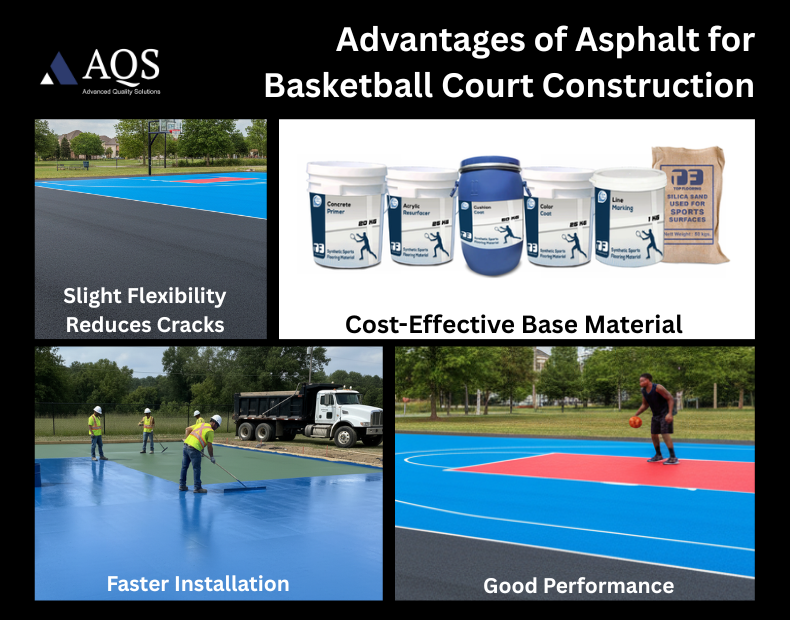
1. Slight Flexibility Reduces Cracks- Asphalt naturally has mild elasticity, allowing it to expand and contract with minor soil movement. This flexibility helps minimise surface cracks that typically occur in rigid concrete slabs. As a result, the court retains better structural performance over time, especially in regions with shifting soil.
2. Faster Installation- Asphalt cools and sets much faster than concrete, allowing the construction team to move to the acrylic coating stage sooner. This speed makes it ideal for projects that have strict timelines, such as school tournaments or community development deadlines. Faster curing means players can begin using the court much earlier than they would with concrete.
3. Cost-Effective Base Material- Asphalt generally costs less per square foot compared to concrete, making it a practical choice for budget-focused basketball court construction. It fits well for facilities like public parks, society courts, or temporary project setups where affordability is important. Because of the lower initial investment, asphalt is often used when clients require cheap outdoor basketball court flooring solutions.
4. Good Performance Under Acrylic Flooring- When topped with a professional AQS acrylic sports flooring system, asphalt delivers impressive traction and safe foot grip during play. It also offers consistent ball bounce and stable performance during rain, thanks to the smooth and even finish. With UV-resistant acrylic coatings, the surface retains colour and durability even in strong sunlight.
Disadvantages of Asphalt basketball Court
1. Heat Softening- Asphalt tends to soften under extremely high temperatures, which is common in many Indian states during peak summer. This softening can create depressions or uneven spots when heavy use continues over time. Such distortions eventually require correction before resurfacing.
2. More Maintenance Over Time- Asphalt needs regular crack repair, surface patching, and sealing to keep it in good condition for outdoor sports use. Without timely maintenance, small cracks may expand and affect the acrylic layer installed above it. This increases the overall upkeep cost compared to concrete slabs.
3. Not Ideal for Heavy Vehicle Loads- Asphalt can deform if heavy vehicles, loaders, or construction equipment drive over the area before or after installation. This makes it unsuitable for courts located in spaces where vehicle movement is frequent. Once damaged, these deformations can be difficult and costly to repair.
4. Sensitive to Poor Drainage- Asphalt deteriorates faster when exposed to standing water, especially in regions prone to long monsoon seasons. Water can weaken the bitumen layer and create soft spots that lead to cracks and potholes. Proper drainage and slope design are essential to avoid premature wear.
Best Use Cases for Asphalt Basketball Courts
Asphalt is ideal for school and college playgrounds where installation speed and budget are key factors. It is widely used in recreational parks and public community courts due to its reasonable cost and decent longevity. The material performs best in regions with moderate heat and stable soil conditions, making it a reliable option for large-scale public development projects.
What Is a Concrete Basketball Court Base?
Concrete is poured in as a tough M20 or M25 grade slab, with added strength from steel mesh or rebar to withstand the kind of movement that can happen when a building shifts. It’s built with a super precise 1 in 100 slope and expansion joints to manage the way concrete expands when it gets hot – a problem that can cause some real issues if you don’t get it right. When put together properly, concrete can become one of the strongest and most dependable bases for outdoor basketball court flooring material, the kind of thing you’d expect to see at the top end of the game.
Advantages of Concrete for Basketball Courts
1. Long-Term Stability and Strength
Concrete is great at staying flat and stable for ages, even with all the high-impact action you get in competitive basketball. Its rigidness helps the ball bounce the same every time, and that’s a real plus for teams and trainers who are counting on it. Some training environments and top level academies only go for concrete because it’s the best.
2. Handles Heat and Rain Better
In countries with really hot summers, like India, concrete does a way better job of staying solid even when it gets boiling hot outside. And when it rains, it stays in shape even better than asphalt. This makes it a lot better suited for places with really harsh weather conditions – you know, places where it can get scorching hot in the summer and then pour with rain all through the monsoon season.
3. Perfect for High-Intensity Play
Concrete gives a ball bounce and still keeps on going. It’ll handle all the heavy foot traffic and quick changes of direction you get in high-intensity play without showing any signs of wear and tear that fast. This makes it perfect for high-performance training courts, or for serious clubs and academies that need a top class surface.
4. Lower Long-Term Maintenance
Concrete costs a bit more upfront to get a concrete court laid down. But when you look at the long term, the savings are huge. Because concrete stays solid for so long, you won’t need to do as much maintenance over the years – you can count on it looking good and playing well for far less hassle and expense than any other surface.
Disadvantages of Concrete Basketball Court Flooring
1. Higher Initial Cost
Concrete requires more material, labour, and time, making the upfront build cost higher. This can impact budget-sensitive projects or temporary installations. However, the long-term savings often compensate for the initial investment.
2. Requires Expansion Joint Treatment Before Acrylic
If you want to put acrylic on top of your concrete surface – which is what most of these high-end basketball courts are now going for – then you need to do some extra work on the joints first. This is because if you don’t fill and seal the joints properly, they can start to show up as cracks on the surface later down the line.
3. Longer Curing Time
Concrete takes a while to get to full strength before you can start laying the final layers – it’s usually around 21-28 days before it’s good to go. That can add a bit to the overall project timeline. Asphalt on the other hand cools down much quicker and gets ready for the final coat in no time.
4. Harder Base Without Cushioning
Playing directly on concrete increases joint impact and fatigue due to its rigid nature. Without cushioned acrylic layers, player comfort is compromised. This is why cushioned systems are recommended for premium concrete-based courts.
Best Use Cases for Concrete Basketball Courts
The one place where concrete really comes into its own is on premium academies that need a surface that will stay good for ages. It’s also perfect for high-intensity training courts where the players are putting in the hours every day. Sports complexes, clubs and institutions also do pretty well out of concrete – it’s just one of those surfaces that really delivers in the long term.
Asphalt vs Concrete Basketball Court – Side-by-Side Comparison
| Feature | Asphalt | Concrete |
| Cost | Lower | Higher |
| Installation Speed | Fast | Slow |
| Heat Resistance | Moderate | Excellent |
| Crack Resistance | Moderate–Good | Good (with joints) |
| Durability | 6–12 yrs (with maintenance) | 20–30 yrs |
| Maintenance Needs | Higher | Lower |
| Performance With Acrylic | Very Good | Excellent |
| Best For | Budget courts | Professional, long-term courts |
Why Choose Acrylic Sports Flooring?
Asphalt or concrete alone cannot deliver the performance qualities needed for a professional basketball court. These base layers provide structural strength, but they lack the surface engineering required for sports. This is why acrylic systems become the real playing surface in modern basketball court flooring.
Grip
Bare asphalt or concrete becomes slippery, especially when dusty or wet. Acrylic coatings create a controlled micro-texture that enhances traction. This ensures safer movement, quick stops, and confident footwork during fast play.
Colour
Base materials fade, stain, and lose uniformity quickly. Acrylic coatings provide rich, vibrant colours that stay consistent over years of outdoor exposure. They also enhance visibility of lines and improve the overall look of the court.
UV Protection
Sunlight breaks down asphalt and concrete surfaces over time. Acrylic basketball court flooring is engineered with UV-resistant resins that shield the court from fading, cracking, and heat damage. This protection ensures long-lasting outdoor basketball court flooring.
Consistent Bounce
Bare surfaces develop uneven patches, affecting ball response. Acrylic layers create uniform thickness and texture, giving players predictable bounce across the entire surface. This consistency is essential for serious training and competitive play.
Water Drainage
Asphalt and concrete can hold water or develop puddles when not coated properly. Acrylic top layers help promote quick drying and ensure that moisture doesn’t stay trapped on the surface. This improves durability and allows play to resume faster after rain.
Player Comfort
Bare courts are harsh on joints and cause fatigue during long practice sessions. Acrylic systems—especially cushioned versions—soften impact and improve comfort. This reduces injury risk and allows players to train longer.
AQS provides full systems that work perfectly on both asphalt and concrete, engineered for long-lasting performance in Indian conditions.
AQS Acrylic Sports Flooring Options
5-Layer Standard System
Ideal for schools, communities, and budget-focused projects. It offers excellent durability and grip while keeping overall basketball court installation cost low. Perfect for general outdoor basketball court flooring material requirements.
8-Layer Premium System
Provides enhanced smoothness, better UV stability, and superior colour retention. Designed for clubs, academies, and projects needing elite performance. Offers long-term resilience even under heavy play.
Cushioned Acrylic System (for enhanced comfort)
Built with shock-absorbent layers to reduce impact on knees and ankles. Designed for high-performance training and professional courts. Offers the best combination of comfort, ball response, and weather resistance.
Why Acrylic Basketball Court Flooring Delivers Superior Performance
Non-Slip Texture: The textured acrylic coating ensures perfect grip in dry and slightly wet conditions. It prevents slipping during lateral movements, jumps, and sprints. This provides a safer playing environment for all skill levels.
UV Stabilizers: Each layer is formulated to resist sun damage and fading. These stabilizers keep the court vibrant and structurally sound for years. This makes AQS flooring ideal for India’s intense outdoor climates.
High Ball Bounce: Acrylic surfaces deliver reliable, uniform bounce across the court. This is essential for shooting, dribbling, and competitive practice. Both asphalt and concrete bases perform better with an acrylic top layer.
Weather Resistance: Acrylic coatings are built to withstand rain, heat, dust, and humidity. They prevent surface deterioration and support quick recovery after weather changes. This ensures uninterrupted play throughout the year.
Advanced Colour Retention: AQS uses premium pigments that resist fading even in harsh sunlight. The court maintains its aesthetic appeal long-term. This reduces frequent repainting and lowers maintenance costs.
This is why most basketball court makers and basketball court builders choose acrylic coatings for the final finish—because only acrylic systems deliver true performance, safety, aesthetics, and all-weather durability, regardless of whether the base is asphalt or concrete.
Climate & Site Conditions: How to Choose the Base
Choose Asphalt When:
Budget is tight: Asphalt is cost-effective during the initial phase of basketball court construction, making it ideal for projects with limited funding. Its lower material and labour costs help institutions start quickly without compromising basic playability. This makes asphalt a common choice for community parks and schools looking for affordable outdoor basketball court flooring.
Soil movement is minor: Asphalt offers mild flexibility, allowing it to tolerate slight ground shifts without major cracking. In areas where the soil is stable and doesn’t expand or contract aggressively, asphalt performs reliably under acrylic coatings. This ensures a smoother surface lifespan without frequent structural repairs.
Court is for casual/community play: For recreational courts, school grounds, and public-use areas, asphalt provides a good balance of durability and cost. It handles moderate daily play well when topped with proper acrylic sports flooring. Communities benefit from a functional, safe, and economical playing surface.
Installation needs to be quick: Asphalt sets faster than concrete, allowing acrylic coating and full court marking sooner. This makes it perfect for projects with short deadlines or events requiring rapid setup. Reduced construction time also means lower labour costs and quicker handover.
Choose Concrete When:
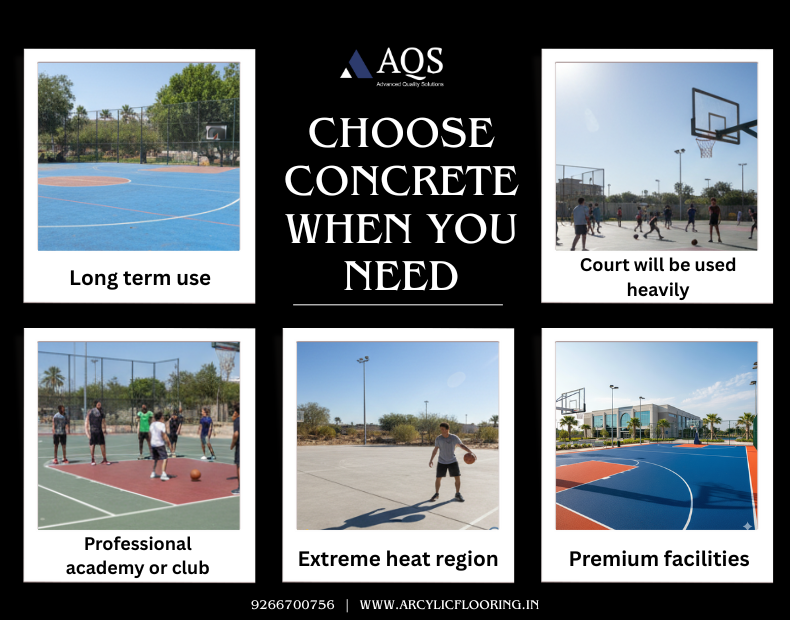
Long term use: Concrete gives better structural stability for courts that will last 20-30 years. Once topped with acrylic systems it gives consistent bounce and durability for long periods. This reduces resurfacing frequency and maintenance cost.
Court will be used heavily: For high traffic facilities like sports academies, colleges and professional training centers, concrete can take the heavy use. Its rigid foundation resists wear and tear and keeps the surface flat even under continuous use. This gives a court that performs consistently through heavy duty sessions.
Professional academy or club: Competitive environments demand a stable high performance base to support advanced training. Concrete gives the precision and strength required for professional level gameplay. When paired with cushioned acrylic flooring it ensures player safety, comfort and performance consistency.
Extreme heat region: Concrete can handle India’s harsh summers better than asphalt which can soften or deform under high temperatures. It maintains structural integrity even in regions with day long sun exposure. This makes it ideal for states like Rajasthan, Gujarat and Telangana.
The project involves premium facilities: Premium residential clubs, luxury housing societies and elite sports complexes require long lasting quality. Concrete combines strength with a refined finish when topped with multi layer acrylic systems. It supports higher aesthetics, better bounce quality and long term value.
Common Mistakes People Do with Asphalt or Concrete Courts
1. Playing Directly on Asphalt or Concrete
Playing on bare asphalt or concrete base increases the impact on ankles, knees and lower back. These surfaces have no cushioning or grip consistency, which increases the risk of slips and long term joint injuries. A proper acrylic basketball court flooring system will give better comfort, traction and player safety.
2. Incorrect Slope
A poorly designed slope prevents water from draining properly, water will stagnate on the court. Water will eventually weaken both asphalt and concrete, causing surface peeling, algae growth and cracks. A 1:100 slope is crucial to maintain performance and extend the life of outdoor basketball court flooring.
3. No Crack Treatment
Small cracks may look harmless but will expand rapidly due to heat, moisture and ground movement. If left untreated, they will reflect through the acrylic surface and damage the entire playing area. Crack filling and reinforcement is mandatory before installing or resurfacing any basketball court material.
4. Using Wall Paint Instead of Sports Acrylic
Some projects try to save money by using regular paint but it has zero UV stability, grip texture and flexibility. It will fade quickly, become slippery and destroy the court within months. Only professional grade acrylic sports coatings should be used to ensure durability and safe outdoor basketball court installation.
5. Skipping Professional Installers
Basketball court construction requires slope design, crack repair, layering and material compatibility all governed by engineering standards. Hiring unskilled labor will result in uneven surface, poor bounce response and early failure of the flooring. Always choose certified basketball court installers and a trusted basketball court contractor to ensure long term quality.
Conclusion
Choosing an asphalt or a concrete base for a basketball court is more than just a construction decision , it really makes all the difference in how well the court will hold up and what kind of performance you can expect over time – not to mention how it’ll handle the rough Indian outdoors. Asphalt gives you all the speed & flexibility you need, and it comes cheap to boot – which makes it a good fit for community courts and schools. On the other hand, concrete gives you long-term stability, it can handle the heat , and it’ll just plain last longer – which is why it’s the top choice for top-notch academies, high-intensity training facilities, and any sports facility that needs to go the distance.
But at the end of the day, the real performance of the court is all about the flooring – no matter if you go with asphalt or concrete, the performance of your outdoor basketball court is only as good as the flooring you put on top of it . This is where AQS really shines. With advanced acrylic systems designed to give you the perfect balance of grip, bounce, UV resistance, and all-weather stability, AQS can turn both asphalt and concrete into a pro-level basketball court that’ll stand the test of time.Whether you’re building a budget-friendly community setup or a world-class training facility, combining the right base with AQS’s specialised basketball flooring materials ensures a smooth, safe, and long-lasting playing surface.
Frequently Asked Questions
Asphalt is cheaper during installation, while concrete has lower long-term maintenance costs.
Concrete generally lasts longer — up to 20–30 years with proper care.
Yes. Both surfaces can be resurfaced using AQS acrylic systems after proper crack/joint treatment.
Concrete is best for long-term family use, but asphalt is a quick, economical option.
Cost varies by size, location, base selection, and type of acrylic system. Concrete bases cost more upfront, and asphalt bases cost less initially.