
Pickleball is one of the fastest-growing sports in the world, and with that growth comes a surge in demand for accurate information about pickleball court size and official layout standards. Whether planning a backyard setup, school facility, club installation, or professional sports complex, understanding precise pickleball court measurements is essential for performance, safety, and compliance.
This comprehensive guide explains everything in detail, including official dimensions, line markings, net height, playing zones, and layout planning.
Table of contents
- What Is the Official Pickleball Court Size?
- Complete Pickleball Court Measurements Explained
- Breakdown of Pickleball Court Layout
- Pickleball Net Height and Placement
- Comparison with Tennis Court Size
- Outdoor vs Indoor Pickleball Court Measurements
- Surface Considerations for Accurate Measurements
- How to Mark Pickleball Court Lines Correctly
- Space Planning for Backyard Pickleball Courts
- Tournament Standards and Compliance
- Common Mistakes in Pickleball Court Measurement
- Why Accurate Pickleball Court Size Matters
- Can Multiple Pickleball Courts Fit in Limited Space?
- Cost Factors Linked to Court Size
- Future Trends in Pickleball Court Design
- Frequently Asked Questions (FAQs)
- Final Thoughts
What Is the Official Pickleball Court Size?
The official pickleball court size is 20 feet wide and 44 feet long. These dimensions apply to both singles and doubles play. Unlike tennis, where singles and doubles courts differ, pickleball maintains the same playing area for all formats. The 20×44 feet playing area is identical to a doubles badminton court, which is one reason pickleball courts are often built inside existing badminton layouts or multi-sport facilities.
However, the actual space required for proper installation is larger than the playing area.
Complete Pickleball Court Measurements Explained
When discussing pickleball court measurements, it is important to understand that the court includes several key sections beyond just length and width. Every line and zone plays a strategic role in gameplay.
- Total Playing Area
The base court measures 20 feet in width and 44 feet in length. These measurements are taken from the outside edges of the boundary lines.
- Recommended Total Space Requirement
While the official court is 20×44 feet, the recommended minimum total space for recreational play is approximately 30 feet by 60 feet. For tournament-level installations, USA Pickleball recommends a total playing area of 34 feet by 64 feet to ensure adequate player safety and comfortable movement. This additional clearance allows players to chase shots safely without obstruction.
Breakdown of Pickleball Court Layout
Understanding pickleball court size is incomplete without understanding how the court is divided internally. The layout consists of baseline areas, service courts, sidelines, and the non-volley zone.
- Baseline and Sidelines
The baselines run parallel to the net at the back of the court and measure 20 feet across. The sidelines run perpendicular to the net and measure 44 feet from end to end. These boundary lines define the outer playing area.
- Centerline
The centerline divides each side of the court into two equal service courts. It extends from the non-volley zone line to the baseline and is crucial for serving accuracy.
- Non-Volley Zone (Kitchen)
One of the most unique aspects of pickleball court measurements is the non-volley zone, commonly called the kitchen. This area extends 7 feet from the net on both sides and spans the full 20-foot width of the court. Players cannot volley the ball while standing inside this zone, which significantly impacts strategy and net play. The kitchen is included within the 44-foot total length.
Pickleball Net Height and Placement
Court measurements are incomplete without understanding net specifications.
- The net spans the full 20-foot width of the court. Its height is 36 inches at the sidelines and 34 inches at the center.
- This slightly lower center height encourages rallies and makes the game accessible to players of all skill levels.
- Net posts are typically placed 22 feet apart to accommodate the net’s proper tension and overhang.
Transform Your Sports Facility Today!
Contact us for high-quality synthetic sports flooring material and elevate your space!
Comparison with Tennis Court Size
Many facility owners compare pickleball court size to tennis dimensions when planning sports flooring installations. A standard tennis court measures 78 feet long and 36 feet wide for doubles. In comparison, pickleball’s 20×44 feet court is significantly smaller. In fact, up to four pickleball courts can fit inside one standard tennis court footprint. This efficiency makes pickleball highly attractive for clubs and community spaces seeking maximum utilization of limited land area.
Outdoor vs Indoor Pickleball Court Measurements
The official pickleball court size remains the same whether indoor or outdoor. However, ceiling height becomes an additional factor indoors.
- Indoor courts typically require a minimum ceiling height of 18 feet, though 20–25 feet is recommended for competitive play. This ensures overhead shots are not obstructed.
- Outdoor courts require proper drainage slope, usually around 1 percent, to prevent water accumulation without affecting gameplay.
Surface Considerations for Accurate Measurements
Accurate pickleball court measurements must be maintained during construction. The most common surface types include acrylic synthetic flooring, concrete base with acrylic coating, and modular tiles. Acrylic synthetic surfaces are widely preferred due to consistent ball bounce, weather resistance, slip resistance, and durability. Proper line marking must follow official dimensions exactly, as even minor deviations can impact gameplay quality. Surface texture also influences play speed. Smooth finishes provide faster ball movement, while textured coatings slow the ball slightly for better control.
How to Mark Pickleball Court Lines Correctly
When marking a court, precision is critical. Measurements must be taken from the outer edge of boundary lines. The process typically begins with marking the full 20×44 feet rectangle. After establishing the outer boundary, the net line is drawn at the midpoint of the 44-foot length, creating two equal halves of 22 feet each. Next, the non-volley zone lines are drawn 7 feet from the net on both sides. Finally, centerlines divide each half into two equal service courts. Professional installers use laser measurement tools to ensure accuracy down to millimeters.
Space Planning for Backyard Pickleball Courts
For residential installations, understanding pickleball court size helps determine if sufficient space exists. While the playing area is 20×44 feet, homeowners should ideally have at least 30×60 feet available. Fencing, lighting poles, and seating areas require additional planning space. Compact backyard courts can be built with minimal clearance, but this may limit advanced play.
Tournament Standards and Compliance
For competitive play and sanctioned tournaments, courts must meet official USA Pickleball standards. Total recommended play area of 34×64 feet ensures player safety during fast-paced rallies. Lighting standards typically require uniform illumination levels between 30 to 50 foot-candles for professional visibility. Surface color contrast between playing area and non-volley zone improves line visibility and reduces eye strain.
Common Mistakes in Pickleball Court Measurement
Incorrect court marking is one of the most common construction errors. Misplacing the non-volley zone line even by a few inches changes the strategic depth of the kitchen area. Improper net height is another frequent issue. A net set too high reduces rally speed, while a net too low gives unfair serving advantages. Failure to include adequate safety clearance is also problematic, particularly in compact installations.
Why Accurate Pickleball Court Size Matters
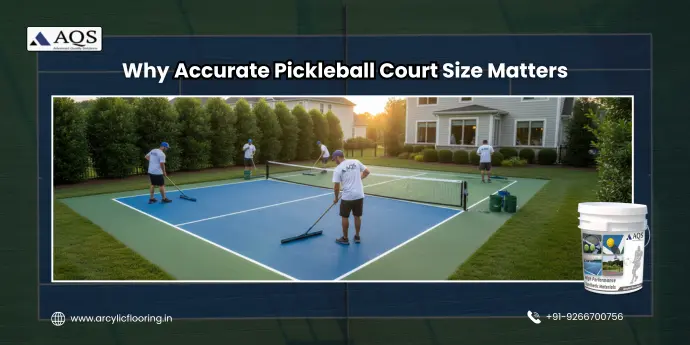
Precision in pickleball court measurements affects gameplay quality, fairness, and long-term player satisfaction. Incorrect dimensions can lead to inconsistent ball bounce zones, awkward player movement, and rule violations during tournaments. For clubs and institutions, this may reduce professional credibility. Properly measured courts enhance player confidence and ensure compliance with international standards.
Can Multiple Pickleball Courts Fit in Limited Space?
Yes, due to the compact pickleball court size, multiple courts can be installed within larger sports complexes. A standard tennis court area can accommodate up to four pickleball courts using temporary or permanent line markings. This increases revenue potential for sports facilities and improves community participation. Multi-court layouts must include adequate spacing between courts to prevent interference.
Transform Your Sports Facility Today!
Contact us for high-quality synthetic sports flooring material and elevate your space!
Cost Factors Linked to Court Size
The smaller size of pickleball courts reduces construction material costs compared to tennis courts. However, overall cost depends on surface type, base preparation, fencing, lighting, and drainage systems. Acrylic synthetic systems provide long-term durability and lower maintenance costs, making them ideal for commercial installations. Proper measurement ensures no rework is required, which saves long-term expenses.
Future Trends in Pickleball Court Design
As pickleball grows globally, innovations in court construction continue to evolve. Cushioned acrylic systems improve joint comfort. UV-resistant coatings extend lifespan in hot climates. Modular multi-sport designs allow facilities to convert spaces between tennis, badminton, and pickleball. Despite technological upgrades, official pickleball court size remains standardized at 20×44 feet.
Frequently Asked Questions (FAQs)
The official pickleball court size is 20 feet wide by 44 feet long.
Yes, both singles and doubles use the same 20×44 feet court dimensions.
The non-volley zone extends 7 feet from the net on both sides.
The recommended total area is at least 30×60 feet, ideally 34×64 feet for tournaments.
The net height is 36 inches at the sidelines and 34 inches at the center.
Yes, up to four pickleball courts can fit within one standard tennis court area.
Final Thoughts
Understanding official pickleball court size and precise pickleball court measurements is fundamental before planning construction, renovation, or backyard setup. The standardized 20×44 feet playing area, combined with carefully marked non-volley zones and accurate net height, ensures consistent and fair gameplay.
Whether designing a recreational court or a professional tournament facility, precision and quality surface materials determine long-term performance. As pickleball continues expanding worldwide, properly measured courts will remain the foundation of its growing success.