
Understanding tennis court measurement is absolutely essential whether you are a professional player, a facility designer, a sports architect. A passionate enthusiast who wants to build a court at home. The dimensions of a tennis court are not arbitrary. They have been carefully standardized by the International Tennis Federation (ITF) after decades of play, research, and refinement. Every line, zone, and surface on a tennis court carries a specific purpose, influencing game strategy, player movement, and the overall experience of the sport. From the baseline to the net, from the service box to the doubles alley, each element of a tennis court layout is precisely defined to ensure fairness and consistency in competitive play worldwide.
This comprehensive guide breaks down every aspect of official tennis court dimensions, covering singles and doubles court sizes, net height, line widths, surface types, run-off zones, and construction standards. Whether you are planning a new court installation, coaching players, or simply satisfying your curiosity about the game, this article delivers the most accurate, detailed, and up-to-date information available on tennis court measurement, layout, and design.
Table of contents
- What Are the Official Tennis Court Measurements?
- Official Tennis Court Dimensions at a Glance
- Tennis Court Layout: Understanding Each Zone
- Service Area Dimensions
- Singles vs. Doubles Court Size: Key Differences
- Singles vs. Doubles Court Comparison
- Tennis Court Net Specifications and Dimensions
- Complete Tennis Court Line Markings and Widths
- Tennis Court Line Markings Guide
- Recommended Run-Off Zones and Total Court Space
- Total Court Space Requirements (Including Run-Off)
- Tennis Court Surface Types and Their Impact on Dimensions
- How to Measure and Mark a Tennis Court: Step-by-Step
- Key Diagonal and Verification Measurements
- Tennis Court Construction Standards and Materials
- ITF Court Classification Categories Explained
- Organic Insights: Common Tennis Court Measurement Mistakes to Avoid
- Conclusion: Why Tennis Court Measurement Matters
- Quick Tips Section (Q&A)
What Are the Official Tennis Court Measurements?
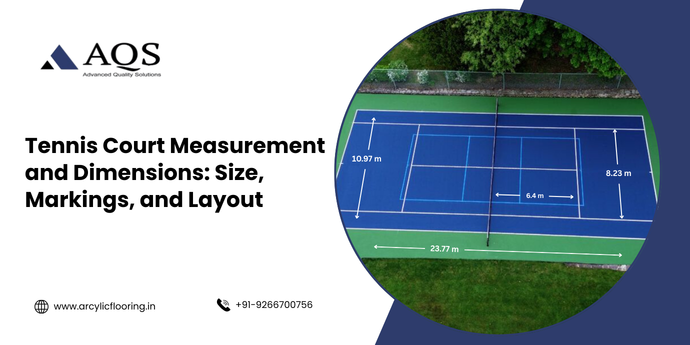
The official tennis court measurement, as governed by the International Tennis Federation (ITF) Rules of Tennis. Specifies that a standard tennis court must be a rectangular flat surface with precise dimensions for both singles and doubles play. For doubles matches, the court measures 23.77 meters (78 feet) in length and 10.97 meters (36 feet) in width. For singles play, the width narrows to 8.23 meters (27 feet), while the length remains the same at 23.77 meters. These measurements are used universally – from Grand Slam stadiums like Wimbledon and the US Open to local club courts and school facilities.
These numbers have remained largely consistent since the late 19th century, though surface standards and construction guidelines have evolved significantly. The court is divided into two equal halves by a net, with each half measuring 11.885 meters (39 feet) from the baseline to the net. The net itself sits at a height of 0.914 meters (3 feet) at the center, supported by posts placed 0.914 meters outside the singles sidelines, at a total post-to-post distance of 12.8 meters (42 feet). Every competitive court around the globe must conform to these ITF-mandated measurements to be considered regulation-standard.
Official Tennis Court Dimensions at a Glance
| Court Component | Meters | Feet / Inches |
| Total Court Length | 23.77 m | 78 ft |
| Doubles Court Width | 10.97 m | 36 ft |
| Singles Court Width | 8.23 m | 27 ft |
| Service Box Length (each) | 6.40 m | 21 ft |
| Service Box Width (each) | 4.115 m | 13.5 ft |
| Doubles Alley Width | 1.37 m | 4.5 ft |
| Net Height at Center | 0.914 m | 3 ft |
| Net Height at Posts | 1.07 m | 3.5 ft |
| Net Post Distance from Court | 0.914 m | 3 ft |
| Total Net Post Span | 12.8 m | 42 ft |
| Baseline to Service Line | 5.485 m | 18 ft |
| Center Service Line Width | 5 cm | 2 inches |
Tennis Court Layout: Understanding Each Zone
The layout of a tennis court is a masterpiece of geometric precision, divided into clearly defined playing zones that govern the flow and rules of the game. When you look at a tennis court from above, you can identify several key areas: the baseline zone at both ends of the court. The service boxes on either side of the center service line, the doubles alleys running the full length of the court alongside the singles sidelines, and the net area at the center. Each of these zones is bounded by painted white lines of exact widths, and each plays a specific role in singles and doubles gameplay.
The baseline is the farthest boundary of the court from the net, running the full width of the doubles court – 10.97 meters wide. Behind the baseline is the run-off area, which the ITF recommends should extend at least 6.40 meters (21 feet) at each end and 3.66 meters (12 feet) on each side for competitive play. This additional space allows players to chase balls beyond the boundary without risk of injury. The center mark, a small 10 cm (4-inch) line that bisects the baseline perpendicularly, is one of the most important but often overlooked markings on the court, as it defines the two halves from which the server must stand during each point.
Did You Know?
The word “tennis” likely comes from the French word tenez, meaning “take this” or “hold!”
Service Boxes and Their Exact Measurements
The service boxes are two rectangular areas on each side of the net, separated by the center service line. Each service box measures exactly 6.40 meters (21 feet) in length from the net to the service line, and 4.115 meters (13.5 feet) in width on each side of the center service line. There are four service boxes in total on a tennis court – two on each side of the net, one on the deuce side and one on the advantage side. When a player serves, the ball must land within the diagonally opposite service box. The precise dimensions of these boxes make service accuracy one of the most trainable and measurable skills in the game.
The service line runs parallel to the net and baseline at a distance of 6.40 meters from the net, dividing the backcourt from the forecourt. This line is also 5 centimeters (2 inches) wide, just like all baseline and sideline markings. The center service line runs perpendicularly from the net to the service line, bisecting the two service boxes on each side. It is important to note that the center service line is treated as part of the service box – a ball landing on any part of the center service line is considered good for a serve.
Service Area Dimensions
| Zone / Marking | Dimension (Meters) | Dimension (Feet) |
| Service Line from Net | 6.40 m | 21 ft |
| Half-Width of Each Service Box | 4.115 m | 13.5 ft |
| Center Service Line Width | 5 cm | 2 in |
| Service Line Width | 5 cm | 2 in |
| Total Service Area (per side) | 51.25 sq. m | 551.6 sq. ft |
Singles vs. Doubles Court Size: Key Differences
One of the most commonly misunderstood aspects of tennis court measurement is the difference between singles and doubles court dimensions. While the total length of the court – 23.77 meters (78 feet) – remains identical for both formats, the width changes significantly. A doubles court is 10.97 meters (36 feet) wide, while a singles court uses only 8.23 meters (27 feet) of that width. The extra 1.37 meters (4.5 feet) on each side, known as the doubles alley or tramline, becomes a valid playing area only during doubles matches. During singles, any ball landing in the doubles alley is considered out.
This distinction has a profound impact on tactics and movement. In singles play, the court feels narrower, rewarding precision and cross-court angles. In doubles, the wider court opens up more lateral space, making the alleys prime targets for angled volleys and wide passing shots. Coaches, players, and court designers must always clearly understand these width differences to properly mark and use the court in training and competition. Both sets of lines – the singles sidelines and the doubles sidelines – are permanently painted on all standard courts, making the transition between formats seamless.
Singles vs. Doubles Court Comparison
| Feature | Singles Court | Doubles Court |
| Total Length | 23.77 m (78 ft) | 23.77 m (78 ft) |
| Total Width | 8.23 m (27 ft) | 10.97 m (36 ft) |
| Total Playing Area | 195.65 sq. m | 260.87 sq. m |
| Alley Width (each side) | N/A | 1.37 m (4.5 ft) |
| Net Post Position | At singles sideline | 0.914 m outside sideline |
| Baseline Width | 8.23 m (27 ft) | 10.97 m (36 ft) |
| Service Box Width | 4.115 m (13.5 ft) | 4.115 m (13.5 ft) |
Tennis Court Net Specifications and Dimensions
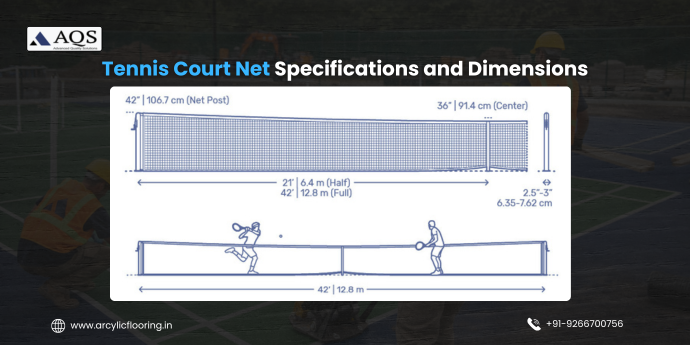
The tennis court net is one of the most critical physical elements of the court, and its specifications are tightly regulated by the International Tennis Federation. The net must span the entire width of the court – covering the full 10.97 meters (36 feet) including the doubles alleys – regardless of whether a singles or doubles match is being played. The net is suspended by a metal cable or cord, no more than 0.8 centimeters (1/3 inch) in diameter, which passes over or is attached to two net posts. The cord must be covered with white tape at the top, called the top band, which is between 5 and 6.35 centimeters (2 to 2.5 inches) wide.
The height of the net varies depending on its position. At the center of the court, the net must be exactly 0.914 meters (3 feet) high, held down by a net strap that is a maximum of 5 centimeters (2 inches) wide. At the net posts, the height is 1.07 meters (3 feet 6 inches). Net posts must be cylindrical and no more than 15 centimeters (6 inches) in diameter, positioned 0.914 meters (3 feet) outside the doubles sideline. When playing singles with a full doubles net, singles sticks – small support posts – are placed on the singles sidelines at a height of 1.07 meters to maintain proper net tension across the singles court area.
Net Post Placement and Construction Standards
Net posts are a vital yet often under-discussed aspect of tennis court construction. They must be firmly anchored into the court surface, either by embedding them in the ground at a fixed location or by using weighted freestanding bases in temporary court setups. According to ITF guidelines, fixed post sleeves embedded in the court surface are the preferred method for permanent installations, as they ensure structural stability and consistent net tension over years of use. The post must be positioned exactly 0.914 meters outside the doubles sideline on each side, giving the total net span – including posts – a width of 12.8 meters (42 feet 0.25 inches).
Complete Tennis Court Line Markings and Widths
The court markings are just as important as the overall dimensions of a tennis court, and their specifications are precisely defined in the ITF rulebook. All lines on a tennis court must be between 2.5 centimeters (1 inch) and 5 centimeters (2 inches) wide, except the baseline, which may be up to 10 centimeters (4 inches) wide. The color of the lines is traditionally white, providing maximum contrast against the court surface, though other high-contrast colors may be used by agreement. The lines are considered part of the court – a ball landing on any line is considered in play.
The markings include: two baselines at each end running the full doubles court width, two doubles sidelines running the full 23.77-meter length, two singles sidelines running parallel inside the doubles sidelines, two service lines running parallel to the net at 6.40 meters, one center service line from net to service line, and one center mark bisecting each baseline. Each of these markings must be painted with equal widths, high-adhesion paint, and clean, sharp edges to meet both tournament standards and visibility requirements. In professional tournaments, court marking is re-done before major events to ensure perfect precision.
Tennis Court Line Markings Guide
| Line Name | Minimum Width | Maximum Width | Function |
| Baseline | 2.5 cm (1 in) | 10 cm (4 in) | Defines back boundary |
| Sidelines (Singles) | 2.5 cm (1 in) | 5 cm (2 in) | Defines singles width |
| Sidelines (Doubles) | 2.5 cm (1 in) | 5 cm (2 in) | Defines doubles width |
| Service Line | 2.5 cm (1 in) | 5 cm (2 in) | Defines service box end |
| Center Service Line | 2.5 cm (1 in) | 5 cm (2 in) | Divides service boxes |
| Center Mark (Baseline) | 2.5 cm (1 in) | 5 cm (2 in) | Defines server position |
Recommended Run-Off Zones and Total Court Space
While the official playing surface of a tennis court has fixed dimensions, the total land area required for a proper tennis court installation is significantly larger when run-off zones are included. The ITF recommends specific minimum clearance spaces around all sides of the court to ensure player safety and adequate room for competitive play. These run-off zones are the spaces behind the baselines and alongside the sidelines where players can move freely when chasing shots beyond the court boundary. They are not merely recommended – for professional and high-level tournament play, they are effectively mandatory.
According to ITF Category 1 facility standards for professional tournaments, the minimum run-off behind each baseline should be 6.40 meters (21 feet), while the minimum run-off on each side of the court should be 3.66 meters (12 feet). For lower-category facilities and recreational courts, the ITF recommends at least 5.485 meters (18 feet) behind the baselines and 3.05 meters (10 feet) on the sides. This means the total land footprint for a single professional-grade tennis court – including run-off – can be approximately 36.57 meters (120 feet) in length and 18.29 meters (60 feet) in width, requiring a land area of roughly 668.9 square meters (7,200 square feet).
Total Court Space Requirements (Including Run-Off)
| Category | Total Length (m) | Total Width (m) | Total Area (sq. m) |
| ITF Category 1 (Pro) | 36.57 m | 18.29 m | ~669 sq. m |
| ITF Category 2 | 34.74 m | 17.07 m | ~593 sq. m |
| Recreational / Club | 32.92 m | 16.46 m | ~541 sq. m |
| Minimum Acceptable | 30.48 m | 15.24 m | ~464 sq. m |
Tennis Court Surface Types and Their Impact on Dimensions
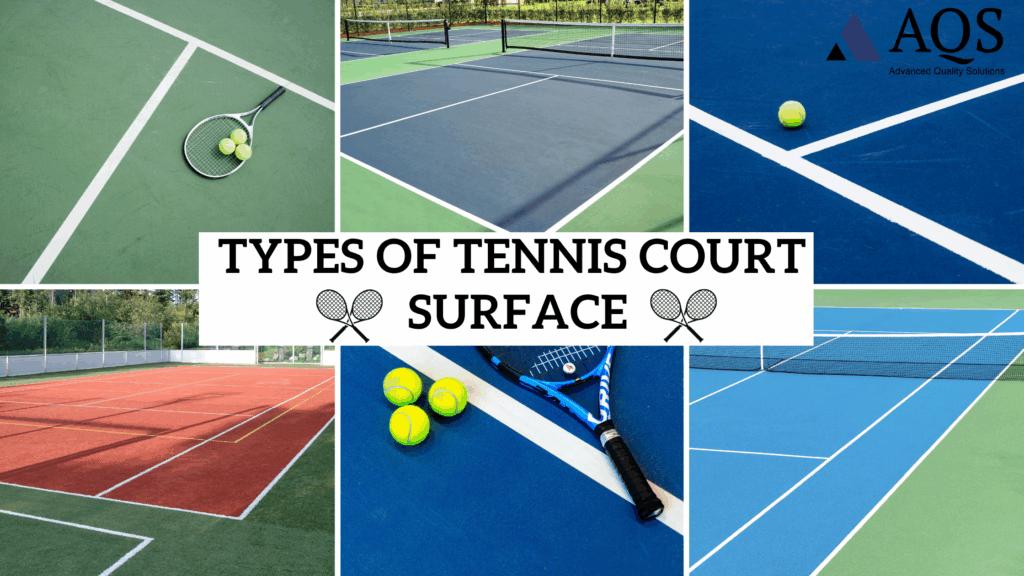
Tennis is one of the very few professional sports played on multiple surface types, each with distinct physical properties that can affect the way the ball bounces, the speed of play, and even certain minor aspects of court construction. The four primary surface types recognized in professional tennis are: hard courts (acrylic or concrete), clay courts (red or green), grass courts (natural or synthetic), and carpet courts (used primarily indoors). Despite the differences in surface materials, the official ITF tennis court measurement and line dimensions remain exactly the same across all surface types – 23.77 meters by 10.97 meters with the same zonal layout.
Hard courts, the most common surface type globally, are constructed from concrete or asphalt bases topped with an acrylic coating that determines ball speed and bounce height. Clay courts use a packed crushed stone or brick dust surface that slows the ball and produces a higher bounce, demanding more physical endurance from players. Grass courts, the oldest surface type and used at Wimbledon, offer a fast, low-bounce game. Each surface requires different construction depths, drainage systems, and maintenance routines, but the dimensional standards never change. Understanding the interaction between surface type and court measurement is crucial for architects, sports engineers, and contractors building new facilities.
Did You Know?
A standard tennis court covers roughly the same area as 4 average-sized parking spaces.
Indoor vs. Outdoor Court Height Clearance
For indoor tennis courts, there is an additional dimension that outdoor courts do not need to account for – ceiling clearance height. The ITF specifies that an indoor tennis facility must have a minimum ceiling height of 9.14 meters (30 feet) above the court surface to allow adequate room for lobbed shots and service motion without obstruction. For recreational and training-only indoor courts, a minimum height of 7.62 meters (25 feet) is considered acceptable. Additionally, adequate lighting must be installed in indoor facilities, with a minimum illumination level of 200 lux for recreational play and 1,000 to 2,000 lux for professional broadcasts and tournament play, depending on the tier of competition.
How to Measure and Mark a Tennis Court: Step-by-Step
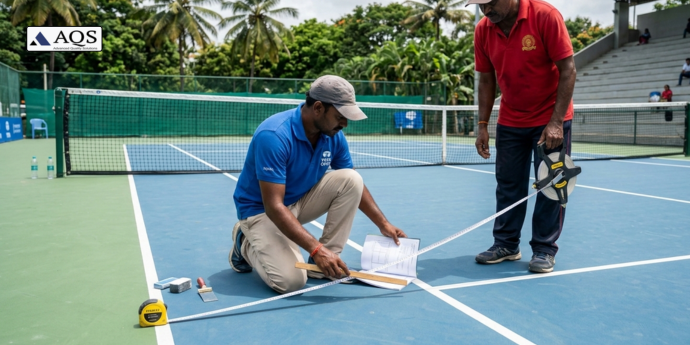
Accurately laying out a tennis court requires careful planning, precise measurement tools, and a systematic approach. The process begins with selecting a flat, level surface of appropriate size. First, establish a perfectly straight and level baseline using a measuring tape and chalk line – this is the foundation from which all other measurements originate. From the baseline, measure 23.77 meters (78 feet) to establish the opposite baseline, ensuring the two baselines are exactly parallel using a builder’s square or laser level. The center of the baseline is marked with the center mark, a 10 cm line perpendicular to the baseline.
Next, establish the sidelines by measuring 10.97 meters (36 feet) across the court for doubles width Or 8.23 meters (27 feet) for singles width, equidistant from the center on both sides. Once the four corners are determined, measure both diagonals across the court. They should both measure 25.91 meters (85 feet) in a perfectly rectangular court. If the diagonals are unequal, the court is not square and must be adjusted. After confirming the rectangle is true, mark the net line at the exact midpoint (11.885 meters from each baseline), then measure 6.40 meters from the net line on each side to mark the service lines. Finally, draw the center service line connecting the net midpoint to the service line midpoint on each side.
Transform Your Sports Facility Today!
Contact us for high-quality synthetic sports flooring material and elevate your space!
Key Diagonal and Verification Measurements
| Measurement Point | Expected Value (m) | Expected Value (ft) |
| Corner-to-Corner Diagonal (Full Court) | 25.91 m | 85.0 ft |
| Diagonal of One Half-Court | 13.41 m | 44.0 ft |
| Diagonal of Service Box | 7.56 m | 24.8 ft |
| Net Midpoint to Each Corner | 12.96 m | 42.5 ft |
Tennis Court Construction Standards and Materials
Building a regulation tennis court involves far more than simply painting lines on a flat surface. The construction process follows strict engineering and material standards to ensure long-term durability, player safety, and surface consistency. A properly built hard court, for instance, consists of multiple layers: a stable compacted sub-base of crushed aggregate, a concrete or asphalt structural layer of specified thickness and grade, and a final acrylic surface coating applied in multiple coats with specific textures for traction and ball bounce characteristics. Each layer must meet defined thickness, gradient, and compaction standards before the next is applied.
The surface gradient – also called slope or fall – is critical for drainage purposes. The ITF recommends a slope of no more than 1% (1 centimeter per meter) in any direction for outdoor hard courts and clay courts, to ensure proper water runoff while maintaining a level playing surface. For grass courts, a slightly greater drainage gradient may be needed depending on the local soil profile and rainfall levels. Fencing around the court is also standardized for professional installations – perimeter fencing should be at least 3 meters (10 feet) high, and the gate should be at least 1.5 meters wide to allow equipment access. Proper lighting, windbreaks, and spectator seating also factor into the total court complex design.
ITF Court Classification Categories Explained
The International Tennis Federation uses a tiered classification system to categorize tennis courts based on their construction quality, dimensional compliance, run-off space, lighting, and overall facility standards. This system – ranging from Category 1 (the highest standard, used for professional Grand Slam events) down to Category 5 (basic recreational courts) – helps tournament organizers, players, and facility developers understand which level of play a court can host. Each category has specific minimum requirements for court dimensions, surface quality, run-off, lighting levels, and supporting infrastructure. Tennis court measurement is the foundation of all category assessments.
A Category 1 court must have the full ITF-mandated run-off zones (6.40 meters behind baselines and 3.66 meters on sides). Certified surface materials tested for pace and cushioning. Adequate lighting for televised play (typically 1,400 lux or more), and approved seating infrastructure. Category 3 courts, commonly used for national and regional tournaments, still require accurate regulation dimensions but may have smaller run-off zones and lower lighting requirements. Category 5 courts, used for recreational and beginner play, must still meet basic ITF dimension standards but have more flexibility in surface materials and surrounding infrastructure. Regardless of category, the core tennis court measurement of 23.77 by 10.97 meters never changes.
Fun Facts
If you played a 5-set match and ran for every ball, you’d cover between 2 to 5 miles all within a 78-foot court.
Organic Insights: Common Tennis Court Measurement Mistakes to Avoid
Even experienced contractors and sports facility developers can make errors in tennis court layout if they are not meticulous about following ITF measurement standards. One of the most frequent mistakes is failing to verify that the court corners are perfectly square. A court that is even a few centimeters off-square will have diagonals that don’t match. Resulting in a skewed playing area that affects the fairness of play. Another common error is placing the net posts at the wrong distance from the court, which changes the net tension and profile across the court. Always double-check that net posts are exactly 0.914 meters outside the doubles sideline on both sides.
A third frequent error involves the center mark at the baseline, which is sometimes omitted or made too short to be visible, causing serving disputes in matches. The center mark must be clearly visible and exactly 10 centimeters long. Additionally, paint thickness can subtly alter the perceived width of lines over time. Courts should be repainted annually or biannually to maintain clean, regulation-width lines. Finally, many recreational courts skip proper run-off zoning. Which can lead to player injuries when chasing balls outside the court boundary. Following every aspect of official tennis court measurement – both on the playing surface and around it – is non-negotiable for safe, fair, and professional-grade play.
Conclusion: Why Tennis Court Measurement Matters
Tennis court measurement is not merely a technical formality. It is the foundation upon which the entire sport is built. From the precise placement of the baseline to the regulated height of the net, from the width of each painted line to the run-off space behind the court, every dimension carries weight in terms of player safety, competitive fairness, and the authentic experience of the game. Whether you are a player sharpening your serve accuracy, a coach optimizing court-based drills. Or a developer planning a new sports facility, understanding these measurements empowers better decisions and superior outcomes.
The International Tennis Federation has established these standards through years of scientific study and competitive experience. They are applied consistently across every level of the sport – from grassroots recreation to the grandest Grand Slam stages. As you move forward with your tennis court project, training program, or simply your appreciation of the game. Use this guide as your authoritative reference for all things related to tennis court dimensions, layout, construction, and design. Proper measurement is where great tennis begins.
Quick Tips Section (Q&A)
The standard tennis court size in meters is 23.77 meters in length. 10.97 meters in width for doubles play, or 8.23 meters in width for singles play. These official ITF dimensions apply universally to all competitive tennis courts worldwide, regardless of surface type, indoor or outdoor location, or tournament level.
Each doubles alley – also called a tramline – is exactly 1.37 meters (4.5 feet) wide. There are two alleys on a tennis court, one on each side, extending the full length of the court alongside the singles sidelines. These alleys are only active as valid playing area during doubles matches; in singles play, any ball landing in the alley is ruled out.
The tennis net height is 0.914 meters (3 feet) at the center, held down by a net strap, and 1.07 meters (3 feet 6 inches) at the net posts. The net posts are positioned 0.914 meters outside the doubles sideline on each side, giving the full net post-to-post distance of 12.8 meters (approximately 42 feet).
For a professional-grade installation, the total space required including run-off zones is approximately 36.57 meters long and 18.29 meters wide, totaling around 669 square meters. For recreational courts, a minimum of 30.48 meters by 15.24 meters (about 464 square meters) is considered the baseline acceptable space requirement.