Getting the badminton court dimensions right is key to having a court that’s safe to play on, that actually works, and will endure with minimal wear & tear. A tiny mistake in the lines or overall layout can significantly affect gameplay quality, player comfort, and whether the court meets standards for proper coaching or hosting tournaments.
At AQS, we’re specialists in acrylic badminton court flooring & other synthetic sport surfaces, so designing court layouts that meet international standards but take local site constraints into account comes naturally to us – like roof height, available plot space, local climate & budget.
This guide gives you the low down on standard badminton court size, explains in detail what BWF badminton court dimensions are all about, shows you the measurements in both feet & meters, plus the area in sq ft, & ties it all back in with synthetic badminton court flooring & acrylic systems that can handle Indian climate conditions.
What is the Standard Badminton Court Dimensions?
Badminton is governed internationally by the Badminton World Federation (BWF). Now the standard badminton court Dimenisons for both singles & doubles is defined by the BWF as follows:
Upgrade Your Sports Court Today
Get premium synthetic acrylic flooring designed for durability, grip, and performance.
Get Free Consultation- Length: 13.40 meters- That’s the official court length from the BWF – you see it doesn’t change whether you’re playing singles or doubles, this helps keep the game fair & consistent whether you’re training at your local club, competing in your national league or reaching for greatness at international tournaments.
- Total Width (Doubles): 6.10 meters- Of course, double courts use the full width to allow 2 players on each side to really cut loose & have at it during the rallies – this wider layout is perfect for fast-paced action, especially when you’re on the back foot & scrambling to get back in defence or unleashing a wide-angle shot.
- Singles Width: 5.18 meters- Singlesson the other hand, uses a narrower width, giving you a more compact court that’s all about individual flair & precision footwork. That inner width line is there to help balance the game out a bit – making those long shots & recovery runs a bit more tricky to get your head around.
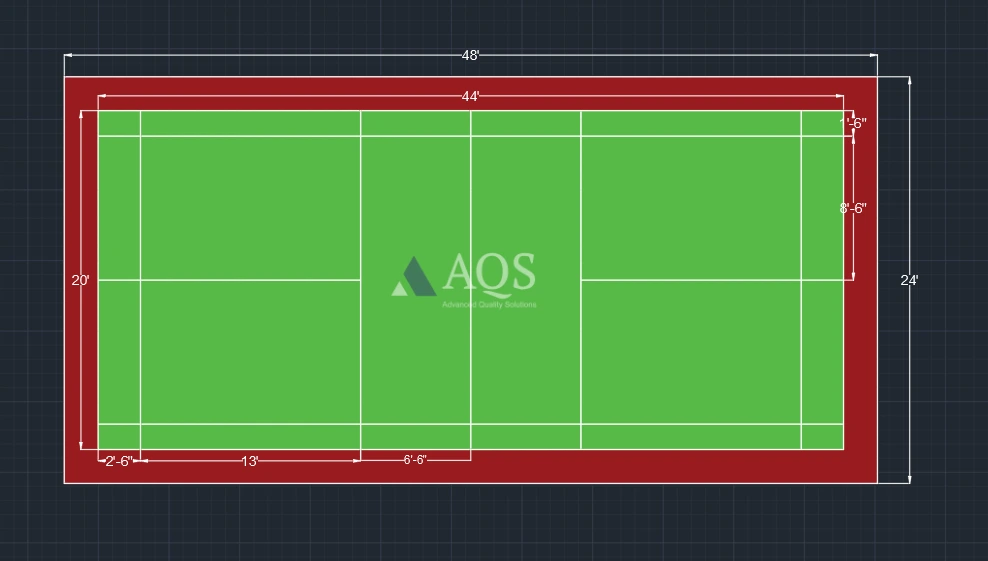
And these are the playing dimensions to keep in mind – measured from the outer edge of the court.
Badminton Court Size in Meters & Feet
| Court Type | Length (m) | Length (ft) | Width (m) | Width (ft) |
| Singles | 13.40 m | 44 ft | 5.18 m | 17 ft |
| Doubles | 13.40 m | 44 ft | 6.10 m | 20 ft |
A key point to keep in mind: All boundary lines are typically 40 mm wide (about an inch and a half) — and that’s including them as part of the actual playing area. So when planning badminton court construction in India, just saying something like “approx 20 × 44 ft” just isn’t enough – you need to get down to the detailed specifics on layout and line placement, the kind of thing you’d use for BWF badminton court dimensions, if you’re expecting the court to be used for coaching, proper play, or events.
Badminton Court Area in Square Feet & Square Meters
- Playing Area (44 ft × 20 ft = 880 sq ft / 81.7 sq m)-These are the official dimensions used for doubles matches by the BWF – and they don’t include any safety space, so you’re going to need to allow some extra room during construction.
- Playing Area (44 ft × 17 ft = 748 sq ft / 69.4 sq m)-The singles court, on the other hand, is a bit narrower but still the same length – that’s just the standard width for singles play. Note that this doesn’t include any of the space for players to move around – you need to factor that in for safety.
- Extra Space on All Sides- A decent court needs to have some extra clearance so players can move around without bashing into the walls or boundaries. This space is super important for safe lunges, recoveries, and fancy footwork.
- Coach Seating if Required- If you’re building a court for competitive play or coaching, you’re going to want to have some seating areas. These help keep the game moving and make it easier for coaches or officials to keep an eye on their players.
- Benches and Equipment Area- When you’re planning the space around the court, make sure to leave enough room for benches, storage for equipment, and walkways that don’t get in the way of the playing area.
- Recommended Run-Off Area (1.5–2 meters / 5–7 ft on all sides)- Adding some extra space outside the court itself makes a big difference and helps keep players safe – as a rule of thumb, the total space you need for one court is usually around 1,200-1,500 sq ft, depending on the specifics of your project.
BWF Badminton Court Dimensions – Detailed Layout
Getting a handle on the overall size of a court is just the start – marking it properly really matters if the game is going to run smoothly and stick to the official rules. Each line has its own reason for being there, and using the BWF-approved layout helps out with fairness, safety and just plain old good performance.
Baselines and Sidelines
- Back boundary lines (baselines): These end lines set the length of the court for singles and doublessand getting the baseline spot on is what makes for even depth and consistent movement for players in the way of rallies, clears, and just getting around the court.
- Sidelines for doubles: The outer sides set the court at 20ft wide, and that’s what doubles games need for good team play, and the wider lines create the boundary that teams use in doubles, making it more about covering ground and strategy.
- Sidelines for singles: The inner side lines knock the width down to 17f, and that changes everything for singles – the players have to be more precise with their footwork and shot selection.
Most courts in India get both singles and doubles lines painted on them using different colours to make them stand out.
Service Lines and Service Courts
The service courts get marked with lines that divide the court into left and right serving zones. This makes sure that every serve is in the right place, keeps things fair and stops people from doing things that break the rules.
Short Service Line
Distance from net: This line is drawn 6ft6in from the net, and it shows on both sides of the court and stops players from doing serves that are too close to the net.
Serve requirement: Every proper serve has to clear that short line before landing in the other court, and that makes for proper serves rather than ones that just drop in and give a player an unfair advantage.
Centre Line
Line position: The centre line pretty much runs the length of the service line right out to the back boundary line from there. It chops the court into two, splitting the court into left and right service areas for both singles and doubles matches.
Purpose: Now this centre line is what really pinpoints the service box for umpires and players to keep track of, to see if a serve is going in the right direction or not. Having decent centre line markings sorted out helps with accuracy and consistency – whether it’s friendly practice matches or the big pros.
Long Service Line for Doubles
Placement: Located a comfy 0.76 m (a shade over 2 ft 6 in) from the back boundary line, this line tweaks the length of the service zone for doubles – shortening it a bit so you can’t just muscle a serve down that wall and get out of doing any real work. It stops the overly aggressive big-hitting serves that make for shorter rallies.
Service restriction: Players need to watch themselves – serves have to stay inside this line, or it’s a fault. What this does is prevent just hammering away at it and makes serving a bit more tactical in doubles.
Long Service Line for Singles
Boundary rule: In singles, on the other hand, the back boundary line itself is the line you have to serve to. Which means you have a longer serving zone and therefore singles get a more strategy-based plan.
Gameplay impact: Singles players can actually serve down into the corners a fair bit more, giving you longer rallies and bringing the balance more into baseline-based play.
Net & Posts
Net height at centre – 1.524 m (5 ft): Centre of the net drops down a touch to help the shuttle take a natural flight path and keep net play on a level playing field. And it’s really crucial to get that exact height right – especially when net exchanges get tight, and players are all about precision.
Net height at posts – 1.55 m (5 ft 1 in): Net posts get fitted with the net just a bit higher on each edge, to keep the tension evenly spread across their width.
Importance of correct installation: And when you get the post and socket placement spot on, you can be sure your net system is going to be rock solid – something that’s especially important on courts made with acrylic or synthetic materials, where you need to avoid chipping the surface and keep the whole thing looking uniform.
Badminton Court Layout and Markings – Practical Considerations
Getting the posts and sockets just right is what keeps your net system stable for the long haul. And when you’ve got a thing like acrylic or synthetic court flooring – it’s not just about measuring things up to the correct size, it is about visibility, durability, and making sure players feel at ease on the court – especially when we are talking about badminton courts in India.
Key points for layout and markings:
Line Thickness
- When it comes down to it, a 40 mm line thickness is the standard – that way every marking is a consistent size and easy enough to see even when the game gets fast.
- Keeping all your lines the same width stops confusion and keeps you compliant with BWF rules – which is a good thing.
Colour Contrast
- Your lines need to stand out – so they can be easily told what’s a boundary and what’s not for players moving fast.
- On synthetic badminton flooring, if you want visibility and a pro look, green or blue on white or yellow is the way to go.
Anti-glare Finish
- Glossy lines are a pain – especially when indoor courts get bright and reflect like crazy, slowing players down.
- Use a matte or satin finish on your acrylic sports paint, and you get sharp clarity without any glare to worry about – that’s top-level badminton in any court, indoors or out.
Precision Marking Tools
- Getting accurate lines is all about using the right tools like chalk lines, masking tape and measuring up spots so every boundary is nice and even – and that means sticking to the BWF dimensions.
- When you’ve got acrylic, you can only apply the lines after the paint has dried, using the right stuff, and that keeps your lines looking good for ages – and not just that, crisp definition is great to see.
At AQS, our job is always the same – get your badminton court designed to perfection – aligning construction with what you see in the textbooks on court layout and markings.
Indoor Badminton Court Dimensions – Hall Size & Height
When it comes to indoor badminton court flooring, you can’t just focus on the 44×20 ft playing area itself, but also the entire hall surrounding it. The overall design needs to support good movement, safe gameplay, and meet international standard performance requirements.
Minimum Clear Floor Size:
Around 34–36 ft (10.4–11 m) wide- This width gives you enough room for safe footwork, quick side-to-side movements, and those unplanned dodges around the sidelines. It also stops players from running into the walls and allows for a comfortable squeeze in when two courts are side by side in a multi-court hall.
Around 52–55 ft (15.8 — 16.8 m) long- This length in terms of length gives you space for the back of the court run-offs, backcourt footwork and a smooth approach during rallies. It also provides room for equipment, umpire stands, benches and safe walkways behind the court.
This Ends Up:
Giving your players adequate room to run off in all directions, extra space around the court means they have room to sprint, recover and change direction without risking a nasty injury. It also makes the court easier to use, especially in those high-intensity training sessions.
Leaving space for the umpire, chairs and walkway, the correct spacing makes it easier to set up a clean, professional match with easy movement for players and support staff. It also stops congestion from getting out of hand during training sessions or tournaments.
Making back and side player movement safer, players get enough clearance to perform those high, high overhead shots, lunges and defensive strokes without bumping into anything. This keeps the gameplay flowing and reduces the risk of accidentally running into someone.
Roof/Ceiling Height
Optimal clear height: 7.5 m to 9 m (around 24–30 ft)- A high ceiling lets your players perform anything from full-height clears, lobs, to defensive lifts without hitting any structural elements. It also meets coaching and tournament standards, where the shuttle flight trajectory must remain free from any kind of obstruction.
For rec courts or society courts, slightly lower heights may do the job, but the shuttle still has to be able to fly freely without being blocked. Lower ceilings will also reduce play quality, especially for those really advanced strokes that need some height. Therefore, the ceiling must still allow for a clear, natural shuttle path that feels comfortable for play.
Low ceiling height ends up with the shuttle hitting the structure, and that limits high lifts or clears. For academies, roof height is non-negotiable. Low ceilings will also stop the training quality and will prevent players from developing those more advanced strokes. Professional academies always go for roof height as it has a direct impact on performance and safety.
Lighting Layout
Don’t put lights directly above the net; this creates all sorts of shadows and glare that make it hard for both players and spectators to see. The placement of your lights should distribute the illumination evenly across the entire court.
Use even LED light fixtures to minimise shadows and glare. Good lighting improves depth perception, shuttle tracking and overall gameplay comfort. LEDs deliver stable brightness suitable for training or tournaments.
Ensure your lux levels meet the training or tournament requirements, depending on what the project is for. Training courts usually need moderate but consistent lighting, while tournament courts need higher lux standards. Proper lighting will enhance the professional feel and usability of the whole facility.
Outdoor Badminton Court Size – Extra Space & Climate Factors
Many Indian projects – be it a school, college, community society or a farmhouse – often opt for open-air or semi-covered badminton court setups. When it comes to standard badminton court size, however, things change – in outdoor court planning, you need to allow for:
Recommended Outdoor Badminton Court Layout
At least 5 to 7 feet clear space – Having some room to breathe is essential – a player needs to be able to speed up, stop, jump and lunge around without stepping off the court. Plus, it’s handy for having some breathing space during those fierce rallies.
Behind each baseline – Giving some extra room at the back lets players fire off those deep shots and high clears without feeling boxed in. And it’s safer for the players, too,,o when those long rallies get intense.
Along both sidelines – Side space stops players from running into fences or walls and makes it easier to move around sideways. When you have multiple courts side by side outdoors, it gets even more important. A slight slope of 1 in 100– A bit of a slope helps keep the rain from getting on the court and damaging the acrylic surface. It also stops the court from getting slippery. Keeping it in good nick means less maintenance and a longer lifespan.
Fencing or netting – A bit of a fence keeps the shuttles from flying off in the wind and stops the play from getting disrupted. Plus, it keeps the players safe.
Court Orientation and Climate
In India, especially in the hotter coastal areas
- You should try to position the court so players aren’t facing directly into the sun. By doing so, you reduce the glare on the court and let the players see what they’re doing. A little bit of planning here makes a big difference in a hot country.
- A UV-resistant coating on the court protects it from getting all beat up by the sun. Plus, it stops the colour fading – keeping the court looking good even in the intense sun for a lot longer.
- A textured surface is nice and grippy even when the court is a bit damp. This is especially useful in a country that has such different climates – from the humid coast to the dusty cities.
Multiple Court Layouts – Academies & Clubs
Lots of badminton academies in India are after 2, 4, or 6 courts squeezed into a single hall. Now, it’s not just a case of building each court to the right size, but also figuring out how to fit the whole hall width and length together.
Side-by-Side Courts
Enough Space Between Courts
- Keep about 1.5–2 metres between each court so players have enough room to dodge those fast rallies without running into the next court’s players.
- It also makes it safer for coaches, officials & support staff to move between courts during lessons.
Outer Run-Off Area
- Leave a bit of extra space – around 1.5–2 metres – along the outer edge of the court so players can take those extra recovery steps or place their gear without having to worry about bumping into anyone or anything.
- Some wiggle room keeps everyone safe and makes sure the courts are up to academy standards.
Typical Multi-Court Sizes
Total Width (For Four Courts in Two Rows)
- The total width is usually calculated as 20 ft for two courts, plus some space between them, plus some extra space at the edges. And that’s with a bit of balance to the spacing on each side.
- Having all these courts uniform in size is super important for professional coaching & big tournaments.
Total Length
- We work out the length by adding up 44 ft for the court, a bit of clearance to be able to move safely at the back, and some walkway space to give players room for those really deep lunges and long back-court shots.
- A bit of extra space helps get players moving in and out of the court smoothly.
The exact numbers will vary from project to project, but it always starts with the BWF badminton court dimensions, and then we add a bit of safe and practical space around them.
Why Accurate Dimensions Matter for Synthetic & Acrylic Flooring
Accurate badminton court dimensions are more than just a detail to get right on a drawing-they can have a real impact on how your synthetic badminton court flooring system actually performs in the long run.

Material Quantities & Cost
- When you know the exact area, including run-off zones, you’re in a much better position to figure out. How much concrete or asphalt base preparation will you need before laying down the synthetic layers.
- Get the dimensions spot o,n and you’ll know exactly how many synthetic or acrylic coating layers you’ll need, which in turn will give you a much better idea of the material usage and total project cost per sq ft.
- For designers, having a rock-solid idea of the badminton court area in sq ft is a must – so they can put together BOQs and cost proposals that actually reflect what the project will need, without any nasty surprises.
Performance & Safety
- A court that’s been accurately dimensioned and marked out with acrylic badminton flooring is a real game-changer for players – the micro-textured surface gives them consistent grip and movement control, wherever they need it.
- The footwork patterns just fall into place when every marking is in the right position – which is just what you want when you’re pushing yourself to be at the top of your game.
- Safe spacing ensures that players can jump, lunge and change direction without worrying about getting injured – keeping the court as a safe and fun place to be.
- But if the court is undersized or the lines are in the wrong place, even the best synthetic flooring can’t compensate for the dodgy geometry – so it’s really worth getting it right from the start.
Aesthetics & Professional Appeal
- Accurate dimensions give you a court that looks neat and symmetrical, which is a real bonus when it comes to the overall visual balance of the place.
- Well-defined, high-contrast lines give the surface a real lift, and when you put it all together with a properly dimensioned acrylic court, you get a look that’s really hard to beat.
- No wonder schools and badminton academies are starting to upgrade from plain cement flooring to top-quality synthetic courts – it’s a real game-changer when it comes to making a good first impression.
- It’s a quality of court that parents and sponsors alike will notice, and it can make all the difference when it comes to attracting and keeping the best players.
Common Mistakes With Badminton Court Dimensions
Even the most skilled builders and institutions can fall into a trap when it comes to planning and marking out badminton court dimensions. Here are some of the most frequent issues we come across in our line of work:
- Ignoring the Need for Extra Around the Court – All too often, the only thing people focus on is the 20 × 44 ft playing area – and that’s it. The result is that players are either crashing into walls or fences, or the court feels ridiculously cramped.
- Bungling the Service Line Placement – Players often measure the service line roughly, disputes over points start almost immediately, and the entire game quickly falls into disarray.
- Getting Singles and Doubles Sidelines Mixed Up – It’s a pretty simple mistake, but all too often, people don’t bother to clearly differentiate between singles and doubles lines. As a result, beginners get totally confused during training sessions.
- Building Indoor Courts with a Low Ceiling – Builders often construct indoor courts with ceilings that are too low, and this quickly makes high-clearance and lifts impossible, which ultimately restricts proper gameplay and hinders the development of the sport.
- Botching the Drainage for Outdoor Courts – Outdoor courts get built with no proper slope to the drainage, so water just stagnates and ends up doing damage to the acrylic layers. And to top it all off, the surface becomes slippery as a snake’s belly.
- Using Ththerong Paint on Acrylic Systems – People use regular old enamel paint instead of the special sports line paint. Before you know it, the lines fade, chip or become slippery underfoot.
Why You Should Pick AQS for Your Badminton Court Construction Project?
AQS has a reputation across India for building world-class synthetic acrylic badminton courts that not only look fantastic but also last a long time. We pride ourselves on delivering precision in every court we build – that means getting the layout just right, the markings perfect, and the overall experience as professional as it gets. Our acrylic systems give you the perfect grip every time, can withstand the elements (that’s UV rays, heat and humidity, and heavy footfall), and the colour stays looking great – even after years of heavy use. That’s not all – our coatings can handle whatever India throws at them – and they won’t fade, peel, or crack under the pressure.
What sets AQS apart is that we take care of everything you need – from sorting out the space planning to helping you choose the right materials. Our surfaces protect joints, enhance safety, and deliver fast, smooth gameplay—making them ideal for schools, academies, clubs, and homeowners building a premium backyard games area. And with our custom colour options, durable line markings and reliable supply chain covering the whole of India, you know your badminton court is going to look amazing, play consistently, and withstand the elements for years to come.
Conclusion
Badminton is a sport that’s really taking off in India, and building a top-notch court starts with getting badminton court dimensions spot on—whether in meters, feet, or just the overall size of the place. When you get the dimensions, layout, and line markings right and finish the surface with a proper badminton court floor, you create a professional-looking court that delivers excellent play and withstands regular use for years.
For any school, academy, club, or developer, treating dimensions as your first design priority—not just an afterthought—can turn what would be a pretty standard cement slab into a full-on sports court that’s actually worth using.
Frequently Asked Questions
The standard court size is 13.40 m long & 6.10 m wide for doubles play.
A standard doubles court covers roughly 880 sq ft – that’s big enough for a good-sized game.
The dimensions stay the same, but you do need a certain hall size and height to get it right.
It’s popular because it’s got a super strong grip, stands up well to UV light, and keeps on performing for a long time.
Yes, the same court supports both singles and doubles play, with clear markings that allow players to use it for different games.