AI Overview
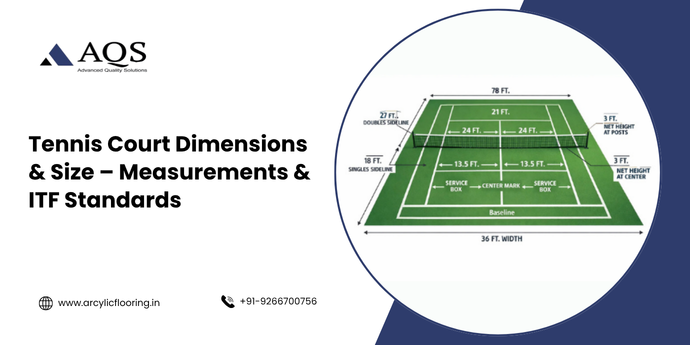
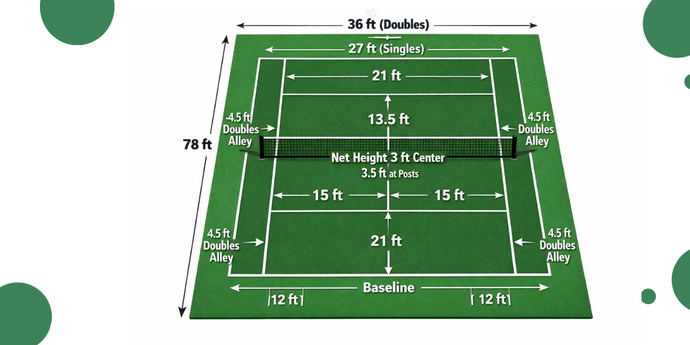
A standard tennis court dimensions 23.77 metres (78 feet) long and 8.23 metres (27 feet) wide for singles play. For doubles, the width expands to 10.97 metres (36 feet). These measurements follow International Tennis Federation (ITF) standards, applicable globally including India in 2026.
- Total court length: 23.77 m (78 ft) – singles & doubles
- Singles width: 8.23 m (27 ft)
- Doubles width: 10.97 m (36 ft)
- Net height at centre: 0.914 m (3 ft); at posts: 1.07 m (3.5 ft)
- Service box length: 6.40 m (21 ft)
- Baseline to backstop clearance (India 2026): Minimum 6.4 m recommended
- Surface types approved: Clay, Hard (Acrylic), Grass, Synthetic
Tennis is one of the fastest-growing sports in India, with court construction projects rising sharply across cities in 2026. Whether you plan to build a new facility, refurbish an existing one, or simply understand the game better, knowing the exact tennis court dimensions is absolutely essential. Every measurement matters from the baseline to the net post, from the service box depth to the doubles alley width. This guide delivers every number, every standard, and every India-specific update you need for 2026.
The International Tennis Federation (ITF) governs all official court specifications worldwide. India’s All India Tennis Association (AITA) follows ITF rules closely, with additional local guidelines published for 2026 regarding surface drainage, lighting lux levels, and surroundings clearance. Builders, architects, and sports facility managers across Mumbai, Delhi, Bengaluru, and Chennai actively reference these updated standards today.
Upgrade Your Sports Court Today
Get premium synthetic acrylic flooring designed for durability, grip, and performance.
Get Free ConsultationStandard Tennis Court Dimensions: Official ITF Measurements
The ITF defines a tennis court as a rectangular flat surface, and every professional tournament from Wimbledon to the Indian Open follows the same core dimensions. Players worldwide compete on courts that share identical boundary measurements, ensuring fairness across all surfaces and geographies. India adopted these updated standards in its 2026 AITA facility handbook.
Core Court Length and Width Measurements
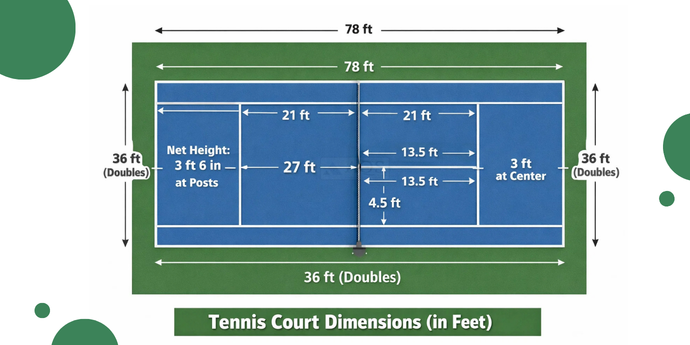
A regulation tennis court runs 23.77 metres (78 feet) in length for both singles and doubles formats. The full court – including both service boxes and both backcourts – stretches from baseline to baseline. The net divides this length precisely in half, placing each half at 11.885 metres (39 feet). Architects and contractors building courts in India in 2026 must nail this measurement during the excavation phase.
The singles court width stands at 8.23 metres (27 feet), while the doubles court extends to 10.97 metres (36 feet). The extra 1.37 metres on each side forms the doubles alley – a thin strip that becomes live during doubles play only. Many Indian clubs build doubles-width courts to maximise flexibility and utility for members of all ages.
| Measurement | Metres | Feet / Inches | Format |
| Court Length (total) | 23.77 m | 78 ft 0 in | Singles & Doubles |
| Court Width – Singles | 8.23 m | 27 ft 0 in | Singles only |
| Court Width – Doubles | 10.97 m | 36 ft 0 in | Doubles only |
| Doubles Alley Width | 1.37 m | 4 ft 6 in | Each side |
| Service Box Length | 6.40 m | 21 ft 0 in | Each box |
| Service Box Width | 4.115 m | 13 ft 6 in | Singles half |
| Baseline to Net | 11.885 m | 39 ft 0 in | Each half |
| Centre Service Line | 6.40 m | 21 ft 0 in | Per half |
| Net Height – Centre | 0.914 m | 3 ft 0 in | – |
| Net Height – Posts | 1.07 m | 3 ft 6 in | – |
| Net Post Distance | 0.914 m | 3 ft 0 in | Outside doubles line |
Service Box and Centre Mark Specifications
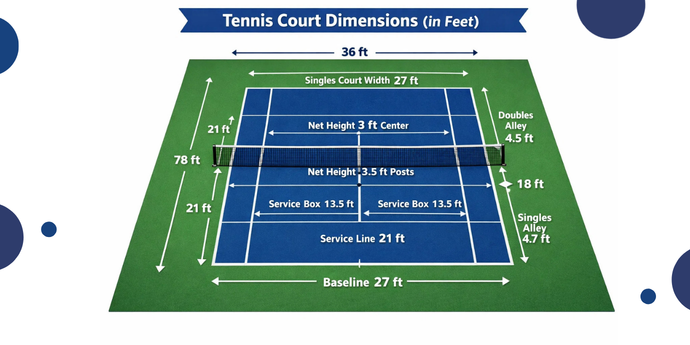
Each service box measures 6.40 m long and 4.115 m wide, forming a rectangle between the net and the service line. Players must land their serve inside the diagonally opposite service box. The centre service line runs perpendicular to the net, dividing each pair of service boxes into deuce and advantage sides. India’s 2026 court construction norms require line marking widths of no more than 50 mm (5 cm), painted in white or yellow for visibility.
The centre mark sits at the midpoint of each baseline, extending inward by 10 cm (4 inches). Servers must stand behind their baseline on either side of this mark. Court painters in India now use acrylic-based paints that withstand monsoon rains and harsh summer heat, ensuring clear markings throughout the year without fading or peeling.
Calculate Your Sports Court Dimensions!
Contact us for Quickly measure and calculate accurate sports court dimensions with this easy-to-use tool!
Complete Tennis Court Area Requirements Including Runoff Zones
The playable surface of a tennis court extends well beyond the white lines. Players run hard, dive, and slide – so every court requires generous clearance areas around all four sides. India’s AITA 2026 guidelines specify minimum runoff zones for both recreational and competitive-level facilities. Ignoring clearance zones causes injuries and fails inspection for affiliated tournaments.
Recommended Overall Court Area Dimensions
For a recreational or club-level court in India 2026, the overall playing area including runoffs should measure at least 36.58 m long × 18.29 m wide. This accounts for a minimum backstop clearance of 6.40 m behind each baseline and a minimum side clearance of 3.66 m from the doubles sideline. Tournament-standard courts require even more space – backstop clearances of up to 8 m for ATP/WTA events.
India 2026 Builder’s Rule of Thumb
Always plan for a minimum total land footprint of 37 m × 19 m per tennis court, including runoff zones. For multi-court facilities, allow 4 m between adjacent courts. This aligns with AITA’s 2026 Club Facility Standards document.
Tennis Court Surface Types and Their Impact on Court Dimensions in India
India hosts courts across four main surface types – clay, hard (acrylic), grass, and synthetic. The physical dimensions of the court remain identical across all surfaces, but the construction depth, drainage layer, and base material differ significantly. Choosing the right surface impacts long-term maintenance costs, performance, and suitability for Indian weather conditions in 2026.
| Surface | Base Depth | Avg Cost (India 2026) | Maintenance | Best For |
| Clay (Red/Green) | 200–300 mm | ₹18–₹25 lakh/court | High (daily watering) | Training academies |
| Hard / Acrylic | 100–150 mm | ₹12–₹18 lakh/court | Low | Public parks, clubs |
| Grass | Natural turf | ₹30–₹50 lakh/court | Very High | Premium estates |
| Synthetic Turf | 50–80 mm infill | ₹14–₹20 lakh/court | Low–Medium | Schools, communities |
Hard Court Surface Specifics for Indian Climate 2026
Hard courts dominate India’s urban landscape because they endure heat, rain, and heavy foot traffic. A hard court uses an asphalt or concrete base, followed by an acrylic cushion layer, and then a coloured acrylic surface. The standard acrylic colour in India is blue (playing area) with green or red surrounds. Courts built in 2026 increasingly use UV-resistant acrylics that reflect 30% more sunlight and keep surface temperatures lower during peak summer afternoons in Rajasthan and Tamil Nadu.
Upgrade Your Sports Court Today
Get premium synthetic acrylic flooring designed for durability, grip, and performance.
Get Free ConsultationNet Specifications and Post Positioning: Exact Measurements You Must Follow
The net is the single most critical piece of equipment affecting play dynamics. Players hit over it thousands of times per match, and its precise height determines shot selection at every point. India’s 2026 facility standards require steel or fibreglass net posts embedded in ground sleeves – not weighted bases – for all permanent installations. This prevents post movement during rallies and ensures accurate net height throughout a match.
Net Height, Tension, and Strap Requirements
The net must stand at exactly 0.914 m (36 inches) at the centre, held taut by a white centre strap anchored to the court surface. At the posts, net height rises to 1.07 m (42 inches). The net itself must be constructed of a mesh small enough that a ball cannot pass through. The top of the net carries a white band between 50 mm and 63 mm wide. Contractors installing nets in Indian courts in 2026 should verify tension with a net gauge tool supplied by the ITF.
Post Placement Outside the Court Lines
Net posts stand 0.914 m outside the doubles sideline on each side, placing them at 6.40 m from the centre of the court. During singles matches played on a doubles court, singles sticks – 1.07 m tall – support the net at the correct singles-court position. Indian clubs increasingly install dual-post systems in 2026 that accommodate both singles and doubles configurations without additional hardware changes.
Comparison Table: Singles vs Doubles vs Mini Tennis Court Dimensions
| Parameter | Singles Court | Doubles Court | Mini Tennis (Kids) |
| Length | 23.77 m | 23.77 m | 10.97 m |
| Width | 8.23 m | 10.97 m | 5.49 m |
| Net Height (Centre) | 0.914 m | 0.914 m | 0.80 m |
| Service Box Length | 6.40 m | 6.40 m | 3.00 m |
| Doubles Alley | N/A | 1.37 m each side | N/A |
| Total Area (court only) | 195.71 m² | 260.87 m² | 60.23 m² |
| With Runoffs (India 2026) | ~668 m² | ~758 m² | ~220 m² |
| ITF Certified | Yes | Yes | Yes (ITF Play+Stay) |
Lighting and Orientation Standards for Outdoor Tennis Courts in India
Court orientation and lighting directly impact playability. India’s AITA 2026 guidelines recommend a north-south axis orientation for all outdoor courts to prevent players from facing direct sunlight during low-angle morning and evening hours. This orientation aligns with ITF’s global recommendation and reduces glare-related errors significantly during competitive play.
Recommended Lux Levels for India 2026 Courts
Recreational courts require a minimum of 200 lux at court level. Club competition courts require 300–500 lux, while national-level tournament courts must achieve a minimum of 1,000 lux with uniformity ratios above 0.7. India’s rapidly growing sports infrastructure push in 2026 has led to LED floodlight adoption at over 3,000 new tennis courts constructed under the Khelo India Urban Sports Scheme, cutting energy consumption by 45% versus older halogen systems.
Real-World Case Study – India 2026
DLF Sports City Tennis Complex, Gurugram – Multi-Court Construction (2025–2026)
Background: DLF Sports City in Gurugram commissioned a 12-court tennis facility in late 2024, targeting AITA Grade-A certification for national-level tournaments by March 2026. The project faced challenges around land grading, monsoon drainage, and achieving consistent court dimensions across all 12 courts simultaneously.
Approach: Engineers used laser-guided levelling equipment to achieve a surface gradient of exactly 1:100 (1% slope) for water runoff – the ITF maximum allowable slope. Each court used an asphalt base (100 mm) + acrylic cushion (3 coats) + coloured acrylic surface (2 coats). All 12 courts measured 23.77 m × 10.97 m, verified by digital total station surveying equipment post-construction.
Outcome: AITA certified the facility in February 2026 after passing dimensional, surface hardness, friction coefficient, and lighting uniformity tests. The facility hosted its first national juniors tournament in April 2026, drawing 280 players from 18 states. The project serves as a benchmark case for large-scale tennis court construction in urban India 2026.
Key Lesson: Accurate court dimensions are achievable at scale when contractors use digital surveying tools and follow ITF spec sheets from the first excavation stage – not as a finishing correction.
Deep Dive: Court Markings, Line Widths, and Boundary Rules
Understanding tennis court markings, baseline dimensions, sideline placements, and centre service line measurements elevates your technical knowledge beyond basic dimensions. Every line on a tennis court has a defined purpose and official width, and officials use these lines to call balls in or out during match play.
Line Width Specifications for All Court Markings
All court lines must measure between 25 mm (1 inch) and 50 mm (2 inches) in width, except the baseline, which may be up to 100 mm (4 inches) wide. Lines form part of the court – a ball touching any line is considered “in.” Indian court painters apply two coats of white or yellow acrylic line paint in 2026, ensuring durability through 200+ playing hours before repainting becomes necessary.
Understanding the No-Man’s Land Area Between Service Line and Baseline
The area between the service line and the baseline – commonly called no-man’s land – stretches 5.485 m deep on each side. This zone runs from the service line (6.40 m from net) to the baseline (11.885 m from net). Coaches in India actively use this measurement in 2026 training drills to teach players optimal court positioning relative to the net and baseline.
How to Measure and Lay Out a Tennis Court from Scratch: Step-by-Step Process
Laying out a tennis court accurately demands methodical approach, quality measuring tools, and knowledge of the exact specifications. Construction teams across India follow a standardised 2026 layout process that prevents costly errors and ensures ITF-compliant dimensions from day one of the build.
Calculate Your Sports Court Dimensions!
Contact us for Quickly measure and calculate accurate sports court dimensions with this easy-to-use tool!
Step-by-Step Court Layout Method
- Step 1: Establish the court centre point and drive a stake.
- Step 2: Lay the 23.77 m length axis precisely north-south using a digital total station.
- Step 3: Mark both baselines perpendicular to the length axis using a 3-4-5 Pythagorean triangle (or digital square).
- Step 4: Mark the net position at 11.885 m from each baseline.
- Step 5: Mark service lines at 6.40 m from the net.
- Step 6: Mark singles and doubles sidelines, doubles alleys, and centre service line.
- Step 7: Verify diagonal measurements – both diagonals must equal 25.91 m for a perfectly rectangular court.
- Step 8: Paint all lines to specified widths and apply final surface coats.
Final Thoughts
Tennis court dimensions represent far more than numbers on a specification sheet they define the fairness, safety, and quality of every match played on the surface. From the precise 23.77 m length to the 0.914 m net height, every measurement carries the authority of the ITF and decades of global play experience. Builders, developers, school administrators, and club owners across India must treat these dimensions as non-negotiable in 2026 and beyond.
India’s tennis infrastructure is expanding rapidly, driven by Khelo India investments, growing urban middle-class interest in racket sports, and a new generation of Indian professional players inspiring youth participation. Getting the tennis court dimensions right from day one ensures your facility contributes positively to this national momentum and passes every certification test with confidence.
Frequently Asked Questions
A standard tennis court measures 23.77 metres long × 10.97 metres wide (doubles), or 8.23 metres wide for singles.
A doubles tennis court is exactly 36 feet (10.97 metres) wide, including both doubles alleys on either side.
The net height at the exact centre of a tennis court is 0.914 metres (3 feet), held down by a white centre strap.
AITA 2026 guidelines recommend a minimum total land footprint of 36.58 m × 18.29 m including mandatory runoff clearance zones.
Each service box is 6.40 metres deep (from the net to the service line), and 4.115 metres wide on the singles court.
Yes – ITF rules mandate identical court dimensions across all surfaces; only the base depth and material construction differ by surface type.