| Overview Summary Box – Quick Answer |
| Outdoor Badminton Court Cost: ₹3 lakh – ₹8 lakh (acrylic/synthetic flooring) |
| Indoor Badminton Court Cost: ₹15 lakh – ₹60 lakh (wooden/PVC/synthetic) |
| Premium Indoor Court (with AC + gallery): ₹80 lakh – ₹1 crore+ |
| Badminton Court Flooring Cost: ₹150 – ₹600 per sq. ft depending on material |
| Badminton Court Installation Cost: ₹2 lakh – ₹15 lakh (structure + flooring + lighting) |
| Standard Court Dimensions (BWF): 13.4m x 6.1m | Ceiling: 9-12m minimum |
| Best Flooring Material: Wooden (professional) | Acrylic (outdoor) | PVC (academy) |
| Annual Maintenance Cost: ₹1 lakh – ₹5 lakh depending on facility size |
| This guide covers: cost breakdown, materials, installation, comparison, ROI, and FAQs |
Table of contents
- Introduction
- Standard Badminton Court Dimensions & Space Requirements in India
- Badminton Court Cost: Complete Price Overview
- Detailed Badminton Court Cost Breakdown: What You Actually Pay For
- Badminton Court Flooring Material: In-Depth Guide
- Badminton Court Installation Cost: Step-by-Step Process & Pricing
- Indoor vs Outdoor Badminton Court: Cost Comparison Table
- Quick Decision Guide: Which Badminton Court is Right for You?
- City-Wise Badminton Court Cost Variation Across
- Annual Maintenance Cost of Badminton Courts
- Understanding Related Badminton Court Terms
- How to Choose the Right Badminton Court Contractor in India
- Return on Investment (ROI) from Badminton Court Business in India
- Cost-Saving Strategies for Building a Badminton Court in India
- Frequently Asked Questions (FAQs)
- Conclusion
Introduction
Badminton has become one of India’s most beloved and fastest-growing sports. From school academies in Lucknow to professional coaching centres in Hyderabad, demand for quality badminton courts has exploded across tier-1, tier-2, and tier-3 cities. Entrepreneurs, schools, housing societies, and sports clubs now actively invest in building well-structured badminton facilities. But the biggest question every project owner faces before breaking ground is: what does a actually badminton court cost in India in 2026?
The answer is not a single number. Badminton court cost depends on a complex matrix of factors – court type (indoor vs. outdoor), badminton court flooring material, structural requirements, lighting, ventilation, amenities, and most critically, the quality of badminton court installation. Understanding each component in depth helps you plan a realistic budget, avoid hidden surprises, and make smart decisions that deliver both performance and ROI.
This comprehensive guide breaks down every cost element, presents updated 2026 pricing data, compares flooring materials, and equips you with the knowledge to make confident decisions. Whether you are building your first single court or developing a multi-court academy, this article covers all the details you need.
Standard Badminton Court Dimensions & Space Requirements in India
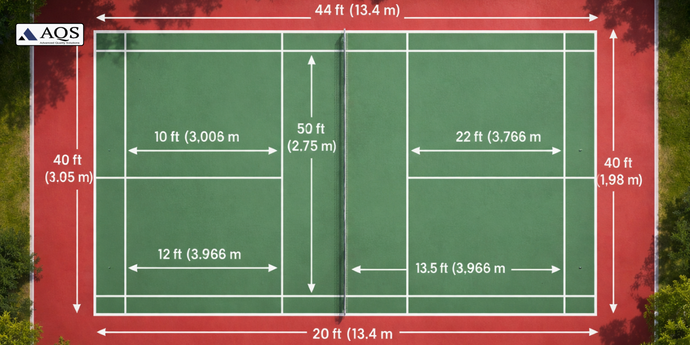
Before calculating any badminton court cost, you must understand the mandatory dimensions set by the Badminton World Federation (BWF). Every professional court – whether in a school gymnasium or a commercial sports complex – must follow these standards precisely. The playing area, safety zones, and ceiling height all influence how much structure, flooring, and lighting material you will need.
| Measurement Parameter | Standard Dimension | Tournament Grade |
|---|---|---|
| Court Length | 13.4 metres | 13.4 metres |
| Court Width (Doubles) | 6.1 metres | 6.1 metres |
| Court Width (Singles) | 5.18 metres | 5.18 metres |
| Total Playing Area | ~81.74 sq. metres | ~81.74 sq. metres |
| Minimum Ceiling Height | 9 metres (30 ft) | 12 metres (40 ft) |
| Safety Buffer Zone | 2 metres all sides | 2.5 metres all sides |
| Net Height (Centre) | 1.524 metres | 1.524 metres |
| Line Width | 40 mm | 40 mm |
| Lighting (Lux Level) | ≥300 lux (training) | ≥500 lux (tournament) |
The total footprint including buffer zones for a single court typically reaches 500-600 sq. ft. Multi-court facilities share buffer zones and structural elements, which significantly reduces the per-court cost. Ceiling height is the most commonly underestimated factor – a ceiling below 9 metres makes high clears and lob shots impractical and ruins gameplay quality.
Calculate Your Sports Court Dimensions!
Contact us for Quickly measure and calculate accurate sports court dimensions with this easy-to-use tool!
Badminton Court Cost: Complete Price Overview
The total badminton court cost in India ranges from ₹3 lakh for a basic outdoor court to over ₹1 crore for a premium multi-court indoor facility. The type of court, flooring material, structural requirements, and additional amenities determine where your project falls in this wide pricing spectrum. Below is a consolidated 2026 pricing overview updated for market conditions across India.
| Court Type | Budget Range (₹) | Flooring Type | Best For |
|---|---|---|---|
| Outdoor Basic | ₹3L – ₹5L | Acrylic/Concrete | Housing Societies, Schools |
| Outdoor Premium | ₹5L – ₹8L | Synthetic Acrylic Multi-Layer | Clubs, Academies |
| Indoor Basic | ₹15L – ₹25L | PVC Vinyl/Synthetic | Training Centers, Schools |
| Indoor Mid-Range | ₹25L – ₹45L | Wooden/PU Synthetic | Academies, Commercial |
| Indoor Premium | ₹45L – ₹60L | Maple Hardwood / BWF Grade | Pro Academies, Clubs |
| Multi-Court Indoor (4 courts) | ₹1.2Cr – ₹2Cr | Wooden / BWF Synthetic | Sports Complexes |
| Home/Backyard Court | ₹4L – ₹12L | PVC / Acrylic | Private Residential Use |
Detailed Badminton Court Cost Breakdown: What You Actually Pay For
Understanding where every rupee goes is the foundation of smart budget planning. The total badminton court cost comprises several distinct components, each with its own market rate, quality tiers, and regional variation. Cutting corners on any critical element – especially flooring or foundation – creates long-term expenses that far exceed initial savings. Let us examine each cost component in precise detail.
1. Site Preparation & Foundation Work
Site preparation forms the invisible backbone of your court. You must level the ground, treat the soil, build a concrete base layer, and ensure proper drainage – especially for outdoor courts. A poorly prepared foundation causes flooring to crack, warp, or become uneven within months of installation. This damage is both expensive and dangerous for players. Foundation quality directly determines your court’s 15-20 year lifespan.
Site survey and levelling: ₹15,000 – ₹50,000 | Concrete base (PCC): ₹80,000 – ₹2,00,000 | Drainage system (outdoor): ₹30,000 – ₹80,000 | Slope correction: ₹20,000 – ₹60,000 | Anti-termite treatment: ₹15,000 – ₹30,000. Total site preparation cost typically ranges from ₹1.5 lakh to ₹4 lakh for a single court in India.
2. Steel Structure & Roofing (Indoor Courts)
Indoor courts require a steel structure shed with precise height clearance. The structure must handle roof loads, wind pressure, and thermal expansion. Pre-engineered steel structures have become the preferred choice in India because they cost less, install faster, and offer better customisation than traditional RCC construction. The cost of the steel structure alone often constitutes 40-50% of an indoor court’s total budget.
Pre-engineered steel structure shed: ₹800 – ₹1,500 per sq. ft. | For a 3,000 sq. ft. shed: ₹24 lakh – ₹45 lakh | RCC construction alternative: ₹1,200 – ₹2,500 per sq. ft. | Roofing sheets (colour-coated): ₹60 – ₹120 per sq. ft. | Gutters and drainage: ₹50,000 – ₹1,50,000. Minimum recommended height for the steel structure is 9 metres (30 feet); tournament-grade facilities need 12 metres (40 feet) clear height.
3. Badminton Court Flooring Cost
Badminton court flooring is the single most critical investment you make. The floor directly affects player safety, joint health, shuttle bounce, shoe grip, and overall gameplay experience. Choosing the wrong flooring material – or an inferior grade of the right material – creates injury risks and dissatisfied players. India’s flooring market in 2026 offers five primary options, each with specific advantages for different court types and budget levels.
| Flooring Type | Cost (₹/sq.ft) | Lifespan | Best For | Maintenance |
|---|---|---|---|---|
| Maple Hardwood (Wooden) | ₹350 – ₹600 | 15-25 years | Pro Indoor Courts | High |
| PU Synthetic (Polyurethane) | ₹250 – ₹450 | 10-15 years | Indoor Academies | Medium |
| PVC Vinyl | ₹150 – ₹300 | 8-12 years | Training, Multi-Use | Low |
| Acrylic Synthetic | ₹150 – ₹250 | 8-10 years | Outdoor Courts | Very Low |
| Rubber Flooring | ₹120 – ₹200 | 6-10 years | Gyms, Multi-Sports | Low |
| Concrete + Marking | ₹40 – ₹80 | 3-5 years | Budget/Community | Very Low |
4. Lighting Installation Cost
Lighting is a non-negotiable investment for any serious badminton facility. Players need clear visibility of the shuttlecock at all times – from low serves to high clears. Professional LED sports lighting systems deliver consistent, glare-free illumination at 300-500 lux depending on the application. Lighting quality also determines whether your court remains usable during evening hours, which directly impacts your revenue potential and booking capacity.
LED sports lights (per court): ₹50,000 – ₹1,50,000 | Complete lighting for a 4-court facility: ₹3 lakh – ₹6 lakh | Wiring and electrical panel: ₹50,000 – ₹1,50,000 | Light fixture mounting structure: ₹30,000 – ₹80,000. Always invest in green-certified, energy-efficient LED lights rated for sports use. Standard tube lights create shadows and compromise gameplay.
5. Additional Amenities & Infrastructure Cost
Beyond the core playing surface, every commercial badminton court facility needs supporting infrastructure. These additions transform a basic court into a professional facility that attracts serious players, academy enrollments, and premium bookings. The scope of these additions depends on your facility’s purpose – community court, training academy, or competitive venue – but each significantly enhances the playing experience and revenue potential.
| Amenity / Component | Estimated Cost (₹) | Notes |
|---|---|---|
| Court Net & Posts (per court) | ₹8,000 – ₹25,000 | BWF-approved nets recommended |
| Court Marking (lines, tape) | ₹5,000 – ₹20,000 | Per court, includes singles & doubles |
| Air Conditioning (central) | ₹3L – ₹8L | Essential for indoor comfort |
| Ventilation / Exhaust System | ₹1L – ₹3L | Minimum for air circulation |
| Spectator Seating | ₹1L – ₹5L | Tiered seating for academies |
| Changing Rooms & Washrooms | ₹3L – ₹8L | Male/female separate units |
| Reception & Office Area | ₹2L – ₹5L | For commercial facilities |
| CCTV Security System | ₹80,000 – ₹2L | 8-16 camera system |
| False Ceiling & Acoustics | ₹2L – ₹5L | Optional, improves ambience |
| Parking & Exterior | ₹1L – ₹4L | Depends on facility size |
Badminton Court Flooring Material: In-Depth Guide
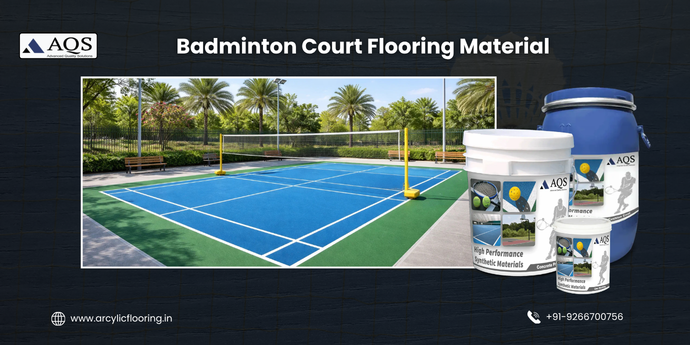
Choosing the right badminton court flooring material is arguably the most important decision in your entire project. The floor determines player safety and injury prevention, shuttle rebound quality, shoe grip and slide resistance, long-term maintenance costs, and overall playing experience that drives repeat bookings. In India’s diverse climate – from humid coastal regions to dry northern plains – material selection must also account for local weather conditions, temperature variation, and maintenance accessibility.
Wooden Flooring – The Gold Standard for Indoor Courts
Maple hardwood flooring remains the undisputed gold standard for professional badminton courts worldwide and increasingly in India’s premium academies. Wooden floors offer superior shock absorption that protects players’ knees, ankles, and hips during intensive training sessions. The natural spring and elastic response of maple wood also enhances shuttle rebound consistency. BWF-approved wooden floors use a multi-layer construction – sub-structure, battens, plywood base, and hardwood surface – that provides optimal playability and meets international competition requirements.
Cost in India: ₹350 – ₹600 per sq. ft. | Total flooring cost for one court: ₹7 lakh – ₹12 lakh | Lifespan: 15-25 years | Annual maintenance: Polishing every 12-18 months at ₹20,000 – ₹60,000 | Best for: Professional academies, club courts, tournament venues. Key consideration: Wooden floors require anti-termite and anti-moisture treatment in humid regions. Annual sanding and refinishing every 8-10 years adds ₹1-₹2 lakh per court.
Synthetic PU (Polyurethane) Flooring – Best Mid-Range Option
Synthetic polyurethane (PU) flooring has gained enormous popularity in India’s mid-range badminton academies because it offers professional-grade performance at a significantly lower cost than wooden floors. PU floors provide excellent shock absorption through their cushion layer system, deliver consistent shuttle bounce, and resist moisture better than wood – making them ideal for cities with high humidity. The surface texture ensures anti-slip properties even under intense movement and sweat conditions.
Cost in India: ₹250 – ₹450 per sq. ft. | Total flooring cost for one court: ₹5 lakh – ₹9 lakh | Lifespan: 10-15 years | Annual maintenance: Simple mopping and occasional surface treatment | Best for: Indoor training centres, badminton academies, multi-sport facilities. PU flooring comes in roll-on or tile formats and installs faster than wooden floors, reducing total installation time from weeks to days.
Acrylic Synthetic Flooring – Ideal for Outdoor Courts
Acrylic synthetic flooring dominates India’s outdoor badminton court market in 2026. These surfaces are engineered specifically for India’s extreme weather – UV-resistant coating prevents colour fading under intense sun, while waterproof layers prevent waterlogging during monsoon seasons. The multi-layer acrylic system typically includes a base concrete layer, cushion coat, and acrylic colour finish with built-in grip texture. ITF and ISO-certified acrylic courts meet international standards for outdoor racket sports.
Cost in India: ₹150 – ₹250 per sq. ft. | Total outdoor court cost (including base prep): ₹3 lakh – ₹5 lakh | Lifespan: 8-10 years | Resurfacing every 5-7 years: ₹80,000 – ₹1,50,000 | Best for: Schools, housing societies, clubs, community courts. Acrylic floors are low-maintenance – regular sweeping and occasional power washing keeps them in excellent condition year-round.
Transform Your Sports Facility Today!
Contact us for high-quality synthetic sports flooring material and elevate your space!
PVC Vinyl Flooring – Budget-Friendly & Quick to Install
PVC vinyl flooring offers a practical, budget-conscious solution for badminton academies and multi-purpose indoor sports halls. Available in rolls or interlocking tiles, PVC floors install quickly without adhesives, making them removable and reusable – an advantage for facilities that need to convert their space for multiple sports. The smooth, consistent surface provides good shuttle bounce and adequate grip for recreational and training-level play.
Cost in India: ₹150 – ₹300 per sq. ft. | Total flooring cost for one court: ₹3 lakh – ₹6 lakh | Lifespan: 8-12 years | Easy DIY-level maintenance: Damp mopping, no special treatment needed | Best for: Training academies, school gymnasiums, multi-sport halls, commercial spaces with multiple usage requirements. PVC floors are particularly popular in tier-2 cities where cost efficiency is prioritised over premium performance.
Badminton Court Installation Cost: Step-by-Step Process & Pricing
The badminton court installation process follows a systematic sequence that professional contractors execute in specific phases. Each phase has associated labour and material costs that contribute to the total installation budget. Understanding this process helps you evaluate contractor quotations accurately, identify overcharging, and set realistic timelines for your project. Typical indoor court installation takes 4-8 weeks; outdoor courts complete in 2-4 weeks.
Phase 1: Site Survey & Design (Week 1)
Professional contractors begin every project with a comprehensive site survey. The survey team measures available space, evaluates soil condition, checks drainage patterns, assesses structural load requirements, and determines ceiling height availability. This phase produces architectural drawings, structural design, material specifications, and a detailed cost estimate. Professional design fees range from ₹25,000 to ₹1,50,000 depending on project complexity. Skipping professional design is a common mistake that leads to expensive structural corrections during construction.
Phase 2: Foundation & Base Construction (Weeks 2-3)
Workers excavate and level the court area to achieve perfectly flat ground – a critical requirement because even minor undulations affect shuttle bounce and player movement. They lay a compacted granular sub-base, install drainage pipes, and pour a reinforced concrete slab of 75-100mm thickness. The concrete must cure completely for 28 days before flooring installation begins. Labour cost for this phase: ₹1 lakh – ₹3 lakh depending on site conditions and court size.
Phase 3: Structural Framework (Weeks 3-5, Indoor Only)
For indoor courts, the steel structure installation proceeds after foundation work completes. A structural engineering team erects column foundations, assembles the pre-engineered steel frame, installs roofing purlins, and fits colour-coated metal roofing sheets. Proper ventilation openings, roof gutters, and drainage downpipes are incorporated at this stage. The steel structure team typically operates independently from the flooring crew, allowing parallel work to reduce overall timelines.
Phase 4: Flooring Installation (Weeks 4-7)
Flooring installation is the most skill-sensitive phase of the entire project. Wooden floor installation requires trained carpenters who understand the batten layout, expansion gap requirements, moisture barrier placement, and surface finishing techniques. Synthetic and acrylic floors require specialised application equipment including squeegees, rollers, and sometimes heat-welding tools. Labour cost for flooring installation: ₹50,000 – ₹2,00,000 depending on material type and court size.
Phase 5: Court Marking & Net Installation (Week 7-8)
Precise court line marking follows flooring installation. Using standard templates and measuring tools, workers apply 40mm-wide court lines – singles lines, doubles lines, service lines, and centre line – all in high-visibility white or yellow colour. Net posts are installed in pre-drilled floor sleeves or surface-mounted brackets, adjusted to the exact regulation height of 1.55m at the posts and 1.524m at centre. Professional marking and net installation cost: ₹15,000 – ₹50,000 per court.
Phase 6: Lighting & Electrical Finishing (Week 7-8)
Electricians install sports-grade LED light fixtures at optimised heights and angles to achieve uniform illumination across the court surface. The electrical panel receives a dedicated sports lighting circuit with appropriate load calculations. Electrical work includes internal wiring, conduit installation, junction boxes, circuit breakers, and switchgear. This phase also covers CCTV installation, scoreboard wiring, PA system if included, and final power connections. Electrical and lighting completion cost: ₹1 lakh – ₹4 lakh per court facility.
Indoor vs Outdoor Badminton Court: Cost Comparison Table
The decision between indoor and outdoor court construction is the single most significant budget decision you make. An outdoor court costs a fraction of an indoor facility but offers fundamentally different capabilities, revenue potential, and playing experience. This comparison table presents a complete side-by-side analysis to help you choose the right option for your goals, budget, and location.
| Comparison Factor | Outdoor Court | Indoor Court |
|---|---|---|
| Base Construction Cost | ₹3L – ₹8L | ₹15L – ₹60L |
| Flooring Material | Acrylic/Concrete | Wooden/PVC/PU Synthetic |
| Flooring Cost (per sq. ft) | ₹150 – ₹250 | ₹250 – ₹600 |
| Steel Structure Required | No | Yes – ₹24L-₹45L |
| Ceiling Height Needed | Open Sky | 9-12 metres minimum |
| Weather Dependence | High – Unusable in rain | Zero – All-weather facility |
| Lighting Requirement | Optional (evening play) | Mandatory |
| Air Conditioning | Not applicable | ₹3L – ₹8L |
| Revenue Potential/month | ₹15,000 – ₹50,000 | ₹50,000 – ₹2,00,000 |
| Maintenance (annual) | ₹30,000 – ₹80,000 | ₹1L – ₹5L |
| ROI Timeline | 1-2 years | 3-6 years |
| Suitable For | Schools, Societies, Clubs | Academies, Businesses, Pro Clubs |
| Lifespan (Flooring) | 8-10 years | 12-25 years |
Quick Decision Guide: Which Badminton Court is Right for You?
| Quick Decision Framework – Choose Your Court Type |
| Budget under ₹5 lakh? → Build an outdoor acrylic court. Best for schools, housing societies. |
| Budget ₹5L – ₹15L? → Outdoor premium court with lighting OR basic indoor PVC court. |
| Budget ₹15L – ₹30L? → Single indoor court with PVC/PU synthetic flooring. Good for academies. |
| Budget ₹30L – ₹60L? → Mid-to-premium indoor court with wooden flooring + full amenities. |
| Budget ₹60L – ₹1Cr+? → Multi-court indoor facility. Ideal for commercial sports business. |
| Building for competitions? → Invest in wooden flooring + 500 lux lighting + 12m ceiling height. |
| Building for a school? → Outdoor acrylic or indoor PVC. Cost-effective and durable. |
| Building for commercial revenue? → Indoor facility. ROI in 3-6 years with right pricing. |
| Residential/home court? → Backyard acrylic or foldable PVC system. ₹4L – ₹12L range. |
City-Wise Badminton Court Cost Variation Across
Construction costs vary significantly across Indian cities due to differences in land values, labour rates, material availability, transportation costs, and local regulatory requirements. A badminton court project in Mumbai costs 30-50% more than an equivalent project in Lucknow or Bhopal. Understanding regional cost variation helps you benchmark contractor quotations and avoid overpaying for your specific location.
| City / Region | Outdoor Court (₹) | Indoor Court (₹) | Cost Index |
|---|---|---|---|
| Mumbai / Pune | ₹6L – ₹10L | ₹25L – ₹65L | Very High (+35%) |
| Delhi / NCR | ₹5L – ₹9L | ₹22L – ₹58L | High (+25%) |
| Bangalore / Chennai | ₹5L – ₹8L | ₹20L – ₹55L | High (+20%) |
| Hyderabad / Kolkata | ₹4.5L – ₹7L | ₹18L – ₹48L | Medium (+10%) |
| Ahmedabad / Surat | ₹4L – ₹7L | ₹17L – ₹45L | Medium (+8%) |
| Jaipur / Lucknow | ₹3.5L – ₹6L | ₹15L – ₹42L | Standard (Base) |
| Bhopal / Nagpur | ₹3L – ₹5.5L | ₹14L – ₹38L | Low (-8%) |
| Tier-3 / Rural Areas | ₹2.5L – ₹4.5L | ₹12L – ₹32L | Very Low (-15%) |
Annual Maintenance Cost of Badminton Courts
Construction cost is a one-time investment, but maintenance is an ongoing operational reality. Ignoring regular upkeep accelerates surface degradation, increases injury risks, and ultimately forces expensive emergency repairs. Budget-conscious facility owners who skip maintenance end up spending more on court replacement within 5-7 years instead of the expected 15-20 year lifespan. Proper maintenance dramatically extends your court’s useful life and maintains player satisfaction.
| Maintenance Activity | Wooden Floor | Synthetic/PVC | Acrylic Outdoor |
|---|---|---|---|
| Daily Cleaning | Dry microfibre mop | Damp mop/wipe | Dry sweep |
| Monthly Inspection | Check seams, expansion gaps | Surface inspection | Check drainage |
| Annual Polishing | ₹20,000 – ₹60,000 | Waxing: ₹8,000-₹20,000 | Not required |
| Surface Refinishing | ₹1L-₹2L (per 8-10 yrs) | ₹50,000-₹1L (5-7 yrs) | ₹80,000-₹1.5L (5-7 yrs) |
| Line Repainting | ₹5,000 – ₹15,000/yr | ₹5,000 – ₹15,000/yr | ₹5,000 – ₹12,000/yr |
| Net & Post Replacement | ₹8,000 – ₹20,000 (3-5 yrs) | Same | Same |
| Total Annual Budget | ₹1L – ₹3L | ₹50,000 – ₹1.5L | ₹30,000 – ₹80,000 |
Understanding Related Badminton Court Terms
Badminton Court Resurfacing Cost
Resurfacing is a cost-effective way to extend a court’s life without rebuilding from scratch. When the surface shows visible wear, colour fading, or traction loss, resurfacing restores performance at 30-50% of original installation cost. Acrylic court resurfacing costs ₹80,000 – ₹1,50,000 per court. Wooden court sanding and refinishing costs ₹1 lakh – ₹2 lakh. The industry recommends resurfacing every 5-8 years depending on usage intensity and environmental conditions in your region.
BWF-Approved Badminton Court Flooring
The Badminton World Federation approves specific flooring systems for tournament use. BWF approval requires the floor to meet strict criteria for shuttle rebound consistency, surface friction coefficient, shock absorption, and durability. In India, Yonex, Taraflex, and select domestic manufacturers produce BWF-approved flooring. Only academies that host state-level or national tournaments need to invest in BWF-certified surfaces – training courts can use high-quality synthetic alternatives at lower cost.
Multi-Court Badminton Facility Cost Optimisation
Building multiple courts simultaneously creates significant economies of scale. The steel structure, electrical infrastructure, washrooms, reception, and parking are shared costs that do not multiply linearly with court count. A 4-court facility typically costs 60-70% of what building 4 separate single courts would cost. Contractors also offer better rates for larger projects. If your long-term goal is a multi-court facility, building all courts in one phase saves 20-30% over multiple incremental phases.
Government Approval & Permits for Badminton Courts
Commercial badminton courts require several regulatory clearances before construction. These include building plan approval from the local municipal authority, fire NOC for enclosed indoor structures, structural safety certificate from a licensed engineer, and trade license for commercial sports facility operation. In some states, sports infrastructure receives relaxed FSI norms and stamp duty benefits. Always consult a local architect familiar with sports construction regulations before beginning your project.
Transform Your Sports Facility Today!
Contact us for high-quality synthetic sports flooring material and elevate your space!
How to Choose the Right Badminton Court Contractor in India
Your contractor choice determines whether your court becomes a premium facility players love or a problematic investment that requires constant repairs. India’s badminton court construction market has experienced rapid growth, but contractor quality varies enormously. Dozens of new contractors have entered the market with limited experience, cutting costs through inferior materials or inexperienced labour. Protect your investment by following these essential contractor evaluation criteria.
- Verify the contractor’s portfolio of completed badminton courts – ask for site visit access to at least 2-3 completed projects
- Check client testimonials and ask existing clients about post-completion support quality
- Confirm that the contractor uses certified, BWF-compliant flooring materials with manufacturer guarantees
- Evaluate their structural engineering capability – ensure licensed civil/structural engineers oversee foundation and framework
- Compare at least 3 detailed quotations – not just total price but material specifications, brand names, and warranty terms
- Insist on a written contract with defined payment milestones tied to construction progress, not time
- Verify warranty terms: a professional contractor offers minimum 2-5 years structural warranty and 1-2 years flooring warranty
- Check if the contractor has completed projects in your state/city – local experience matters for regulatory knowledge
Return on Investment (ROI) from Badminton Court Business in India
A commercial badminton court is not just a construction project – it is a business investment with measurable financial returns. When planned strategically with the right location, pricing, and facility quality, indoor badminton courts generate consistent monthly revenue from court bookings, coaching programs, tournaments, and membership packages. India’s growing fitness consciousness and badminton popularity create strong demand for well-managed facilities across all urban centres.
| Revenue Source | Small Facility (1-2 Courts) | Medium (3-4 Courts) | Large (5+ Courts) |
|---|---|---|---|
| Court Booking (hourly) | ₹40,000 – ₹80,000/mo | ₹1.2L – ₹2.5L/mo | ₹3L – ₹6L/mo |
| Coaching Programs | ₹30,000 – ₹80,000/mo | ₹1L – ₹2L/mo | ₹2L – ₹5L/mo |
| Membership Packages | ₹10,000 – ₹30,000/mo | ₹40,000 – ₹1L/mo | ₹1L – ₹3L/mo |
| Tournament Hosting | ₹5,000 – ₹20,000/mo | ₹20,000 – ₹50,000/mo | ₹50,000 – ₹1.5L/mo |
| Corporate Events | ₹10,000 – ₹30,000/mo | ₹30,000 – ₹80,000/mo | ₹80,000 – ₹2L/mo |
| Total Potential Revenue | ₹95,000 – ₹2.4L/mo | ₹2.9L – ₹6.3L/mo | ₹7L – ₹17.5L/mo |
| Typical ROI Timeline | 2-4 years | 3-5 years | 5-8 years |
Cost-Saving Strategies for Building a Badminton Court in India
Smart planning and strategic decisions can reduce your badminton court construction cost by 15-30% without compromising essential quality. These savings come from design optimisation, material selection, phased construction, and procurement strategy – not from cutting corners on structural integrity or flooring quality. Apply these professional cost-optimisation strategies to stretch your investment further.
- Build multiple courts simultaneously – shared infrastructure reduces per-court cost by 25-35%
- Choose pre-engineered steel structures over RCC – faster installation, lower cost, equal durability
- Select PVC or PU synthetic flooring over wooden for training academies – saves ₹3-5 lakh per court without sacrificing player experience
- Phase your amenities – build core playing infrastructure first, add AC, spectator seating, and extra rooms in Year 2
- Source flooring materials directly from manufacturers rather than through multiple intermediaries
- Obtain multiple detailed quotations and negotiate – material prices have dropped 10-15% in 2025-2026 due to increased competition
- Invest in solar panels for lighting – reduces monthly electricity bills by 40-60% within 3-4 years
- Explore state government sports infrastructure schemes – several states offer subsidies or land allocation for sports facilities
Frequently Asked Questions (FAQs)
A single indoor badminton court costs ₹15 lakh to ₹45 lakh depending on flooring type, structure quality, and location in India.
Acrylic synthetic flooring is best for outdoor courts in India’s climate, while maple hardwood or PU synthetic flooring is ideal for professional indoor facilities.
Outdoor badminton court installation cost in India ranges from ₹3 lakh to ₹8 lakh including site preparation, acrylic flooring, court markings, and net posts.
Wooden floors last 15-25 years, PU synthetic 10-15 years, PVC vinyl 8-12 years, and acrylic outdoor flooring 8-10 years with proper maintenance.
Annual badminton court maintenance cost ranges from ₹30,000 for basic outdoor courts to ₹3-5 lakh for premium indoor wooden floor facilities.
Yes – a residential backyard badminton court with acrylic or PVC flooring, basic lighting, and court markings is achievable within a ₹6-12 lakh budget.
Conclusion
Building a badminton court in India represents a genuine opportunity – whether your goal is community service, sports development, or commercial revenue generation. Badminton’s explosive popularity, India’s rising fitness culture, and the shortage of quality courts in most cities create strong demand for well-built facilities at every price point. The market rewards quality: facilities that invest in proper flooring, adequate lighting, and player comfort generate significantly better bookings, retention, and word-of-mouth growth than budget setups that cut corners.
The total badminton court cost in India ranges from ₹3 lakh for a simple outdoor court to ₹1 crore or more for a premium multi-court indoor academy. Your ideal investment point depends on your purpose, location, land situation, and long-term revenue goals. Use the cost tables, comparison frameworks, and case study in this guide to build a realistic budget, evaluate contractor quotations accurately, and make informed decisions about materials and amenities.