
Understanding the exact badminton court size is essential for anyone looking to play the sport competitively, build a professional facility, or simply set up a recreational space. Whether you are a player, a badminton court builder, a sports architect, or a facility manager, getting the dimensions right ensures fair play, player safety, and compliance with international standards. This comprehensive guide covers every aspect of badminton court dimensions – from the official measurements set by the Badminton World Federation (BWF) to flooring materials, line markings, surface preparation, and construction best practices.
Table of contents
- Badminton Court Size: Quick Reference Table
- Official Badminton Court Dimensions as per BWF Standards
- Singles vs Doubles Badminton Court Dimensions
- Understanding Badminton Court Lines and Layout
- Badminton Court Flooring: Materials and Surface Standards
- Badminton Court Flooring Comparison Table
- Surface Preparation Materials: Concrete Primer, Acrylic Resurfacer, and Cushion Coat
- Badminton Court Construction: Step-by-Step Process
- Badminton Court Construction Stages at a Glance
- Badminton Court Clearance Zones and Surrounding Space
- Badminton Court Dimensions for Different Court Types
- Indoor vs Outdoor Badminton Court Size: Key Differences
- Maintaining Badminton Court Size & Dimensions Over Time
- Conclusion: Getting Badminton Court Size Right the First Time
- Badminton Court Size & Construction (Q&A)
Badminton Court Size: Quick Reference Table
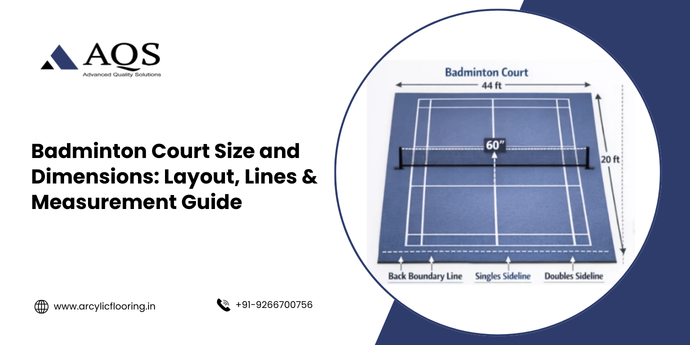
Before diving into the detailed breakdown, here is a quick-reference summary table of standard badminton court dimensions as mandated by the BWF. These measurements apply to both singles and doubles games played at club, national, and international levels.
| Parameter | Measurement (Meters) | Measurement (Feet) |
| Overall Court Length | 13.40 m | 43.96 ft |
| Overall Court Width (Doubles) | 6.10 m | 20.01 ft |
| Overall Court Width (Singles) | 5.18 m | 16.99 ft |
| Net Height (Center) | 1.524 m | 5.00 ft |
| Net Height (Posts) | 1.55 m | 5.09 ft |
| Short Service Line (from net) | 1.98 m | 6.50 ft |
| Long Service Line – Doubles (from back) | 0.76 m | 2.49 ft |
| Back Boundary Line to Long Service Line | 0.76 m | 2.49 ft |
| Center Line (Half Width) | 3.05 m | 10.00 ft |
| Line Width | 0.04 m | 1.57 in |
Official Badminton Court Dimensions as per BWF Standards
Total Court Length and Width
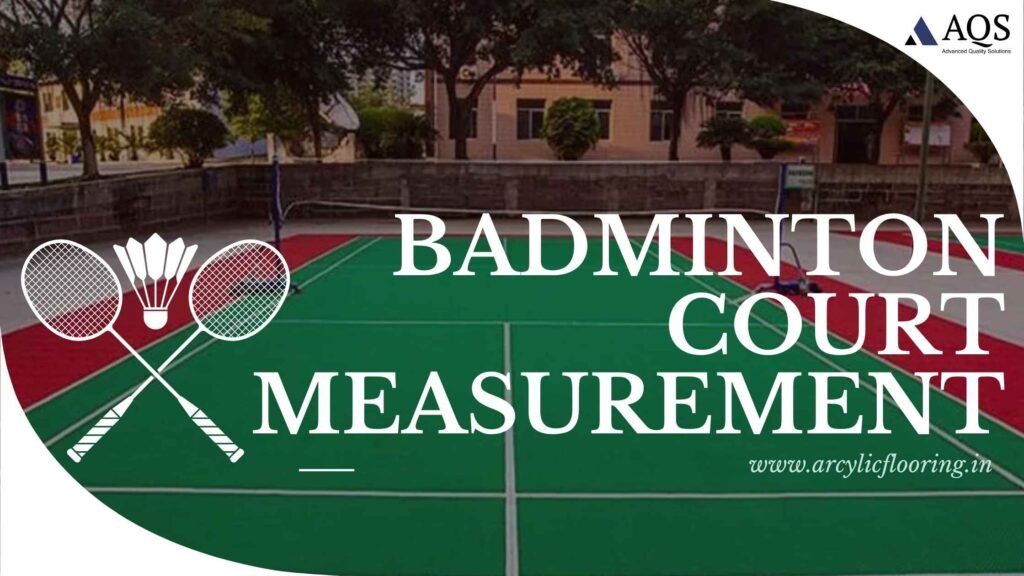
The official badminton court size as recognized by the Badminton World Federation measures 13.40 meters (43.96 feet) in length and 6.10 meters (20.01 feet) in width for doubles play. For singles matches, the width narrows to 5.18 meters (16.99 feet), while the length remains the same at 13.40 meters. These dimensions are strictly enforced in all professional and international tournaments, and any deviation can invalidate the match setup. The court is a rectangular shape, and every measurement must be taken from the outer edge of the boundary lines, which are themselves 40 millimeters (4 cm) wide. It is critical that these lines are precisely painted with no room for approximation, particularly in tournament-grade facilities.
Net Measurements and Post Placement
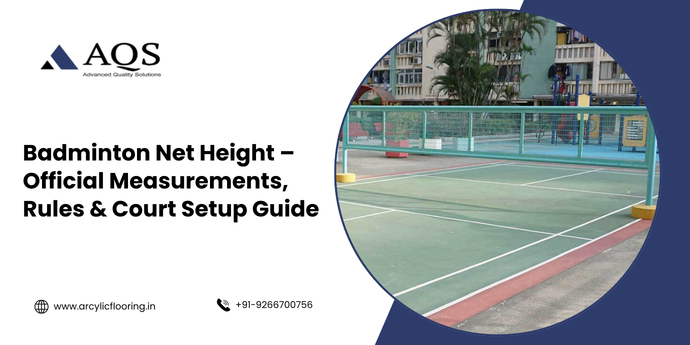
The net divides the badminton court exactly in half along its width. The net must be 6.10 meters wide, matching the full court width for doubles play. According to official BWF badminton court dimensions, the net height at the center must be exactly 1.524 meters (5 feet), while at the posts, it rises slightly to 1.55 meters (5 feet and 1 inch). The net posts are placed on the doubles sidelines, regardless of whether a singles or doubles match is being played. The net itself should be constructed from fine dark cord or nylon, with a mesh size between 15 mm and 20 mm. The top of the net must be edged with a 75 mm white tape doubled over a cord or cable running through it.
Singles vs Doubles Badminton Court Dimensions
A common source of confusion is how the court changes between singles and doubles formats. The table below clearly outlines the differences, helping players, coaches, and court builders understand which zones apply to each game format.
| Court Zone | Singles | Doubles |
| Court Width | 5.18 m (16.99 ft) | 6.10 m (20.01 ft) |
| Court Length | 13.40 m (43.96 ft) | 13.40 m (43.96 ft) |
| Service Court Length | 6.71 m (22.0 ft) | 5.95 m (19.52 ft) |
| Long Service Line Used | Back Boundary Line | 0.76 m inside back line |
| Sidelines Used | Inner Sidelines | Outer Sidelines |
| Back Alley Width | Not Used | 0.76 m (2.49 ft) |
| Side Alley Width | Not Used | 0.46 m (1.51 ft) |
Understanding Badminton Court Lines and Layout
Boundary Lines and Their Significance
The layout of a badminton court is defined by a series of precisely marked lines that govern the play zones for both singles and doubles formats. The outermost lines form the boundary of the full court and are used as the sidelines and back boundary lines during doubles play. Inside these outer lines are the inner sidelines, which define the width of the singles court. Each line on the court is 40 mm (4 cm) wide and is included within the measurement of the area it defines. This means, for example, that the measurement of 6.10 meters for the doubles court includes the width of both side boundary lines. Proper line marking is not merely cosmetic – it directly affects the legality of shots, service zones, and out-of-bounds calls during competitive play.
Short Service Line and Long Service Line
The short service line runs parallel to the net at a distance of 1.98 meters (6.5 feet) from the net on both sides of the court. No service may land in front of this line during play, making it one of the most strategically important lines on the court. The long service line differs depending on the format being played. In singles, the long service line coincides with the back boundary line. In doubles, there is a dedicated long service line drawn 0.76 meters (2.5 feet) inside the back boundary line. This means that during doubles, the deep serve must land between the short service line and this dedicated long service line – a narrower target zone that adds strategic complexity to the doubles game.
Did You Know? A Shuttlecock Can Travel Over 490 km/h – On a Court Just 13.4 Meters Long
Badminton is officially the fastest racket sport on the planet. The world record shuttlecock smash was recorded at 493 km/h (306 mph), struck by Danish player Mads Pieler Kolding. What makes this jaw-dropping is that this incredible projectile must be handled within a court measuring just 13.40 meters in total length. That means a player on the opposite baseline has less than 0.1 seconds to react, read the shot, move their feet, and swing their racket. This extreme pace is precisely why the badminton court dimensions, the flooring’s shock absorption properties, and the cushion coat surface system must all meet exact standards any slip, uneven surface, or incorrect footing can be dangerous at these reaction speeds.
Center Line and Service Court Zones
The center line runs perpendicular to the net, dividing each side of the court into two equal halves – the left service court and the right service court. This line extends from the short service line to the long service line (or back boundary line in singles). The center line is essential for determining the correct service court. At the start of a game, or when the server’s score is even, the serve is made from and into the right service court. When the score is odd, it switches to the left service court. This creates four distinct service boxes on the court, each measuring approximately 3.96 meters by 2.59 meters in doubles. Getting the center line perfectly straight and properly positioned is crucial for both official matches and training environments.

Badminton Court Flooring: Materials and Surface Standards
Why Court Flooring Matters
Badminton court flooring plays a massive role in player performance, injury prevention, and the longevity of the court surface itself. The right floor must offer consistent ball bounce (or rather, shuttle response), adequate grip, shock absorption, and durability under heavy foot traffic. Unlike outdoor sports, badminton is predominantly played indoors, meaning the flooring must also consider moisture resistance, ease of maintenance, and low reflectivity to ensure optimal visibility of the shuttle. The Badminton World Federation specifies that court surfaces must be non-slippery and should provide sufficient cushioning to reduce strain on players’ joints. Choosing the right flooring in collaboration with a professional badminton court builder is one of the most important decisions in court construction.
Types of Badminton Court Flooring
There are several types of flooring used in badminton courts today, each suited to different applications and budget levels. Wooden flooring – particularly maple hardwood – is the gold standard for indoor professional courts and is used in most BWF-sanctioned tournament venues. Synthetic flooring, such as polyurethane (PU) or polyvinyl chloride (PVC) mats, is widely used in club-level and multi-sport facilities due to its affordability and versatility. Acrylic sports flooring systems are increasingly popular for outdoor or semi-outdoor courts, especially when applied over concrete substrates. These systems involve multiple layers, including a base coat, cushion coat, and color finish coat, and provide excellent durability and performance when correctly installed.
Badminton Court Flooring Comparison Table
| Flooring Type | Best Use | Durability | Cost Range | Maintenance |
| Maple Hardwood | Professional/Indoor | High | Premium | Moderate |
| PU Synthetic | Club/Multi-Sport | High | Moderate | Low |
| PVC Mat | Portable/Temporary | Medium | Low | Very Low |
| Acrylic System | Outdoor/Concrete Base | Very High | Moderate | Low |
| Rubber Flooring | Training/Recreational | Medium | Low-Moderate | Low |
Surface Preparation Materials: Concrete Primer, Acrylic Resurfacer, and Cushion Coat
Concrete Primer: The Foundation of a Quality Court Surface
When building an acrylic badminton court over a concrete base, surface preparation is absolutely non-negotiable. Concrete Primer is the very first layer applied to the concrete substrate before any sport surface coating is laid down. A high-quality concrete primer penetrates deep into the pores of the concrete, sealing the surface, improving adhesion of subsequent layers, and preventing moisture from migrating upward and causing delamination or bubbling in the finish coats. Primers designed specifically for sports courts are typically water-based, low-VOC formulations that are compatible with acrylic coating systems. The concrete surface must be properly cleaned, dried, and repaired before primer application – any cracks, holes, or surface irregularities must be filled and leveled. Skipping or rushing the concrete primer stage is one of the most common causes of premature court surface failure.
Acrylic Resurfacer: Building a Smooth, Even Playing Surface
After the concrete primer has cured fully, an Acrylic Resurfacer is applied to fill any minor surface imperfections, cracks, or texture variations in the base concrete. This product is a heavily filled acrylic emulsion designed to create a smooth, uniform base for the color and finish coats. Acrylic resurfacer is typically applied in one or two coats using a squeegee or trowel, depending on the condition of the substrate and the desired smoothness level. On older or heavily textured concrete surfaces, multiple passes of resurfacer may be needed. The resurfacer must be allowed to cure completely between coats, and the final surface should be level, smooth, and free of any dust, contamination, or surface defects before proceeding to the next stage. This layer is critical for ensuring that the cushion and finish coats adhere correctly and perform as expected over the long term.
Cushion Coat: Shock Absorption and Player Safety
The Cushion Coat layer is what differentiates a professional sports court from a basic painted concrete surface. Applied after the acrylic resurfacer, the cushion coat is a specially formulated material that contains rubber granules or a similar elastic component, creating a layer of controlled give and shock absorption underfoot. In the context of badminton court construction, the cushion coat reduces the impact forces transmitted through players’ feet, ankles, and knees during intensive lateral movements, jumps, and sudden direction changes – all of which are defining movements of badminton. Courts can be classified by their cushion level (low, medium, high) depending on the number of cushion coat layers applied. More layers mean greater shock absorption. The cushion coat also improves surface traction and provides the slightly textured finish needed for adequate grip without causing excessive shoe wear.
Badminton Court Construction: Step-by-Step Process
Site Selection and Base Preparation
Constructing a badminton court begins long before a single line is painted or a coating is applied. The first step is site selection, which involves choosing a location with adequate dimensions to accommodate not just the court itself, but also the required clearance zones. The minimum recommended space is 15.5 meters in length and 8.5 meters in width, allowing for the 13.40 × 6.10 meter court plus safety margins on all sides. The base – typically concrete – must be laid to exacting standards: a minimum of 100 mm thick for indoor use, with a minimum compressive strength of 25 MPa.
The surface must be level within 3 mm over a 3-meter straightedge. Any slope for outdoor drainage must not exceed 1% in any direction. A good badminton court builder will conduct a full substrate assessment before proceeding with any surface work, ensuring that the base is strong, stable, and ready for the coating system.
Court Line Marking and Dimensions Layout
Once the surface layers – including concrete primer, acrylic resurfacer, cushion coat, and color base coat – have all been properly applied and cured, the court lines are marked. Professional line marking requires accurate measurement tools, including a long measuring tape, chalk lines, and masking tape. The process begins by establishing the center of the court, then working outward symmetrically to lay out all boundary lines, service lines, and the center line. All lines must be exactly 40 mm wide and painted using a durable, contrasting-color acrylic court paint – typically white or yellow on a green or blue court surface. The lines are included within the measurements of the courts and service areas they define, as per BWF regulations. A laser level or optical square is often used to ensure that all right angles are precisely 90 degrees and that the court is perfectly rectangular with equal diagonals.
Badminton Court Construction Stages at a Glance
| Stage | Activity | Key Material / Tool | Purpose |
| 1 | Site Assessment & Layout | Measuring Tools, Laser Level | Ensure correct dimensions & level base |
| 2 | Concrete Base Preparation | Concrete Mix, Reinforcement | Provide strong, stable substrate |
| 3 | Surface Cleaning & Repair | Grinder, Crack Filler | Remove defects before coating |
| 4 | Apply Concrete Primer | Concrete Primer, Roller | Seal & improve adhesion |
| 5 | Apply Acrylic Resurfacer | Acrylic Resurfacer, Squeegee | Level and smooth the surface |
| 6 | Apply Cushion Coat | Cushion Coat, Trowel | Add shock absorption & traction |
| 7 | Apply Color Base Coat | Acrylic Sport Paint | Provide uniform playing surface color |
| 8 | Line Marking | Acrylic Line Paint, Tape | Define all court zones accurately |
| 9 | Net Post Installation | Steel Posts, Anchor Bolts | Support regulation net at correct height |
| 10 | Final Inspection | BWF Dimension Checklist | Verify all measurements and quality |
Badminton Court Clearance Zones and Surrounding Space
Minimum Clearance Requirements
Beyond the court itself, official badminton court dimensions include mandatory clearance zones around all boundaries to ensure player safety and uninterrupted play. The BWF recommends a minimum of 1.0 meter of clear space on each sideline and a minimum of 2.0 meters behind each back boundary line. However, for international tournament play, these clearances are typically larger – up to 2.0 meters on the sides and 3.0 meters behind the back lines. These clearance zones must be free of any obstacles including walls, columns, seating, or equipment. Overhead clearance is equally important: the court must have a minimum ceiling height of 9.0 meters to allow for high-trajectory shuttle shots. For recreational or club-level play, a ceiling height of at least 7.5 meters is generally considered acceptable by most governing bodies.
Lighting Standards for Badminton Courts
Proper lighting is a critical component of any badminton court setup and is closely linked to the overall court dimensions and layout. The Badminton World Federation recommends a minimum illuminance of 500 lux for recreational and club play, 750 lux for national-level competitions, and up to 1,500 lux or more for international broadcast events. Lights must be positioned to avoid glare directly in players’ sightlines, particularly above the net area where players frequently look upward to track high shuttles. LED lighting systems are now the industry standard due to their energy efficiency, high Color Rendering Index (CRI of 80 or above), and minimal flickering – all of which contribute to better visibility and player comfort. Lighting fixtures should be mounted at a height commensurate with the ceiling clearance and arranged in rows parallel to the net for the most even distribution of light across the full court surface.
Badminton Court Dimensions for Different Court Types
Single Court vs Multi-Court Facilities
While a single badminton court requires a minimum area of approximately 15.5 × 8.5 meters including clearances, large indoor badminton facilities typically accommodate multiple courts laid out in parallel. When designing a multi-court facility, the space between adjacent courts can be shared – with a recommended minimum of 1.5 to 2.0 meters between side boundaries of neighboring courts. This shared clearance reduces the total footprint per additional court. For example, a six-court indoor facility may require a hall of approximately 36 to 38 meters in width and 18 to 20 meters in length, depending on clearance allowances and whether spectator seating is included. Each court must maintain its own independent line markings, and courts are typically color-coded or separated by clearly distinct line colors to prevent confusion during simultaneous multi-court play.
Outdoor Badminton Courts
While badminton is predominantly an indoor sport at the competitive level, outdoor courts are popular for recreational play. Outdoor badminton court dimensions are identical to indoor standards – 13.40 × 6.10 meters for doubles – but the construction considerations differ significantly. Outdoor courts require robust weather-resistant surface systems, beginning with a high-strength concrete base with adequate drainage slope, followed by application of a UV-resistant concrete primer, a waterproof acrylic resurfacer, and a UV-stable acrylic sport coating system. The cushion coat used on outdoor courts must also be formulated to resist temperature fluctuations, moisture ingress, and UV degradation. Additionally, windbreaks are often installed around outdoor courts to minimize the effect of wind on shuttle flight, especially in exposed locations. Proper drainage channels must be incorporated at the design stage to prevent water pooling on the court surface.
Indoor vs Outdoor Badminton Court Size: Key Differences
| Feature | Indoor Court | Outdoor Court |
| Court Dimensions | 13.40 × 6.10 m | 13.40 × 6.10 m |
| Flooring Material | Wood / PU / Acrylic | Acrylic / Concrete System |
| Concrete Primer Needed | Yes | Yes (Waterproof Grade) |
| Acrylic Resurfacer | Yes | Yes (Exterior Grade) |
| Cushion Coat | Yes | Yes (UV Resistant) |
| Drainage Requirement | Minimal | Essential |
| Wind Management | Not Required | Windbreaks Recommended |
| Lighting | LED Ceiling Fixtures | LED Floodlights |
| Surface Lifespan | 8-12 Years | 5-8 Years |
| Maintenance Frequency | Annual | Bi-Annual |
Maintaining Badminton Court Size & Dimensions Over Time
Regular Inspection and Maintenance Protocols
Even the most precisely constructed badminton court requires ongoing inspection and maintenance to preserve its dimensional accuracy and surface quality over time. Court surfaces – particularly acrylic systems built over concrete – can experience settlement, cracking, or delamination if the substrate shifts or moisture infiltrates the layers. A regular maintenance schedule should include quarterly visual inspections of all line markings for fading or chipping, biannual checks of the net post anchoring and net height calibration, and annual professional assessment of the overall surface condition. If line markings become faded or worn, they can be repainted using compatible acrylic court line paint without needing to resurface the entire court. Cracks in the surface should be addressed promptly using appropriate crack fillers before reapplying a fresh coat of acrylic resurfacer to the affected area, preventing further deterioration.
When to Resurface Your Badminton Court
A professionally constructed acrylic badminton court surface – built with quality concrete primer, acrylic resurfacer, and cushion coat layers – typically has a service life of between 5 and 12 years depending on usage intensity, climate conditions, and maintenance quality. Signs that resurfacing is needed include widespread surface cracking or crazing, significant loss of surface texture and grip, visible delamination or bubbling of the coating layers, and heavily faded or worn line markings that can no longer be adequately refreshed with simple repainting. Full resurfacing involves mechanical grinding or scarification of the existing surface to remove loose or failing material, followed by substrate repair, reapplication of concrete primer, fresh layers of acrylic resurfacer and cushion coat, a new color base coat, and precise line remarking. When handled by an experienced badminton court builder, a full resurface can restore the court to like-new performance standards.
Conclusion: Getting Badminton Court Size Right the First Time
Whether you are setting up a single recreational court in your backyard or constructing a multi-court professional badminton facility, getting the badminton court size and dimensions exactly right is the foundation of everything else. From the official 13.40 × 6.10 meter doubles court dimensions to the precise placement of service lines, the correct net height, and the proper application of surface materials including concrete primer, acrylic resurfacer, and cushion coat layers, every detail matters. A court built to BWF specifications not only ensures fair and competitive play but also protects players from injury and delivers a surface that will perform consistently for years to come. Working with an experienced badminton court builder who understands both the technical construction requirements and the official badminton court dimensions will always deliver the best long-term value for your investment.
Badminton Court Size & Construction (Q&A)
A 13.40 m long × 6.10 m wide (doubles) / 5.18 m wide (singles).
A Exactly 1.524 m (5 ft) at the center; 1.55 m at the posts.
A 1.98 meters (6.5 feet) from the net on both sides.
A 0.76 m (2.5 ft) inside the back boundary line — not the baseline itself.
A All lines are exactly 40 mm (4 cm) wide and included within court measurements.
A 9.0 m for competitive play; 7.5 m minimum for recreational facilities.
A It seals the concrete, blocks moisture, and bonds all acrylic coating layers above it.
A It fills surface cracks and imperfections to create a smooth, level base for finish coats.