When it comes to setting up a professional or recreational badminton court, understanding the exact badminton ground size is absolutely essential. Whether you are planning to build an indoor facility, an outdoor court, or a multi-sport complex, every dimension matters. The official badminton court dimensions are governed by the Badminton World Federation (BWF), and these standards apply globally from local clubs to international tournaments. Getting the size right ensures fair play, player safety, and optimal performance.
Many sports enthusiasts, architects, and facility managers often confuse badminton court measurements with those of other racket sports. The badminton ground size has unique characteristics designed specifically for the speed and agility demands of the sport. A standard court must accommodate both singles and doubles formats, each requiring different boundary configurations while sharing the same underlying court structure.
In this comprehensive guide, we will walk you through everything you need to know about badminton court dimensions from the total ground size and net specifications to line thickness, service box measurements, and surface construction. Whether you are building from scratch or simply want to understand how the game is played within its spatial boundaries, this article is your definitive reference.
Table of contents
- Badminton Court Dimensions at a Glance
- Official Badminton Ground Size: Full Court Layout Explained
- Singles vs. Doubles Badminton Court Size Comparison
- Net Dimensions and Post Specifications
- Line Markings: Width, Color, and Placement
- Badminton Court Line Markings Reference Table
- Badminton Court Flooring: Surface Types and Construction
- Lighting Requirements for Badminton Courts
- Complete Badminton Facility Planning: Space Requirements
- How Badminton Ground Size Compares to Other Racket Sports
- BWF Regulations: What Makes a Court ‘Tournament Legal’
- Step-by-Step Guide to Marking a Badminton Court
- Common Mistakes to Avoid When Sizing a Badminton Court
- Frequently Asked Questions About Badminton Ground Size
- Conclusion: Why Getting the Badminton Ground Size Right Matters
Badminton Court Dimensions at a Glance
Before diving into the detailed breakdown, here is a quick-reference table that summarizes the key badminton ground size measurements as per BWF official standards. These figures serve as the foundation for every court indoor or outdoor, professional or amateur.
| Measurement Category | Dimension (Meters) | Dimension (Feet) |
| Total Court Length | 13.40 m | 43.96 ft |
| Total Court Width (Doubles) | 6.10 m | 20.01 ft |
| Total Court Width (Singles) | 5.18 m | 16.99 ft |
| Net Height at Centre | 1.524 m | 5.0 ft |
| Net Height at Posts | 1.55 m | 5.09 ft |
| Short Service Line (from net) | 1.98 m | 6.49 ft |
| Long Service Line – Doubles | 0.76 m from back | 2.49 ft from back |
| Back Boundary Line to Net | 6.70 m | 21.98 ft |
| Width of Centre Line | 0.04 m (40 mm) | 1.57 inches |
| Recommended Clearance (each side) | 1.00–2.00 m | 3.28–6.56 ft |
Official Badminton Ground Size: Full Court Layout Explained
Total Playing Area and Court Footprint
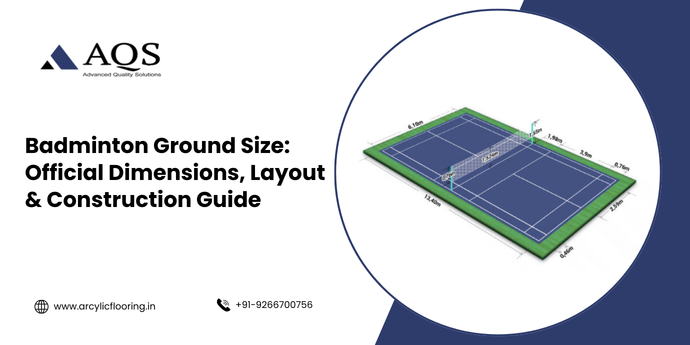
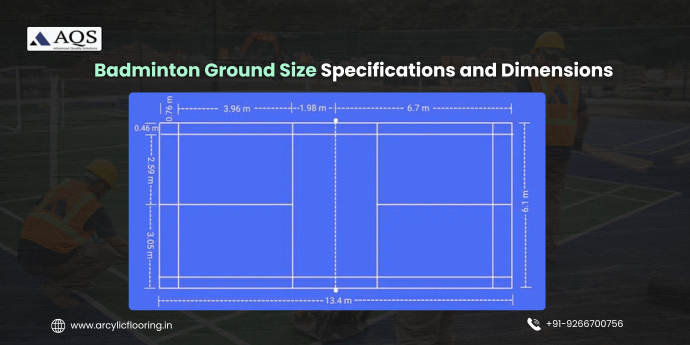
The official badminton ground size as defined by the Badminton World Federation measures 13.40 meters in length and 6.10 meters in width for the full doubles court. This creates a total playing surface area of approximately 81.74 square meters. However, this measurement only accounts for the court within the boundary lines. A fully functional badminton facility requires significant additional space around the court for player movement, safety run-off zones, and official sideline space for umpires and line judges.
When planning any badminton facility, the recommended total room size for a single court should be no less than 15.40 meters in length and 8.10 meters in width. This allows for at least 1 meter of free space on each side and end of the court. For professional competitions, the clearance on the longer sides may extend to 2 meters, bringing the total hall requirement to approximately 10.10 meters in width. This clearance is not just a guideline it is critical for player safety and unobstructed shuttlecock flight during high-paced rallies.
Singles vs. Doubles Court Width: Key Differences
One of the most important aspects of understanding badminton ground size is recognizing how the court changes between singles and doubles play. The full court width of 6.10 meters is used for doubles matches. However, for singles play, only the inner singles sidelines are active, reducing the effective playing width to 5.18 meters. This means the outer 0.46-meter strip on each side of the court becomes out-of-bounds during singles games. The length of the court, however, remains the same at 13.40 meters for both formats.
In doubles play, the back boundary line and the doubles long service line are also different. The long service line in doubles sits 0.76 meters inside the back boundary line, meaning the effective service area is slightly shorter than the full court length. This distinction is a common source of confusion for new players. For singles, the full length of the court up to the back boundary line is used for serving, while the outer side tramlines are excluded. Knowing these distinctions is fundamental to both playing and constructing a properly marked badminton court.
Singles vs. Doubles Badminton Court Size Comparison
| Court Feature | Singles | Doubles |
| Court Length | 13.40 m | 13.40 m |
| Court Width | 5.18 m | 6.10 m |
| Service Box Width | 2.59 m | 3.05 m |
| Long Service Line | Back boundary line | 0.76 m from back |
| Side Tramlines Used | No (out-of-bounds) | Yes (in-bounds) |
| Rear Tramlines Used | Yes (in-bounds) | No for serve only |
Net Dimensions and Post Specifications
Official Net Height and Width Standards
The net is a critical structural element of the badminton ground size and layout. According to BWF regulations, the net must span the full width of the court 6.10 meters for doubles. The net height at the centre of the court must be exactly 1.524 meters (5 feet), while at the posts on either side, the height must be 1.55 meters (5 feet 1 inch). This slight difference ensures the net remains taut across its span without sagging at the centre. The net itself must be made of fine, dark-colored cord with a mesh that is neither too small to prevent shuttlecock passage nor too large to allow it.
The top of the net should be edged with a 75mm white tape doubled over the cord running through it. This white tape serves as a clear visual boundary and helps players and umpires determine whether shuttlecocks have cleared the net or not. The net posts must be 1.55 meters tall and should be placed on the doubles side lines regardless of whether a singles or doubles match is being played. Many recreational courts incorrectly place posts at the singles sideline, which is a common error that affects the structural integrity and fairness of play.
Net Post Placement and Court Division
The net posts divide the court into two equal halves, each measuring 6.70 meters in length from the net to the back boundary line. This symmetrical division ensures both sides of the court offer identical playing conditions. The centre of the court is marked by the net itself, and from this midpoint, players must hit the shuttlecock over the net and into the diagonally opposite service court. The net posts must be firmly anchored to prevent movement during play, especially during intense smashes or net play where shuttlecock contact with the post may occur.
Line Markings: Width, Color, and Placement
Standard Line Width and Boundary Lines
All lines on a badminton court must be 40 millimeters (4 centimeters) wide. These lines are part of the court area they define, meaning a shuttlecock landing on any line is considered in-play and counts as a valid shot. The lines must be clearly visible and are traditionally white or yellow in color, especially for indoor courts. For outdoor or multi-sport surfaces, different colors may be used to distinguish badminton lines from those of other sports marked on the same surface.
The boundary lines include the back boundary lines (which also serve as the long service lines for singles), the side boundary lines for both singles and doubles, the short service lines on both sides of the net, the centre service lines that divide each half into two service courts, and the doubles long service lines. Each of these lines has a specific function during play, and their precise placement is non-negotiable for any court claiming to meet BWF standards.
Service Box Layout and Centre Lines
The service boxes on a badminton court are defined by the intersection of the short service line, the long service line (specific to format), the side boundary line, and the centre line. For doubles, each service box measures 3.05 meters wide and 4.72 meters deep (from short service line to the doubles long service line). For singles, each box is 2.59 meters wide and extends to the full back boundary. The centre line runs from the short service line on each side of the net to the long service line, dividing the court into left and right service boxes. Players must serve into the diagonally opposite service box, making this the most strategically important zone on the court.
Badminton Court Line Markings Reference Table
| Line Type | Position | Width | Purpose |
| Back Boundary Line | Both ends of court | 40 mm | Outer long boundary |
| Singles Long Service Line | Same as back boundary | 40 mm | Serve limit in singles |
| Doubles Long Service Line | 0.76 m inside back boundary | 40 mm | Serve limit in doubles |
| Short Service Line | 1.98 m from net (each side) | 40 mm | Minimum serve distance |
| Centre Line | Divides each half lengthwise | 40 mm | Separates service boxes |
| Doubles Side Line | Outer edge (6.10 m width) | 40 mm | Doubles outer boundary |
| Singles Side Line | Inner side (5.18 m width) | 40 mm | Singles outer boundary |
Badminton Court Flooring: Surface Types and Construction
Indoor Court Flooring Options
The playing surface is one of the most significant factors affecting player performance, injury prevention, and the longevity of a badminton facility. For professional and tournament-level play, BWF recommends wooden flooring specifically maple hardwood or synthetic wood panels that offer the right combination of grip, shock absorption, and ball rebound. The recommended surface hardness allows for quick pivots and explosive movements without putting excessive stress on players’ joints. A high-quality wooden floor should have a minimum thickness of 22 millimeters to provide adequate cushioning and structural rigidity.
Synthetic PU (polyurethane) courts have also become increasingly popular, particularly for multi-use indoor facilities. These surfaces offer consistent grip, are easier to maintain than natural wood, and can be installed over concrete or other subfloors. Rubberized court mats are used for temporary or portable setups and are often seen in school gymnasiums or community halls. However, for serious play, a permanently installed wooden or PU surface is always preferred. The flooring should be non-reflective to prevent glare from overhead lighting, and the surface must be level with a tolerance of no more than 3mm over a 3-meter span.
Outdoor Badminton Court Surface Materials
Outdoor badminton courts face unique challenges including weather exposure, temperature variation, and UV radiation. For outdoor surfaces, concrete with an acrylic coating is the most common choice. The acrylic surface provides adequate grip and resists fading from sunlight. Some facilities opt for asphalt with a textured finish or rubberized surfaces that offer better shock absorption and weatherproofing. Grass surfaces are generally discouraged for serious play as they create uneven bounce and unpredictable shuttlecock behavior. When constructing an outdoor badminton court, proper drainage is critical the surface should slope very slightly (approximately 1%) away from the centre to prevent water pooling after rain.
Court Base and Sub-Base Construction
Regardless of the final surface material, the sub-base of a badminton court must be engineered correctly to ensure longevity and performance. A typical outdoor construction consists of a well-compacted native soil base, a crushed stone or gravel drainage layer of at least 100 millimeters, a compacted stone base of approximately 75 millimeters, a concrete slab of 100 to 150 millimeters thickness, and finally the finish surface layer. Indoor courts may skip the drainage layer but must ensure the concrete subfloor is perfectly level and cured before installation of the playing surface. Moisture barriers are recommended under all indoor courts to prevent warping of wooden flooring.
Transform Your Sports Facility Today!
Contact us for high-quality synthetic sports flooring material and elevate your space!
Lighting Requirements for Badminton Courts
Lux Levels and Fixture Placement
Proper lighting is a fundamental yet often overlooked aspect of badminton ground size planning. The BWF recommends a minimum illuminance of 500 lux for club and recreational play, and a minimum of 1000 lux for national-level competitions. For international tournaments, illuminance levels of 1500 to 2000 lux are required. All lighting fixtures should be positioned to minimize direct glare in players’ eyes, particularly for those looking upward while tracking high lob shots or clears. LED lighting is now the industry standard due to its energy efficiency, consistency, and long lifespan.
The height of the ceiling and lighting fixtures significantly impacts shuttle visibility. BWF recommends a minimum ceiling clearance of 9 meters for tournament play to allow for full lob shots and clears without hitting the roof. Recreational facilities may have lower ceilings, but anything below 7.5 meters significantly limits the style of play possible. The lighting fixtures should be arranged so that each court is uniformly lit with no dark spots or excessively bright areas, ensuring consistent shuttle tracking for all players throughout the session.
Complete Badminton Facility Planning: Space Requirements
| Court Configuration | Min. Hall Length | Min. Hall Width | Ceiling Height |
| 1 Single Court (Recreational) | 15.40 m | 8.10 m | 7.5 m |
| 1 Court (Tournament) | 17.40 m | 10.10 m | 9.0 m |
| 2 Courts Side-by-Side | 15.40 m | 14.20 m | 9.0 m |
| 4 Courts (Club Standard) | 17.40 m | 28.40 m | 9.0 m |
| 6 Courts (Competitive Venue) | 17.40 m | 40.60 m | 12.0 m |
| 8 Courts (Tournament Hall) | 17.40 m | 52.80 m | 12.0+ m |
How Badminton Ground Size Compares to Other Racket Sports
Badminton vs. Tennis Court Size
A comparison of badminton ground size with other racket sports reveals how compact and unique the badminton court truly is. A standard tennis court measures 23.77 meters in length and 10.97 meters in width for doubles nearly double the length and almost double the width of a full badminton court. Despite this vast difference in size, badminton matches are played at extraordinary speed, with professional players covering the smaller court with equally demanding athleticism. The smaller court size of badminton demands rapid direction changes, shorter sprints, and explosive power concentrated in a tighter space.
Badminton vs. Squash and Table Tennis
Compared to squash, which is played in an enclosed box measuring 9.75 meters by 6.4 meters, badminton’s court is significantly longer though similarly narrow. Table tennis, at just 2.74 meters by 1.525 meters, operates on an entirely different scale. These differences highlight how badminton occupies a unique spatial position among racket sports large enough to demand exceptional endurance and court coverage, yet compact enough that every millimeter of the precisely measured court matters. For multi-sport facility designers, understanding these dimensional differences is essential for efficient court layout planning.
| Sport | Court Length | Court Width (Doubles) | Net Height |
| Badminton | 13.40 m | 6.10 m | 1.524 m |
| Tennis | 23.77 m | 10.97 m | 0.914 m |
| Squash | 9.75 m | 6.40 m | N/A (Wall) |
| Table Tennis | 2.74 m | 1.525 m | 0.1525 m |
| Volleyball | 18.00 m | 9.00 m | 2.43 m (Men) |
BWF Regulations: What Makes a Court ‘Tournament Legal’
Surface Compliance and Court Certification
For a badminton court to be considered tournament-legal under BWF regulations, it must meet a comprehensive set of criteria that go beyond just the badminton ground size. The playing surface must provide adequate grip without being sticky, have consistent shock absorption properties, and be free from any irregularities or hazards. Tournament courts must use approved shuttlecocks, have clearly marked boundary lines, and use nets that conform exactly to the specified height and mesh standards. The court must also be free from obstructions within the required clearance zones on all sides.
Beyond physical dimensions, tournament venues must ensure appropriate lighting, environmental conditions (humidity and temperature particularly for feather shuttle play), and spectator separation zones. Many professional venues also install electronic line-calling systems (Hawk-Eye or similar), which require additional infrastructure around the court perimeter. Courts at BWF Super Series and Thomas/Uber Cup events are inspected and certified before competition begins. Even a small deviation in court size or net height can result in remediation requirements before the event is permitted to proceed.
Approved Surface Materials and Non-Slip Requirements
BWF maintains a list of approved court surface materials that have been tested and certified for professional use. These surfaces must achieve a minimum friction coefficient (for grip) and maximum hardness rating (for player safety). Courts that fall outside approved friction ranges either too slippery or too sticky create injury risks during the fast lateral movements characteristic of badminton. For international events, court mats are typically laid over the permanent floor surface. These mats are specifically engineered to provide tournament-standard grip, shock absorption, and marking clarity. The mats must be free from joins or gaps within the playing area and must not curl or lift at the edges during play.
Start AQS Sports Court Measurement!
Contact us for high-quality synthetic sports flooring material and elevate your space!
Step-by-Step Guide to Marking a Badminton Court
Tools and Materials Required
Marking a badminton court correctly requires precision tools and the right materials. You will need a 50-meter measuring tape, chalk or line-marking paint (white or yellow), a marking machine for permanent courts, string lines for alignment, a carpenter’s square or digital angle checker to ensure 90-degree corners, and stakes or adhesive tape for temporary setups. For permanent courts, high-quality acrylic or epoxy line paint is recommended for durability and UV resistance. The width of the marking tool should be set precisely to 40 millimeters to ensure all lines meet BWF specifications. Planning the layout on paper before transferring to the court surface will save time and prevent costly errors.
Measurement Process From Centre Outward
The most accurate method for marking a badminton court is to start from the centre and work outward. Begin by identifying the exact centre point of the court and drawing the net line across the full 6.10-meter width. From the net line, measure 6.70 meters in both directions to mark the two back boundary lines. Then measure 5.18 meters across for the singles sidelines and 6.10 meters for the doubles sidelines from the centre axis. From the net, measure 1.98 meters to draw both short service lines. Finally, measure 0.76 meters inside the back boundary on each side to draw the doubles long service lines. The centre service line on each half should bisect the service area from short service line to long service line. Verify all corners are perfectly square using the 3-4-5 triangle method before applying final paint or tape.
Common Mistakes to Avoid When Sizing a Badminton Court
Incorrect Net Post Placement
One of the most frequent errors when constructing a badminton court is placing the net posts at the singles sidelines rather than the doubles sidelines. According to BWF rules, net posts must always be positioned on the doubles side boundary lines, even during singles matches. This placement ensures the net is kept taut across its full span and maintains the correct height at the centre. Posts placed incorrectly cause the net to sag or angle, leading to unfair play and potential shuttle catching on the net cord. Always double-check post placement before finalizing the court setup.
Ignoring Clearance Zones
Another common mistake is building or marking a badminton court without adequate clearance around its perimeter. Many facility managers focus solely on the court dimensions and forget that players need open space around the court to safely chase shuttlecocks, make recovery runs, and avoid collisions with walls or other courts. A minimum clearance of 1 meter is recommended on all sides for recreational play, while 2 meters or more is standard for competitive facilities. Walls, pillars, or other courts within the minimum clearance zone create safety hazards and lead to cramped, inhibited play that reduces the quality of the game experience significantly.
Using Incorrect Shuttle Service Line for Format
Mixing up the service lines for singles and doubles is perhaps the most common playing error tied directly to court markings. In doubles, the long service line is the one 0.76 meters inside the back boundary meaning serves must land before this line to be legal. In singles, the full back boundary serves as the long service line, giving servers more depth. Courts that do not clearly differentiate these lines, or players who are unaware of the distinction, regularly dispute service faults during match play. Clear, correctly labeled and distinctly visible lines help prevent these disputes and make the game fairer and more enjoyable for all participants.
Frequently Asked Questions About Badminton Ground Size
The standard badminton court size is 13.40 meters in length and 6.10 meters in width for doubles play. For singles matches, the width reduces to 5.18 meters, although the full 6.10-meter wide court is used as the physical structure. These are the officially mandated dimensions set by the Badminton World Federation and apply to all levels of competitive and recreational play worldwide. Always measure within the inner edges of the boundary lines, as the lines themselves are included in the court area.
The minimum room size recommended for a single recreational badminton court is 15.40 meters long and 8.10 meters wide, with a ceiling height of at least 7.5 meters. For tournament-standard courts, these dimensions increase to at least 17.40 meters in length, 10.10 meters in width, and 9 meters in ceiling height. These additional dimensions account for the required safety clearance zones around the playing area and allow for unobstructed shuttlecock flight during lobs and clears. Planning a facility without adequate room dimensions results in unsafe and substandard playing conditions.
All lines on a standard badminton court must be exactly 40 millimeters (4 centimeters) wide. This applies to all boundary lines, service lines, and centre lines without exception. The thickness is part of the BWF specification, and all lines are considered ‘in’ meaning a shuttlecock landing on any line is judged as having landed in the area that line bounds. Using the correct line width ensures fair officiating and consistent visual clarity for players and spectators both at courtside and on broadcast footage.
Conclusion: Why Getting the Badminton Ground Size Right Matters
Understanding and implementing the correct badminton ground size is far more than a technical exercise it is the foundation upon which fair, safe, and enjoyable badminton is played. From the precise 13.40 × 6.10 meter court dimensions and the 1.524-meter net height to the 40mm line widths and the carefully calculated service box measurements, every element of the badminton court has been designed with purpose and precision by the Badminton World Federation.
Whether you are a sports facility architect planning a world-class badminton center, a school administrator setting up a recreational court, or simply a passionate player wanting to understand the game better, the dimensions detailed in this guide give you the complete picture. Correct court sizing ensures player safety through adequate clearance, fair play through precise service zones, and consistent performance through appropriate surface construction and lighting standards.
As badminton continues to grow in popularity globally with increasing participation at both grassroots and elite levels the demand for properly constructed courts that meet BWF standards will only rise. By following the official guidelines for badminton ground size, you are not just building a court. You are creating a space where the full potential of this fast, exciting, and dynamic sport can be experienced to its fullest. Invest in getting the dimensions right from the start, and the court will reward players and organizers alike for years to come.