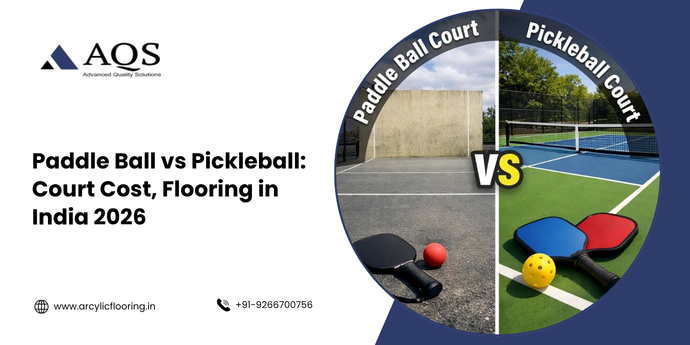
India’s sports ecosystem is witnessing a seismic shift in 2026. Two racket sports – paddle ball and pickleball – are grabbing attention across urban fitness clubs, residential societies, and school sports programs. While both use paddles and balls, they are fundamentally different in origin, rules, court design, flooring material, and competitive landscape. Understanding the contrast between paddle ball vs pickleball is essential for sports facility managers, players, and investors who want to build the right infrastructure.
In India, pickleball has already established a formal federation – the Pickleball Federation of India (PFI) – and hosts national-level tournaments in cities like Delhi, Mumbai, Hyderabad, and Bengaluru. Paddle ball, on the other hand, remains a recreational activity with no standardized courts or governing body in the country. As sports infrastructure investment surges in tier-1 and tier-2 Indian cities, facility owners increasingly ask: should we build a paddle ball court or a pickleball court?
This guide gives you a data-driven, deep-dive comparison to answer exactly that question. We cover everything – from equipment and rules to pickleball court flooring, pickleball court material, and pickleball court installation cost in India – so you can make the smartest decision for your sports investment.
Table of contents
- What Is Paddle Ball? Origin, Rules & India Status 2026
- Paddle Ball vs Pickleball – Complete Information Table (India 2026)
- What Is Pickleball? Origin, Rules & India 2026 Growth
- Paddle Ball vs Pickleball: Key Differences Explained
- Pickleball Court Flooring: Types, Materials & India 2026 Pricing
- Pickleball Court Installation Cost in India 2026 – Flooring Type Comparison
- Pickleball Court Installation Cost in India 2026: Complete Breakdown
- Paddle Ball vs Pickleball – Detailed Comparison Table (India 2026)
- Real-World Case Study: Paddle Ball Court Converted to Pickleball Court in Delhi
- Deep Dive: Pickleball Court Flooring, Material & Installation in India
- Quick Decision Guide: Should You Choose Paddle Ball or Pickleball?
- Health Benefits: Paddle Ball vs Pickleball – What Science Says
- Pickleball Growth in India 2026: Data, Statistics & Market Trends
- Maintenance of Pickleball Court Flooring vs Paddle Ball Court: India Guide
- Frequently Asked Questions (FAQs)
- Conclusion
What Is Paddle Ball? Origin, Rules & India Status 2026
History and Origin of Paddle Ball
Paddle ball originated in the United States in the 1930s and gained popularity as an indoor racquet sport played against a wall. The game requires a solid wooden or composite paddle and a rubber ball. Players rally the ball against a wall in a confined space, earning points based on keeping the rally going or winning against a walled boundary. The sport is closely related to racquetball, squash, and paddleball variants played across different countries.
Paddle ball requires minimal infrastructure and can be played solo or in pairs. The compact court size – typically 20×34 feet with walls on multiple sides – makes it a popular choice for urban gyms and schools with limited outdoor space. The simplicity of the sport makes it accessible for beginners, but competitive paddle ball demands exceptional reflexes, stamina, and spatial awareness.
Paddle Ball Rules and Gameplay
Players use a solid paddle to hit a pressurized rubber ball against the front wall. The ball must bounce off the front wall and can touch side walls before the opponent returns it. Points are scored when the opponent fails to return the ball before the second bounce. In India, most paddle ball games follow informal rules without a standardized scoring system, which explains why competitive adoption remains low.
The sport develops outstanding hand-eye coordination and cardiovascular endurance. However, without formal coaching programs or national tournaments in India, paddle ball has not gained the mainstream momentum that pickleball enjoys in 2026. Most paddle ball facilities in India exist within squash clubs or multi-sport complexes, often sharing infrastructure with squash or racquetball courts.
Calculate Your Sports Court Dimensions!
Contact us for Quickly measure and calculate accurate sports court dimensions with this easy-to-use tool!
Paddle Ball Court Design in India
A standard paddle ball court measures approximately 20 feet wide by 34 feet long with a ceiling height of at least 20 feet. The walls form a critical part of the playing surface, and they must be smooth, durable, and capable of withstanding repeated ball impact. In India, most existing paddle ball courts use concrete or painted plaster walls. The floor surface is typically hardwood, epoxy-coated concrete, or rubber tiles – all affordable options that keep the overall court construction cost between ₹1 lakh and ₹3 lakh.
Paddle Ball vs Pickleball – Complete Information Table (India 2026)
| Feature | Paddle Ball | Pickleball | India Status 2026 |
| Players | 2 (singles) | 2 or 4 | Pickleball dominant |
| Ball Type | Solid rubber | Perforated plastic | Imported & local |
| Court Size | ~20×34 ft | 20×44 ft | Standard courts growing |
| Net Height | No net (wall) | 34″ center | PFI regulated |
| Governing Body | None in India | PFI (India) | PFI active |
| Popularity | Recreational | Competitive | Pickleball surging |
| Court Cost (₹) | 1–3 lakh | 3.5–12 lakh | Varies by city |
| Flooring | Concrete/Wood | Acrylic/PU/Rubber | Acrylic preferred |
| Age Group | All ages | All ages | 30–60 yr fastest growth |
What Is Pickleball? Origin, Rules & India 2026 Growth
History and Origin of Pickleball
Pickleball was invented in 1965 in Bainbridge Island, Washington, USA, by Joel Pritchard, Bill Bell, and Barney McCallum. The founders created the game using ping-pong paddles, a perforated plastic ball, and a badminton net to keep their children entertained. The sport quickly evolved into a structured competitive activity with official rules, governing bodies, and international tournaments. Today, the USA Pickleball Association (USAPA) and the International Federation of Pickleball (IFP) regulate the sport globally.
In India, pickleball arrived in the early 2010s and witnessed explosive growth after 2020. The Pickleball Federation of India (PFI), affiliated with the Sports Authority of India (SAI), now registers players, sanctions tournaments, and promotes court construction across the country. By 2026, India has over 15,000 registered pickleball players and more than 800 dedicated courts – a 320% increase from 2021. The sport appeals strongly to the 35–65 age group because it offers full-body exercise with low impact on joints.
Pickleball Rules and Gameplay
Pickleball uses a 20×44 foot court – identical in size to a badminton doubles court. The net stands 36 inches at the sidelines and 34 inches at the center. Players use solid composite or graphite paddles and a lightweight perforated plastic ball. The scoring system is rally-scoring or side-out scoring, with games typically played to 11 points. The non-volley zone – called the kitchen – is the 7-foot area on both sides of the net where players cannot volley the ball.
The game blends the strategy of tennis, the quick reflexes of ping-pong, and the court dynamics of badminton. It is easier to learn than tennis but offers enough depth for elite competitive play. Pickleball accommodates both singles and doubles formats, making it socially versatile. In India 2026, corporate wellness programs, senior citizen fitness centers, and residential societies are actively installing pickleball courts as a premier recreational and competitive sport offering.
Why Pickleball Is Booming in India in 2026
Several factors explain pickleball’s explosive rise in India. First, the sport is physically accessible – older adults, rehabilitation patients, and beginners can play without intensive training. Second, a pickleball court fits within the footprint of a badminton court, making conversion affordable for existing clubs. Third, the global pickleball market – valued at $1.3 billion in 2024 – brings brand investment, equipment availability, and international player exposure to India. Fourth, the PFI’s active media campaigns and celebrity endorsements have elevated the sport’s mainstream visibility.
Also Read: Pickleball Court Cost India 2026 | Construction, Flooring & ROI Guide
Paddle Ball vs Pickleball: Key Differences Explained
Equipment Differences
The equipment in paddle ball and pickleball differs significantly in design, weight, and price. Paddle ball uses a solid wood or composite paddle, typically 15–16 inches long, and a pressurized rubber ball. The setup costs between ₹800 and ₹3,500 in India. Pickleball equipment includes a solid composite or graphite paddle (typically 15–17 inches) and a lightweight plastic Wiffle-style ball. A quality pickleball paddle in India costs ₹2,500 to ₹15,000, with balls ranging from ₹150 to ₹600 per piece. Dedicated outdoor and indoor pickleball balls have different hole patterns to optimize performance on each surface type.
Court Size and Design Differences
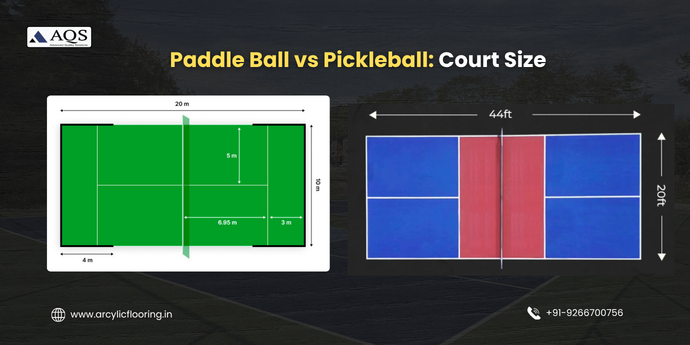
Court dimensions fundamentally separate the two sports. A paddle ball court measures 20 feet wide by 34 feet long with sealed walls forming part of the gameplay boundary. A pickleball court measures 20 feet wide by 44 feet long – 10 feet longer – with a 36-inch net and clear sideline and baseline markings. Pickleball courts require precise line markings for the kitchen, service boxes, and baseline, while paddle ball courts primarily need wall markings. This structural difference directly influences pickleball court material choice and installation complexity.
Playing Surface and Flooring Requirements
Paddle ball floors need to be hard, smooth, and non-slip to allow consistent ball bounce off the playing surface and walls. Epoxy concrete and hardwood are the most common choices. Pickleball court flooring demands higher specifications because the sport involves fast lateral movements, quick direction changes, and volleys that put stress on players’ knees and ankles. Quality pickleball court flooring must provide cushioning, UV resistance, anti-slip texture, and consistent ball bounce characteristics. This is why dedicated pickleball court material solutions – acrylic, polyurethane, and rubber – have emerged as industry standards in India.
Transform Your Sports Facility Today!
Contact us for high-quality synthetic sports flooring material and elevate your space!
Pickleball Court Flooring: Types, Materials & India 2026 Pricing
Pickleball court flooring is the most critical investment decision for any facility building a dedicated court. The flooring directly affects player safety, ball behavior, court longevity, and overall playing experience. In India 2026, three main categories of pickleball court flooring dominate the market: acrylic surfaces, polyurethane systems, and rubber/synthetic surfaces. Each offers a distinct combination of performance, durability, and pickleball court installation cost.
Acrylic Pickleball Court Flooring
An Acrylic pickleball court flooring is the most popular choice for Indian facilities in 2026, accounting for approximately 65% of all new court installations. Synthetic Acrylic systems use a latex-based acrylic coating applied over a prepared concrete or asphalt base. Standard acrylic systems use 2-4 coats of acrylic resurfacer followed by 2–3 coats of colored acrylic paint with sand or silica additives for grip. Cushioned acrylic systems add a rubberized cushion layer beneath the top coat, significantly reducing player fatigue and joint impact.
Acrylic pickleball court material costs between ₹45 and ₹120 per square foot in India, depending on the number of coats and cushion layer specifications. A full standard pickleball court (880 sq ft playing area + run-off zones ≈ 1,200 sq ft) costs ₹3.5 lakh to ₹9 lakh for acrylic installation including surface prep, color coating, and line marking. Leading acrylic pickleball court suppliers in India include AcrylicFlooring.in, SportTech, and Laykold-India partners.
Polyurethane (PU) Pickleball Court Material
Polyurethane pickleball court material represents the premium tier of court flooring in India. PU systems use a two-component polyurethane base layer topped with a UV-stable polyurethane or acrylic wear layer. The result is a seamless, highly elastic surface that provides excellent shock absorption, ball rebound consistency, and durability in Indian climatic conditions – including high humidity, UV exposure, and temperature swings between 5°C and 48°C.
PU pickleball court flooring costs ₹100 to ₹160 per square foot in India. Total pickleball court installation cost for a PU system ranges from ₹8 lakh to ₹12 lakh per court. PU systems are especially recommended for indoor courts in air-conditioned facilities and for professional tournament venues where surface consistency is paramount. The lifespan of a properly installed PU court in India reaches 12–20 years with minimal maintenance.
Rubber and Synthetic Pickleball Court Flooring
Rubber-based pickleball court flooring uses vulcanized rubber tiles or rolled rubber sheets bonded to a concrete base. This system offers excellent cushioning and is particularly popular for converting existing basketball or badminton courts into pickleball courts. Rubber flooring costs ₹60 to ₹100 per square foot in India and delivers mid-range durability (8–12 years). Synthetic sports turf with integrated drainage is another emerging option for outdoor pickleball courts in residential projects and resorts.
Pickleball Court Installation Cost in India 2026 – Flooring Type Comparison
| Flooring Type | Material Cost/sqft | Installation Cost (Full Court) | Lifespan |
| Acrylic (Standard) | ₹45 – ₹80 | ₹3.5 – ₹6 lakh | 8–12 years |
| Acrylic (Cushioned) | ₹80 – ₹120 | ₹6 – ₹9 lakh | 10–15 years |
| Polyurethane (PU) | ₹100 – ₹160 | ₹8 – ₹12 lakh | 12–20 years |
| Rubber/Synthetic | ₹60 – ₹100 | ₹5 – ₹8 lakh | 8–12 years |
| Concrete + Paint | ₹20 – ₹35 | ₹1 – ₹3 lakh | 5–8 years |
Pickleball Court Installation Cost in India 2026: Complete Breakdown
Factors Affecting Pickleball Court Installation Cost
Pickleball court installation cost in India varies significantly based on six primary factors: (1) geographic location – metro cities like Mumbai and Delhi command 20–35% higher labor rates than tier-2 cities; (2) flooring material type – acrylic vs PU vs rubber; (3) base condition – a new concrete base costs ₹60,000–₹1,20,000 more than resurfacing an existing smooth surface; (4) indoor vs outdoor – indoor courts require additional ventilation and lighting infrastructure; (5) number of courts – multi-court projects enjoy 15–25% material cost discounts; (6) accessories – net posts, nets, perimeter fencing, lighting, and seating all add to total project cost.
Average Pickleball Court Installation Cost by City in India
In Delhi NCR, a standard acrylic outdoor pickleball court installation costs ₹4.5–₹7 lakh in 2026. In Mumbai, land cost pressure drives total project costs to ₹6–₹10 lakh. Bengaluru and Hyderabad fall in the ₹4–₹8 lakh range. Tier-2 cities like Jaipur, Lucknow, Pune, and Chandigarh offer the best value, with full court installations possible between ₹3.5 and ₹6 lakh using quality acrylic pickleball court material. Multi-court outdoor complexes of 4–8 courts with perimeter fencing and floodlighting typically range from ₹20 lakh to ₹55 lakh depending on city and specifications.
Hidden Costs in Pickleball Court Installation
Facility developers often overlook several cost components when budgeting for pickleball court installation. Drainage planning adds ₹25,000–₹60,000 for outdoor courts. Perimeter fencing (chain-link or welded mesh, 10 ft height) costs ₹1.2 to ₹2.5 lakh per court. LED sports lighting for evening play adds ₹80,000–₹1.8 lakh. Court signage, player benches, and equipment storage add another ₹30,000–₹60,000. Obtaining municipal approvals and structural certifications in metro cities can cost ₹25,000–₹80,000 in professional fees. Budgeting for these elements ensures no unpleasant financial surprises during construction.
Paddle Ball vs Pickleball – Detailed Comparison Table (India 2026)
| Category | Paddle Ball | Pickleball |
| Origin | USA (1930s) | USA (1965) |
| Equipment Cost | ₹800 – ₹3,500 | ₹2,500 – ₹15,000 |
| Court Material | Concrete/Asphalt | Acrylic / PU / Rubber |
| Court Installation (India) | ₹1–3 lakh | ₹3.5–12 lakh |
| Indoor/Outdoor | Mostly Indoor | Both Indoor & Outdoor |
| Skill Level Required | Low to Medium | Low to High |
| Tournament Scene India | Absent | National + State Level |
| Health Benefits | Cardio + Reflex | Full Body + Mental |
| Learning Curve | Easy | Moderate |
| Best For | Casual play | Competitive & fitness |
Real-World Case Study: Paddle Ball Court Converted to Pickleball Court in Delhi
| CASE STUDY: Delhi Sports Club Converts Paddle Ball Court to Pickleball Court (2025) Location: Vasant Kunj Sports Complex, New Delhi Challenge: An ageing paddle ball court with low usage (15–20 players/week) was costing the club ₹80,000/year in maintenance with minimal returns. Decision: The club committee evaluated the growing pickleball scene in Delhi NCR and decided to invest in converting the existing 1,200 sq ft concrete floor into two pickleball courts using cushioned acrylic pickleball court flooring with PU base coating. Pickleball Court Installation Cost Breakdown: • Surface preparation & leveling: ₹55,000 • Acrylic pickleball court material (2 coats): ₹1,20,000 • Net posts + nets: ₹32,000 • Court line marking: ₹18,000 • Lighting upgrades: ₹45,000 • Total Investment: ₹2,70,000 Result (6 months post-conversion): Court usage jumped to 120+ players/week. Monthly revenue from court bookings increased from ₹12,000 to ₹68,000. The investment paid back in under 5 months. Member satisfaction scores improved by 38%. The club now plans to add two more courts with polyurethane pickleball court material in Phase 2. Key Lesson: Transitioning from paddle ball to pickleball infrastructure brings measurable ROI in India’s growing sports ecosystem. Quality pickleball court flooring is the single biggest factor driving player satisfaction and repeat bookings. |
Deep Dive: Pickleball Court Flooring, Material & Installation in India
Pickleball Court Flooring India – What Players & Facility Owners Need to Know
Pickleball court flooring is not just about aesthetics – it directly determines player performance, injury risk, and long-term maintenance costs. In India’s diverse climate, the flooring must withstand both intense summer heat (up to 50°C surface temperature) and monsoon humidity. The best pickleball court flooring in India combines an acrylic or polyurethane top layer with sufficient shock absorption, UV stability, and anti-skid surface texture. Many Indian facilities now specify IFP-approved acrylic systems that meet international pickleball court surface standards for both recreational and tournament play.
Pickleball Court Material Selection Guide for Indian Conditions
Choosing the right pickleball court material in India requires evaluating your location, budget, and use case. Outdoor courts in hot, humid regions like Chennai or Kolkata benefit from UV-stable acrylic systems with anti-fungal additives. Indoor courts in climate-controlled gyms in Delhi, Pune, or Bengaluru can use premium PU systems for maximum performance. Schools and residential societies on a budget can start with basic acrylic systems at ₹3.5–₹5 lakh and upgrade to cushioned acrylic or PU in later phases. Always work with ITTF or IFP-approved material suppliers to ensure surface performance consistency and warranty coverage.
Pickleball Court Installation Cost vs Long-Term Value
While the upfront pickleball court installation cost appears significant – ranging from ₹3.5 lakh to ₹12 lakh – the return on investment is compelling in India’s 2026 sports economy. A well-marketed public pickleball court in an urban location charges ₹300–₹800 per hour per court for bookings. With 8–12 hours of daily usage, a single court generates ₹2.5–₹9.6 lakh per year. At these rates, the investment recovers in 6–18 months. Premium PU courts command higher booking rates and attract corporate events, coaching academies, and league partnerships that further accelerate ROI.
Difference Between Outdoor and Indoor Pickleball Court Material
Outdoor pickleball court material must prioritize UV resistance, weather sealing, drainage slope, and anti-slip performance in wet conditions. Acrylic systems with silica sand texture are the standard outdoor choice. Indoor pickleball court material, on the other hand, prioritizes surface consistency, cushioning, and visual clarity for line markings under artificial lighting. Indoor courts often use cushioned acrylic or polyurethane systems without the silica sand aggregate. Knowing this distinction helps facility managers specify the correct product and avoid premature surface degradation.
Quick Decision Guide: Should You Choose Paddle Ball or Pickleball?
Making the right sport infrastructure decision in 2026 depends on your facility’s goals, budget, target audience, and market positioning. Use the decision matrix below to identify which sport aligns with your objectives.
| Choose PICKLEBALL if… You want competitive sport in India You seek organized tournaments & rankings You’re aged 40+ looking for low-impact fitness You want to invest in a court (₹3.5–12 lakh) You want a sport growing globally & in India | Choose PADDLE BALL if… You want casual, no-rules recreation You have a walled court or wall space You prefer solo play or 1v1 games Budget is a concern (₹1–3 lakh court cost) You are exploring recreational wall sports |
The data is clear
If you are building a sports facility in India in 2026, pickleball delivers dramatically superior ROI, community engagement, and future-proof market positioning compared to paddle ball. Paddle ball works best as an add-on recreational option for existing squash or racquetball facilities. Standalone paddle ball investment in India’s current sports market carries significant utilization risk.
Health Benefits: Paddle Ball vs Pickleball – What Science Says
Both paddle ball and pickleball deliver significant health benefits, but their physiological impact profiles differ. Paddle ball demands explosive bursts of speed, rapid directional changes, and wall-reading cognition that elevate heart rate to 75–85% of maximum, delivering excellent cardiovascular conditioning. A 45-minute paddle ball session burns approximately 400–600 calories, making it an efficient weight-management activity. The sport strengthens core muscles, improves reflexes, and builds ankle and knee stability through repeated dynamic movement patterns.
Pickleball studies published in the Journal of Aging & Physical Activity (2023) found that senior players who engaged in pickleball 3 times weekly experienced significant improvements in cardiovascular health, balance, and cognitive function within 8 weeks. The sport burns 350–500 calories per hour – comparable to paddle ball – while generating lower joint stress due to smaller court dimensions and slower ball speeds. This makes pickleball particularly valuable for India’s rapidly aging urban population, where joint health and fall prevention are critical wellness priorities by 2026.
Pickleball Growth in India 2026: Data, Statistics & Market Trends
India’s pickleball market is one of the fastest-growing in Asia. In 2022, India had approximately 200 registered pickleball courts. By June 2026, that number exceeds 800 courts – a 4x increase in four years. The Pickleball Federation of India conducts over 50 state and national tournaments annually, with prize pools reaching ₹5 lakh for major events. Corporate sponsorship from brands like Yonex, Head, and Selkirk has accelerated equipment availability and pricing competitiveness in Indian retail.
Tier-2 cities are driving the next wave of pickleball expansion in India. Cities like Jaipur, Indore, Kochi, Coimbatore, and Vadodara have seen double-digit percentage growth in court installations between 2024 and 2026. Residential townships and club facilities account for 68% of new court installations, followed by educational institutions (18%) and municipal sports facilities (14%). Sports infrastructure companies specializing in pickleball court flooring report a 40–60% year-on-year increase in project inquiries from across India.
The Indian government’s Khelo India initiative has also played a role in pickleball’s rise, funding court construction in 12 states through its Urban Sports Infrastructure Development scheme. This government support, combined with private investment and PFI’s promotional activities, positions India to become one of the top 10 global pickleball markets by 2028.
Maintenance of Pickleball Court Flooring vs Paddle Ball Court: India Guide
Pickleball Court Flooring Maintenance Best Practices
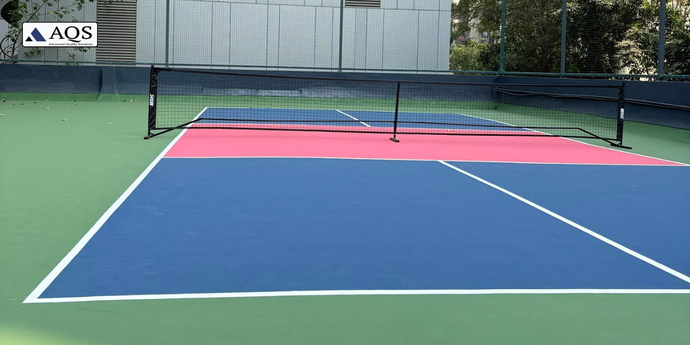
Proper maintenance significantly extends pickleball court flooring lifespan and protects your investment. Acrylic pickleball court surfaces require cleaning with pH-neutral detergents and a soft-bristle brush weekly to remove dust, bird droppings, and algae – especially in humid coastal cities. Inspect the surface biannually for cracks, delamination, or worn color layers. Minor cracks should be repaired within 30 days to prevent water infiltration, which rapidly accelerates surface failure in Indian monsoon conditions. Full resurfacing with a fresh acrylic pickleball court material coat is recommended every 4–7 years depending on court usage intensity.
Paddle Ball Court Maintenance in India
Paddle ball court walls and floors require periodic inspection for surface cracks and plaster damage – essential because wall damage affects ball bounce consistency. Hardwood paddle ball floors need refinishing every 3–5 years using polyurethane varnish. Epoxy-coated concrete floors in paddle ball courts should be inspected annually for coating delamination and chemical discoloration. Annual maintenance costs for a paddle ball court in India range from ₹15,000 to ₹40,000 – substantially lower than pickleball court maintenance (₹25,000–₹70,000 annually) due to simpler surface specifications.
Transform Your Sports Facility Today!
Contact us for high-quality synthetic sports flooring material and elevate your space!
Frequently Asked Questions (FAQs)
Paddle ball is a wall-based sport using a rubber ball in an enclosed court, while pickleball uses a net, perforated plastic ball, and standardized 20×44 ft court with formal international rules and governing bodies.
Pickleball court installation cost in India ranges from ₹3.5 lakh (basic acrylic outdoor court) to ₹12 lakh (premium polyurethane indoor court) depending on material, location, and court specifications.
UV-stable cushioned acrylic flooring is the best pickleball court flooring for most Indian outdoor conditions, while polyurethane systems are preferred for premium indoor courts due to superior durability and surface consistency.
Yes, most paddle ball concrete floors can be converted to pickleball courts by resurfacing with acrylic pickleball court material, installing a net, and adding proper line markings – typically costing ₹1.5 to ₹3.5 lakh for conversion.
Pickleball is far more popular in India in 2026, with over 15,000 registered players, 800+ courts, and a national governing body (PFI), while paddle ball remains a niche recreational activity with no formal competitive structure.
Standard 2-coat acrylic pickleball court material on a prepared concrete base is ideal for residential societies – it balances quality, durability, and affordability at a total installation cost of ₹3.5–₹6 lakh per court.
Conclusion
After a thorough comparison across equipment, court design, flooring requirements, installation costs, market growth, health benefits, and ROI potential, the conclusion is unambiguous: pickleball is the superior sport investment for India in 2026. Paddle ball remains a fun recreational option for facilities with existing walled courts, but it lacks the competitive infrastructure, community ecosystem, and commercial viability that pickleball offers.
For facility developers, sports club owners, residential societies, and corporate wellness managers, building a pickleball court with quality acrylic or polyurethane pickleball court flooring delivers measurable returns – both in player satisfaction and financial performance. Pickleball court installation cost in India is an investment, not an expense, when viewed through the lens of long-term usage revenue and asset value creation.
Whether you are a seasoned squash club owner exploring new revenue streams, a residential developer adding lifestyle amenities, or an individual player choosing your next sport – pickleball offers the best combination of accessibility, competition, community, and fitness in India’s 2026 sports landscape. Choose pickleball. Build right. Play long.