
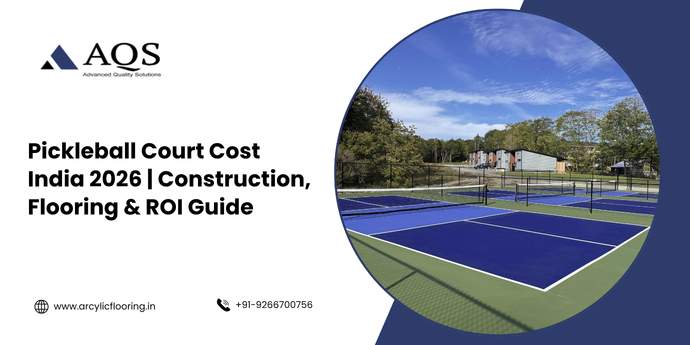
Pickleball is the fastest-growing racquet sport in India right now. From housing societies in Mumbai to school campuses in Chennai, everyone wants a dedicated pickleball court. But before you break ground, you need one critical piece of information – the pickleball court cost. Understanding the complete investment helps you plan smarter, avoid contractor traps, and build a high-performance court that lasts decades.
India reported over 50,000 active pickleball players as of 2025, with more than 500 courts already built across various states. That number is growing rapidly. Schools, private clubs, fitness centres, corporate campuses, and township developers are all commissioning new courts. Whether you plan to build a single recreational court or a multi-court commercial facility, this guide covers every cost component in Indian Rupees (₹) with complete transparency.
At Advanced Quality Solutions (AQS), we are delivering world-class, durable, and high-performance sports flooring solutions for outdoor sports. With 14+ years of expertise and a passion for sports infrastructure, we’ve become a trusted name for high-performance courts across India. And hundreds of successfully delivered projects across India, AQS has established itself as the go-to partner for housing societies, schools, sports academies, corporate campuses, and government institutions that demand quality, durability, and performance from every court they build.
Table of contents
- What Is Pickleball?
- Pickleball Court Dimensions and Specifications
- Standard Court Dimensions
- Pickleball Court Cost in India: Complete Price Breakdown (2026)
- Pickleball court construction cost Breakdown
- Types of Pickleball Court Surfaces and Their Costs in India
- Pickleball court cost per square foot
- Factors That Affect Pickleball Court Cost in India
- Pickleball court flooring cost India
- Converting a Tennis Court to a Pickleball Court: Cost and Method
- Pickleball Court Maintenance Cost in India
- Return on Investment: Can a Pickleball Court Be Profitable in India?
- Pickleball Court Cost for Schools and Institutions in India
- Pickleball Court Construction Process in India
- Common Mistakes to Avoid When Building a Pickleball Court
- Case Study on Gwalior Court
- Frequently Asked Questions (FAQs)
What Is Pickleball?
Pickleball is a paddle sport that combines elements of tennis, badminton, and table tennis. Players use solid paddles to hit a lightweight, perforated plastic ball over a low net on a compact rectangular court. The game suits all age groups and fitness levels, making it incredibly popular in residential societies, retirement communities, and corporate wellness programmes.
Pickleball was introduced in India in 2006 by sports enthusiast Sunil Valavalkar, who immediately recognised its potential as an accessible and engaging sport. In the years since, it has transformed from a niche activity into a mainstream competitive sport. Indian players now participate in global tournaments, and the sport receives recognition from official sports bodies at state and national levels.
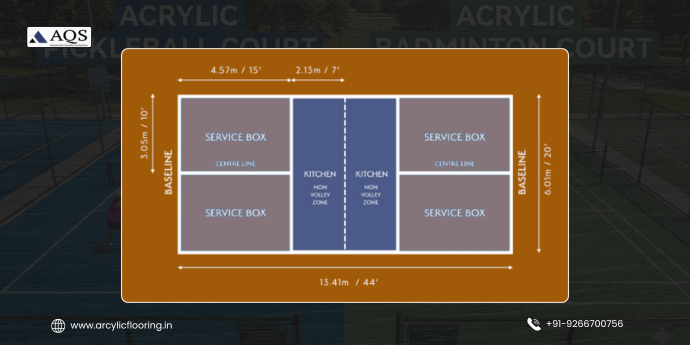
The court measures just 20 feet by 44 feet – the same footprint as a Badminton Court – making it highly space-efficient for Indian urban environments. You can even fit four pickleball courts inside a single standard tennis court. This space efficiency, combined with low equipment costs, makes pickleball an attractive investment for sports facility owners who want maximum utilisation from limited square footage.
Pickleball Court Dimensions and Specifications
Before you calculate the pickleball court cost, you must understand the official dimensions and layout requirements. Getting the dimensions right ensures a legally compliant court, smooth gameplay, and no expensive rework later.
Standard Court Dimensions
The International Pickleball Federation (IPF) mandates a playing area of 20 feet (6.1 m) wide and 44 feet (13.4 m) long for both singles and doubles play. The net stands 34 inches (86 cm) at the centre and 36 inches (91 cm) at the sideline posts. The non-volley zone – popularly known as the ‘kitchen’ – extends 7 feet (2.1 m) from the net on both sides and is one of the most distinctive features of pickleball.
| Dimension Parameter | Measurement (Feet) | Measurement (Metres) |
|---|---|---|
| Playing Court Width | 20 ft | 6.1 m |
| Playing Court Length | 44 ft | 13.4 m |
| Total Area with Run-Off (Recommended) | 30 ft × 60 ft | 9.1 m × 18.3 m |
| Total Surface Area (with Run-Off) | 1,800 sq ft | 167 sq m |
| Non-Volley Zone (Kitchen) Depth | 7 ft | 2.1 m |
| Net Height at Centre | 34 inches | 0.86 m |
| Net Height at Posts | 36 inches | 0.91 m |
| Minimum Fence Height | 10 ft | 3.0 m |
The total recommended footprint – including run-off buffer zones on all sides – is approximately 30 feet by 60 feet, which equals 1,800 square feet (around 167 square metres). This is the benchmark area used by most professional contractors in India when calculating surface costs and material quantities. Ensure you account for this total area, not just the playing surface, when budgeting your project.
Also Read: Pickleball Court Dimensions: Official Size, Layout & Measurements Guide
Calculate Your Sports Court Dimensions!
Contact us for Quickly measure and calculate accurate sports court dimensions with this easy-to-use tool!
Pickleball Court Cost in India: Complete Price Breakdown (2026)
The pickleball court cost in India varies significantly depending on surface type, location, add-ons, and contractor quality. A basic concrete court with acrylic surface starts from ₹5 lakh, while a premium indoor facility with full amenities can reach ₹25 lakh or more. Below is a detailed component-wise cost breakdown to help you plan your Bill of Quantities (BOQ) accurately.
Overall Cost Summary Table
| Court Type | Estimated Cost Range (₹) | Best Suited For |
|---|---|---|
| Basic Outdoor Concrete + Acrylic | ₹5,00,000 – ₹8,00,000 | Schools, Housing Societies |
| Mid-Range Outdoor with Fencing & Lighting | ₹8,00,000 – ₹12,00,000 | Clubs, Sports Academies |
| Premium Outdoor with Full Amenities | ₹12,00,000 – ₹18,00,000 | Commercial Facilities |
| Indoor Pickleball Court (Basic) | ₹15,00,000 – ₹22,00,000 | Corporate, Premium Clubs |
| Indoor Pickleball Court (Premium) | ₹22,00,000 – ₹35,00,000 | Tournament Venues |
| DIY / Modular Tile Court (Basic) | ₹3,00,000 – ₹5,00,000 | Residential, Rooftops |
Pickleball court construction cost Breakdown
| Cost Component | Estimated Cost (₹) | Notes |
|---|---|---|
| Site Survey & Soil Testing | ₹10,000 – ₹30,000 | Essential for sloped or rooftop sites |
| Site Clearing & Levelling | ₹30,000 – ₹80,000 | Higher for uneven terrain |
| Base Preparation (Concrete/Asphalt) | ₹2,00,000 – ₹4,00,000 | RCC concrete is recommended |
| Acrylic Surface Coating (2-4 layers) | ₹1,50,000 – ₹2,50,000 | UV-resistant, IPF-compliant |
| Line Marking & Painting | ₹30,000 – ₹50,000 | Weather-resistant paint |
| Net System (Posts + Net) | ₹20,000 – ₹60,000 | Fixed or portable options |
| Chain-Link Fencing (10 ft height) | ₹80,000 – ₹1,50,000 | All four sides, standard spec |
| LED Floodlighting (4-6 poles) | ₹1,00,000 – ₹2,50,000 | For evening play |
| Drainage System | ₹20,000 – ₹50,000 | Critical for outdoor courts |
| Gate & Entry Hardware | ₹15,000 – ₹30,000 | Lockable gate recommended |
| Seating / Spectator Benches | ₹20,000 – ₹50,000 | Optional but adds value |
| Contractor Labour Charges | ₹50,000 – ₹1,50,000 | Varies by city and scope |
| Permits & Local Approvals | ₹10,000 – ₹50,000 | Varies by municipality |
These are approximate ranges for 2025. Costs in metro cities like Mumbai, Delhi, and Bengaluru tend to run 15-25% higher than in tier-2 cities. Always get a detailed BOQ from at least three vendors before finalising your contractor. Never accept a lump-sum quote without a line-item breakdown.
Types of Pickleball Court Surfaces and Their Costs in India
The surface type is the single biggest cost driver in any pickleball court project. It determines not just your initial investment but also your long-term maintenance expenses, player safety, and court longevity. You have four primary surface options available in India, each with distinct advantages and price points.
1. Concrete Base with Acrylic Coating (Most Recommended)
This is the gold standard for outdoor pickleball courts in India. Contractors pour a reinforced cement concrete (RCC) base, allow it to cure, then apply multiple coats of acrylic surface paint. The acrylic coating provides excellent ball bounce consistency, UV resistance, anti-slip texture, and a vibrant colour finish. Acrylic surfaces also withstand India’s harsh monsoon conditions and intense summer heat better than most alternatives.
2. Asphalt Base with Acrylic Topping
Asphalt is a faster and cheaper base option compared to concrete. Contractors lay a hot-mix asphalt base and then apply the same acrylic coating system on top. While the initial cost is marginally lower, asphalt is more prone to cracking in extreme heat and may require resurfacing sooner than concrete. It works well in moderate climates but demands careful drainage planning in high-rainfall regions like coastal India.
3. Modular Interlocking Tiles (Polypropylene)
Modular tiles made from high-impact polypropylene interlock directly without requiring a concrete base if an existing flat surface is available. They suit rooftop courts, indoor halls, and temporary setups beautifully. Installation is fast (1-2 days), and tiles are removable and reusable. However, modular tiles cost more per square foot than poured surfaces, and some players find the bounce slightly different from acrylic.
4. Wooden/Synthetic Wooden Flooring (Indoor Only)
Indoor pickleball courts in multi-sport halls sometimes use wooden or synthetic wooden flooring similar to indoor badminton courts. This option is the most expensive and is typically reserved for premium clubs and institutional facilities with controlled-environment halls. Wooden flooring absorbs shock well and provides excellent traction but requires regular maintenance and does not suit outdoor applications.
Pickleball court cost per square foot
| Surface Type | Cost per sq ft (₹) | Total Surface Cost (1,800 sq ft) | Durability | Recommended For |
|---|---|---|---|---|
| Concrete + Acrylic | ₹120 – ₹180 | ₹2,16,000 – ₹3,24,000 | 10-15 years | Outdoor, All Climates |
| Asphalt + Acrylic | ₹100 – ₹150 | ₹1,80,000 – ₹2,70,000 | 7-12 years | Moderate Climate Zones |
| Modular PP Tiles | ₹220 – ₹380 | ₹3,96,000 – ₹6,84,000 | 8-12 years | Rooftop, Indoor, Temporary |
| Wooden / Synthetic Wood | ₹350 – ₹600 | ₹6,30,000 – ₹10,80,000 | 12-20 years | Premium Indoor Only |
Factors That Affect Pickleball Court Cost in India
Many variables influence the final cost of your pickleball court project. Understanding these factors helps you make smarter decisions during the planning phase and avoid expensive surprises during construction.
Geographic Location
Urban areas, especially tier-1 cities like Mumbai, Delhi NCR, Bengaluru, Hyderabad, and Pune, have significantly higher construction costs because of elevated labour rates, expensive raw material delivery, and stricter municipal building codes. A court that costs ₹8 lakh in Coimbatore might cost ₹10-11 lakh in Bengaluru. Rooftop installations in metro cities also require structural engineering assessments, which add to the total cost.
Indoor vs. Outdoor Construction
Outdoor courts are the most cost-effective option. They need minimal structural work beyond a solid base and surface coating. Indoor courts, however, require roofing, climate consideration, specialised flooring, and integrated lighting systems from day one. The cost difference between a basic outdoor court (₹5-8 lakh) and a basic indoor court (₹15-22 lakh) is substantial and reflects the added civil and mechanical infrastructure.
Site Conditions
A flat, well-drained site with easy access to utilities costs the least to prepare. Sloping land requires grading and filling work, which adds ₹50,000 to ₹2 lakh depending on the degree of slope and area size. Rocky terrain, waterlogged sites, or rooftop locations with load-bearing limitations each add unique engineering challenges and corresponding cost increases that you must account for during site evaluation.
Additional Amenities
Lighting, fencing, seating, score-boards, ball-return systems, and player rest areas all add to the base construction cost. LED floodlighting alone adds ₹1 lakh to ₹2.5 lakh but dramatically increases court utilisation hours. Fencing adds another ₹80,000 to ₹1.5 lakh. While these feel like optional extras, they are essential for any commercial or club-level facility that wants to generate sustainable revenue.
Contractor Quality and Warranty
Experienced, certified contractors charge more but deliver consistent quality, use IPF-compliant materials, and provide written warranties. Cheap contractors cut corners on base preparation and acrylic coating thickness, leading to premature cracking, peeling, and poor ball bounce. A court built by an experienced contractor with a 5-year warranty often costs ₹1-2 lakh more but saves ₹3-5 lakh in premature repair expenses over its lifetime.
Pickleball court flooring cost India
Construction costs vary significantly across Indian cities due to differences in labour rates, material availability, and municipal regulations. The table below provides city-wise estimated cost ranges for a standard outdoor pickleball court with fencing and basic lighting, based on market data from 2024-2025.
| City / Region | Estimated Cost Range (₹) | Key Cost Driver |
|---|---|---|
| Mumbai & MMR | ₹10,00,000 – ₹18,00,000 | High labour & material cost |
| Delhi NCR (Gurugram, Noida) | ₹9,00,000 – ₹16,00,000 | Premium land & contractor fees |
| Bengaluru | ₹8,50,000 – ₹15,00,000 | Growing demand, competitive market |
| Hyderabad | ₹7,50,000 – ₹13,00,000 | Rising sports infra investment |
| Pune | ₹7,00,000 – ₹12,00,000 | Active club scene, mid-range costs |
| Chennai | ₹7,00,000 – ₹12,00,000 | Coastal climate requires UV-resistant surface |
| Ahmedabad | ₹6,00,000 – ₹10,00,000 | Cost-effective labour market |
| Kochi | ₹7,00,000 – ₹12,00,000 | High humidity needs quality drainage |
| Tier-2 Cities (Jaipur, Indore, etc.) | ₹5,00,000 – ₹9,00,000 | Lower labour, limited contractors |
| Tier-3 & Rural Areas | ₹4,00,000 – ₹7,00,000 | Very low labour, material transport adds cost |
Converting a Tennis Court to a Pickleball Court: Cost and Method
One of the most cost-efficient strategies for adding pickleball infrastructure is converting an existing tennis court. A standard tennis court (78 ft × 36 ft) can accommodate four pickleball courts simultaneously when fitted with proper markings and portable nets. This approach delivers tremendous value for clubs and institutions that already own tennis court infrastructure.
Conversion Cost Breakdown
A temporary conversion using portable nets and court-marking tape costs as little as ₹30,000 to ₹70,000 for all four pickleball courts. A semi-permanent conversion with painted pickleball lines over existing tennis court markings costs ₹50,000 to ₹1,00,000. A full permanent resurfacing with dedicated pickleball markings and fixed nets costs ₹2,00,000 to ₹5,00,000, depending on the condition of the existing surface.
| Conversion Type | Estimated Cost (₹) | Duration | Best For |
|---|---|---|---|
| Temporary (Tape + Portable Nets) | ₹30,000 – ₹70,000 | 1-2 days | Trial Programmes, Events |
| Semi-Permanent (Painted Lines + Fixed Nets) | ₹50,000 – ₹1,00,000 | 2-3 days | Clubs, Academies |
| Full Resurfacing + Permanent Markings | ₹2,00,000 – ₹5,00,000 | 2-3 weeks | Commercial Facilities |
Converting an existing tennis court is always cheaper than building a new dedicated pickleball court. However, the orientation of the tennis court affects pickleball playability – the ideal court orientation runs north-south to minimise sun glare for players. Verify the existing court’s orientation and surface condition before committing to any conversion project.
Pickleball Court Maintenance Cost in India
Building the court is just the beginning. Ongoing maintenance ensures consistent play quality, player safety, and a longer surface lifespan. Skipping maintenance leads to cracks, fading lines, and surface degradation that ultimately forces expensive full resurfacing years before necessary. Budget for both routine and preventive maintenance from day one.
Annual Maintenance Cost Estimates
| Maintenance Activity | Frequency | Estimated Cost (₹ per year) |
|---|---|---|
| Surface Cleaning & Pressure Washing | Quarterly | ₹5,000 – ₹12,000 |
| Line Marking Repainting | Every 2-3 years | ₹15,000 – ₹30,000 (amortised: ₹5,000-₹10,000/yr) |
| Net Replacement | Every 3-5 years | ₹8,000 – ₹20,000 (amortised: ₹2,000-₹5,000/yr) |
| Acrylic Resurfacing (Top Coat) | Every 5-8 years | ₹60,000 – ₹1,20,000 (amortised: ₹8,000-₹20,000/yr) |
| Crack Repair (if needed) | As required | ₹5,000 – ₹30,000 per incident |
| Lighting Maintenance / Bulb Replacement | Annual | ₹3,000 – ₹10,000 |
| Fencing Repair | As required | ₹5,000 – ₹20,000 |
| Total Estimated Annual Maintenance | – | ₹30,000 – ₹80,000 |
Acrylic surfaces are relatively low-maintenance compared to wooden or modular tile surfaces. The biggest ongoing cost is periodic resurfacing, which rejuvenates the court and extends its life significantly. Courts that receive regular maintenance last 10-15 years before requiring a full base rebuild. Courts that are neglected may need costly structural repairs within just 4-6 years.
Transform Your Sports Facility Today!
Contact us for high-quality synthetic sports flooring material and elevate your space!
Return on Investment: Can a Pickleball Court Be Profitable in India?
A professionally constructed pickleball court is not just a sporting facility – it is a revenue-generating asset. With the right location, pricing model, and management, your court can deliver a strong return on investment within 3-5 years. Many facility owners in India have already demonstrated that pickleball courts generate higher revenue per square foot than most other sports courts due to short game duration and high throughput of players.
Revenue Models for Pickleball Courts
You can monetise a pickleball court through pay-per-play hourly bookings (₹300-₹800 per hour per court), monthly memberships (₹1,500-₹4,000 per player per month), coaching programmes and academy batches (₹3,000-₹8,000 per player per month), corporate wellness packages, weekend tournaments with entry fees, and sponsorship opportunities from sports equipment brands. Many successful operators combine two or three of these models to maximise occupancy.
Estimated ROI Calculation
| Revenue/Cost Parameter | Conservative Scenario (₹) | Optimistic Scenario (₹) |
|---|---|---|
| Total Court Construction Cost | ₹8,00,000 | ₹15,00,000 |
| Annual Hourly Booking Revenue | ₹1,80,000 | ₹4,80,000 |
| Annual Membership Revenue | ₹1,20,000 | ₹3,60,000 |
| Annual Coaching/Academy Revenue | ₹60,000 | ₹2,40,000 |
| Total Annual Revenue | ₹3,60,000 | ₹10,80,000 |
| Annual Operating Cost (maintenance + staff) | ₹80,000 | ₹1,80,000 |
| Net Annual Profit | ₹2,80,000 | ₹9,00,000 |
| Estimated Payback Period | ~2.9 years | ~1.7 years |
The pickleball court business model benefits from short game durations (typically 45-60 minutes per session), which allows high court turnover throughout the day. Peak hours (6-9 AM and 5-9 PM) consistently fill up in urban facilities. Residential society courts see especially rapid ROI because they eliminate the need for paid staff during resident-only access hours, slashing operating costs substantially.
Pickleball Court Cost for Schools and Institutions in India
Educational institutions represent one of the fastest-growing segments for pickleball court construction in India. Schools and colleges are integrating pickleball into their physical education curriculum because the sport develops agility, hand-eye coordination, teamwork, and strategic thinking. Government-aided schools and private institutions approach the budget differently, but both can find cost-effective solutions.
Budget Options for Educational Institutions
A basic outdoor pickleball court on existing school grounds – using the concrete surface of an idle basketball or badminton area – costs as little as ₹1,50,000 to ₹3,00,000 for repainting, line marking, and net installation. A fresh-build dedicated court for a school typically costs ₹5,00,000 to ₹8,00,000 for a single outdoor court with basic fencing. Institutions in rural areas often benefit from government sports infrastructure grants that subsidise up to 50% of construction costs.
Corporate Campus Pickleball Courts
Corporate campuses in Bengaluru, Hyderabad, Pune, and Gurugram have adopted pickleball as a preferred employee wellness activity. Companies typically invest ₹8,00,000 to ₹15,00,000 in a well-equipped outdoor court with lighting, seating, and branding elements. Some large campuses build multi-court facilities ranging from ₹25,00,000 to ₹60,00,000. The return comes in improved employee engagement, lower attrition, and brand positioning as a health-forward employer.
Pickleball Court Construction Process in India
Understanding the construction process helps you monitor quality, hold contractors accountable, and avoid common mistakes. A well-executed project follows a clear sequence from site selection to final handover. Rushing any step – especially base preparation – leads to problems that are expensive to fix after the surface coating is applied.
Phase 1: Site Selection and Survey
Select a flat or nearly flat site with good natural drainage and orientation towards the north-south axis to minimise sun glare. Conduct a professional soil test to assess bearing capacity and drainage characteristics. Measure the available area to confirm it meets the minimum 30 ft × 60 ft requirement. Identify utility lines, overhead cables, and any municipal setback requirements before finalising the location.
Phase 2: Base Preparation
Clear the site of debris, vegetation, and loose soil. Grade the surface to achieve a gentle slope (0.5-1%) for water runoff. Compact the sub-base thoroughly before laying gravel or crushed stone as a drainage layer. Pour the concrete (M20 grade minimum) or asphalt base to the specified thickness (100-150 mm for outdoor courts). Allow adequate curing time – at least 28 days for concrete – before applying any surface coating.
Phase 3: Surface Application
Once the base has fully cured, apply a primer coat to seal the concrete and ensure adhesion. Apply the acrylic surface in two to four layers, depending on the specification, allowing each coat to dry completely before the next application. Use IPF-approved pickleball court paint in the specified colour scheme. The standard colour combination features a contrasting court interior and out-of-bounds area, typically blue/green court with a lighter surround.
Phase 4: Line Marking and Net Installation
Paint all court lines with weather-resistant acrylic marking paint in strict accordance with IPF specifications. Lines must be 2 inches wide and clearly visible against the court colour. Install the net posts at the specified positions and tension the net correctly to achieve the required heights at centre and sidelines. Test the net height with a measuring tape before marking the project as complete.
Phase 5: Fencing, Lighting, and Finishing
Install chain-link or PVC-coated chain-link fencing at a minimum height of 10 feet on all four sides. Fit a lockable gate on at least one side. Install LED floodlight poles at appropriate heights (6-8 metres) outside the fencing perimeter for even illumination. Complete any seating, signage, water point, or storage room installations. Conduct a final quality inspection before handover.
Common Mistakes to Avoid When Building a Pickleball Court
Many first-time court builders in India fall into expensive traps that are entirely avoidable with the right knowledge. Learning from others’ mistakes saves you significant money and frustration during and after construction. Here are the most critical errors that experienced contractors and facility managers consistently flag.
- Accepting the Cheapest Quote: A suspiciously low quote almost always means compromised base thickness, inferior acrylic brand, or inadequate curing time. Insist on a detailed BOQ and verify the material specifications against IPF standards before signing any contract.
- Ignoring Drainage Design: Poor drainage causes water pooling, accelerated surface cracking, algae growth, and slippery playing conditions. Ensure the base has a proper 0.5-1% cross-slope and install perimeter drains if the site has limited natural drainage.
- Using Tennis Court Paint Instead of Pickleball-Certified Acrylic: Tennis court paints have different thickness, texture, and ball-friction coefficients. Always specify USAPA/IPF-approved pickleball surface systems to ensure correct ball bounce and player safety.
- Skipping the Curing Period: Applying surface coating over inadequately cured concrete causes delamination and bubbling within months. Enforce a minimum 28-day curing period regardless of contractor schedule pressure.
- Planning Lighting as an Afterthought: Installing lighting as a later addition costs 30-40% more than integrating it from the start because conduit laying and fencing adjustments become difficult after construction. Plan lighting from day one.
- No Written Warranty: Always demand a written warranty covering both materials and workmanship – minimum 3 years for acrylic surface and 5 years for the base. A contractor who refuses to provide a warranty signals low confidence in their own work.
Transform Your Sports Facility Today!
Contact us for high-quality synthetic sports flooring material and elevate your space!
Conclusion: Build Smart, Build Right
The pickleball court cost in India is a worthwhile investment for anyone looking to create a high-quality sports facility, generate revenue, or simply enjoy the game in their own backyard or community. With costs ranging from ₹5 lakh for a basic outdoor court to ₹35 lakh for a premium indoor facility, there is a construction solution for every budget and purpose.
The key to getting the best value lies in thorough planning: choose the right surface system for your climate, demand a detailed BOQ from certified contractors, never skip base curing, and integrate lighting and drainage from day one. A well-built pickleball court serves players for 10-15 years with minimal upkeep, making it one of the most cost-effective sports infrastructure investments you can make in India today.
As pickleball continues its explosive growth trajectory – with player numbers doubling every two to three years – the demand for quality courts will only intensify. Builders, investors, schools, and housing societies that act now position themselves at the forefront of one of India’s most exciting sporting movements. Start with the right information, choose the right partner, and build a court that delivers joy, health, and returns for years to come.
Case Study on Gwalior Court
Project Title: “From Waste Ground to Revenue-Generating Court – A Gwalior Pickleball Journey”
Background: A 280-unit Ground in Gwalior had a 4,500 sq ft unused Ground that collected dust and served as an informal storage area. The society’s sports committee identified pickleball as the ideal sport for their diverse resident demographic – ranging from young IT professionals in their 20s to retired senior citizens in their 60s and 70s. In early 2025, they decided to transform the space into a dedicated pickleball facility.
Frequently Asked Questions (FAQs)
A standard outdoor pickleball court in India costs between ₹5,00,000 and ₹12,00,000, depending on surface type, location, and amenities included.
An Outdoor pickleball court in India typically costs between ₹15,00,000 and ₹35,00,000, reflecting the added expense of roofing, specialised flooring, and integrated lighting.
Yes, a tennis court conversion costs ₹30,000 for a basic temporary setup and up to ₹5,00,000 for a full permanent resurfacing with dedicated markings and fixed nets.
The most budget-friendly approach is to use an existing flat concrete surface (such as an idle basketball court or terrace) and add acrylic coating, line marking, and a portable net, which costs as little as ₹1,50,000 to ₹3,00,000.
A complete outdoor pickleball court, including base preparation, surface coating, and finishing, typically takes 4 to 8 weeks from groundbreaking to handover, depending on weather conditions and project scope.