Pickleball court dimensions are one of the first things any facility planner, coach, or court builder needs to understand before breaking ground or applying a single coat of surface material. A standard pickleball court measures 44 feet long by 20 feet wide, including all lines. However, knowing only those two numbers is not enough to build a court that is safe, regulation-compliant, and built to last. This comprehensive guide breaks down every measurement – from the kitchen zone to the baseline, from net height to total playing area with runoff – so you have everything you need to build or resurface a world-class pickleball facility.
Table of contents
- What Are the Official Pickleball Court Dimensions?
- Breaking Down the Pickleball Court Layout in Detail
- Official Net Specifications and Post Placement
- Total Playing Area and Required Safety Runoff Zones
- Pickleball Court vs. Other Court Sports: Size Comparison
- Converting a Tennis Court to Pickleball Courts
- Surface Materials for Building a Pickleball Court
- Orientation, Drainage, and Site Planning for Pickleball Courts
- Indoor vs. Outdoor Pickleball Court Dimensions
- Step-by-Step Guide to Marking a Pickleball Court from Scratch
- Pickleball Court vs. Badminton Court Size: Key Differences
- How Many Pickleball Courts Fit on a Tennis Court?
- Quick Tips Section (Q&A)
- Conclusion: Build It Right from the First Measurement
What Are the Official Pickleball Court Dimensions?
The USA Pickleball Association (USAPA) and the International Federation of Pickleball (IFP) define the official pickleball court dimensions for both recreational and tournament play. The playing surface itself is a tight, compact rectangle that is significantly smaller than a tennis court but demands just as much precision in construction and surface preparation. Understanding every component of the court layout ensures your facility delivers consistent performance, safety, and regulatory compliance for players of all skill levels.
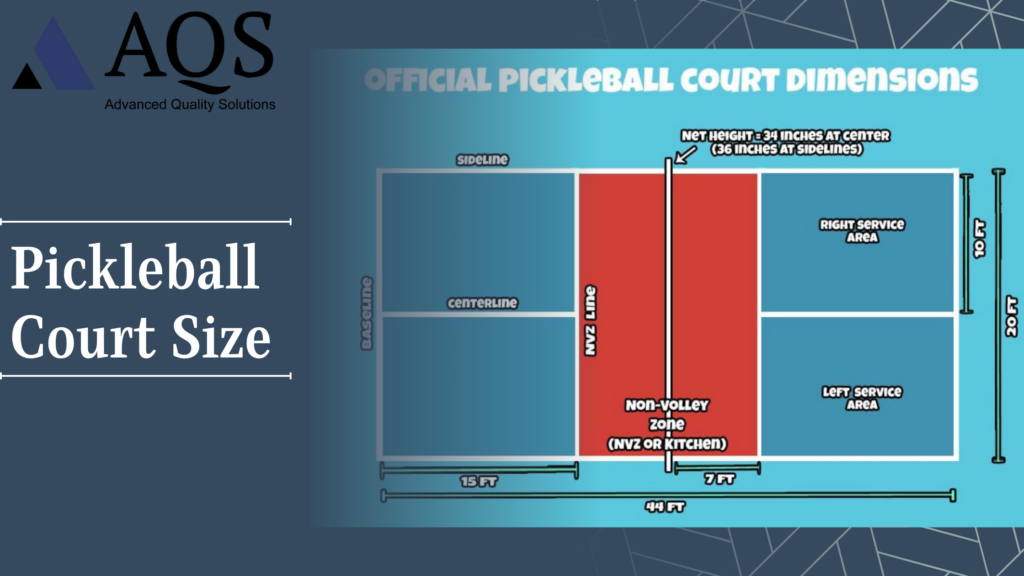
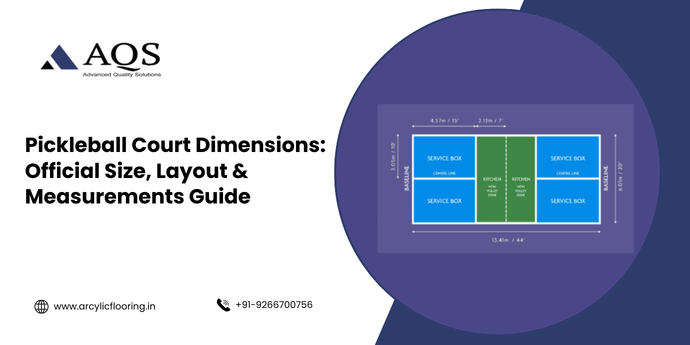
The official pickleball court is 44 feet (13.41 meters) long and 20 feet (6.10 meters) wide. These dimensions apply to both singles and doubles play – unlike tennis, pickleball uses the same court size for all formats. The total playing area, including recommended out-of-bounds safety zones, typically extends to 64 feet (19.51 meters) long by 34 feet (10.36 meters) wide, giving players enough room to move, recover, and play safely without running into boundaries, fences, or adjacent courts.
| Measurement Component | Imperial (Feet/Inches) | Metric (Meters) |
| Court Length (Baseline to Baseline) | 44 feet | 13.41 m |
| Court Width (Sideline to Sideline) | 20 feet | 6.10 m |
| Non-Volley Zone (Kitchen) Depth | 7 feet each side | 2.13 m each side |
| Net Height at Center | 34 inches | 0.86 m |
| Net Height at Posts/Sidelines | 36 inches | 0.91 m |
| Total Playing Area (with runoff) | 64 ft x 34 ft | 19.51 m x 10.36 m |
| Recommended Outdoor Runoff (each end) | 10 feet | 3.05 m |
| Recommended Outdoor Runoff (each side) | 7 feet | 2.13 m |
| Service Area Length (each side of net) | 15 feet | 4.57 m |
| Center Line Width | 2 inches | 5.08 cm |
| Baseline, Sideline Width | 2 inches | 5.08 cm |
Breaking Down the Pickleball Court Layout in Detail
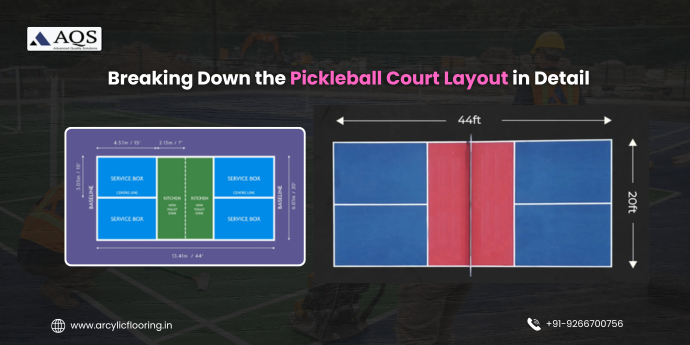
The layout of a pickleball court is deceptively simple in appearance but highly technical in execution. Every zone on the court serves a tactical and regulatory purpose, and the dimensions of each zone must be painted and constructed with precision. A court that is off by even a few inches in a critical zone like the non-volley zone can affect ball bounce consistency, player positioning, and ultimately, the fairness of competitive play. Below is a zone-by-zone breakdown that every contractor, facility manager, and serious player should know.
The Non-Volley Zone (The Kitchen)
The non-volley zone, universally known as ‘the kitchen,’ is one of the most strategically important areas in pickleball. It extends 7 feet (2.13 meters) from the net on both sides of the court, running the full 20-foot width. Players are prohibited from volleying the ball (hitting it out of the air) while standing inside this zone or touching its lines during a volley. The kitchen line itself is included as part of the non-volley zone for volleying purposes, making the precise placement of this line critically important for competitive integrity.
The Service Areas
On each side of the net, beyond the non-volley zone, the remaining court space is divided into two service areas by the center line. Each service area measures 10 feet wide by 15 feet deep (3.05 meters by 4.57 meters). The center line runs from the non-volley zone line all the way to the baseline, bisecting the court exactly down the middle. Service must land diagonally in the opposite service area, making the accurate placement of the center line and the non-volley zone line a non-negotiable requirement for rule-compliant play.
The Baseline and Sidelines
The baseline runs along the end of the court at both sides, parallel to the net, defining the rear boundary of the playing area. The sidelines connect the baselines along both sides of the court, forming the lateral boundaries. All boundary lines – including the baseline, sidelines, non-volley zone line, and center line – are 2 inches (5.08 cm) wide and are considered in-bounds when touched by a ball. Line markings must be painted in a clearly contrasting color to the court surface, typically bright white, and must be applied using professional-grade line paint that bonds firmly with acrylic surfaces.
Pickleball Court Zone Reference Table
| Court Zone | Dimensions | Distance from Net | Key Rule |
| Non-Volley Zone (Kitchen) | 20 ft wide x 7 ft deep | 0 – 7 feet | No volleys allowed |
| Left Service Area | 10 ft wide x 15 ft deep | 7 – 22 feet | Serve must land here diagonally |
| Right Service Area | 10 ft wide x 15 ft deep | 7 – 22 feet | Serve must land here diagonally |
| Center Line | 15 ft long x 2 in wide | From NVZ to baseline | Divides service areas |
| Baseline | 20 ft wide x 2 in wide | 22 feet from net | Rear boundary |
| Sidelines | 44 ft long x 2 in wide | N/A | Lateral boundary |
Official Net Specifications and Post Placement
The net is the centerpiece of a pickleball court, and its specifications are governed precisely by USAPA rules. The net must span the full 20-foot width of the court. Net posts are placed 1 foot (0.30 meters) outside each sideline, making the total post-to-post distance 22 feet (6.71 meters). The net height at the center is 34 inches (0.864 meters), which is intentionally lower than the 36-inch (0.914 meter) height measured at the sideline posts. This slight sag in the middle is a defining characteristic of the game and intentional in the rules.
Net tension must be sufficient to maintain the 34-inch center height without a net strap, though a center strap is used to secure and maintain this height consistently. The net must be made of a mesh material fine enough that the ball does not pass through it. For outdoor permanent courts, posts are typically anchored in concrete sleeves embedded in the court base, making the precise positioning of these sleeves during construction absolutely critical – a misplaced sleeve cannot be corrected after the surface is applied.
| Net Specification | Measurement |
| Net Height at Center | 34 inches (0.864 m) |
| Net Height at Posts | 36 inches (0.914 m) |
| Net Length (post to post) | 22 feet (6.71 m) |
| Net Post Placement | 1 ft outside each sideline |
| Minimum Net Width (overhang) | 1 inch beyond sidelines on each side |
Total Playing Area and Required Safety Runoff Zones
One of the most overlooked aspects of pickleball court construction is the difference between the court dimensions and the total playing area required for safe, comfortable gameplay. The USAPA recommends a minimum runoff of 10 feet (3.05 meters) beyond each baseline and 7 feet (2.13 meters) beyond each sideline. This means that a single pickleball court requires a total footprint of approximately 64 feet long by 34 feet wide, equating to roughly 2,176 square feet of total prepared surface area per court, not just the 880 square feet of the court lines themselves.
For multi-court facilities, the spacing between adjacent courts is equally important. A minimum of 10 feet should be maintained between the sidelines of neighboring courts to prevent player collisions and allow uninhibited movement during rallies. When courts are placed end-to-end, a 10-foot buffer between the baselines of facing courts is required. These runoff areas must be surfaced with the same quality material as the court itself, since they receive just as much foot traffic and are part of the continuous playing environment.
| Space Type | Minimum (Recreational) | Recommended (Tournament) | Notes |
| End Runoff (per baseline) | 10 feet | 12–14 feet | Players frequently overrun baseline |
| Side Runoff (per sideline) | 7 feet | 10 feet | Lateral safety zone |
| Between Courts (side-by-side) | 10 feet | 14 feet | Shared space counts for each court |
| Between Courts (end-to-end) | 10 feet | 12 feet | Combined buffer for both courts |
| Total Single Court Footprint | 64 ft x 34 ft | 68 ft x 40 ft | Including all runoffs |
Pickleball Court vs. Other Court Sports: Size Comparison
Understanding pickleball court dimensions becomes even more meaningful when placed side-by-side with other popular court sports. Pickleball courts are noticeably smaller than tennis courts, which makes them ideal for indoor gyms, community centers, and multi-sport facilities. Their compact size also allows facility owners to convert a single tennis court into multiple pickleball courts, dramatically increasing court availability without requiring additional land. This versatility has been a key driver of pickleball’s explosive growth worldwide.
| Sport | Court Length | Court Width | Total Area (Lines Only) | Net Height (Center) |
| Pickleball | 44 feet | 20 feet | 880 sq ft | 34 inches |
| Tennis (Doubles) | 78 feet | 36 feet | 2,808 sq ft | 36 inches |
| Badminton (Doubles) | 44 feet | 20 feet | 880 sq ft | 5 feet 1 inch |
| Badminton (Singles) | 44 feet | 17 feet | 748 sq ft | 5 feet 1 inch |
| Table Tennis | 9 feet | 5 feet | 45 sq ft | 6 inches |
| Volleyball | 59 feet | 29.5 feet | 1,740 sq ft | 7 feet 11.5 inches |
Converting a Tennis Court to Pickleball Courts
One of the most common infrastructure projects in sports facilities today is converting an existing tennis court into one or more pickleball courts. A standard tennis court footprint of 120 feet by 60 feet can comfortably accommodate four dedicated pickleball courts, or two pickleball courts with larger safety runoffs. When converting, the existing tennis court surface is an ideal starting base – provided it is properly prepared with the right materials before pickleball lines are applied. The key is to add the new pickleball lines in a visually distinct color so that the two sets of lines do not create confusion during play.
The surface preparation for a successful pickleball conversion requires careful attention to the existing base. Old, oxidized, or cracked tennis court surfaces must be treated with a Concrete Primer to seal the substrate and improve adhesion before any new coating system is applied. Following the primer, an Acrylic Resurfacer is used to fill minor surface irregularities, level the playing field, and create a uniform, porous foundation that bonds perfectly with the finish coats. For courts where player comfort and joint protection are a priority, a Cushion Coat system is applied over the resurfacer to provide a padded underfoot feel that reduces fatigue during long rallies.
Transform Your Sports Facility Today!
Contact us for high-quality synthetic sports flooring material and elevate your space!
Surface Materials for Building a Pickleball Court
The surface of a pickleball court directly affects ball bounce consistency, player traction, durability, and long-term maintenance costs. Whether you are building a new court from scratch or resurfacing an old concrete or asphalt base, the layering system you choose determines the overall quality and longevity of the installation. Professional-grade pickleball surfaces use a multi-layer acrylic system, with each layer serving a specific structural and performance function in the overall court system.
Concrete Primer – The Foundation of Surface Adhesion
Concrete Primer is the first and most critical layer applied to any new or existing concrete base before a pickleball court surface can be installed. This specialized primer deeply penetrates the pores of the concrete substrate, sealing dust, laitance, and micro-cracks that would otherwise compromise the adhesion of subsequent layers. Without a quality Concrete Primer, acrylic coatings applied over bare concrete will peel, blister, or delaminate within a short period, especially when exposed to temperature fluctuations, moisture, or UV radiation. A properly primed surface ensures every subsequent layer bonds permanently and performs as designed for years.
Acrylic Resurfacer – Leveling and Surface Restoration
Acrylic Resurfacer is a thick, high-solids acrylic compound applied over the primed base to fill low spots, hairline cracks, and surface texture irregularities. It creates a smooth, consistent canvas that eliminates uneven ball bounce – one of the most common complaints on improperly prepared courts. Acrylic Resurfacer is typically applied in one to two coats depending on the condition of the substrate. On older courts being rehabilitated, it can dramatically extend the life of the surface without the need for a full reconstruction. The resurfacer dries to a slightly rough, open texture that forms the ideal mechanical bond for color coats and finish layers.
Cushion Coat – Performance and Player Comfort
Cushion Coat is the performance differentiator that separates a standard acrylic court from a premium, player-friendly installation. Applied as an intermediate layer between the resurfacer and the final color coats, Cushion Coat contains rubber granules or similar elastic materials that provide a measurable degree of surface give underfoot. This cushioning effect reduces the impact stress on players’ knees, ankles, and lower back – a significant advantage in a sport like pickleball where quick lateral movements and rapid direction changes are fundamental to gameplay. Cushion Coat is available in various thickness grades to match the desired level of cushioning for recreational or competitive use.
| Material Layer | Function | Typical Application | Key Benefit |
| Concrete Primer | Seals & primes substrate | 1 coat on new/old concrete | Maximum adhesion, prevents peeling |
| Acrylic Resurfacer | Fills cracks & levels surface | 1–2 coats depending on condition | Consistent ball bounce |
| Cushion Coat | Adds cushioning underfoot | 1–4 coats per desired thickness | Reduced joint fatigue for players |
| Color Coat / Finish | Provides texture & color | 2–3 coats | Player traction & aesthetics |
| Line Marking Paint | Defines court boundaries | Applied after color coats | Clear visual boundaries |
Orientation, Drainage, and Site Planning for Pickleball Courts
Beyond the physical pickleball court dimensions, successful court planning requires consideration of orientation, drainage, and surrounding infrastructure. Courts should be oriented with the long axis running north-to-south wherever possible. This minimizes the time during which players face direct sun exposure into their eyes, which is particularly important in the morning and late afternoon hours when sun angles are low. East-west oriented courts are generally considered unsuitable for competitive play due to the persistent sun glare problem that affects players on one side of the net.
Drainage is a structural requirement that directly affects the longevity of the acrylic surface system. Since acrylic coatings are non-porous and do not allow water to pass through, all water must drain off the surface via a carefully calibrated slope. The recommended slope for a pickleball court is 1 inch of fall for every 10 feet of run (approximately 0.83% to 1% gradient). This slope must be established in the concrete or asphalt base before any surface coating is applied; attempting to correct drainage issues with surface materials alone is not effective and will lead to standing water (birdbaths) and premature surface failure.
Transform Your Sports Facility Today!
Contact us for high-quality synthetic sports flooring material and elevate your space!
Indoor vs. Outdoor Pickleball Court Dimensions
The official pickleball court dimensions – 44 feet by 20 feet – are the same for both indoor and outdoor courts. The key differences lie in the surrounding infrastructure, surface material selection, and environmental exposure. Indoor courts are typically installed on hardwood gym floors, existing concrete gymnasium slabs, or dedicated sports surfaces. Outdoor courts are exposed to UV radiation, temperature swings, rain, freeze-thaw cycles, and heavy wind, all of which affect both the surface material specification and the base construction requirements.
For indoor courts, the total space requirement is slightly more forgiving in terms of runoff because controlled environments eliminate wind and rain as factors. However, ceiling height is a critical indoor dimension often overlooked in pickleball facility planning. The minimum recommended ceiling clearance for indoor pickleball is 18 to 20 feet above the court surface. This allows for lofted dink shots, overhead smashes, and high lob returns without interference from ceiling infrastructure, lights, or beams. Courts installed in facilities with lower ceilings are technically playable but create an altered game dynamic that disadvantages aerial shot strategies.
| Factor | Indoor Courts | Outdoor Courts |
| Court Dimensions | 44 ft x 20 ft (same) | 44 ft x 20 ft (same) |
| Surface Recommended | Acrylic on concrete / hardwood | Acrylic multi-layer on concrete/asphalt |
| Minimum Ceiling Height | 18–20 feet clear span | N/A (open sky) |
| Concrete Primer Required? | Yes (on concrete base) | Yes (critical for adhesion) |
| Cushion Coat Benefit | High (joint protection) | High (player comfort in long sessions) |
| Drainage Requirement | Floor drains / slope | 0.83%–1% surface slope |
| UV Resistance Needed? | Low | High (UV-stable color coats essential) |
Step-by-Step Guide to Marking a Pickleball Court from Scratch
Marking a pickleball court accurately requires the right sequence of steps, the right tools, and a thorough understanding of the court geometry. Whether you are laying out a standalone pickleball court or converting an existing tennis court surface, the marking process begins with establishing the centerline of the net and working outward from that reference point. Precision at the initial layout stage eliminates compounding errors that become more difficult to correct once line paint is applied.
- Step 1: Establish the net centerline – measure and mark the exact center of the court width (10 feet from each sideline).
- Step 2: Measure 22 feet from the net center in each direction to locate both baselines (total 44-foot court length).
- Step 3: Mark both sidelines 10 feet on either side of the centerline, running the full 44-foot length.
- Step 4: Measure and mark the non-volley zone lines 7 feet from each side of the net, parallel to the baselines.
- Step 5: Draw the center line from each NVZ line to each baseline, bisecting the service areas.
- Step 6: Verify all diagonal measurements (corner to corner) are equal – confirming a perfectly square layout.
- Step 7: Apply all court lines at 2-inch width using professional line marking paint over the cured color coat.
Pickleball Court vs. Badminton Court Size: Key Differences
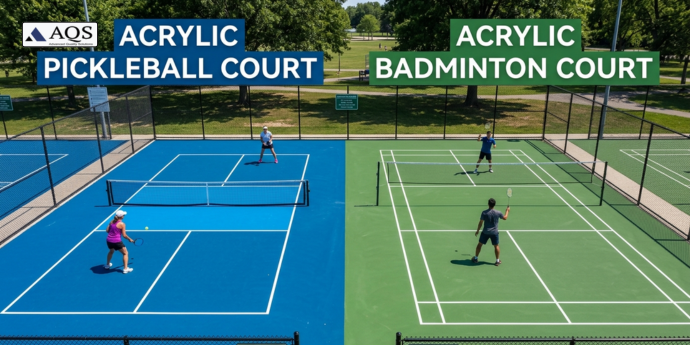
One of the most frequently asked questions in multi-sport facility planning is the relationship between pickleball court dimensions and badminton court dimensions. Interestingly, both sports share the same court footprint – 44 feet long by 20 feet wide for doubles play. However, the two sports are played very differently on that shared space, and the critical internal markings differ significantly. Understanding these differences is essential when planning multi-use or convertible courts in schools, recreation centers, and community sports hubs.
A badminton doubles court measures 44 feet (13.41 meters) long and 20 feet (6.10 meters) wide – identical to a pickleball court in outer boundary dimensions. However, badminton uses a singles court that is 44 feet long by only 17 feet (5.18 meters) wide. The net in badminton is set at a height of 5 feet 1 inch (1.55 meters) at the center and 5 feet (1.52 meters) at the posts – significantly taller than the pickleball net. Badminton also has short service lines, long service lines for singles and doubles, and back boundary lines that differ between service and rallying situations, creating a more complex internal line system than pickleball.
Badminton Court Dimension Table
| Measurement | Badminton (Doubles) | Badminton (Singles) | Pickleball |
| Court Length | 44 feet (13.41 m) | 44 feet (13.41 m) | 44 feet (13.41 m) |
| Court Width | 20 feet (6.10 m) | 17 feet (5.18 m) | 20 feet (6.10 m) |
| Net Height (Center) | 5 ft 1 in (1.55 m) | 5 ft 1 in (1.55 m) | 34 inches (0.864 m) |
| Net Height (Posts) | 5 feet (1.52 m) | 5 feet (1.52 m) | 36 inches (0.914 m) |
| Short Service Line | 6.5 feet from net | 6.5 feet from net | N/A (NVZ = 7 ft) |
| Back Boundary Line | 2.5 ft inside baseline (doubles service) | N/A | N/A |
| Total Area (Doubles) | 880 sq ft | 748 sq ft | 880 sq ft |
The shared outer dimensions of badminton and pickleball courts make converting or dual-marking a court for both sports entirely feasible. When painting both sets of lines on a single surface, the color coding of lines is crucial. Using white for pickleball lines and a secondary color such as yellow for badminton lines prevents visual confusion during play. The acrylic surface system – including the Concrete Primer, Acrylic Resurfacer, and Cushion Coat layers – is equally suited to both sports since both require a consistent, non-slip, weather-resistant playing surface.
How Many Pickleball Courts Fit on a Tennis Court?
A standard tennis court footprint of 120 feet by 60 feet (including recommended runoffs) can accommodate four regulation pickleball courts arranged in two rows of two. Each pickleball court occupies a footprint of approximately 64 feet by 34 feet when runoffs are included. When configuring four courts on a tennis court, nets are typically installed permanently with their posts anchored in the court surface. The tennis net posts can be left in place and used as anchor points for portable pickleball net systems, making the conversion economically efficient. However, for permanent multi-court pickleball facilities, dedicated net post sleeves should be installed during the resurfacing process.
| Configuration | Courts Per Tennis Court | Runoff Per Court | Best Use |
| 4 Pickleball Courts | 4 courts (2×2 layout) | Minimal (shared) | High-traffic clubs, tournaments |
| 2 Pickleball Courts | 2 courts (side by side) | Generous (tournament spec) | Schools, rec centers |
| 1 Pickleball Court | 1 court (centered) | Maximum runoff space | Practice, casual play |
| 2 Courts + Tennis Lines | 2 + 1 tennis (blended) | Moderate | Multi-sport facilities |
Quick Tips Section (Q&A)
A standard pickleball court is 44 feet long and 20 feet wide, used for both singles and doubles play.
The kitchen extends exactly 7 feet from the net on both sides of the court, running the full 20-foot court width.
The pickleball net stands 34 inches at the center and 36 inches at the sideline posts.
Including safety runoffs, plan for a minimum footprint of 64 feet long by 34 feet wide for a single pickleball court.
Concrete Primer seals the base substrate to ensure maximum adhesion of the Acrylic Resurfacer and all subsequent surface layers.
Conclusion: Build It Right from the First Measurement
Getting the pickleball court dimensions right from the very beginning is the foundation of every high-quality court project. From the 44-foot court length and the 7-foot kitchen zone to the 34-inch net height and the 10-foot recommended end runoffs, every measurement exists for a reason – player safety, competitive fairness, and surface longevity. Whether you are constructing a standalone outdoor facility, converting tennis courts for multi-use play, or installing an indoor pickleball complex, the precision of your layout determines the quality of every game played on it.
Equally important is the surface system you choose. Applying a professional-grade Concrete Primer, followed by an Acrylic Resurfacer to create a level base, and finishing with a Cushion Coat for player comfort ensures that your court not only meets official pickleball court dimensions on paper but delivers a world-class experience underfoot. Invest in accurate measurements, quality materials, and professional installation – and your court will serve players at the highest level for years to come.