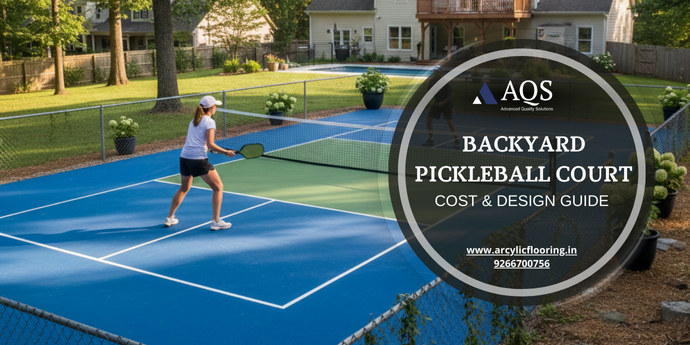
Pickleball is quickly becoming the fastest-growing sport in the world, and people all over the world are creating pickleball playgrounds in their own backyards. Having a backyard pickleball court flooring enhances your lifestyle, whether you’re playing like a pro in your own backyard, meeting up with friends on the weekends, spending time with the family, getting a little exercise fix, or even creating a dedicated training area. It also increases the appeal of your property and reduces your recreational expenses.
AQS offers sports flooring systems made of synthetic acrylic that are durable, weatherproof, and provide a high-quality playing experience. With more than 14+ years of experience, AQS can help homeowners, academies, and institutions with everything from site assessment to installation, providing them the assurance that they are in capable hands. Whether you’re constructing a multipurpose backyard sports arena or a dedicated pickleball court, AQS can offer you a flawless, durable, and polished sports surface.
However, the actual issue is not whether or not to construct a pickleball court in your backyard, but rather how to do it perfectly. Each homeowner is unique, with their own objectives, spending limits, and available backyard area. A really high-performance acrylic court that feels as good as the one at the neighbourhood academy is what some people desire. Others want to build a multi-sport court for children to play on. Then there are some who simply want a well-maintained, long-lasting court that looks good. This is where AQS’s expertise in synthetic acrylic comes in; they are known for creating robust, weatherproof sports flooring systems that are ideal for backyard installations.
Backyard Pickleball Court Ideas for Every Home
Acrylic Backyard Court
A fully finished court with AQS synthetic acrylic pickleball flooring brings the experience of a professional facility right into your home. The multi-layer acrylic system offers consistent, competition-grade bounce, vibrant two-tone colour combinations, and excellent performance in both hot and rainy weather.
Upgrade Your Sports Court Today
Get premium synthetic acrylic flooring designed for durability, grip, and performance.
Get Free ConsultationMulti-Sport Court
One surface may be easily transformed into a complete multi-sport arena using AQS acrylic flooring. You can add basketball, volleyball, or badminton markings alongside your pickleball court since the material takes different line colours without compromising texture, grip, or game performance.
Driveway or Side-Yard Pickleball Court
You can turn an underused side-yard slab or a long, level driveway into a useful pickleball court. Just adding AQS acrylic surfacing improves ball reaction, increases grip, and provides the area with a polished, clean appearance. You may create a ready-to-play area that is ideal for small homes, weekend games, or someone who is just beginning out in pickleball, without having to completely rebuild the area.
Poolside Court + Lounge
A poolside pickleball court is both visually striking and highly functional, especially when finished with custom AQS acrylic colours that complement your pool tiles or home exterior. The result is a coordinated, luxury backyard aesthetic. Adding acoustic fencing reduces paddle noise, while warm LED lighting creates an inviting atmosphere for evening matches.
Rooftop or Terrace Home Pickleball Court
For homes with limited ground space, AQS’s lightweight acrylic system is an excellent option for building a rooftop or terrace pickleball court. The flooring adds minimal load to the structure while still delivering top-tier bounce, traction, and durability. With secure safety railings and optional windbreak screens, your terrace transforms into a private, urban play zone.
Pickleball Court Dimensions for Your Backyard
Before you start thinking about aesthetics or add-ons, make sure your outdoor space can fit standard pickleball court dimensions. Proper sizing means safe movement, accurate playability and a long-lasting backyard setup.
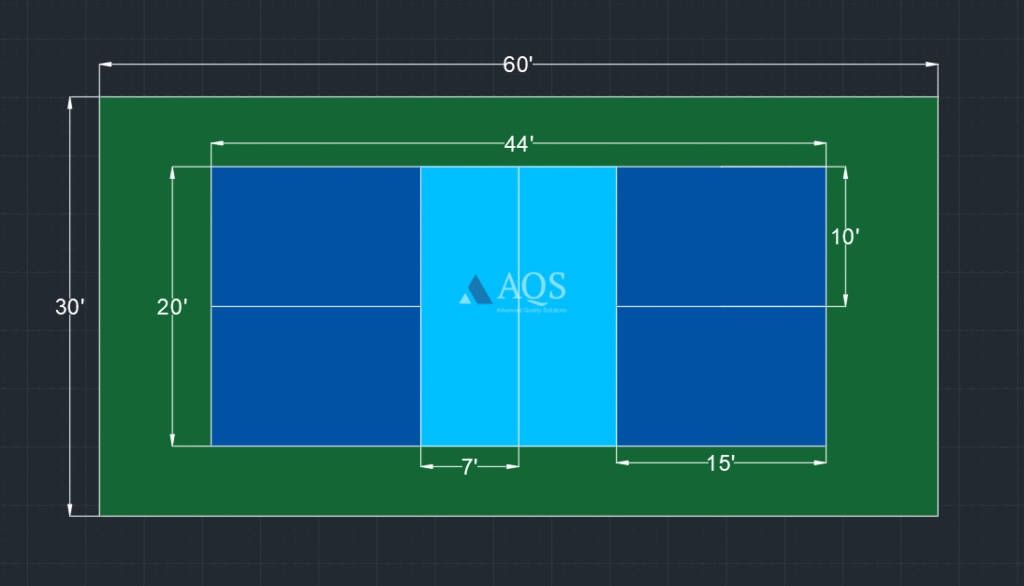
- Standard Dimensions: The core playing area of every pickleball court is 20 ft by 44 ft, including service zones, baselines and non-volley zone. This must remain exact for correct gameplay and ball response.
- Total Playing Area: For a comfortable backyard court, a 30 ft × 60 ft footprint is ideal as it provides extra run-off space around the edges. This extra buffer means safer play, fewer edge collisions and smoother rally movement.
- Practice Court: If your backyard is tight, you can still install a scaled practice court by keeping the lines proportional. This allows daily drills, dinking practice and casual play without needing a full 30 × 60 ft layout.
- Half-Court Setup: A half-court is great for small spaces and perfect for solo practice or warm-ups. It keeps the essential markings but reduces the overall footprint for easier backyard installation.
- Driveway or Patio Conversion: Your existing driveway or patio slab can be a functional pickleball zone by simply marking the lines and adding a portable net. This is an affordable option to turn unused hardscape into a dedicated play area.
- Portable Net Court: Portable net systems allow flexible, temporary pickleball setups that can go anywhere in the backyard. They’re easy to install, quick to store and perfect for families who want a removable court layout.
- Keep the Lines Exact: Regardless of space constraints, always keep the 20 × 44 ft internal court dimensions exact. Even if run-of-the-space is reduced, the core size must remain exact for correct gameplay, ball response and a true pickleball experience.
Cost to Build a Pickleball Court in Your Backyard
The cost to build a pickleball court in your backyard can vary a lot depending on the state of your slab, what kind of flooring you choose, how you decide on fencing and lighting, and whether you want to add any fancy features. One big factor in determining cost is whether you’ve got to lay a brand new concrete or asphalt base – or if you can just make use of an existing slab you’ve already got.
| Category | Details |
| Typical Cost Range (USA) | $15,000 – $45,000+ |
| USA Cost Notes | Includes surfacing, fencing, lighting, and court accessories. Premium upgrades, such as cushioned flooring or luxury landscaping, increase the total cost. |
| Typical Cost Range (India) | ₹5,00,000 – ₹15,00,000 |
| India Cost Notes | Covers professional acrylic or modular flooring, standard fencing, and durable lighting. Cost varies depending on base preparation and material quality. |
Cost Breakdown:
Base Work – 50-60% of the total
The base of your court has to be rock solid – it needs to be well sloped, compacted, and able to handle water properly. All that’s got to come together, or your flooring is likely to crack or start to disintegrate prematurely.
Pickleball Court Flooring
Flooring is what’s going to give your court its overall play experience, how comfortable it is to play on, and how long it’s going to last. This is where AQS synthetic acrylic flooring really stands out with its engineered layers that give you premium outdoor performance.
- UV-stable colour coats: The colour on an AQS court doesn’t fade quickly – even in super harsh sunlight, it stays bright for years.
- A non-slip texture: AQS gives you some nice traction when you’re moving fast on the court – so you can play safely no matter how good you are or how new you are to the game.
- Consistent ball bounce: Its layers are designed so that the ball bounces pretty much the same all over the court, which is pretty essential for a game like pickleball.
- Cushioning for comfort: If you want to soften the impact of playing, there are options for cushioning that can be added, which makes a big difference when the kids are out there splashing around or you’re playing every day.
- It’s built to last: AQS is made to withstand all sorts of weather – rain, heat, and dust – so you don’t have to worry about it not holding up over time.
Fencing
Fencing keeps the ball from flying out into the neighbouring garden and adds some safety. It also gives you a proper court feel, if you know what I mean.
Lighting
You can play in the evenings with some decent LED sports lighting and make the most of your space. As long as the lights are set up right, you shouldn’t get any glare, and you can use the court all year round.
Net Posts & Extras
Posts, a regulation-sized net and a few little extra bits like a ball holder or some windbreaks – these all add up to a better experience and some long-term convenience if you play a lot.
If you can use an existing slab that you already have (like a driveway or an old patio), it slashes your construction costs because then the flooring becomes the main thing you need to worry about. That makes backyard courts a whole lot more affordable, and yet they still play like a proper pro court.
Best Pickleball Court Flooring & Material
The flooring you choose is going to make all the difference in the way your court plays – how bouncy it is, how easy it is to run around on, and how long it will last before it starts to look worn out. Choosing the right material is key to having a court that performs consistently and looks great for years to come.
Option 1: AQS Synthetic Acrylic Pickleball Flooring
AQS have put together a pretty top-notch acrylic flooring system that’s specifically designed for grip, bounce and durability. It’s UV stable, non-slip and decent cushioning – so it will play smoothly even when the weather is not so great. It works on a concrete or asphalt base – if you’re planning on putting it in backyard and it’s one of the best options available for anyone looking to install a professional-quality pickleball court.
Option 2: Modular PP Tiles
If you’re after a flooring option that you can put in yourself relatively easily or that you can easily take out again, then these polypropylene tiles might be the way to go. They’re quick to install, have a bit of cushioning and can easily be swapped out if they get damaged – which makes them a good choice for people who rent their homes or who want to set up a pickleball court in their backyard for a short while.
Option 3: Plain Concrete with Court Paint
But if you’re looking to save a bit of cash, then using plain concrete and some court paint is one option. However, it’s a pretty low-spec solution – the grip, comfort and UV stability are all pretty poor, so it’s often a bit of a pain to keep the court looking its best. And when you factor in the fact that AQS acrylic systems, in particular, are really going to give you a lot of bang for your buck in terms of long-term durability, its probably not the best idea if you want a court that will last.
Backyard Pickleball Court Construction
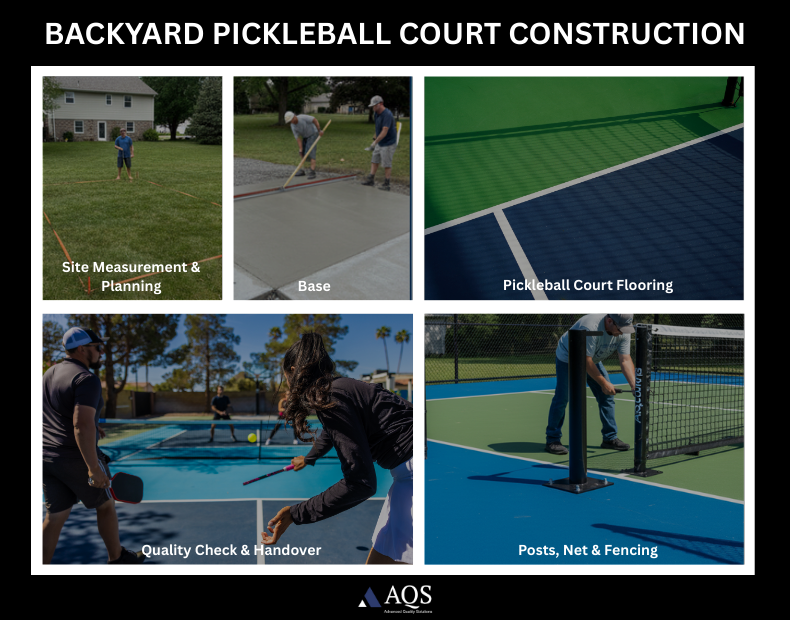
Step 1: Site Measurement & Planning
Measure out the pickleball court dimensions to make sure a full-size court will fit in your backyard. Position the court north–south to reduce direct sunlight in players’ eyes and playability throughout the day.
Step 2: Base
Compact the sub-base properly to avoid future cracks or settlement. Lay a good-quality concrete or asphalt slab with a 1:100 slope for drainage and to prevent water accumulation. Let it cure properly—especially for concrete—to reach full strength before applying surface materials.
Step 3: Pickleball Court Surface
Apply primer, then crack repair or patching to get a smooth base. Apply resurfacer and optional cushion layers for shock absorption, then finish with AQS acrylic colour coats for UV stability. Complete the court with high-visibility line marking for play boundaries and long-lasting performance.
Step 4: Posts, Net & Fencing
Once the surface is done, install the net posts and the pickleball net at regulation height. Add fencing around the perimeter for safety, to retain balls in the court and for a clean professional look.
Step 5: Quality Check & Handover
Do a final check to ensure line accuracy, bounce consistency and surface uniformity. Check drainage and make sure the surface finish meets AQS standards before handing over the court for use.
How to Avoid Mistakes When Building a Backyard Pickleball Court
- Compromising on the Base: A weak or uneven base will crack, puddle and damage the court surface. The flooring can only perform as well as the slab beneath it. AQS acrylic systems perform best when installed on a level, compacted and fully cured base.
- Wrong Dimensions: Changing the standard 20 × 44 ft playing area affects shot angles, gameplay and player movement. It may seem like a small adjustment, but a few inches can mess up regulation play. Always follow official dimensions so your backyard court feels professional and accurate.
- Using Non-Sports Paint: Regular exterior paint is slippery, fades quickly in the sun and lacks the texture for traction. Over time, it cracks from continuous foot traffic and weather exposure. Choosing AQS professional-grade acrylic coatings gives you long-lasting colour, grip and performance.
- Ignoring Noise Reduction: Backyard pickleball can create loud paddle and ball impact sounds that can disturb nearby homes. Simple additions like hedges, acoustic screens or mesh windscreens reduce echo and keep the neighbourhood quiet. Good planning avoids future complaints.
- Skipping Shade or Lighting: Courts without shade are scorching hot in the afternoon, and courts without lighting can’t be played on in the evening. Adding pergolas, umbrellas or basic LED poles makes the court usable all day and night. This small planning step increases how often your backyard court gets used.
Why Choose AQS to Build Your Backyard Pickleball Court
Building a backyard pickleball court is an investment that will pay off over the next year, and the quality of the flooring is going to make all the difference. We’re one of India’s most trusted names in synthetic acrylic sports flooring and have been delivering outdoor courts to schools, academies, housing societies and private homes for years.
We know the challenges of building a court in your own backyard – it’s all about working with a small space, sun beating down, monsoon rains and trying to get a consistent bounce. With AQS, you can use professional-grade stuff, engineered for the outdoors. Each layer is designed to withstand the elements and give your court a smooth, even texture that’s safe to play on. Whether your court is in an open backyard, next to your pool or even on your rooftop – our flooring adapts without losing its grip or durability.
We also offer cushioned acrylic systems, which take the impact out of play for kids and seniors – and allow regular players to play longer without getting tired out. Our outdoor-tested pigments and surfacers ensure your court stays looking great and crack-free for years to come, even in India’s harsh climate.
So when you choose AQS, you’re not just choosing a flooring – you’re getting a long-term solution to your backyard pickleball needs.
Conclusion
From driveway courts to premium acrylic installations, every backyard can be a pickleball court. Choosing the right pickleball court surface, especially durable and weatherproof like synthetic acrylic, means long-lasting performance, good grip and consistent bounce. With proper planning, professional installation and quality materials, your backyard court will last for years.
Whether you choose cushioned acrylic, modular tiles or multi-sport design, the ideas in this guide will help you build a backyard pickleball court that looks great, plays smoothly and is the best part of your home.
Frequently Asked Questions
A backyard should be 30×60 ft, with a minimum 20×44 ft playable area for a proper pickleball court.
Build a smaller pickleball practice or half court—just maintain the essential 20×44 ft playing area.
Backyard pickleball courts cost ₹5–15 lakh in India or $15,000–$45,000+ in the USA, depending on site and materials.
Use your existing driveway or patio slab and add acrylic surfacing — the simplest, most cost-effective backyard court option.
Acrylic flooring offers great grip, durability, and bounce, while PP tiles work as a budget DIY alternative
A terrace pickleball court works if you add strong railings and windbreaks for safety.