
If you’re planning to build or repaint a badminton court, the first question is usually the same: what will it cost? Badminton court paint cost in India generally falls between ₹45 and ₹150 per square foot. The exact number depends on the type of acrylic system, the number of coating layers, and whether the court is indoor or outdoor.
This guide breaks down every part of that cost, from paint layers to flooring types, so you know what you’re paying for before you sign a contract. Whether you run a sports academy, manage a housing society, or want a personal court at home, getting the paint cost right saves you from budget surprises later. Let’s look at the real numbers.
What Affects Badminton Court Paint Cost?
No two courts cost the same. A handful of factors push the price up or down.
- Number of coating layers: Acrylic court systems come in 5-layer, 6-layer, 7-layer, and 8-layer options. More layers mean more material, more labor, and a higher bill. They also mean better cushioning and a longer life.
- Indoor vs outdoor: Outdoor courts need extra UV-resistant and weatherproof coats to survive sun and rain. Indoor courts skip some of that but often add cushioning for player comfort instead.
- Base condition: If your existing surface has cracks, uneven patches, or old paint that needs stripping, you’ll pay more for surface preparation before a single coat goes on.
- Cushioning requirement: A non-cushioned court costs less. A cushioned system, built for academies and long training sessions, costs more because of the extra rubberized layers underneath.
- Brand and quality of paint: Domestic acrylic brands cost less than imported ones. Imported, BWF-recognised coatings sit at the top end of the price range.
- City and labor rates: Painting a court in a metro city usually costs more than in a smaller town, simply because labor and transport charges differ.
Badminton Court Paint Cost Per Square Foot
Here’s a realistic breakdown based on current market rates across India.
Upgrade Your Sports Court Today
Get premium synthetic acrylic flooring designed for durability, grip, and performance.
Get Free Consultation| Coating System | Layers | Cost per sq ft | Best Suited For |
| Basic acrylic (non-cushion) | 5-layer | ₹45 – ₹150 | Budget outdoor courts, schools |
| Standard acrylic with color coat | 6-layer | ₹150 – ₹200 | Housing societies, clubs |
| Cushioned acrylic | 7 to 8-layer | ₹180 – ₹350 | Academies, competitive play |
| PU (polyurethane) coating | – | ₹180 – ₹320 | Indoor, all-weather use |
These are approximate material and installation figures before GST. Actual quotes vary by city, contractor, and site condition, so always confirm what’s included before comparing two quotes.
Example: Badminton Court Paint Cost for One Full Court
A standard doubles court’s playing area is 880 square feet. For a basic 5-layer acrylic system, you’re looking at roughly ₹79,000 to ₹1,32,000 for the paint and coating alone. Move up to a premium cushioned 8-layer system, and that figure rises to about ₹1.58 lakh to ₹3.08 lakh.
Keep in mind, this is just the paint and coating. It doesn’t include the base, fencing, net, or lighting.
Badminton Court Measurement You Should Know Before Painting
Getting the badminton court measurement right matters more than most people think. Paint over the wrong dimensions, and you’ll need to redo the lines, which means extra cost and delay.
Here are the official BWF measurements:
| Detail | Doubles | Singles |
| Length | 13.4 m (44 ft) | 13.4 m (44 ft) |
| Width | 6.1 m (20 ft) | 5.18 m (17 ft) |
| Total playing area | 880 sq ft | 747 sq ft |
| Net height (center) | 1.524 m (5 ft) | Same |
| Net height (at posts) | 1.55 m (5 ft 1 in) | Same |
| Short service line from net | 1.98 m (6 ft 6 in) | Same |
Don’t plan your plot around the marked lines alone. You need run-off space around the court so players don’t hit walls or fences mid-rally. Most builders recommend at least 50 feet by 30 feet of clear space for one court, and closer to 57 feet by 33 feet if you want tournament-standard clearance.
Types of Badminton Court Flooring
Paint is only one layer of the full flooring system. Badminton court flooring generally falls into four categories.
| Flooring Type | Cost per sq ft | Typical Lifespan | Notes |
| Synthetic acrylic | ₹45 – ₹150 | 6 to 8 years | Most common, weather-resistant, low maintenance |
| PU (polyurethane) | ₹180 – ₹320 | 6 to 8 years | Good shock absorption, suited to Indian climate |
| PVC / modular tiles | ₹80 – ₹250 | Varies by grade | Fast to install, panels can be replaced individually |
| Wooden flooring | ₹350 – ₹800 | Long-lasting with proper care | Premium underfoot feel, needs humidity control indoors |
Upgrade Your Sports Court Today
Get premium synthetic acrylic flooring designed for durability, grip, and performance.
Get Free ConsultationSynthetic acrylic badminton court flooring remains the most popular choice for both indoor and outdoor courts in India. It handles heat, humidity, and rain reasonably well, and it’s what most academies and housing societies go with when budget matters.
Full Badminton Court Construction Cost Breakdown
Paint cost is just one piece of the puzzle. If you’re starting from scratch, here’s what badminton court construction typically involves, cost-wise.
| Component | Estimated Cost |
| Base / foundation (PCC or concrete) | ₹120 – ₹450 per sq ft |
| Acrylic paint and coating | ₹45 – ₹150 per sq ft |
| Indoor structure (pre-engineered steel shed) | ₹800 – ₹2,000 per sq ft |
| Lighting | ₹1 lakh – ₹5 lakh |
- For a basic outdoor court, concrete base plus acrylic paint, total cost usually lands between ₹3 lakh and ₹5 lakh for one court, all inclusive.
- For an indoor court with a proper shed structure, lighting, and premium flooring, budgets typically run from ₹15 lakh to ₹45 lakh or more for a single court. Costs come down per court when you build a multi-court facility, since the structure and civil work get shared across courts.
How Many Coats Does a Badminton Court Need?
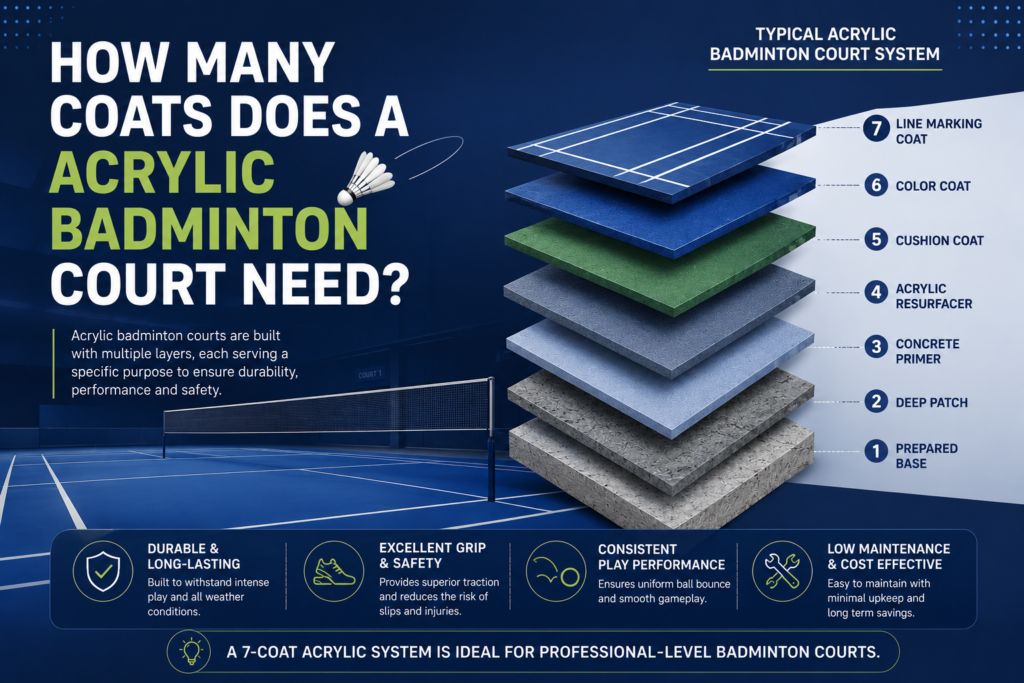
A typical acrylic system goes on in this order:
- Primer coat – helps the paint bond to the concrete or asphalt base.
- Resurfacer coat(s) – usually one or two coats, fills small cracks and evens out the surface.
- Cushion coat(s) – optional, two to five layers if you want shock absorption.
- Color coat(s) – typically two coats, gives the final look and UV protection.
- Line marking – white acrylic paint applied last, following exact BWF measurements.
Skipping steps to save money almost always shows up later as peeling paint or an uneven surface.
How Long Does Badminton Court Paint Last?
Quality acrylic coating usually lasts five to eight years indoors before it needs a fresh coat. Outdoor courts facing heavy monsoon rain and direct sun tend to wear faster, often needing a repaint every four to six years.
Watch for these signs that it’s time to repaint:
- Faded or peeling color coat
- Cracks showing through the surface
- Lines that are hard to see during play
- A surface that feels slippery or unusually rough underfoot
Tips to Save Money on Badminton Court Paint Cost
- Get at least three quotes from different contractors before deciding.
- Choose a non-cushioned system if the court is for recreational use, not competitive training.
- Fix the base properly the first time. A weak foundation means you’ll pay for repainting sooner than expected.
- Ask for a written, layer-by-layer breakdown in every quote. Some contractors quietly reduce coats to cut their own cost.
- If you’re building more than one court, negotiate a bulk rate. Material and labor costs drop per court.
- Time outdoor projects before monsoon, not during it. Wet conditions slow curing and can affect the finish.
Common Mistakes to Avoid
- Skipping surface preparation: Painting over cracks or uneven patches without fixing them first is the most common mistake. It looks fine on day one and fails within a year.
- Choosing paint based on price alone: The cheapest quote often means fewer layers or lower-grade material. Ask what’s included before comparing numbers.
- Getting the measurement wrong: Even a few inches off on badminton court measurement can throw off service lines and cause disputes during play.
- Ignoring drainage for outdoor courts: Standing water after rain damages acrylic coating fast. Proper slope and drainage should be part of the base work, not an afterthought.
- Not budgeting for line marking separately: Line marking needs precision and a different paint grade than the base color coat. Some contractors treat it as an afterthought, and it shows.
Final Thoughts
Badminton court paint cost in India isn’t one fixed number. It depends on how many layers you choose, whether the court is indoor or outdoor, and the condition of your base surface. As a rough guide, expect ₹45 to ₹150 per square foot for the paint and coating itself, and ₹3 lakh to ₹5 lakh for a complete basic outdoor court.
Before you sign off on a contractor, get the badminton court measurement confirmed, ask for a layer-by-layer quote, and check what’s included in the badminton court flooring and construction cost beyond just the paint. That way, there are no surprises once the first coat goes down.
Frequently Asked Questions
Badminton court paint cost in India typically ranges from ₹45 to ₹150 per square foot, depending on the number of coating layers and whether it’s a cushioned system.
For a standard doubles court of 880 sq ft, painting alone costs roughly ₹79,000 for a basic system and can go up to ₹3 lakh or more for a premium cushioned system.
A doubles court measures 13.4 m by 6.1 m (44 ft by 20 ft), while a singles court measures 13.4 m by 5.18 m (44 ft by 17 ft).
Acrylic-based sports court paint is the standard choice. It’s weather-resistant, provides good grip, and holds color well under UV exposure.
Most systems use a primer, one or two resurfacer coats, optional cushion layers, two color coats, and a final line marking coat.
Indoor courts usually last five to eight years. Outdoor courts, exposed to sun and rain, often need repainting every four to six years.
PU flooring offers slightly better shock absorption and is popular indoors, but it costs about the same as premium acrylic. The right choice depends on your budget and whether the court is indoor or outdoor.
Small touch-ups are possible, but full resurfacing needs proper base preparation, correct paint ratios, and precise line marking. Hiring an experienced contractor is safer for anything beyond minor patch.