Badminton is a fast-paced sport that demands speed, balance, and precision. While players focus on technique and fitness, one crucial factor often decides performance and safety—the badminton court material. The right surface improves grip, controls impact, and ensures consistent shuttle bounce. Whether it is a school, academy, stadium, or residential setup, choosing the correct flooring is the foundation of successful badminton court construction.
Table of contents
- Why Badminton Court Material Matters
- Types of Badminton Court Material Used Today
- Why Acrylic Flooring is Ideal for Badminton Court Construction
- Step-by-Step Badminton Court Construction Process
- Standard Badminton Court Dimensions (Quick Overview)
- Indoor vs Outdoor Badminton Court Material
- Maintenance of Badminton Court Material
- Cost Factors in Badminton Court Construction
- Common Mistakes to Avoid
- Why Choose a Professional Acrylic Flooring Supplier
- Final Thoughts
- Frequently Asked Questions
Why Badminton Court Material Matters
Badminton involves quick direction changes, sudden stops, jumps, and lunges. A poor-quality surface can cause slips, joint pain, and injuries. On the other hand, a scientifically designed badminton court material offers:
- Excellent grip and traction
- Shock absorption to reduce stress on knees and ankles
- Even, non-slippery finish
- Long life with minimal maintenance
- Professional playing experience
This is why modern badminton court construction focuses more on flooring quality than ever before.
Types of Badminton Court Material Used Today
Different materials are used based on location, budget, and usage. Below are the most common options:
Upgrade Your Sports Court Today
Get premium synthetic acrylic flooring designed for durability, grip, and performance.
Get Free Consultation1. Synthetic Acrylic Badminton Court Flooring
Synthetic acrylic flooring is one of the most preferred badminton court materials today, especially in India.
Why acrylic is popular:
- Seamless and smooth finish
- Anti-skid and player-friendly
- Suitable for indoor and covered courts
- Strong adhesion with concrete base
- Weather and moisture resistant
Acrylic systems from professional suppliers like AQS are designed specifically for sports performance, not just surface coating.
2. PVC/Vinyl Badminton Flooring
PVC flooring comes in roll or tile format and is mainly used indoors.
Key features:
- Good shock absorption
- Comfortable for joints
- Easy installation
However, it is costlier and requires controlled indoor conditions. It is less durable in high-humidity or multi-use spaces.
3. Wooden Badminton Court Flooring
Wooden floors are common in international stadiums.
Pros:
- Excellent performance and bounce
- Premium appearance
Cons:
- Very high cost
- High maintenance
- Not suitable for Indian climate without advanced care
This makes it less practical for most local badminton court construction projects.
4. Cement or Concrete (Not Recommended)
Plain cement floors are still seen in older courts but are unsafe.
Problems include:
- Slippery surface
- High injury risk
- No shock absorption
Modern badminton court material standards strongly discourage this option.
Why Acrylic Flooring is Ideal for Badminton Court Construction
Among all options, synthetic acrylic flooring offers the best balance of performance, safety, cost, and durability.
Performance Benefits
Acrylic surfaces provide controlled friction, allowing players to move fast without slipping. Shuttle bounce remains consistent across the court.
Safety & Comfort
The layered system reduces impact on joints, making it ideal for daily practice and long matches.
Durability
High-quality acrylic badminton court material lasts for years with basic maintenance.
Cost-Effective
Compared to wooden or PVC floors, acrylic systems are more affordable for large-scale badminton court construction.
Step-by-Step Badminton Court Construction Process
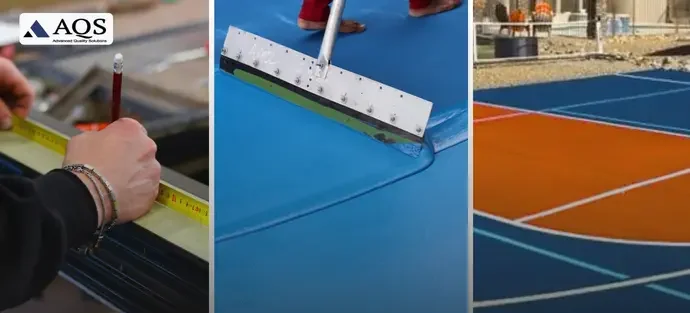
A professional badminton court construction follows a structured process to ensure quality and longevity.
1. Site Inspection & Planning
- Area measurement
- Indoor or outdoor assessment
- Usage intensity evaluation
2. Base Preparation
- Concrete or asphalt base
- Proper slope and drainage
- Crack filling and surface leveling
A strong base is critical for any badminton court material to perform well.
3. Primer Application
The primer ensures strong bonding between the base and acrylic layers.
4. Cushion & Acrylic Coating Layers
Multiple layers are applied to build:
- Shock absorption
- Surface strength
- Anti-skid texture
5. Court Line Marking
Standard badminton court dimensions and markings are applied using durable, non-fading paint.
6. Final Inspection
Surface grip, level, and finish are checked before handover.
Standard Badminton Court Dimensions (Quick Overview)
- Singles court: 13.4 m × 5.18 m
- Doubles court: 13.4 m × 6.1 m
- Recommended clearance: Minimum 1.5–2 m around the court
- Ceiling height (indoor): Minimum 9 m
Correct dimensions are as important as the badminton court material itself.
Indoor vs Outdoor Badminton Court Material
Indoor Courts
- Acrylic or PVC preferred
- Controlled environment
- Longer surface life
Outdoor Courts
- UV-resistant acrylic systems
- Weatherproof coatings
- Proper drainage required
For Indian conditions, acrylic badminton court material works well in both settings when installed professionally.
Maintenance of Badminton Court Material
One major advantage of acrylic flooring is easy maintenance.
Basic care includes:
- Regular dry or wet cleaning
- Avoiding sharp objects
- Checking for minor cracks annually
With proper care, acrylic badminton courts remain playable for 6–8 years or more.
Cost Factors in Badminton Court Construction
The total cost depends on several elements:
- Quality of badminton court material
- Base condition
- Number of acrylic layers
- Indoor or outdoor location
- Court size and quantity
While cheaper materials may seem attractive, investing in quality flooring reduces long-term repair costs.
Common Mistakes to Avoid
- Using non-sports-grade paint
- Ignoring base preparation
- Incorrect line marking
- Choosing flooring only based on price
Reliable badminton court construction always focuses on material quality and expert installation.
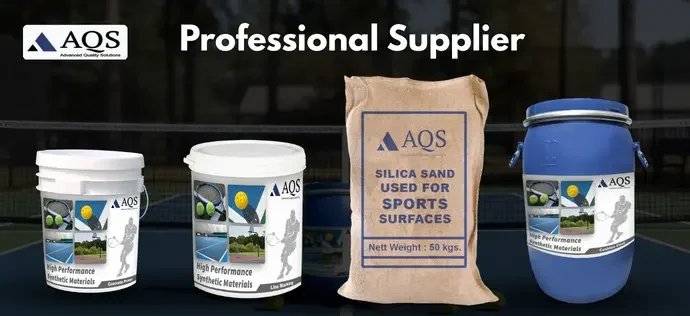
Why Choose a Professional Acrylic Flooring Supplier
A professional supplier ensures:
- Sports-grade materials
- Correct installation process
- Warranty and after-support
- Compliance with playing standards
Final Thoughts
Choosing the right badminton court material is not just about looks—it directly affects player safety, performance, and court lifespan. Among all available options, synthetic acrylic flooring stands out as a reliable, cost-effective, and high-performance solution. When combined with expert badminton court construction, it creates a surface that supports both beginners and professional players.
If the goal is a long-lasting, low-maintenance, and tournament-ready badminton court, investing in quality acrylic flooring from experienced suppliers is always the smart decision.
Frequently Asked Questions
Synthetic acrylic flooring is the most reliable and durable choice.
Yes, it offers excellent grip and playing comfort indoors.
Usually 10–15 days, depending on site condition.
Yes, UV-resistant acrylic works well outdoors.
Yes, quality flooring reduces slips and injuries.
Yes, it only needs basic cleaning and care.