The demand for professional sports infrastructure is rising rapidly across India. Schools, universities, residential townships, sports academies, and private villas are investing in modern tennis facilities. As a result, one of the most searched queries today is “Synthetic Tennis Court Price.” Alongside this, decision-makers frequently search for “Synthetic tennis court near me” to identify reliable contractors and manufacturers.
This comprehensive guide explains the real cost of building a synthetic tennis court, what factors influence pricing, how to evaluate quotations, and how to select the right company for long-term value. The structure is designed to answer high-intent queries clearly and help rank in Google AI overviews and featured snippets.
Table of contents
- What Is a Synthetic Tennis Court?
- Synthetic Tennis Court Price in India
- Standard Tennis Court Dimensions That Impact Cost
- Major Factors That Influence Synthetic Tennis Court Price
- Detailed Cost Structure of a Synthetic Tennis Court
- Why Synthetic Tennis Courts Are a Smart Investment
- How to Choose the Right Synthetic Tennis Court Contractor
- Construction Timeline for Synthetic Tennis Courts
- Maintenance Cost and Lifespan
- Synthetic Tennis Court vs Clay Court Cost Comparison
- Growing Demand and Future Trends
- Who Should Consider Building a Synthetic Tennis Court
- Conclusion
- Frequently Asked Questions
What Is a Synthetic Tennis Court?
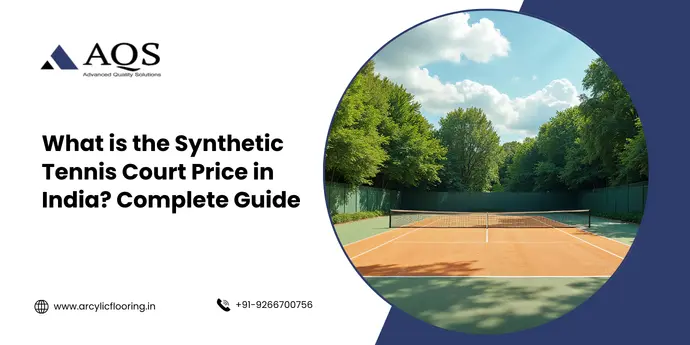
A synthetic tennis court is a hard court system built using acrylic coating layers over a concrete or asphalt base. Unlike clay or natural grass courts, synthetic surfaces are engineered to provide consistent ball bounce, controlled pace, excellent grip, and long-term durability. Modern acrylic tennis court systems typically include a primer coat, resurfacer, cushion layers, color coats, and professional line markings. These layers work together to create a smooth, weather-resistant, UV-stable playing surface suitable for Indian climate conditions. Synthetic courts are now widely preferred because they require less maintenance, last longer, and offer predictable performance throughout the year.
Synthetic Tennis Court Price in India
The average synthetic tennis court price in India typically ranges between ₹450 and ₹900 per square foot. The total project cost for a full-sized court, including run-off area, generally falls between ₹22 lakhs and ₹45 lakhs depending on specifications. This range varies based on base construction type, location, number of acrylic layers, and additional infrastructure such as fencing and lighting. While the per square foot rate is important, the overall project scope determines the final investment. Understanding what is included in the quoted price is essential before comparing contractors.
Upgrade Your Sports Court Today
Get premium synthetic acrylic flooring designed for durability, grip, and performance.
Get Free ConsultationStandard Tennis Court Dimensions That Impact Cost
A standard tennis playing area measures 78 feet in length. The width is 27 feet for singles and 36 feet for doubles. However, pricing is not calculated based only on the playing lines. Professional courts include run-off space for player safety. The recommended total construction area is approximately 120 feet by 60 feet, which equals around 7,200 square feet. Any increase in run-off area, customized layout, or spectator zones will increase the total Synthetic Tennis Court Price. Therefore, accurate measurement planning is critical before budgeting.
Major Factors That Influence Synthetic Tennis Court Price
The first and most significant cost component is base construction. A properly engineered base ensures durability and prevents cracks. Concrete bases are generally more durable but costlier than asphalt. Soil condition, compaction quality, drainage slope, and ground preparation all influence the final price. The second factor is the acrylic surface system. A basic system may include fewer layers, while premium systems include multiple cushion coats designed to reduce joint stress and improve player comfort. More layers increase both material and labor costs. Location also plays a major role. When users search for “synthetic tennis court near me,” they are often looking to reduce transportation and logistics expenses. Projects in metro cities may have higher labor costs, whereas remote areas may incur higher transportation charges.
Additional components such as chain-link fencing, galvanized poles, LED sports lighting, drainage channels, net posts, and seating structures further affect the total investment. High-quality sports lighting alone can significantly raise the overall budget. Finally, if the court is built to meet tournament or international standards, tighter slope tolerances and premium coatings may increase the price.
Detailed Cost Structure of a Synthetic Tennis Court
To better understand the Synthetic Tennis Court Price, it is helpful to break down the project into major segments. Civil base construction generally accounts for nearly half of the total cost. Acrylic coating layers contribute approximately one-third of the project budget. Fencing and lighting can form another significant percentage, depending on specifications. If the site already has a ready, properly leveled concrete slab with correct slope and drainage, the overall cost reduces considerably. However, skipping proper base work to save money often leads to long-term structural issues. Investing in a strong foundation ensures durability for more than a decade.
Why Synthetic Tennis Courts Are a Smart Investment
Although the initial Synthetic Tennis Court Price may seem substantial, the long-term financial benefits are significant. Clay courts require daily watering, frequent rolling, and continuous line maintenance. Grass courts demand mowing, irrigation systems, and high upkeep. Synthetic acrylic courts require only periodic cleaning and occasional resurfacing after several years. Maintenance expenses remain predictable and low.
- For schools and academies, this means uninterrupted usage throughout the year.
- Real estate developers, a tennis court enhances property value and attracts premium buyers.
- For sports clubs, consistent surface performance improves player training outcomes. Over a ten-year period, synthetic courts often prove more economical than traditional surfaces.
How to Choose the Right Synthetic Tennis Court Contractor
Searching for “Synthetic tennis court near me” is often the first step in selecting a contractor. However, proximity alone should not determine the decision. Experience in tennis-specific construction is critical. Contractors must understand slope design, drainage, crack prevention, and correct acrylic layer application. Reviewing past projects and visiting completed sites can provide clarity on quality. It is also important to confirm whether the company supplies materials directly or depends on third-party vendors. Integrated material supply and installation ensure accountability. Warranty terms should be clearly defined. Professional contractors provide surface warranties and explain maintenance procedures transparently. Selecting a technically competent contractor ensures the Synthetic Tennis Court Price paid today delivers long-term value.
Construction Timeline for Synthetic Tennis Courts
A typical synthetic tennis court project takes between 30 and 45 days depending on site readiness and weather conditions. Base construction consumes the majority of the timeline. Proper curing of concrete is essential before applying acrylic layers. Acrylic coating application requires dry weather for correct bonding and curing. Planning construction outside monsoon seasons often ensures faster project completion.
Maintenance Cost and Lifespan
A well-built synthetic tennis court can last 10 to 15 years with proper care. Routine cleaning removes dust and debris. Minor crack repairs should be addressed promptly to prevent expansion. Resurfacing is typically required every five to eight years depending on usage intensity. Resurfacing cost is significantly lower than rebuilding the entire court, making long-term ownership economical. Understanding maintenance expectations helps evaluate the true Synthetic Tennis Court Price beyond installation.
Synthetic Tennis Court vs Clay Court Cost Comparison
Clay courts may appear cheaper initially, but they involve continuous operational costs including watering, rolling, line repainting, and labor. Synthetic courts have higher initial installation costs but much lower ongoing expenses. Over time, total ownership cost tends to favor synthetic acrylic systems, especially in urban and semi-urban areas where labor and water costs are rising. For institutions seeking predictable budgeting, synthetic surfaces provide financial stability.
Growing Demand and Future Trends
The growth of tennis academies, residential townships, and government sports initiatives has increased demand for high-quality synthetic courts. Technological advancements in acrylic polymers are improving surface flexibility and UV resistance. Cushion systems designed to reduce joint impact are becoming more common in premium projects. As domestic manufacturing expands, material quality continues to improve, which may stabilize the overall Synthetic Tennis Court Price in the coming years.
Who Should Consider Building a Synthetic Tennis Court
- Educational institutions aiming to enhance sports infrastructure benefit from durable, year-round playable courts.
- Residential developers use tennis courts as premium lifestyle amenities that increase property appeal.
- Private villa owners invest in personal courts for recreational and professional practice use.
- Sports academies rely on consistent bounce and controlled surface speed for advanced training programs.
- Municipal authorities developing public sports complexes increasingly prefer synthetic systems due to lower maintenance demands.
Conclusion
Understanding the true Synthetic Tennis Court Price requires evaluating base construction quality, acrylic layer thickness, infrastructure additions, and contractor expertise. Focusing solely on the lowest per square foot rate often leads to compromised durability. When searching for a “Synthetic tennis court near me,” prioritize experienced contractors with proven project history, transparent pricing, and warranty-backed systems. A professionally built synthetic tennis court is not just a sports facility. It is a long-term asset that delivers performance, durability, and financial efficiency for years.
Frequently Asked Questions
The average cost ranges between ₹450 and ₹900 per square foot depending on specifications.
A complete project typically costs between ₹22 lakhs and ₹45 lakhs.
With proper maintenance, it can last 10 to 15 years.
Resurfacing is usually needed every five to eight years.
Yes, it requires significantly lower maintenance and provides consistent playing conditions.
Search for experienced local contractors offering full installation services, verified projects, and warranty-backed systems.