Understanding the tennis court size in feet is essential before planning any professional or recreational tennis facility. Whether the project involves a school ground, sports academy, club, or residential court, accurate dimensions directly impact gameplay quality, player safety, and long-term surface performance. This detailed guide explains official measurements, layout planning, clearance requirements, and how Acrylic Flooring enhances durability and performance on standard-sized courts.
Table of contents
- Official Tennis Court Size in Feet (Standard Dimensions)
- Breakdown of Tennis Court Measurements in Feet
- Recommended Total Area Including Clearance Space
- Why Accurate Tennis Court Size in Feet Matters
- Surface Choice and Its Impact on Court Dimensions
- Why Acrylic Flooring is Preferred for Standard Tennis Court Sizes
- Construction Planning Based on Tennis Court Size in Feet
- Indoor vs Outdoor Tennis Court Size in Feet
- Mini Tennis Court and Practice Court Dimensions
- Tennis Court Size in Feet for Doubles vs Singles
- Importance of Precision in Line Marking
- Drainage and Slope Considerations
- Lighting Layout Based on Tennis Court Size in Feet
- Cost Estimation Based on Tennis Court Size in Feet
- Maintenance Planning for Standard Court Size
- Common Mistakes in Measuring Tennis Court Size in Feet
- Professional Construction Checklist
- Conclusion
- Frequently Asked Questions
Official Tennis Court Size in Feet (Standard Dimensions)
The tennis court size in feet depends on whether the game is singles or doubles, but the base rectangular playing area remains constant.
A standard tennis court measures:
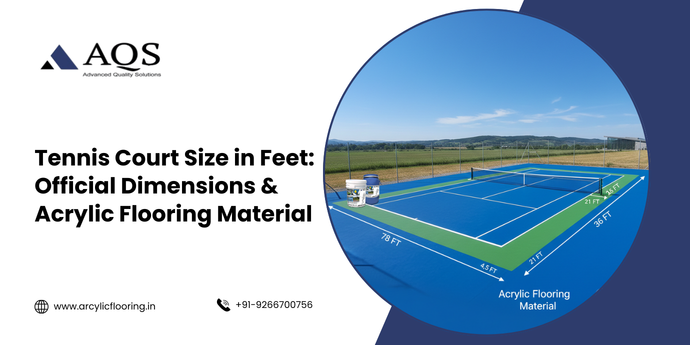
- Length: 78 feet
- Width (Doubles): 36 feet
- Width (Singles): 27 feet
Although the overall court length remains 78 feet for both formats, the width changes using sidelines designated for singles play. These measurements are defined by international tennis authorities and are followed worldwide for tournaments, training centers, and professional facilities.
Upgrade Your Sports Court Today
Get premium synthetic acrylic flooring designed for durability, grip, and performance.
Get Free ConsultationBreakdown of Tennis Court Measurements in Feet
To fully understand the tennis court size in feet, it is important to break the surface into sections.
Total Playing Area
- 78 feet long
- 36 feet wide (doubles court)
This equals 2,808 square feet of total playing space for doubles matches.
Singles Playing Area
- 78 feet long
- 27 feet wide
This equals 2,106 square feet of total playing space for singles matches.
The additional 4.5 feet on each side creates the doubles alley.
Net Height and Placement
Net dimensions are equally important when calculating the full tennis court size in feet.
- Net height at center: 3 feet
- Net height at posts: 3 feet 6 inches
- Distance of net posts from doubles sideline: 3 feet
The net divides the court into two equal halves of 39 feet each.
Service Line and Markings in Feet
Court markings must follow precise measurements to maintain competitive standards.
- Distance from net to service line: 21 feet
- Distance from baseline to service line: 18 feet
- Center service line divides service boxes equally
- Baseline width: 4 inches
- Sideline width: 2 inches
These exact measurements ensure consistent ball bounce and player positioning.
Recommended Total Area Including Clearance Space
While the standard tennis court size in feet refers to the playing surface, additional space around the court is necessary for safe movement.
For comfortable play and tournaments, recommended total space is:
- Length: 120 feet
- Width: 60 feet
This includes run-off areas behind baselines and sidelines. Without proper clearance, players risk injuries and restricted movement.
Why Accurate Tennis Court Size in Feet Matters
Proper dimensions are not just technical requirements. They directly affect:
- Ball trajectory and bounce accuracy
- Player positioning and footwork
- Tournament compliance
- Surface longevity
- Drainage system planning
Incorrect measurements can lead to reconstruction costs and reduced professional credibility.
Surface Choice and Its Impact on Court Dimensions
Although the tennis court size in feet remains fixed, surface materials influence performance and durability. This is where Acrylic Flooring becomes highly relevant.
Why Acrylic Flooring is Preferred for Standard Tennis Court Sizes
Acrylic Flooring systems are widely used for tennis courts due to:
- Consistent ball bounce across the full 78 feet length
- UV resistance for outdoor courts
- Slip-resistant texture
- Low maintenance requirements
- Long-lasting color stability
Because the court size in feet is standardized, Acrylic Flooring ensures uniform thickness and surface tension throughout the 2,808 square feet area, avoiding uneven bounce zones.
Transform Your Sports Facility Today!
Contact us for high-quality synthetic sports flooring material and elevate your space!
Construction Planning Based on Tennis Court Size in Feet
When constructing a tennis court, builders must calculate materials based on total square footage.
For a doubles court:
- Surface area: 2,808 sq ft
- With clearance area: 7,200 sq ft (120 x 60 ft)
This affects:
- Concrete base preparation
- Acrylic coating quantity
- Fencing installation
- Lighting pole placement
- Drainage slope design
Precise measurements reduce material waste and improve budget accuracy.
Indoor vs Outdoor Tennis Court Size in Feet
The playing dimensions remain identical indoors and outdoors. However, indoor facilities require additional vertical clearance.
Recommended Ceiling Height
- Minimum: 30 feet
- Preferred: 35 to 40 feet
Outdoor courts require proper slope grading of approximately 1% to allow water drainage without affecting the 78-foot level surface.
Mini Tennis Court and Practice Court Dimensions
For academies and training centers, smaller practice courts are sometimes developed.
Typical mini court sizes:
- 60 feet length
- 27 feet width
However, these are not tournament standard courts and are used for beginner-level training.
Tennis Court Size in Feet for Doubles vs Singles
The only dimensional difference lies in width.
| Format | Length (Feet) | Width (Feet) |
| Singles | 78 | 27 |
| Doubles | 78 | 36 |
The doubles alley accounts for 4.5 feet on each side beyond singles sidelines.
Importance of Precision in Line Marking
Line marking must be measured carefully from the baseline inward. Even a few inches of deviation can affect gameplay fairness.
Professional Acrylic Flooring systems allow clean and sharp line application using specialized court paint, ensuring:
- Long-term visibility
- Fade resistance
- Proper adhesion
- Tournament compliance
Drainage and Slope Considerations
Although the tennis court size in feet remains flat visually, outdoor courts are built with a slight slope of 1:100 ratio.
This means:
- For every 100 feet of length, 1 foot slope is applied
- On a 78-foot court, slope difference remains minimal but essential
Acrylic Flooring works effectively with proper drainage planning, preventing water accumulation and surface damage.
Lighting Layout Based on Tennis Court Size in Feet
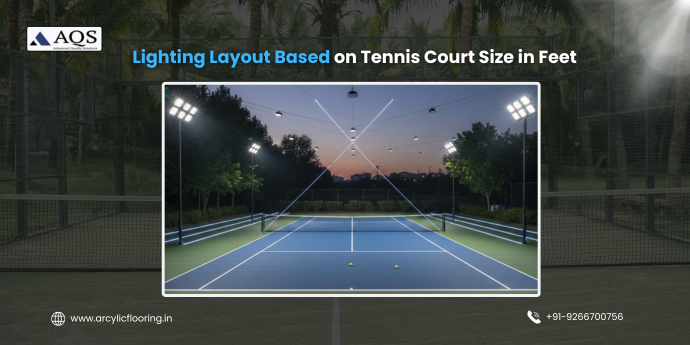
For professional visibility during evening matches, lighting poles are positioned outside the recommended 120 x 60 feet area.
Typical lighting height:
- 20 to 30 feet
Positioning must avoid casting shadows inside the 78-foot playing zone.
Cost Estimation Based on Tennis Court Size in Feet
For a doubles court:
- Base construction cost
- Acrylic Flooring system application cost
- Fencing cost per linear foot
- Lighting installation cost
Since the tennis court size in feet is fixed, budgeting becomes straightforward when using standard measurements
Maintenance Planning for Standard Court Size
Routine maintenance includes:
- Surface cleaning
- Crack inspection
- Recoating Acrylic Flooring every 4–6 years
- Line repainting if required
Because the playing dimensions are uniform worldwide, maintenance materials are standardized and easily calculated.
Common Mistakes in Measuring Tennis Court Size in Feet
Some frequent errors during construction include:
- Incorrect baseline placement
- Improper doubles alley width
- Inadequate clearance area
- Misaligned service boxes
- Ignoring net post placement distance
Avoiding these mistakes ensures long-term structural integrity and tournament eligibility.
Transform Your Sports Facility Today!
Contact us for high-quality synthetic sports flooring material and elevate your space!
Professional Construction Checklist
Before finalizing a tennis court project, confirm:
- Length exactly 78 feet
- Doubles width exactly 36 feet
- Net centered at 39 feet
- Service line placed 21 feet from net
- Adequate 120 x 60 feet clearance
Following this checklist guarantees proper tennis court size in feet compliance.
Conclusion
Understanding the exact tennis court size in feet is the foundation of professional court construction. From the standard 78-foot length to the 36-foot doubles width, every inch matters in ensuring quality gameplay and regulatory compliance. Choosing a high-performance surface like Acrylic Flooring further enhances durability, player safety, and long-term performance across the full playing area. Whether constructing a residential court or a tournament-grade facility, precise measurements combined with advanced surfacing systems guarantee optimal results. Accurate planning today ensures a professional, long-lasting tennis facility built to global standards.
Frequently Asked Questions
The official tennis court measures 78 feet long and 36 feet wide for doubles.
A singles tennis court is 27 feet wide.
A minimum area of 120 feet by 60 feet is recommended.
The net is 3 feet high at the center and 3.5 feet at the posts.
No, the playing dimensions remain 78 by 36 feet in both cases.
Acrylic Flooring is widely preferred for its durability, consistent bounce, and low maintenance.