Pickleball is the fastest-growing sport in the world, and with that growth comes a surge in court construction – from backyard builds to professional-grade facilities. Yet, one of the most overlooked aspects of a new pickleball project is also the most critical: getting the pickleball court dimensions exactly right. A court that is even a few inches off can compromise gameplay, create safety hazards, and fail to meet USA Pickleball (USAP) or International Federation of Pickleball (IFP) standards. Whether you are a school administrator, club manager, municipal planner, or homeowner, this guide covers every official measurement, line detail, layout principle, and construction material requirement you need to build a regulation-standard court from the ground up.
Table of contents
- What Are the Official Pickleball Court Dimensions?
- Full Pickleball Court Dimension Reference Table
- The Anatomy of a Pickleball Court: Zone-by-Zone Breakdown
- Official Pickleball Net Dimensions and Specifications
- Pickleball Court Line Specifications – Width, Color, and Placement
- Pickleball Court Surface Construction: Step-by-Step Guide
- Pickleball Court Dimensions for Multi-Sport Configurations
- Indoor vs Outdoor Pickleball Court Dimensions
- Orientation, Lighting, and Drainage Planning for Pickleball Courts
- Pickleball Court Dimensions vs Other Court Sports – Comparison Table
- Calculating Material Requirements Based on Pickleball Court Dimensions
- Question & Answer (Q&A)
- Conclusion: Precision in Pickleball Court Dimensions Is Non-Negotiable
What Are the Official Pickleball Court Dimensions?
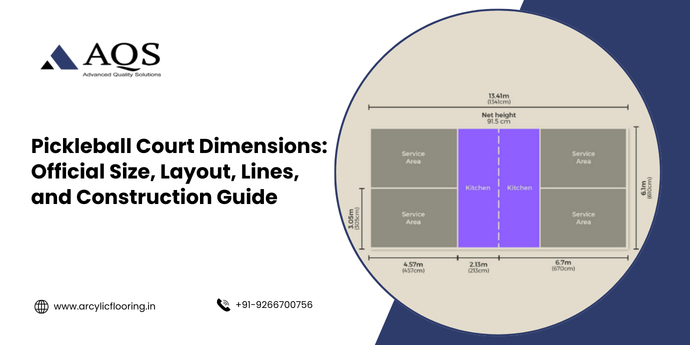
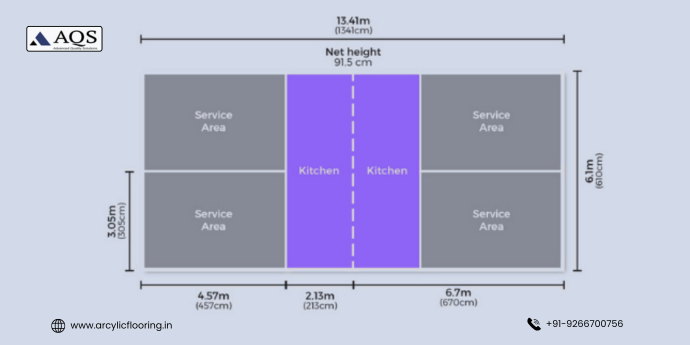
The official pickleball court dimensions as defined by USA Pickleball (formerly USAPA) are a playing surface measuring 44 feet long by 20 feet wide. This total playing area includes both the kitchen (non-volley zone) on each side and the service areas behind it. However, it is critical to understand that these are only the in-bounds court lines – the actual total footprint required for safe, competitive play is considerably larger. The recommended total playing area, including out-of-bounds clearance zones, is 64 feet long by 34 feet wide for recreational courts, and ideally 74 feet by 44 feet for tournament-level facilities. Every builder, architect, and facility owner must plan for this full footprint, not just the boundary lines, before a single drop of Concrete Primer or Acrylic Resurfacer is applied to the base.
Full Pickleball Court Dimension Reference Table
Understanding every line and zone before construction begins is essential for accuracy. The table below presents the complete official measurements for a standard regulation pickleball court.
| Court Component | Imperial Measurement | Metric Measurement |
| Total Court Length (Baseline to Baseline) | 44 feet | 13.41 meters |
| Total Court Width | 20 feet | 6.10 meters |
| Non-Volley Zone (Kitchen) Depth | 7 feet from net | 2.13 meters |
| Service Area Length (each side) | 15 feet | 4.57 meters |
| Centerline Width | 20 feet (full court width) | 6.10 meters |
| Net Length | 22 feet (post to post) | 6.71 meters |
| Net Height at Center | 34 inches | 0.86 meters |
| Net Height at Sidelines | 36 inches | 0.914 meters |
| Recommended Total Playing Area (Recreational) | 64 feet × 34 feet | 19.51m × 10.36m |
| Recommended Total Playing Area (Tournament) | 74 feet × 44 feet | 22.56m × 13.41m |
| Minimum Side Clearance (each side) | 7 feet | 2.13 meters |
| Minimum End Clearance (each end) | 10 feet | 3.05 meters |
The Anatomy of a Pickleball Court: Zone-by-Zone Breakdown
Understanding pickleball court dimensions means understanding each zone’s role in the game. The court is divided into distinct areas, each governed by specific rules. Measurements that directly influence how the game is played. Unlike tennis, where the baseline receives most of the attention, pickleball courts are highly strategic in every zone – from the non-volley line to the centerline. A thorough knowledge of each section allows construction teams to lay out lines accurately, helps surface coating technicians know where transitions must be seamless, and guides players in understanding the legal playing boundaries. Every zone on a pickleball court has both a dimensional and a strategic purpose, making precision in marking absolutely non-negotiable.
Upgrade Your Sports Court Today
Get premium synthetic acrylic flooring designed for durability, grip, and performance.
Get Free ConsultationThe Non-Volley Zone (Kitchen)
The Non-Volley Zone – commonly called “the kitchen” – is one of the most strategically important and dimensionally precise areas on the court. It extends 7 feet from the net on both sides, running the full 20-foot width of the court. Players are not allowed to volley (strike the ball in the air without a bounce) while standing inside this zone or while touching its lines. The kitchen line itself is considered part of the non-volley zone. This 7-foot measurement is fixed for all levels of play – recreational, club, and professional – making it one of the most important dimensions a line-marking crew must get precisely right. An error of even 2–3 inches in the kitchen line can technically alter the legality of shots during competitive play.
Transform Your Sports Facility Today!
Contact us for high-quality synthetic sports flooring material and elevate your space!
The Service Areas
Behind the kitchen on each side of the net lie the two service areas, each measuring 15 feet deep (from the kitchen line to the baseline) and 10 feet wide (half the full 20-foot court width, separated by the centerline). Players serve from within these areas diagonally cross-court to the opponent’s service box. The centerline divides each side’s service area into a left and right box. Both service areas on a single side together span the full 20-foot width. It is worth noting that unlike tennis, the server in pickleball must use an underhand stroke and make contact with the ball below waist level. The service area dimensions are designed to make this style of play both fair and challenging across all skill levels.
The Baseline and Sidelines
The baseline is the back boundary of the court, running 20 feet wide at each end. Players must serve from behind this line, and it is the outermost boundary of legal play on the long axis of the court. The sidelines run the full 44-foot length of the court on each side and define the lateral boundaries. Balls landing outside these lines are considered out. For construction and surfacing purposes, the sideline and baseline are among the most trafficked edges of the court – players frequently stop and pivot near these lines – making the durability of the court coating, including products like Cushion Coat applied along these boundaries, especially important for player safety and long-term wear resistance.
Did You Know? The Court Is Smaller Than You Think!
A pickleball court at 44 × 20 feet is less than one-third the size of a standard doubles tennis court (78 × 36 feet). Yet somehow, the game feels just as intense — proving that great sport doesn’t need great space!
Official Pickleball Net Dimensions and Specifications
The net is the centerpiece of the court and must conform to specific dimensional standards to ensure fair play. According to USA Pickleball regulations. The net must be 22 feet wide – that is, 2 feet wider than the court on each side, with the net posts positioned 1 foot outside each sideline. The net height must measure 34 inches at the center and 36 inches at the sideline posts. This slight droop in the center is intentional and mirrors the design philosophy in tennis, where the center of the net is lower to create a slightly different geometry for cross-court shots. The net itself must be made of a mesh fabric fine enough that the ball cannot pass through it. Posts must be rigid and set firmly into the ground or a weighted base system for permanent and temporary installations respectively.
Net Post Placement – A Critical Dimension Often Overlooked
One of the most frequently misunderstood aspects of official pickleball court dimensions is the net post placement. The posts are not placed at the sidelines. They are placed 1 foot outside each sideline, meaning the full post-to-post net span is 22 feet even though the court is only 20 feet wide. This distinction matters enormously during construction and court marking. If a builder mistakenly places post sleeves at the sideline (20 feet apart), the net will sag incorrectly at the edges and may not maintain the required 36-inch height at the posts. This error is also difficult to correct once the surface has been coated with Acrylic Resurfacer and Cushion Coat layers, which is why pre-surface layout verification is essential.
Pickleball Court Line Specifications – Width, Color, and Placement
Line marking on a pickleball court is governed by strict specifications that must be followed to meet both playability and officiating standards. All court lines must be 2 inches wide, and they must be the same color – uniformly. The lines must contrast clearly with the surface color of the court. Typically, white lines are used on blue or green court surfaces, as these color combinations provide maximum visual clarity for players, spectators, and line judges. The lines include: two baselines, two sidelines (full length), two non-volley zone lines (kitchen lines), and one centerline on each side. All lines are considered in-bounds, meaning a ball that lands on any line is considered a legal shot.
Line Marking Material Requirements
Line paint for pickleball courts is not ordinary paint. It must be formulated to bond with acrylic court surfaces without cracking, peeling, or creating uneven textures that alter ball bounce. Using the wrong line material can result in inconsistent ball bounce right at the line versus the rest of the court, which frustrates players and creates disputes during competitive play. Professional-grade court line paints are typically water-based acrylic emulsions with fine sand additives to ensure the line texture matches the surrounding Acrylic Resurfacer and Cushion Coat playing surface. This texture consistency is what separates a professionally built court from an amateur installation. Always apply line marking as the final step after all base coats and color layers have been fully cured.
Pickleball Court Surface Construction: Step-by-Step Guide
Building a regulation pickleball court from scratch is a multi-stage process. Requires careful attention to both the sub-base and the surface layers. Skipping or shortcutting any phase of this process leads to premature surface degradation, cracking, drainage failure, and costly resurfacing within just a few years. The construction process can be broadly divided into five phases: site preparation and sub-base, concrete or asphalt base laying, priming, resurfacing, and color coating with line marking. Each phase directly affects the long-term performance of the court surface, and each requires specific materials suited to the demands of sports court construction.
Phase 1 – Site Preparation and Sub-Base
The construction of a pickleball court begins well before any concrete is poured. The site must first be cleared, graded, and compacted to create a stable, level sub-base. A proper sub-base typically consists of 4 to 6 inches of compacted aggregate (crushed gravel or stone base material) to ensure adequate drainage and structural support. The entire playing area including the recommended clearance zones – must be graded with a minimum slope of 1% (1 inch per 10 feet) in a single plane to allow water to drain off the court efficiently. Poor drainage is one of the leading causes of surface failure in outdoor courts. Standing water accelerates the breakdown of acrylic coatings and can cause dangerous algae growth on the playing surface over time.
Phase 2 – Concrete or Asphalt Base
Once the sub-base is compacted, the structural court base is laid. For pickleball courts, both concrete and asphalt bases are acceptable, but each has distinct properties that affect how surface products like Concrete Primer and Acrylic Resurfacer are applied. Concrete offers superior rigidity and longevity but is more prone to cracking if the sub-base settles unevenly. Asphalt is more flexible and easier to repair but has a shorter lifespan and requires more frequent resurfacing. A concrete slab for a pickleball court should be a minimum of 4 inches thick (6 inches recommended), using a 3,000 PSI concrete mix with proper expansion joints to manage thermal expansion and contraction across seasons. All joints must be sealed before surface coatings are applied.
Phase 3 – Applying Concrete Primer
After the base has cured completely (typically 28 days for concrete. And until it reaches sufficient hardness), the surface is ready for its first treatment. Concrete Primer is the critical first step in the surface layering system. It performs three essential functions: it seals the pores of the concrete to prevent moisture from migrating through the slab, it bonds the base layer to the subsequent acrylic coatings, and it ensures that the Acrylic Resurfacer applied on top adheres uniformly across the entire surface. Without proper Concrete Primer application, the acrylic system above it will peel, blister, or delaminate – especially under the thermal and mechanical stress of daily sports play. The primer must be applied with a squeegee or roller, ensuring complete and even coverage without puddling or missed spots.
Phase 4 – Acrylic Resurfacer Application
Acrylic Resurfacer is the leveling and smoothing layer applied over the primed concrete or asphalt base. It is a sand-filled acrylic compound that fills micro-cracks, surface imperfections, and porosity irregularities to create a consistently smooth and stable playing surface. For a new concrete court, typically 1 to 2 coats of Acrylic Resurfacer are required. On older or more porous surfaces, additional coats may be necessary. The key performance standard for Acrylic Resurfacer is flatness: after application and curing, the surface must not deviate more than 1/8 inch in any 10-foot radius. Any deviations larger than this will result in “birdbaths” – puddles that pool after rain and can take hours to dry, making the court unplayable. The resurfacer must be allowed to cure fully before the color coat is applied.
Phase 5 – Cushion Coat and Color Coating
After the Acrylic Resurfacer has fully cured, the Cushion Coat layer is applied. Cushion Coat is a rubber-fortified, multi-layer acrylic system specifically engineered to provide shock absorption, joint protection, and comfort for players during extended play. It reduces the impact load on players’ knees, ankles, and hips – a critical feature for pickleball, which attracts a large number of older adult players. The number of Cushion Coat layers determines the degree of cushioning: more layers mean greater shock absorption. After the Cushion Coat, the top color coats are applied in the desired court colors (typically 2–3 color coats using high-quality acrylic color emulsions), followed by the application of the white line marking paint. Each layer must be allowed to cure between applications for optimal adhesion and performance.
Pickleball Court Dimensions for Multi-Sport Configurations
One of the most practical aspects of pickleball court design is that pickleball courts can be built within existing tennis court footprints, making multi-sport conversions highly cost-effective. A standard tennis court (78 feet × 36 feet) can accommodate two pickleball courts side by side with comfortable clearance zones on all sides, or even four pickleball courts if the full tennis footprint with runoff (120 feet × 60 feet) is used. This multi-sport configuration is increasingly popular in schools, community centers, and residential clubs where space is limited. When designing a multi-court layout, it is important to use contrasting line colors to prevent player confusion – for example, blue pickleball lines on a green tennis surface, or vice versa. The existing Acrylic Resurfacer base of the tennis court can serve as the foundation, requiring only additional Cushion Coat and color coats before pickleball line marking.
How Many Pickleball Courts Fit on a Tennis Court?
| Tennis Court Configuration | Number of Pickleball Courts | Notes |
| Single Tennis Court (baseline area) | 2 Pickleball Courts | Side-by-side layout with shared net |
| Full Tennis Footprint (120′ × 60′) | 4 Pickleball Courts | Tight but functional |
| Double Tennis Court Facility | 6–8 Pickleball Courts | Ideal for club-level pickleball programs |
| New Dedicated Pickleball Facility | 1 per 64′ × 34′ area | Includes full recommended clearance |
Pickleball and Badminton Are Secret Twins!!
Here’s a dimension fact that surprises almost everyone: a pickleball court and a badminton doubles court are exactly the same size, both 44 feet long and 20 feet wide. The sports look completely different, but they literally share the same footprint!
Indoor vs Outdoor Pickleball Court Dimensions
The official The Length of Pickleball Court of 44 feet by 20 feet remain constant whether the court is indoors or outdoors. However, the practical requirements around those dimensions differ significantly depending on the environment. Outdoor courts must account for wind, UV exposure, temperature cycling, and rain drainage. Indoor courts face different challenges: ceiling height requirements, HVAC airflow interference, and artificial lighting must all be planned carefully. For indoor courts, a minimum ceiling clearance of 18–20 feet above the court surface is recommended to allow for lobs without restriction. Outdoor courts must have their slope and drainage system engineered to handle local rainfall volumes. Surface material choices also differ: outdoor courts benefit from UV-resistant Acrylic Resurfacer and Cushion Coat formulations, while indoor courts prioritize consistent surface speed and cushioning performance.
Transform Your Sports Facility Today!
Contact us for high-quality synthetic sports flooring material and elevate your space!
Orientation, Lighting, and Drainage Planning for Pickleball Courts
Beyond the physical pickleball court construction, the orientation of the court on the site is a critical design decision that affects playability every single day. The universally recommended orientation for pickleball courts is North-South, placing the net running East-West. This ensures that neither player faces the rising or setting sun during play, which would create severe visibility disadvantages and make the court functionally unusable during certain hours. Lighting for outdoor courts should be positioned to align with the sidelines and net, using pole heights of at least 18–20 feet to minimize shadows across the playing surface. Drainage must be planned with a single-plane slope of 1% – never a crowned slope – so water runs consistently off one side rather than pooling at the center of the court.
Pickleball Court Dimensions vs Other Court Sports – Comparison Table
Understanding where pickleball sits in relation to other court sports helps facility planners design multi-use complexes and properly estimate material requirements for surface coatings.
| Sport | Court Length | Court Width | Total Court Area | Net Height (Center) |
| Pickleball | 44 feet | 20 feet | 880 sq. ft. | 34 inches |
| Tennis (Doubles) | 78 feet | 36 feet | 2,808 sq. ft. | 36 inches |
| Badminton (Doubles) | 44 feet | 20 feet | 880 sq. ft. | 5 feet |
| Platform Tennis | 60 feet | 30 feet | 1,800 sq. ft. | 34 inches |
| Paddle Tennis | 50 feet | 20 feet | 1,000 sq. ft. | 31 inches |
Upgrade Your Sports Court Today
Get premium synthetic acrylic flooring designed for durability, grip, and performance.
Get Free ConsultationAs this comparison illustrates, pickleball and badminton share identical court dimensions – a fact that often surprises facility planners. The key differentiator is the net height and the surface requirements, where pickleball’s acrylic hard court surfaces demand specifically engineered products like Cushion Coat for player comfort, while badminton is played on resilient wood or synthetic indoor surfaces.
Calculating Material Requirements Based on Pickleball Court Dimensions
Knowing the official pickleball court dimensions directly determines how much surfacing material is needed for a build or resurfacing project. The fundamental formula is straightforward: Total Length × Total Width = Total Surface Area. For a single recreational court with recommended clearance: 64 feet × 34 feet = 2,176 square feet. For a tournament court: 74 feet × 44 feet = 3,256 square feet. However, material quantities are not simply based on one coat of one product – a complete acrylic system involves multiple layers, each with its own coverage rate. A typical multi-layer system for pickleball courts includes: 1 coat of Concrete Primer, 1–2 coats of Acrylic Resurfacer, 2–4 coats of Cushion Coat, 2–3 color coats, and a final line marking layer. Always factor in a 10–15% overage for porous substrates or complex multi-court configurations.
Material Estimation Reference Table
| Product | Application Stage | Typical Coats | Coverage Rate (approx.) |
| Concrete Primer | Layer 1 | 1 coat | 400–500 sq. ft. per gallon |
| Acrylic Resurfacer | Layer 2 | 1–2 coats | 100–150 sq. ft. per gallon |
| Cushion Coat | Layer 3 | 2–4 coats | 100–120 sq. ft. per gallon |
| Acrylic Color Coat | Layer 4 | 2–3 coats | 200–300 sq. ft. per gallon |
| White Line Marking | Final Layer | 1–2 coats | 250–400 sq. ft. per gallon |
Question & Answer (Q&A)
The official playing area is 44 feet long by 20 feet wide. The recommended total playing footprint, including clearance zones, is 64 feet by 34 feet for recreational courts and 74 feet by 44 feet for tournament facilities.
The net measures 34 inches at the center and 36 inches at the sideline posts. The net spans 22 feet from post to post, which is 1 foot wider than the court on each side.
All lines on a pickleball court must be exactly 2 inches wide. Lines are typically white and must contrast clearly with the court surface color.
Yes. A standard tennis court (78′ × 36′) can accommodate two pickleball courts side-by-side, and the full tennis footprint (120′ × 60′) can hold four pickleball courts. Additional surface coatings like Cushion Coat and new line marking are needed for conversion.
The kitchen extends 7 feet from the net on both sides of the court, running the full 20-foot width of the court.
A complete acrylic pickleball court system includes: Concrete Primer for base sealing, Acrylic Resurfacer for surface leveling, Cushion Coat for shock absorption and player comfort, followed by acrylic color coats and line marking paint.
A minimum slope of 1% (1 inch drop per 10 feet) in a single plane is required for proper water drainage.
Conclusion: Precision in Pickleball Court Dimensions Is Non-Negotiable
From the 44-foot baseline-to-baseline length to the 7-foot kitchen depth and the 34-inch center net height, every Pickleball court manufacturer serves a purpose – competitive fairness, player safety, and the integrity of the game itself. But accurate dimensions are only the beginning. The long-term performance of a pickleball court depends equally on the quality of the construction materials used to bring those dimensions to life. A properly engineered surface system – starting with Concrete Primer to seal and bond the base, built up with Acrylic Resurfacer to create a smooth, level playing field, and completed with Cushion Coat for player comfort and durability – is what separates a court that performs for decades from one that deteriorates within a few years.
Whether you are building a single backyard court or a multi-court tournament facility, precision measurement and premium-grade acrylic surface materials are the two pillars of every successful pickleball court project. Plan your dimensions carefully, invest in the right surface system, and your court will deliver world-class play for years to come.
Ready to surface your pickleball court? Contact AQS today to discuss your material requirements for Concrete Primer, Acrylic Resurfacer, Cushion Coat, and complete court flooring systems engineered for peak performance.