Pickleball has exploded across India in 2026, and professional pickleball court builders are now among the most sought-after sports infrastructure specialists in the country. The sport combines tennis, badminton, and ping-pong into one fast, fun, and highly social game that suits all age groups. Builders now serve clients ranging from housing societies and luxury hotels to government sports academies and private clubs.
The demand for quality court construction has pushed builders to adopt advanced materials, precision engineering, and international surface standards. Acrylic flooring systems have emerged as the clear winner in India’s climate and court-usage conditions. Understanding what separates an expert pickleball court builder from a generic contractor is the first step to getting a court that performs, lasts, and looks world-class.
What Does a Professional Pickleball Court Builder Actually Do?
Full-Scope Construction Services Offered in 2026
Professional pickleball court builders in India today deliver end-to-end court construction solutions that go far beyond laying a surface. They conduct site surveys, soil testing, and drainage assessments before a single slab is poured. They design custom layouts for residential backyards, commercial rooftops, indoor gymnasiums, and multi-court complexes.
A qualified builder handles civil foundation work, concrete or asphalt base preparation, acrylic or synthetic surface application, line marking, net post installation, fencing, lighting, and final certification. Many builders now offer digital design previews using 3D modelling tools before construction begins. This full-service model ensures clients get a court that meets PFI and international pickleball association standards in 2026.
Upgrade Your Sports Court Today
Get premium synthetic acrylic flooring designed for durability, grip, and performance.
Get Free ConsultationIndoor vs Outdoor Court Construction Specialists
Builders differentiate their services between indoor and outdoor court construction because each demands different materials and engineering. Outdoor courts require UV-stable acrylic coatings, proper slope for water runoff, and high-durability sub-base layers. Indoor courts need cushioned acrylic or rubberised synthetic systems with controlled lighting and ventilation planning.
In 2026, Indian builders report that demand for rooftop and indoor courts has grown by over 60% compared to 2023. Apartment complexes and IT parks are leading this indoor pickleball court construction boom. Builders now carry both indoor and outdoor certifications from surface manufacturers.
Acrylic Flooring vs Clay Court – Why Acrylic Wins Every Time
This is one of the most critical decisions any court owner faces. The surface type defines gameplay quality, maintenance burden, player safety, and long-term cost. Below is a thorough comparison.
Performance and Playability on Acrylic Courts
Acrylic hard courts offer a consistent, true, and predictable ball bounce that serious pickleball players demand. The surface texture is engineered to control speed – builders can choose from slow, medium, and fast acrylic systems depending on client preference. Players experience low-impact cushioning on cushioned acrylic systems, which reduces knee and ankle strain significantly.
Acrylic surfaces are the official choice for national and international pickleball tournaments in India as of 2026. The Pickleball Federation of India mandates acrylic or similar hard-court surfaces for all PFI-sanctioned events. No clay court has ever been used at a national-level pickleball event in India – and for very good reason.
Why Clay Courts Fail for Pickleball in Indian Climate
Clay courts absorb moisture heavily during monsoon season, making them soft, uneven, and dangerous for pickleball play. Maintenance costs on clay courts in India run 3–5 times higher annually than on acrylic courts because resurfacing, rolling, and watering are constant requirements. The slower surface also distorts the fast-paced pickleball gameplay that makes the sport exciting.
Clay court lines wash away, the surface cracks and shifts in peak summer heat above 40°C, and clay courts cannot host play for several days after rain. India’s climate – with six to eight months of high humidity or monsoon conditions across most regions – makes clay courts a poor investment for pickleball. Acrylic courts are playable within 30 minutes of rain stopping, require annual recoating at most, and provide zero weather disruption for most of the year.
Comparison Table – Acrylic Court vs Clay Court for Pickleball
| Feature | Acrylic Hard Court | Clay Court |
| Ball Bounce Consistency | Excellent – uniform every time | Poor – varies with moisture |
| Maintenance Frequency | Annual coating check | Weekly/monthly rolling & watering |
| Annual Maintenance Cost | ₹15,000 – ₹40,000 | ₹80,000 – ₹2,00,000 |
| Playable After Rain | 20–30 minutes | 24–72 hours |
| Surface Lifespan | 8–15 years | 3–6 years |
| Player Joint Safety | High (cushioned systems available) | Moderate |
| PFI Tournament Approved | Yes | No |
| UV & Heat Resistance | Excellent | Poor – dries and cracks |
| Suitable for Rooftop | Yes | No |
| Suitable for Indoors | Yes | No |
| Initial Construction Cost | ₹4,50,000 – ₹12,00,000 | ₹2,50,000 – ₹5,00,000 |
| Long-Term Value (10 years) | High | Low |
Verdict
Acrylic courts cost more upfront but deliver dramatically better value, gameplay, and safety over a 10-year period.
Types of Acrylic Flooring Systems Used by Pickleball Court Builders in India
Standard Acrylic Coating on Concrete Base
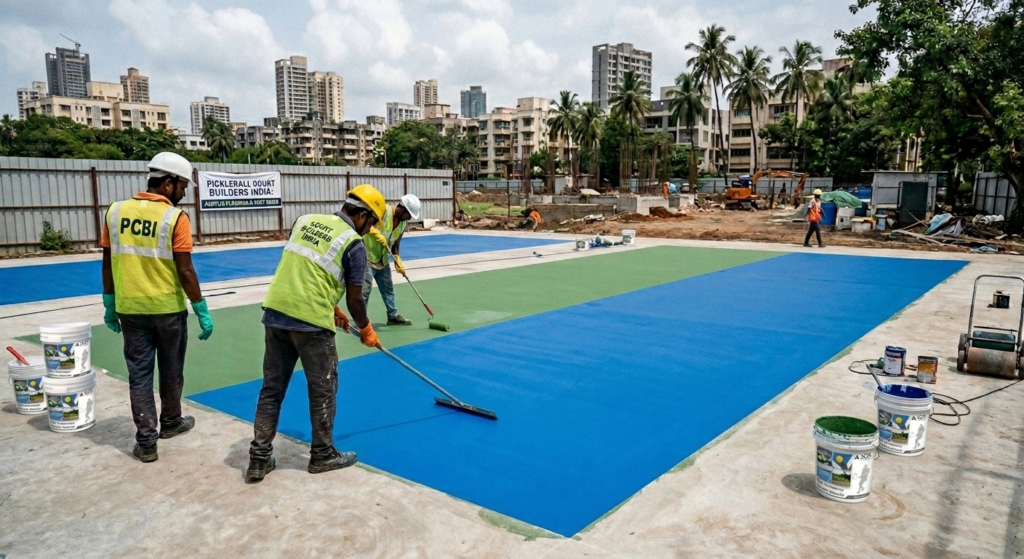
This is the most popular system chosen by pickleball court builders across India in 2026. A 100–150mm reinforced concrete base is laid first, cured, and then multiple layers of acrylic resurfacer and colour coat are applied. The result is a hard, flat, visually sharp court that lasts 10–15 years with basic annual maintenance.
Builders typically apply 3–4 layers of acrylic on top of the concrete – a filler coat, levelling coat, colour base, and a final texture coat. Sand is embedded in the texture coat to control the ball’s speed and provide grip for players’ shoes. This system costs between ₹4,50,000 and ₹7,50,000 for a standard doubles court in most Indian cities as of 2026.
Cushioned Acrylic System for Joint Protection
The cushioned acrylic system includes a layer of rubber granules or foam beneath the acrylic colour coating, providing a slight spring that significantly reduces fatigue and joint stress. This system is popular for schools, senior citizen communities, and high-usage commercial courts where player wellbeing is a top priority.
Cushioned acrylic systems are 20–30% more expensive than standard acrylic but are recommended by sports physiotherapists for players who train daily. Many corporate sports facilities and luxury residential communities across Bangalore, Mumbai, Pune, and Delhi are now specifying cushioned acrylic as a standard requirement when engaging pickleball court builders.
Modular Acrylic Tiles for Temporary or Indoor Courts
Modular interlocking acrylic tiles offer a removable, portable court solution ideal for indoor gymnasiums, multi-purpose halls, and temporary tournament setups. These tiles click together without adhesive and sit on any flat surface. They require no concrete base, making them ideal for rooftop courts where structural weight limits apply.
Top pickleball court builders in India now stock multiple modular tile brands including globally certified systems. Installation takes as little as one to two days. The cost ranges from ₹6,00,000 to ₹10,00,000 for a doubles court setup with tiles, net posts, and line marking.
Transform Your Sports Facility Today!
Contact us for high-quality synthetic sports flooring material and elevate your space!
Pickleball Court Construction Cost Breakdown – India 2026
Detailed Cost Information Table
| Cost Component | Estimated Cost (INR) | Notes |
| Site Survey & Soil Testing | ₹5,000 – ₹15,000 | One-time |
| Earthwork & Levelling | ₹20,000 – ₹60,000 | Depends on site condition |
| Concrete Sub-Base (RCC) | ₹1,20,000 – ₹2,50,000 | Standard thickness |
| Acrylic Surface (Standard) | ₹1,50,000 – ₹2,50,000 | Multi-coat system |
| Acrylic Surface (Cushioned) | ₹2,20,000 – ₹3,50,000 | Premium cushion layer |
| Line Marking | ₹8,000 – ₹20,000 | PFI-approved dimensions |
| Net Posts & Net | ₹15,000 – ₹40,000 | Galvanised steel posts |
| Chain-Link Fencing | ₹60,000 – ₹1,80,000 | Per court perimeter |
| LED Floodlighting | ₹80,000 – ₹2,50,000 | 4–8 pole system |
| Drainage System | ₹25,000 – ₹75,000 | Slope and channel design |
| Total Estimated (Standard) | ₹4,50,000 – ₹7,50,000 | |
| Total Estimated (Premium) | ₹8,00,000 – ₹12,00,000 |
Prices reflect 2026 Indian market rates and may vary by city and builder.
Case Study – Multi-Court Acrylic Pickleball Complex, Pune 2025
Client: Private Sports & Wellness Club, Pune (Name withheld for privacy) Project Scope: 4 outdoor doubles pickleball courts with full acrylic surfacing, fencing, LED lighting, and spectator seating Builder: Certified pickleball court construction firm with PFI partnership Timeline: 28 days from groundbreaking to inauguration Budget: ₹38,00,000 (all four courts, complete turnkey)
Challenge: The site had significant slope variation of nearly 600mm across the plot, and the soil had high clay content with poor load-bearing capacity. Heavy monsoon rains had also waterlogged the area in prior years.
Solution: The builder’s civil team designed a raised RCC foundation with integrated French drains across all four courts. A geo-textile membrane was laid before the concrete pour to prevent ground moisture migration. Standard cushioned acrylic was chosen for all courts to accommodate the club’s senior membership base.
Result: All four courts passed PFI inspection and are now certified for state-level tournament hosting. Member usage reached 85% court occupancy within the first 60 days of opening. The club reported zero weather-related closures in the first monsoon season post-construction. The builder also completed a 12-month maintenance contract that includes quarterly surface inspection and an annual colour coat refresh.
Key Takeaway: Expert site engineering before surface application is what separates successful court projects from failed ones. Choosing acrylic over clay was a unanimous club committee decision driven by maintenance convenience and tournament eligibility.
How to Choose the Right Pickleball Court Builder in India
Credentials, Certifications, and PFI Alignment in 2026
The right pickleball court builder holds certifications from recognized acrylic surface manufacturers such as Laykold, Plexipave, or equivalent brands. They maintain documented experience with PFI dimension standards and can provide a certificate of compliance upon project completion. Always ask builders for PFI court dimension drawings before signing any contract.
In 2026, the Pickleball Federation of India updated its court construction guidelines to include stricter surface friction coefficient standards and mandatory drainage gradient specifications. Builders who are not aware of these 2026 updates may construct courts that fail PFI certification checks. Always verify that your builder works with these updated specifications.
Portfolio, References, and Site Visits Before Hiring
A credible pickleball court builder will maintain a portfolio of at least five to ten completed court projects with client references. Ask for permission to visit two or three of their completed courts and assess surface quality, line marking precision, drainage functionality, and net post stability. Playing a game on the builder’s previous work is the best test of their quality.
Builders who refuse to share references or discourage site visits should be avoided. In India’s growing pickleball market, several low-quality contractors are positioning themselves as specialists without genuine court construction experience. Due diligence through reference visits protects your investment.
Warranty Terms and Annual Maintenance Contracts
Top pickleball court builders in India now offer 2–5 year structural warranties on their court foundations and 1–2 year surface warranties on acrylic coatings. Always get warranty terms in writing before work begins. A strong maintenance contract – typically priced at ₹15,000 to ₹40,000 per year – ensures your court surface is inspected, cleaned, and recoated on schedule.
Upgrade Your Sports Court Today
Get premium synthetic acrylic flooring designed for durability, grip, and performance.
Get Free ConsultationLatest 2026 Pickleball Court Standards in India
PFI Updated Specifications You Must Know
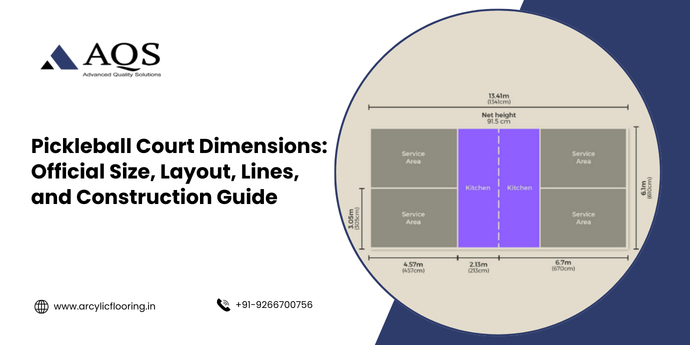
The Pickleball Federation of India released updated construction standards in early 2026 covering court dimensions, surface texture, net height, and fencing requirements. The standard doubles court must measure exactly 13.41 metres in length and 6.1 metres in width for singles, or 7.01 metres for doubles. The non-volley zone (kitchen) line must sit exactly 2.13 metres from the net on both sides.
Surface friction coefficients must now fall between 0.5 and 0.8 under the updated PFI 2026 framework to ensure player safety across all playing surfaces. Courts targeting PFI certification must also include a minimum 1.83-metre clearance on both ends and 0.91-metre clearance on both sides. Builders unfamiliar with these 2026 measurements may create courts that cannot host official events.
Lighting and Fencing Standards for Certified Courts
LED floodlighting for certified pickleball courts must deliver a minimum of 300 lux at court level for recreational play and 500 lux for competitive events under updated 2026 Indian sports infrastructure norms. Builders should mount poles at minimum 6–8 metres height to avoid shadow interference during play. Glare control panels are now recommended for all outdoor lighted courts.
Perimeter fencing must be a minimum 2.74 metres in height using galvanised chain-link or PVC-coated mesh. The fencing should sit at least 0.9 metres outside the court boundary lines on all sides. These standards ensure both player safety and ball containment during fast rally exchanges.
Transform Your Sports Facility Today!
Contact us for high-quality synthetic sports flooring material and elevate your space!
Some Different Factors of Pickleball Court Installation
Rooftop Pickleball Court Installation for Apartments and Commercial Buildings
Rooftop courts are the fastest-growing segment for pickleball court builders in urban India in 2026. Builders must conduct structural load analysis before installation and typically opt for modular acrylic tile systems to keep weight manageable. Waterproofing of the rooftop membrane must be completed before any court base is laid.
Indoor Pickleball Court Construction for Gyms and Sports Academies
Gym owners and sports academies across India are converting badminton and multipurpose halls into dedicated pickleball facilities. Indoor acrylic surfaces – often combined with cushioning – are applied over existing concrete floors with minimal civil disruption. Builders should account for ceiling height of at least 6 metres for comfortable indoor play.
Multi-Sport Court Conversion – Pickleball Lines on Existing Courts
Many tennis, badminton, and basketball court owners want to add pickleball lines to existing surfaces without full reconstruction. Professional pickleball court builders offer line marking services using contrasting colours on existing acrylic or wooden floors. This is the most cost-effective entry point into pickleball infrastructure at ₹8,000 to ₹25,000 per court set of lines.
Eco-Friendly and Sustainable Court Construction Trends in 2026
Several leading pickleball court builders are now offering low-VOC acrylic coatings, recycled rubber cushion layers, and solar-powered LED lighting packages as standard sustainability options. Green-certified court projects qualify for LEED and IGBC points in commercial construction projects across India. Sustainable construction also supports faster municipal approvals in several progressive Indian cities.
Conclusion
The pickleball revolution in India is real, fast-moving, and here to stay in 2026. Whether you are building your first residential backyard court or a professional multi-court club complex, choosing the right pickleball court builder and the right surface material defines every aspect of your court’s future. Acrylic flooring is not simply a preference it is the professional, practical, and performance-driven standard that all serious court owners across India are adopting.
From rooftop installations to indoor sports academies, from single courts to ten-court complexes, professional pickleball court builders deliver the engineering precision, surface quality, and certification compliance that the sport demands. Do your due diligence, check credentials, visit previous projects, and always specify acrylic. Your court will reward you and every player who steps on it for years to come.
Frequently Asked Questions
The cost of building a pickleball court in India depends on the location, material used, site conditions and additional features like fencing and lighting. On average, you can expect to spend between ₹3.5 lakh and ₹7 lakh for a standard outdoor court with synthetic acrylic flooring.
A standard pickleball court is 20 feet wide by 44 feet long. This includes both singles and doubles play. Extra space is required around the court for safe movement and play.
Yes, absolutely. Many people are installing backyard pickleball courts for recreation. A professional will assess the space available, provide layout planning and recommend the right flooring material for your location.
Synthetic acrylic flooring is the best for outdoor pickleball courts as it has UV protection, slip resistance, weather durability and consistent bounce. It’s the top choice for both recreational and professional use.
Depending on the site condition and weather, it takes 2 to 4 weeks to complete a standard outdoor pickleball court, including base work, surface application and court markings.