Building a basketball court is one of the most rewarding investments you can make for your home, school, or sports facility. Whether you envision a full-size NBA-regulation court or a compact backyard half-court, understanding the true basketball court cost helps you plan smarter, spend wiser, and avoid costly surprises. This guide breaks down every pricing factor – from basketball court flooring and basketball court material to basketball court installation cost – so you make the right decision from day one.
Basketball court costs in India in 2026 range from as low as ₹3,02,400 for a basic backyard half-court to over ₹1,26,00,000 for a premium indoor facility with hardwood flooring, professional lighting, and custom graphics. The wide range reflects differences in court size, surface material, location, labor rates, and added features. This comprehensive guide covers all cost categories with real data, detailed tables, expert tips, and frequently asked questions to help you budget accurately.
Table of contents
- Full Basketball Court Measurements
- Basketball Court Measurement Table
- Basketball Court Cost at a Glance: Quick Reference Table
- Key Factors That Determine Your Basketball Court Cost
- Basketball Court Flooring Cost Per Square Foot by Material
- Basketball Court Flooring: A Deep Dive Into Every Material Option
- Additional Equipment & Feature Costs for Your Basketball Court
- Basketball Court Installation Cost: What the Process Involves
- Indoor vs. Outdoor Basketball Court: Cost Comparison Table
- Detailed Basketball Court Cost Breakdown by Project Type
- Basketball Court Maintenance Cost Overview
- How to Reduce Your Basketball Court Installation Cost Without Sacrificing Quality
- Frequently Asked Questions
Full Basketball Court Measurements
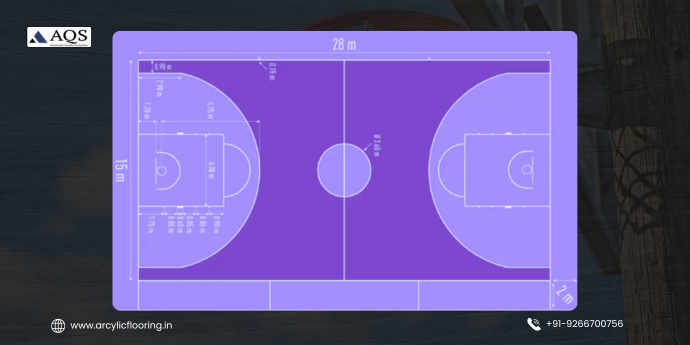
A standard NBA basketball court measures 28.65 meters (94 feet) in length and 15.24 meters (50 feet) in width, covering a total playing area of approximately 436 square meters (4,700 square feet). Under FIBA international regulations – which govern Olympic games, World Cup competitions, and most professional leagues outside North America – the court measures 28 meters (91.86 feet) long and 15 meters (49.21 feet) wide. In India, schools, colleges, and state-level tournaments follow FIBA standards, making these the most relevant dimensions for domestic court construction.
The three-point line sits 7.24 meters (23.75 feet) from the basket at its furthest point in the NBA, while FIBA places it at 6.75 meters (22.15 feet) – a difference that significantly affects shooting strategy at the professional level. The free-throw line is drawn 4.57 meters (15 feet) from the center of the basket on both NBA and FIBA courts, and the paint area (also called the key or lane) measures 4.88 meters (16 feet) wide in the NBA versus 4.9 meters (16.08 feet) under FIBA rules. The basketball rim sits at a universal height of 3.05 meters (10 feet) above the floor across all levels of play – NBA, FIBA, college, and school – and the backboard measures 1.83 meters (6 feet) wide by 1.07 meters (3.5 feet) tall.
Upgrade Your Sports Court Today
Get premium synthetic acrylic flooring designed for durability, grip, and performance.
Get Free ConsultationThe center circle has a diameter of 3.66 meters (12 feet) and is used for the opening tip-off. A residential half-court – the most popular choice for home and backyard installations across India – measures approximately 14.33 meters by 15.24 meters (47 feet by 50 feet), delivering nearly the full playing experience at roughly half the construction cost of a full-size court.
Basketball Court Measurement Table
| Measurement | NBA | FIBA | Feet (NBA) |
|---|---|---|---|
| Court Dimensions | |||
| Court Length | 28.65 m | 28.00 m diff | 94 ft |
| Court Width | 15.24 m | 15.00 m diff | 50 ft |
| Total Playing Area | ~437 sq m | ~420 sq m diff | ~4,700 sq ft |
| Half-Court Length | 14.33 m | 14.00 m diff | 47 ft |
| Key Lines & Zones | |||
| Three-Point Line (corner) | 6.71 m | 6.60 m diff | 22 ft |
| Three-Point Line (top of arc) | 7.24 m | 6.75 m diff | 23.75 ft |
| Free-Throw Line | 4.57 m | 4.57 m same | 15 ft |
| Paint Area (Key) Width | 4.88 m | 4.90 m diff | 16 ft |
| Paint Area (Key) Length | 5.79 m | 5.80 m same | 19 ft |
| Restricted Area Arc | 1.22 m | 1.25 m diff | 4 ft |
| Center Circle Diameter | 3.66 m | 3.66 m same | 12 ft |
| Basket & Backboard | |||
| Rim Height (from floor) | 3.05 m | 3.05 m same | 10 ft |
| Rim Diameter | 45.72 cm | 45.72 cm same | 18 in |
| Backboard Width | 1.83 m | 1.83 m same | 6 ft |
| Backboard Height | 1.07 m | 1.07 m same | 3.5 ft |
| Basket to Baseline | 1.22 m | 1.20 m diff | 4 ft |
| Boundary & Safety | |||
| Sideline Out-of-Bounds | – | 2.00 m min | – |
| Baseline Out-of-Bounds | – | 2.00 m min | – |
| Minimum Ceiling Height | – | 7.00 m | 23 ft |
Calculate Your Sports Court Dimensions!
Contact us for Quickly measure and calculate accurate sports court dimensions with this easy-to-use tool!
Basketball Court Cost at a Glance: Quick Reference Table
| Court Type | Size (sq ft) | Estimated Cost Range | Avg. Cost |
|---|---|---|---|
| Backyard Half-Court (Outdoor) | ~2,350 | ₹7,22,400 – ₹33,60,000 | ₹20,16,000 |
| Full-Size Outdoor Court | ~4,700 | ₹16,80,000 – ₹63,00,000 | ₹39,90,000 |
| Indoor Half-Court (Residential) | ~2,350 | ₹8,40,000 – ₹37,80,000 | ₹22,68,000 |
| Indoor Full-Size Court | ~4,700 | ₹18,48,000 – ₹1,04,16,000 | ₹61,32,000 |
| NBA-Regulation Full Court | 4,700+ | ₹63,00,000 – ₹1,26,00,000+ | ₹94,50,000 |
| Multi-Sport Court (Indoor) | Varies | ₹25,20,000 – ₹1,09,20,000 | ₹67,20,000 |
These figures represent total project costs including surface preparation, flooring, hoops, line marking, and labor. Actual quotes will vary based on your geographic location, contractor rates, and the specific materials you select for your basketball court flooring and base.
Key Factors That Determine Your Basketball Court Cost
1. Court Size: The Biggest Price Driver
The dimensions of your court are the single largest factor in determining total basketball court installation cost. A standard NBA full court measures 94 feet by 50 feet (4,700 sq ft), while a high school court runs 84 by 50 feet. A residential half-court typically covers 47 by 50 feet, requiring roughly half the materials and labor of a full-size build. Every additional square foot adds incremental cost for materials, surface coating, paint, and finishing work. Defining your target size before reaching out to contractors helps you get accurate estimates from the very first conversation.
2. Indoor vs. Outdoor Construction
Indoor courts carry significantly higher costs than outdoor courts because they require structural enclosures, specialized subfloor systems, HVAC, and premium-grade basketball court flooring materials like maple hardwood. An outdoor court relies on a concrete or asphalt base with acrylic coating, which is far more affordable to install. Indoor courts also demand moisture barriers, rubber pad shock-absorption layers, and professional line striping with specialized lacquer. If you plan to build an indoor court in an existing structure – such as a garage or barn – you save on the structural shell cost, though the flooring and fit-out costs remain significant.
3. Surface Material Choice
Basketball court material selection directly impacts both upfront cost and long-term maintenance expense. Maple hardwood delivers the gold-standard performance used in the NBA and professional arenas, but it costs the most and requires controlled indoor environments. Concrete and asphalt base courts with acrylic coating work well outdoors at lower prices. Modular interlocking tiles suit multi-use facilities and offer DIY installation potential. Rubber flooring provides excellent shock absorption at a mid-range price point. Each material carries its own lifecycle cost profile, so weigh initial investment against maintenance over 10–20 years when making your decision.
4. Labor and Contractor Expertise
Labor typically accounts for approximately 55% of the total basketball court installation cost, making it the largest single line item in most budgets. Rates vary significantly by region – contractors in major metropolitan areas charge premium fees compared to rural installers. Specialized sports court builders bring expertise in proper grading, drainage, subfloor installation, and precision line marking that general contractors often lack. Always request at least three written quotes from licensed, insured sports court specialists. Comparing itemized estimates – materials, labor, permits, and finishing – lets you identify overpriced line items and negotiate from a position of knowledge.
5. Site Preparation and Foundation
Proper groundwork is foundational to your court’s longevity. The installation site must be leveled, graded, compacted, and fitted with drainage infrastructure before any surface goes down. Poor drainage leads to surface cracking, water accumulation, and premature deterioration. Concrete bases offer maximum durability and consistency, while asphalt provides a more affordable alternative with slightly shorter service life. Post-tension concrete – which uses embedded steel cables to resist cracking – represents the industry gold standard for high-use courts and adds cost but dramatically extends the court’s lifespan. Site prep alone can run ₹168 to ₹504 per square foot depending on existing conditions.
Basketball Court Flooring Cost Per Square Foot by Material
| Flooring Material | Best For | Material Cost/sq ft | Install Cost/sq ft | Total Cost/sq ft |
|---|---|---|---|---|
| Maple Hardwood | Indoor professional courts | ₹294 – ₹504 | ₹252 – ₹672 | ₹546 – ₹1,176 |
| Laminate Flooring | Budget indoor courts | ₹59 – ₹168 | ₹84 – ₹168 | ₹143 – ₹336 |
| Polyurethane | Multi-sport indoor | ₹420 – ₹756 | ₹252 – ₹420 | ₹672 – ₹1,176 |
| Rubber Tiles | Indoor/Outdoor dual-use | ₹336 – ₹1,008 | ₹84 – ₹420 | ₹420 – ₹1,428 |
| Modular Vinyl Tiles | Multi-sport flexible courts | ₹168 – ₹672 | ₹84 – ₹504 | ₹252 – ₹1,176 |
| Acrylic Coating (on Concrete) | Outdoor courts | ₹42 – ₹210 | ₹126 – ₹378 | ₹168 – ₹588 |
| Epoxy Coating (on Concrete) | Budget indoor/outdoor | ₹168 – ₹420 | ₹84 – ₹336 | ₹252 – ₹756 |
| Concrete Slab (base) | Outdoor courts | ₹336 – ₹1,008 | ₹252 – ₹672 | ₹588 – ₹1,680 |
| Asphalt (base) | Budget outdoor courts | ₹227 – ₹529 | ₹109 – ₹311 | ₹336 – ₹840 |
Upgrade Your Sports Court Today
Get premium synthetic acrylic flooring designed for durability, grip, and performance.
Get Free ConsultationBasketball Court Flooring: A Deep Dive Into Every Material Option
Maple Hardwood Flooring – The Professional Standard
Maple hardwood stands as the undisputed gold standard for indoor basketball court flooring. Every NBA arena, college gymnasium, and professional training facility relies on maple for its unmatched combination of ball bounce consistency, shock absorption, and surface friction. Northern hard maple (Acer saccharum) is the species of choice due to its tight grain, hardness rating of 1,450 on the Janka scale, and resistance to wear under heavy play. Courts built on maple hardwood systems – which include rubber pad shock absorbers beneath a plywood subfloor and a finished maple surface – deliver playing characteristics that no synthetic material fully replicates. The investment is substantial, but maple courts refinished every 8–10 years can serve a facility for 40–50 years.
Modular Interlocking Tiles – Flexibility Meets Performance
Modular interlocking tiles have gained major ground as a basketball court material for both residential and institutional settings. These systems – made from polypropylene, vinyl, or rubber composites – snap together without adhesive, making them DIY-friendly and removable. They install over virtually any flat surface, including existing concrete or asphalt, without requiring a subfloor. Leading brands engineer tiles with perforated or ribbed undersides that create an air gap, improving shock absorption and reducing fatigue for players. Modular tile courts suit multi-sport facilities particularly well because different sport line colors can be applied across the same surface. Costs range from ₹252 to ₹1,176 per square foot depending on material grade.
Polyurethane Flooring – Seamless Durability
Polyurethane is a poured, seamless flooring system applied directly over a concrete subfloor in multiple layers to create a cushioned, non-slip playing surface. It delivers excellent shock absorption, even traction, and resistance to scratches, UV damage, and heavy foot traffic. Polyurethane surfaces suit both indoor and outdoor courts, with outdoor-grade formulations offering superior weather resistance. The seamless nature of polyurethane eliminates grout lines and tile joints that can create uneven ball bounce. Maintenance is simple – a periodic cleaning and recoating every 5–7 years keeps the surface performing at its best. At ₹672 to ₹1,176 per square foot installed, it strikes a strong balance between performance and affordability.
Acrylic and Cushion Acrylic Coating – The Outdoor Workhorse
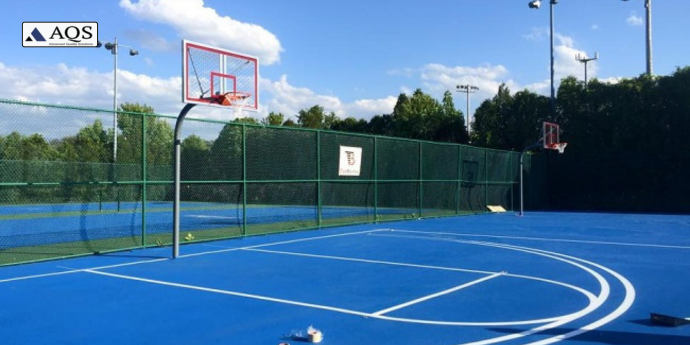
Acrylic coatings are the dominant surface system for outdoor basketball courts globally. Applied in multiple layers over a prepared concrete or asphalt base, standard acrylic coatings create a UV-resistant, fast-drying, weather-stable playing surface available in virtually any color. Cushion acrylic systems add a rubber-powder-filled intermediate layer beneath the topcoat, reducing surface hardness and improving player comfort during long play sessions. Acrylic coatings are quick to apply, easy to maintain, and relatively affordable – making them the go-to recommendation for school playgrounds, community courts, and residential outdoor installations. Expect a resurfacing cost of ₹126 to ₹336 per square foot every 7–10 years as the topcoat wears.
Rubber Flooring – Impact Absorption Champion
The Rubber basketball court flooring provides excellent impact protection and is gentle on joints, making it popular for training facilities, physical therapy gyms, and community recreation centers where player comfort takes priority. The Rubber surfaces are available as rolled sheets or interlocking tiles and install cleanly over flat concrete substrates. The material resists moisture, is easy to clean, and holds line markings well. On the downside, rubber courts need resurfacing every 6–8 years to maintain appearance and traction, and rubber surfaces tend to run warm underfoot – a consideration for courts in hot climates. Costs range from ₹420 to ₹1,008 per square foot installed.
Additional Equipment & Feature Costs for Your Basketball Court
| Feature / Equipment | Low Estimate | High Estimate | Notes |
|---|---|---|---|
| Basketball Hoops (pair) | ₹12,600 | ₹1,68,000+ | Portable to in-ground mounted |
| Court Line Marking (paint) | ₹16,800 | ₹5,04,000 | DIY vs. professional application |
| Scoreboard | ₹1,26,000 | ₹8,40,000+ | Basic electronic to digital LED |
| Lighting (indoor recessed) | ₹10,500/fixture | ₹25,200/fixture | Avoid hanging fixtures over court |
| Lighting (outdoor pole lights) | ₹1,68,000 | ₹6,72,000 | Full court LED system |
| Fencing (outdoor) | ₹4,20,000 | ₹16,80,000 | Chain link to ornamental |
| Court Cover (outdoor) | ₹4,20,000 | ₹33,60,000 | Fabric dome to rigid structure |
| Bleacher Seating | ₹2,52,000 | ₹25,20,000+ | Retractable vs. fixed |
| Soundproofing (indoor) | ₹84,000 | ₹8,40,000 | Panels, acoustic ceiling tiles |
| HVAC (indoor court) | ₹4,20,000 | ₹21,00,000 | Essential for climate control |
| Custom Logo / Graphics | ₹42,000 | ₹4,20,000 | Center court logo and branding |
| Resurfacing (every 7–10 yrs) | ₹12,60,000 | ₹71,40,000 | Depends on surface material |
Basketball Court Installation Cost: What the Process Involves
Step 1: Site Survey and Design Planning
Every professional basketball court installation begins with a detailed site survey. Contractors assess the land slope, soil stability, drainage patterns, and proximity to utilities before recommending a base system. This survey informs the grading plan, which determines how much earth the team needs to move and compact to achieve a perfectly level playing surface. Design planning at this stage also includes court orientation – minimizing sun glare for outdoor courts – and marking setback distances from property lines per local building codes. A professional survey costs ₹16,800 to ₹67,200 but prevents costly rework later in the project.
Step 2: Excavation, Grading, and Drainage
Excavation involves removing topsoil and organic matter from the court footprint to reach stable subgrade material. The team then grades the surface to a precise slope – typically 1% gradient – that channels rainwater away from the court without affecting play. Drainage channels or French drain systems route water away from the court perimeter. Poor drainage is the leading cause of premature surface cracking and subbase failure, so investing in proper drainage infrastructure upfront saves significant repair costs over the court’s lifetime. Excavation and drainage work typically costs ₹1,26,000 to ₹6,72,000 depending on site conditions and court size.
Step 3: Base Installation – Concrete or Asphalt
The base layer carries the entire structural load of the court and directly influences surface performance and longevity. Concrete bases deliver superior strength, dimensional stability, and resistance to freeze-thaw cycles, making them the preferred choice for serious courts. A 4-inch reinforced concrete slab over a compacted gravel sub-base represents the industry standard. Asphalt offers a more economical alternative that performs well in warmer climates but is more susceptible to cracking under temperature extremes. Post-tension concrete – using steel cables tensioned after pour – provides maximum crack resistance for high-traffic courts. Base installation alone runs ₹336 to ₹1,008 per square foot for concrete and ₹168 to ₹504 per square foot for asphalt.
Step 4: Flooring System Installation
With the base in place, the contractor installs the chosen basketball court flooring system. For indoor hardwood courts, this involves placing rubber shock pads at regular intervals across the concrete slab, followed by a plywood subfloor system, and finally the finished maple hardwood surface – all precisely leveled and fastened. For acrylic outdoor courts, crews apply a primer coat, followed by multiple acrylic resurfacing layers, and finish with a color-coat topcoat. Modular tile systems simply click into place across the prepared base, requiring minimal specialized labor. Flooring installation timelines range from two days for modular tile systems to four to eight weeks for full hardwood court builds.
Step 5: Line Marking and Finishing
Accurate line marking transforms a plain surface into a regulation basketball court. Professional painters use templates and laser measurement tools to lay out the center circle, three-point arcs, free throw lanes, restricted areas, and boundary lines with precision. Court lines require specialized acrylic or water-based paint formulated for athletic surfaces – ordinary paint wears too quickly under foot traffic. On indoor hardwood floors, lines receive multiple finish coats to seal and protect them. Custom center court logos, team graphics, and sponsor branding add visual identity and cost between ₹42,000 and ₹4,20,000 depending on complexity. Line marking typically adds ₹16,800 to ₹5,04,000 to the project, with professional crews faster and more accurate than DIY attempts.
Transform Your Sports Facility Today!
Contact us for high-quality synthetic sports flooring material and elevate your space!
Indoor vs. Outdoor Basketball Court: Cost Comparison Table
| Cost Factor | Outdoor Court | Indoor Court |
|---|---|---|
| Base/Foundation | ₹336 – ₹1,008/sq ft (concrete) | ₹336 – ₹1,008/sq ft (concrete slab) |
| Surface/Flooring | ₹168 – ₹840/sq ft (acrylic/asphalt) | ₹504 – ₹2,184/sq ft (hardwood/polyurethane) |
| Subfloor System | Not required | ₹252 – ₹840/sq ft (shock pad + plywood) |
| Lighting | ₹1,68,000 – ₹6,72,000 (pole lights) | ₹10,500 – ₹25,200/fixture (recessed) |
| Climate Control | Not required | ₹4,20,000 – ₹21,00,000 (HVAC) |
| Fencing | ₹4,20,000 – ₹16,80,000 | Not required |
| Total Half-Court | ₹7,22,400 – ₹33,60,000 | ₹8,40,000 – ₹37,80,000 |
| Total Full Court | ₹16,80,000 – ₹63,00,000 | ₹18,48,000 – ₹1,04,16,000 |
| Lifespan (surface) | 7–15 years before resurfacing | 20–50 years (hardwood with care) |
| Maintenance Cost/yr | ₹42,000 – ₹1,68,000 | ₹84,000 – ₹4,20,000 |
Detailed Basketball Court Cost Breakdown by Project Type
Residential Backyard Basketball Court Cost
Building a backyard basketball court costs an average of ₹29,40,000 in India, with most homeowners spending between ₹7,22,400 and ₹35,28,000 depending on size, surface, and features. A simple half-court with a concrete base, acrylic coating, standard hoop, and line marking sits at the lower end of this range. Homeowners who add lighting, fencing, a custom logo, or high-end surface materials push the total toward the upper bound. Location matters significantly – labor rates in Mumbai, Delhi, or Bangalore differ substantially from those in tier-2 and tier-3 cities. Obtaining three detailed quotes from licensed sports court contractors ensures you pay a competitive market rate for your region.
School and Community Basketball Court Cost
Schools and community organizations typically build full-size outdoor courts with concrete bases, colored acrylic surfaces, and regulation hoops. These projects run from ₹16,80,000 to ₹63,00,000 for outdoor installations. Indoor gymnasium courts – the most common school upgrade – involve hardwood flooring, professional line marking for multiple sports, and updated lighting, bringing total costs to ₹42,00,000 to ₹1,04,16,000 or more depending on gymnasium size. Schools often leverage federal grants, local government funds, and private-sector donations from organizations like the NBA and ESPN to offset costs. The ESPN Homecourt Program, for example, provides qualified schools with free design and construction packages.
Commercial Sports Facility Basketball Court Cost
Commercial gyms, training academies, and multi-sport facilities invest heavily in court quality because the surface directly affects member experience, athlete performance, and facility reputation. Full hardwood courts with custom team graphics, professional-grade lighting, electronic scoreboards, and bleacher seating easily reach ₹84,00,000 to ₹2,10,00,000 per court. Multi-court facilities compound these costs across several playing surfaces. Operators in this segment prioritize lifetime cost analysis over upfront price – a maple hardwood court maintained properly over 40 years delivers superior value per dollar compared to cheaper surfaces requiring frequent replacement and resurfacing.
Basketball Court Maintenance Cost Overview
| Maintenance Task | Frequency | Estimated Cost | Applies To |
|---|---|---|---|
| Daily cleaning/sweeping | Daily | ₹0 – ₹4,200/month | All court types |
| Acrylic surface repaint | Every 2–3 years | ₹1,26,000 – ₹4,20,000 | Outdoor courts |
| Full court resurfacing | Every 7–10 years | ₹12,60,000 – ₹71,40,000 | All court types |
| Hardwood sanding & refinishing | Every 8–10 years | ₹4,20,000 – ₹16,80,000 | Indoor hardwood |
| Line repainting | Every 2–4 years | ₹16,800 – ₹5,04,000 | All court types |
| Hoop replacement/repair | Every 5–10 years | ₹12,600 – ₹1,68,000 | All court types |
| Crack filling (concrete/asphalt) | As needed | ₹42,000 – ₹2,52,000 | Outdoor courts |
| Lighting maintenance | Annually | ₹16,800 – ₹84,000 | Lit courts |
How to Reduce Your Basketball Court Installation Cost Without Sacrificing Quality
Choose the Right Court Size for Your Actual Needs
Many homeowners and facility managers automatically plan for a full-size court when their actual usage patterns – recreational family play, 3-on-3 games, or youth training – only require a half-court. A well-designed half-court delivers 95% of the play value at roughly 45-50% of the cost. Assess how you realistically intend to use the court before committing to full-size dimensions. Designing for current needs while leaving expansion potential in the site layout gives you a cost-effective starting point with growth flexibility built in.
Opt for Modular Tile Systems Where Appropriate
Interlocking modular tile systems offer significant savings on basketball court installation cost compared to poured concrete with acrylic coating or hardwood builds. These systems install over existing concrete or asphalt surfaces, eliminating excavation and base-pour costs. Many homeowners with existing driveways or concrete pads can simply lay modular tiles directly on their existing surface after cleaning. DIY installation is feasible with modular tiles, saving the ₹84 to ₹420 per square foot labor charge. While modular tiles do not replicate the playing feel of professional hardwood, premium systems provide excellent traction, consistent bounce, and durability for recreational play.
Get Multiple Quotes and Negotiate Line Items
Prices vary widely between contractors – sometimes by 30 to 50% for identical scopes of work. Always request at minimum three itemized quotes from licensed sports court builders with verifiable references. An itemized quote breaks out material costs, labor rates, permits, and finishing separately, allowing you to identify inflated line items and negotiate with confidence. Timing your project during a contractor’s slow season – typically late fall and winter in many regions – can yield meaningful discounts as builders seek to maintain crews between peak spring and summer projects.
Use DIY Line Marking on Concrete Courts
Professional line marking services charge ₹16,800 to ₹5,04,000 depending on court complexity and geographic market. Homeowners with patience and steady hands can DIY court line marking using high-quality acrylic athletic court paint, measurement tape, chalk lines, and masking tape. NBA and NCAA court dimension templates are freely available online. The main risk with DIY line marking is inaccuracy – uneven or misplaced lines affect play quality. Invest in quality paint and take your time with measurements; the savings versus hiring a professional painter make this one of the most accessible DIY tasks in the entire basketball court installation process.
Transform Your Sports Facility Today!
Contact us for high-quality synthetic sports flooring material and elevate your space!
Conclusion: Plan Smart, Build Right, Play Long
Understanding basketball court cost in its full complexity – from surface material selection and base construction to lighting, hoops, and long-term maintenance – empowers you to build a court that fits your budget and exceeds your expectations. Whether you invest ₹8,40,000 in a modular half-court or ₹1,26,00,000 in a professional-grade hardwood facility, the key is matching your material choices to your actual usage needs and climate conditions.
Basketball court flooring is the most impactful decision you make in the entire project. Maple hardwood delivers unmatched performance for serious play, acrylic-coated concrete serves outdoor recreational courts reliably for years, and modular tiles bridge the gap between affordability and versatility. Every basketball court material carries its own cost, performance, and maintenance profile – evaluate all three before committing.
Basketball court installation cost ultimately reflects the quality of your site preparation, base construction, and finishing. Cutting corners on foundation work to save money upfront leads to cracked surfaces, drainage failures, and expensive repairs within just a few years. Work with licensed, experienced sports court builders, compare multiple itemized quotes, and invest in proper drainage and base construction – these are the decisions that deliver courts lasting 20, 30, or even 50 years of reliable, high-quality play.
Start your project by defining your court size and primary use, then select your basketball court material accordingly. Request multiple quotes, explore grant funding if you represent a school or community organization, and prioritize base quality over surface aesthetics. A well-built court is not just an amenity – it is an investment in health, community, and property value that returns dividends every day players step onto the surface you create.
Frequently Asked Questions
The average backyard basketball court costs around ₹29,40,000, with most projects ranging from ₹7,22,400 to ₹35,28,000 depending on size, surface material, and features.
Laminate flooring is the most affordable indoor option at ₹143 to ₹336 per square foot installed, while acrylic-coated asphalt is the cheapest outdoor basketball court flooring system.
A full indoor basketball court installation costs between ₹18,48,000 and ₹1,04,16,000, depending on the flooring system, subfloor type, lighting, HVAC, and other features selected.
Maple hardwood is the most durable indoor basketball court material, lasting 40 to 50 years with proper maintenance, refinishing, and climate control.
You can handle tasks like line marking or modular tile installation yourself, but base pours, drainage systems, and hardwood floor installation require professional expertise to ensure safety, level play, and lasting quality.
Most basketball court surfaces need resurfacing every 7 to 10 years, at a cost of ₹12,60,000 to ₹71,40,000, depending on the material type and extent of wear.