
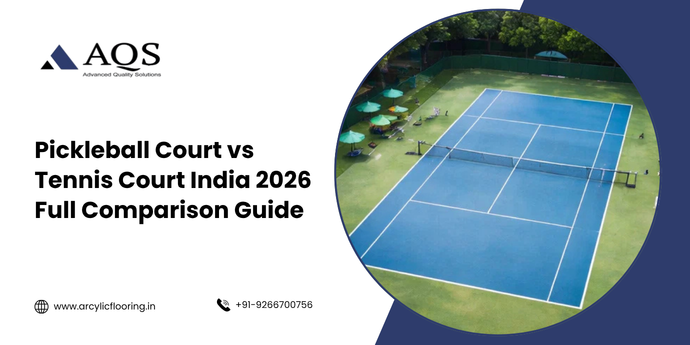
India’s sports infrastructure landscape changed dramatically between 2023 and 2026. Pickleball – the paddle sport that blends elements of tennis, badminton, and table, Tennis – now attracts players in residential societies, corporate campuses, schools, and professional academies across every major Indian city. Meanwhile, tennis retains its prestige status with dedicated courts in clubs, hotels, and coaching academies. When planners, facility managers, and developers ask the question pickleball court vs tennis court, they really want practical clarity on cost, space, surface, and suitability.
Pickleball uses a perforated plastic ball and a solid paddle on a compact rectangular court with a low net. Tennis uses a felt ball and a strung racket on a full-length court with a higher net. These fundamental differences drive every downstream decision – from how much land you need to which type of synthetic acrylic sports flooring you select. Understanding both sports holistically helps decision-makers build smarter, cheaper, and more utilised facilities in 2026.
The sport of pickleball recorded over 3 million active players in India by early 2026 according to industry estimates, with new courts being installed at a pace that outstrips tennis court construction in the urban residential segment. Schools in Delhi NCR, Bengaluru, Pune, and Hyderabad now build pickleball courts on previously unused rooftops and parking spaces. This growth is directly tied to the lower pickleball court installation cost and the compact nature of pickleball court dimensions compared to tennis court requirements.
Key Insight
India’s sports construction market in 2026 sees pickleball courts being built at nearly 3× the rate of new tennis courts in urban residential and school segments, driven entirely by lower land and material requirements.
Table of contents
- Court Dimensions: Pickleball Court Size vs Tennis Court Size – Layout, Lines & Zones Explained
- Pickleball Court Flooring vs Tennis Court Flooring – Surfaces, Layers & Performance
- Pickleball Court Material vs Tennis Court Material – What Goes Into Building Each Court?
- Pickleball Court Installation Cost vs Tennis Court Cost in India 2026 – Detailed Breakdown
- Full installation range (India 2026)
- Can You Convert a Tennis Court into Pickleball Courts? Step-by-Step Guide for India
- Complete Head-to-Head Comparison Table: Pickleball Court vs Tennis Court
- How to Choose the Right Pickleball Court Flooring or Tennis Court Flooring for Your Facility
- Frequently Asked Questions (FAQ’S)
- Conclusion
Court Dimensions: Pickleball Court Size vs Tennis Court Size – Layout, Lines & Zones Explained
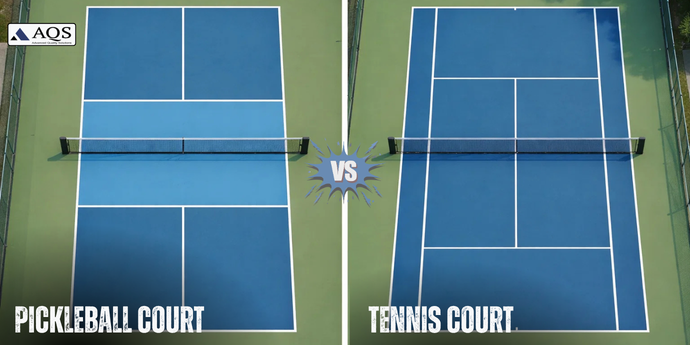
The most striking difference between a pickleball court and a tennis court is physical size. A standard pickleball court measures 20 feet wide by 44 feet long for both singles and doubles formats. This remains identical regardless of whether the court is indoors or outdoors. In contrast, a standard tennis court for doubles measures 36 feet wide by 78 feet long. These numbers confirm that a tennis court is approximately four times the size of a pickleball court in playing area alone.
Upgrade Your Sports Court Today
Get premium synthetic acrylic flooring designed for durability, grip, and performance.
Get Free ConsultationRecommended Total Space Including Safety Buffers
Beyond the playing area, both courts require additional run-off and safety zones for player movement. A pickleball court requires a minimum recommended total space of 30 feet × 60 feet, which gives players enough room to chase wide shots and maintain safe distances from boundary walls. A tennis court requires a total recommended space of approximately 60 feet × 120 feet when safety run-offs and spectator margins are included. This nearly doubles the land footprint again when you compare real-world space consumption of pickleball court vs tennis court.
Calculate Your Sports Court Dimensions!
Contact us for Quickly measure and calculate accurate sports court dimensions with this easy-to-use tool!
Court Line Markings and Zone Differences
Pickleball courts include a Non-Volley Zone – widely known as “the kitchen” – which spans 7 feet on each side of the net. Players cannot volley the ball while standing inside this zone, which creates a unique strategic element. Tennis courts use service boxes, deuce and ad courts, and a baseline service line. Pickleball uses a centerline, sidelines, and the kitchen line, which makes line marking faster and more economical on the pickleball court flooring surface. When facilities use multi-coloured acrylic line markings – white for tennis, yellow or blue for pickleball – they can create dual-purpose court layouts efficiently.
| Dimension Detail | Pickleball Court | Tennis Court |
| Playing Width | 20 ft (6.1 m) | 36 ft doubles (10.97 m) |
| Playing Length | 44 ft (13.4 m) | 78 ft (23.77 m) |
| Total Recommended Area | 30 × 60 ft (~1,800 sq ft) | 60 × 120 ft (~7,200 sq ft) |
| Net Height (Centre) | 34 inches (86 cm) | 36 inches (91 cm) |
| Net Height (Posts) | 36 inches (91 cm) | 42 inches (107 cm) |
| Non-Volley Zone | 7 ft each side | Not applicable |
| Singles vs Doubles Court | Same size for both | Different widths |
| Courts Per Tennis Space | 4 courts | 1 court |
| Indoor Ceiling Min. Height | 18-20 ft | 25-30 ft |
Pickleball Court Flooring vs Tennis Court Flooring – Surfaces, Layers & Performance
Choosing the right surface is not a secondary decision – it directly determines how long your court lasts, how safely players move on it, and whether the court holds up to India’s extreme weather conditions. Both pickleball and tennis courts share a common preference in India: synthetic acrylic flooring. However, the specific formulation, cushion depth, and layering systems differ based on each sport’s biomechanical demands.
Pickleball Court Flooring: Types & Performance Factors
Pickleball demands quick lateral movement, fast stops, and precise low-bounce ball response. The ideal pickleball court flooring provides consistent traction, absorbs joint stress, and delivers predictable ball rebound from the hard plastic ball. Synthetic acrylic flooring dominates the Indian pickleball court market because it offers UV resistance, all-weather durability, non-slip texture, and colour vibrancy that lasts 6-10 years with basic maintenance. Multi-layer acrylic systems – typically 3 to 5 coats applied over a prepared concrete or asphalt base – create the standard surface used in professional and recreational facilities alike.
Modular PP (polypropylene) interlocking tiles represent a secondary option for temporary or indoor pickleball courts. These tiles allow for quick installation and reconfiguration, making them popular for events and portable setups. However, for permanent outdoor courts in India, synthetic acrylic remains the undisputed choice due to its weather resistance and low long-term maintenance cost versus the performance degradation of PP tiles in prolonged UV exposure.
Transform Your Sports Facility Today!
Contact us for high-quality synthetic sports flooring material and elevate your space!
Tennis Court Flooring: Clay, Grass, Hard Court & Acrylic
Tennis courts globally use clay, grass, and hard court surfaces. In India, the practical reality of maintenance cost, weather conditions, and consistent playability makes synthetic acrylic hard courts the dominant choice for 95% of new court construction in 2026. Clay courts require daily watering, rolling, and resurfacing – impractical for most Indian facilities outside premium clubs. Grass courts demand specialised turf management unsuitable for India’s climate in most regions. Hard acrylic courts deliver the best combination of durability, low maintenance, and performance for Indian conditions.
Tennis court flooring systems use a thicker layering system than pickleball courts because the sport involves higher-speed ball impact, heavier player loading from baseline sprinting, and the need to absorb serve-and-volley shock forces. Premium cushioned acrylic systems for tennis courts use up to 6-8 coats with rubberised intermediate layers to provide shock absorption and reduce fatigue on players during extended matches. This additional material depth contributes directly to the higher per-square-foot cost of tennis court flooring compared to pickleball court flooring in India.
| Flooring Feature | Pickleball Court | Tennis Court |
| Primary Surface Type (India) | Synthetic Acrylic | Synthetic Acrylic / Hard Court |
| Secondary Options | Modular PP Tiles, Cushioned Acrylic | Clay, Grass, Rubberised Acrylic |
| Number of Acrylic Coats | 3-5 layers | 5-8 layers (cushioned) |
| Surface Texture | Medium grit non-slip | Fine to medium grit |
| Ball Bounce Response | Low, consistent | Medium-high, spin-dependent |
| UV Resistance | Excellent | Excellent |
| Weather Performance (India) | Excellent – heat, rain, humidity | Excellent for acrylic type |
| Surface Lifespan | 6-10 years | 8-12 years (with maintenance) |
| Maintenance Frequency | Low – cleaning + occasional recoat | Moderate – crack filling, recoat |
| Colour Retention | High with quality acrylic | High with quality acrylic |
Pro Tip for Indian Facilities
For housing societies and schools with limited maintenance staff, synthetic acrylic flooring on pickleball courts offers the best combination of durability and zero-hassle upkeep. A single annual cleaning and 5-year recoat cycle keeps the surface performing at professional standards.
Pickleball Court Material vs Tennis Court Material – What Goes Into Building Each Court?
Understanding pickleball court material and tennis court material requirements gives facility developers precise control over budget allocation and procurement. Both courts share a similar construction stack – sub-base, concrete or asphalt base, acrylic surface system, line markings – but differ in quantities, specifications, and optional components such as fencing, net systems, and lighting.
Pickleball Court Material Breakdown
A standard pickleball court construction in India uses the following material layers. The sub-base involves compacted soil, gravel, or crushed stone for drainage. The base layer uses M20 grade RCC concrete (4-6 inches) or compacted asphalt as the structural foundation. The surface system uses 3-5 coats of synthetic acrylic sports flooring, with the first coat being a crack-filler or resurfacer, followed by colour coats and a textured final coat mixed with silica sand for grip. Line markings use acrylic line paint in white, yellow, or blue for clear visibility. The net system uses a portable or permanent pickleball net post with a 34-inch centre net height. Perimeter fencing uses GI (galvanised iron) chain-link or welded mesh fencing at 3-4 metre height.
Tennis Court Material Breakdown
Tennis courts require a substantially larger material volume due to the greater court area. The concrete base for a full tennis court uses significantly more cement, aggregate, and labour than a pickleball court base. The acrylic surface system for tennis courts uses 5-8 layers including a rubberised cushion intermediate layer for premium courts. Tennis net posts use heavier steel with a centre strap for regulation 36-inch centre height. Perimeter fencing for tennis courts uses 4-5 metre high fencing panels given the higher ball speed and trajectory. LED lighting systems for night play require more fixtures due to the larger area, adding to the overall material bill.
| Material Component | Pickleball | Tennis |
| Concrete Base Grade | M20 RCC, 4 inches | M20-M25 RCC, 4-6 inches |
| Acrylic Surface Layers | 3-5 coats | 5-8 coats |
| Cushion Layer Required | Optional | Recommended for premium courts |
| Net System | Portable / permanent steel post | Heavy-gauge permanent steel post |
| Fencing Height | 3-3.5 m | 4-5 m |
| Lighting Fixtures (LED) | 4-6 fixtures | 8-12 fixtures |
| Court Markings | Kitchen, service, sideline | Service box, baseline, tram lines |
| Drainage System | Simple slope drainage | Perimeter channel drainage |
| Colour Options (Acrylic) | Green, blue, red, multi | Green, blue, red, clay-tone |
Pickleball Court Installation Cost vs Tennis Court Cost in India 2026 – Detailed Breakdown
Budget clarity is the single most important factor for facility decision-makers. The pickleball court installation cost in India is dramatically lower than an equivalent tennis court, and this gap widens further when land area costs are factored in for urban locations like Mumbai, Delhi, Bengaluru, Hyderabad, and Pune. Below we break down both cost structures with 2026 pricing data to give developers and institutions a reliable budgeting baseline.
Pickleball Court Installation Cost in India (2026)
A basic outdoor pickleball court on a prepared concrete base with 3-layer synthetic acrylic flooring, permanent net post, line markings, and chain-link fencing costs approximately ₹2.5-3.5 lakh in India. A mid-range court with 5-layer acrylic, cushioned intermediate layer, LED lighting, and premium fencing costs ₹3.5-4.5 lakh. A premium competition-grade pickleball court with 6-layer cushioned acrylic, international-standard line markings, spectator-friendly fencing, drainage system, and floodlighting costs ₹4.5-6 lakh. The acrylic flooring material component alone costs ₹180-350 per square foot depending on the number of layers and cushion specification, while the total installed cost including base, fencing, and net ranges from ₹350-600 per square foot.
Upgrade Your Sports Court Today
Get premium synthetic acrylic flooring designed for durability, grip, and performance.
Get Free ConsultationTennis Court Installation Cost in India (2026)
+A standard outdoor acrylic tennis court in India costs ₹7-9 lakh for a basic configuration with 5-layer acrylic, standard fencing, and a single net post system. A mid-range tennis court with cushioned acrylic, LED flood lighting, and premium fencing costs ₹9-11 lakh. A professional or tournament-grade tennis court with spectator seating integration, wind screens, drainage channels, and competition-grade cushioned acrylic flooring costs ₹11-14 lakh or more. The tennis court acrylic flooring material cost ranges from ₹250-500 per square foot for the surface system alone, with total installed costs between ₹300-600 per square foot across the larger court area.
Full installation range (India 2026)
| Cost Component | Pickleball Court (₹) | Tennis Court (₹) |
| Site Preparation & Grading | 15,000-40,000 | 40,000-1,00,000 |
| Concrete / Asphalt Base | 50,000-90,000 | 1,50,000-3,00,000 |
| Acrylic Flooring (Surface) | 40,000-80,000 | 1,50,000-3,00,000 |
| Cushioned Acrylic Layer | 20,000-50,000 (optional) | 60,000-1,20,000 |
| Net & Post System | 8,000-20,000 | 20,000-60,000 |
| Perimeter Fencing | 25,000-60,000 | 80,000-1,80,000 |
| LED Floodlighting | 25,000-60,000 | 80,000-1,80,000 |
| Line Marking | 5,000-10,000 | 8,000-20,000 |
| Drainage System | 5,000-15,000 | 20,000-50,000 |
| Total Estimated | ₹2.5-5 Lakh | ₹7-12 Lakh |
Cost-Per-Player Insight
Because one tennis court footprint can host 4 simultaneous pickleball games, the pickleball model delivers 4× the player capacity per unit of land cost. For a housing society building sports infrastructure for 200+ residents, four pickleball courts at ₹12-16 lakh total serve the community far more efficiently than one tennis court at ₹9-12 lakh hosting only two players at a time.
Can You Convert a Tennis Court into Pickleball Courts? Step-by-Step Guide for India
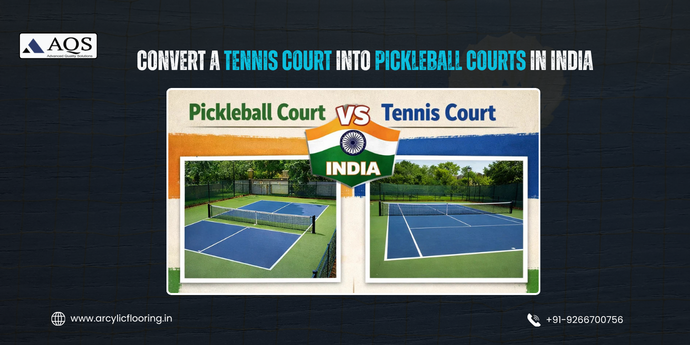
Tennis court conversion into pickleball courts is one of the most cost-effective infrastructure decisions in India’s sports facility management space. Hundreds of clubs, residential complexes, and schools have converted underutilised tennis courts into vibrant pickleball spaces between 2023 and 2026. The process is straightforward, relatively affordable, and delivers an immediate increase in court utilisation rates.
How Many Pickleball Courts Fit in One Tennis Court?
A standard tennis court with dimensions of 78 × 36 ft accommodates up to four standard pickleball courts within its boundary when courts are oriented in a specific layout pattern. Each pickleball court occupies 20 × 44 ft, and with careful alignment, four courts fit neatly within the tennis court area with adequate safety clearance between courts. This four-court configuration simultaneously allows 8-16 players to engage in pickleball, compared to the 2-4 players using the single tennis court previously.
Steps to Convert a Tennis Court into Pickleball Courts in India
The first step involves surface assessment – a qualified sports flooring contractor inspects the existing tennis court surface for cracks, delamination, drainage issues, and surface flatness. Minor surface repairs and crack filling come first, followed by acrylic resurfacing to restore a uniform playing surface. New pickleball court line markings are then applied in contrasting colours – typically yellow or blue for pickleball lines alongside retained white tennis lines – using acrylic line paint. Portable net systems replace or supplement the existing tennis net, with each pickleball court using its own 34-inch centre net. Temporary or permanent boundary markers indicate each court zone. Total conversion cost typically ranges from ₹80,000 – 2.5 lakh depending on the condition of the existing surface and the number of permanent modifications required.
Conversion Advantages
- Uses existing infrastructure investment
- Costs ₹80K-2.5L vs building from scratch
- 4× player capacity from same footprint
- Increases court booking revenue
- Fast turnaround (7-14 days typically)
- Retains tennis playability with dual markings
Conversion Limitations
- Existing surface must be structurally sound
- Multiple line markings can confuse beginners
- Tennis net height differs from pickleball standard
- Sight lines may not be optimised
- Fencing height may need upgrading
- Player separation barriers recommended
Complete Head-to-Head Comparison Table: Pickleball Court vs Tennis Court
The table below consolidates every key parameter to give readers a single-view reference for the pickleball court vs tennis court decision. Use this table to evaluate which investment makes sense for your specific facility type, budget, and community needs.
| Parameter | Pickleball Court | Tennis Court |
| Standard Playing Dimensions | 20 × 44 ft | 78 × 36 ft (doubles) |
| Total Area Required | ~1,800 sq ft | ~7,200 sq ft |
| Net Height (Centre) | 34 inches | 36 inches |
| Net Height (Posts) | 36 inches | 42 inches |
| Best Flooring (India) | Synthetic Acrylic | Synthetic Acrylic |
| Flooring Cost (per sq ft) | ₹180-350 | ₹250-500 |
| Total Installation Cost | ₹2.5-6 Lakh | ₹7-14 Lakh |
| Court Surface Lifespan | 6-10 years | 8-12 years |
| Maintenance Level | Low | Moderate |
| Players Per Court | 2-4 | 2-4 |
| Courts Per Tennis Space | 4 | 1 |
| Skill Learning Curve | Low (beginner-friendly) | Moderate to High |
| Age Accessibility | All ages (6-80+) | Primarily 10-60 |
| Equipment Cost | ₹800-5,000 (paddle + ball) | ₹2,500-15,000 (racket + ball) |
| Ideal For | Societies, schools, clubs, corporates | Academies, clubs, premium facilities |
| Popular Indian Cities (2026) | Pan-India, rapid urban growth | Metro cities, tier-1 clubs |
| Conversion Possible | Yes (from tennis courts) | Limited conversion options |
| Fencing Height Required | 3-3.5 m | 4-5 m |
| Indoor Ceiling Height | 18-20 ft min | 25-30 ft min |
Real-World Case Study: Mumbai Residential Society Converts Tennis Court into Pickleball Hub (2025)
A large gated residential community in Thane, Mumbai – home to approximately 480 families – faced a common challenge in 2024: their single tennis court, built in 2017 at a cost of ₹8.5 lakh, was being used by fewer than 12 residents regularly. The court’s utilisation rate had dropped below 15%, and the society committee faced pressure to either renovate it or repurpose the space entirely.
The committee engaged a sports infrastructure consultant who recommended converting the existing tennis court into four permanent pickleball courts using a dual-line marking system. The existing acrylic surface received crack filling and a fresh 2-coat acrylic resurfacing treatment in a bright blue colour scheme. Yellow pickleball court lines were applied over the repaired surface. Four portable pickleball net systems replaced the single tennis net. Safety barriers were installed between adjacent courts.
Within 90 days of project completion, court utilisation jumped from 15% to over 85%. The society now runs weekly pickleball tournaments, beginner coaching sessions, and morning senior citizen programmes. Residents aged 7 to 74 now actively use the facility. The committee recovered their conversion investment cost through court booking fees within 14 months. The dual-line system also allows occasional tennis play for the remaining tennis enthusiasts. This case study demonstrates how the pickleball court vs tennis court decision is not always binary – smart conversion creates multi-sport value from a single piece of infrastructure.
How to Choose the Right Pickleball Court Flooring or Tennis Court Flooring for Your Facility
Selecting the right sports flooring system starts with understanding usage intensity, climate exposure, budget constraints, and the player demographic. For Indian outdoor courts, synthetic acrylic sports flooring consistently outperforms alternatives across all these criteria. However, the specific acrylic system – standard, cushioned, or modular – varies based on the intended use case and available budget for your pickleball court installation cost or tennis court project.
Standard Acrylic Flooring – Best for Budget and Recreational Play
Standard 3-4 layer acrylic systems deliver solid performance for recreational pickleball and tennis courts in housing societies, school playgrounds, and community centres. These systems cost less per square foot and require minimal maintenance. They provide consistent ball bounce, non-slip surface texture, and UV resistance adequate for 6-8 years of regular use in Indian climate conditions. This remains the most widely installed pickleball court material in India in 2026 for non-commercial projects.
Transform Your Sports Facility Today!
Contact us for high-quality synthetic sports flooring material and elevate your space!
Cushioned Acrylic Flooring – Best for Academies and Competitive Players
Cushioned acrylic systems add a rubberised intermediate layer between the base and the colour coats, which significantly increases shock absorption and reduces joint fatigue. Coaching academies, sports clubs, and facilities catering to older adults or children particularly benefit from cushioned acrylic systems. The pickleball court installation cost rises by 30-50% for cushioned systems, but the added player comfort and injury prevention value justifies the investment in high-use commercial environments.
Modular PP Tiles – Best for Temporary and Indoor Courts
Polypropylene interlocking tiles offer a tool-free, portable solution for indoor pickleball courts and temporary event courts. These tiles install over flat concrete or even hardwood floors without adhesive. They provide acceptable traction and ball bounce for recreational play. However, their performance in high-temperature outdoor conditions in India degrades over time compared to synthetic acrylic systems, making them suitable as an indoor or event solution rather than a primary outdoor court surface material.
| Flooring Type | Best Use Case | Approx. Cost (₹/sq ft) | Durability (Years) | Weather Resistance |
| Standard Acrylic (3-4 layers) | Recreational, housing societies | ₹180-260 | 6-8 | Excellent |
| Premium Acrylic (5-6 layers) | Club courts, academies | ₹260-350 | 8-10 | Excellent |
| Cushioned Acrylic | Professional, senior-friendly | ₹350-500 | 8-12 | Excellent |
| Modular PP Tiles | Indoor, temporary, events | ₹200-400 | 5-8 | Moderate |
| Plain Concrete (not recommended) | Ultra-budget only | ₹80-120 | 3-5 | Poor |
Frequently Asked Questions (FAQ’S)
A pickleball court measures 20×44 ft while a standard doubles tennis court measures 36×78 ft, making the tennis court roughly four times larger in total playing area.
Synthetic acrylic flooring is the best pickleball court flooring choice in India due to its weather resistance, non-slip texture, UV durability, and low maintenance requirements for both indoor and outdoor courts.
Pickleball court installation cost in India ranges from ₹2.5 lakh for a basic outdoor court to ₹5-6 lakh for a premium cushioned acrylic competition court including fencing and lighting.
Yes, one standard tennis court can be converted into up to four pickleball courts through resurfacing, new line markings, and portable net installation at a cost of approximately ₹80,000-2.5 lakh.
Both courts use synthetic acrylic flooring as their primary surface material, but tennis courts require more layers, heavier fencing, taller net posts, and more extensive drainage systems due to the larger court area and higher-impact gameplay.
Quality synthetic acrylic pickleball court flooring lasts 6–10 years in Indian conditions with basic annual cleaning and a full recoat every 5-7 years depending on usage intensity and weather exposure.
Conclusion
The pickleball court vs tennis court debate in India has a clear answer for most facilities in 2026: pickleball delivers more value, serves more players, fits smaller spaces, and costs significantly less to build and maintain. That does not make tennis obsolete it simply means each sport serves a different infrastructure role. Premium clubs, professional coaching academies, and large institutions with established tennis programmes rightly continue investing in tennis court infrastructure. Schools, residential societies, corporates, and community centres find that pickleball courts deliver faster ROI, higher utilisation, and broader community inclusion.
The material question resolves simply: synthetic acrylic flooring leads both categories in India for its weather resilience, consistent performance, long lifespan, and vibrant aesthetics. Whether you choose standard acrylic, cushioned acrylic, or modular tiles depends entirely on your use case, player demographic, and budget for pickleball court installation cost or tennis court construction. Work with qualified sports flooring contractors who understand Indian climate conditions, local building regulations, and drainage requirements to ensure your court investment delivers maximum returns across a decade or more of active use.
The sports infrastructure of India is evolving rapidly. Building the right court today sized correctly, surfaced properly, and planned smartly positions your facility as a vibrant, revenue-generating community asset well into the 2030s. Whether it is four pickleball courts on an existing tennis court footprint or a premium new tennis facility for a coaching academy, the foundations of success remain the same: precise dimensions, quality flooring materials, and expert construction.