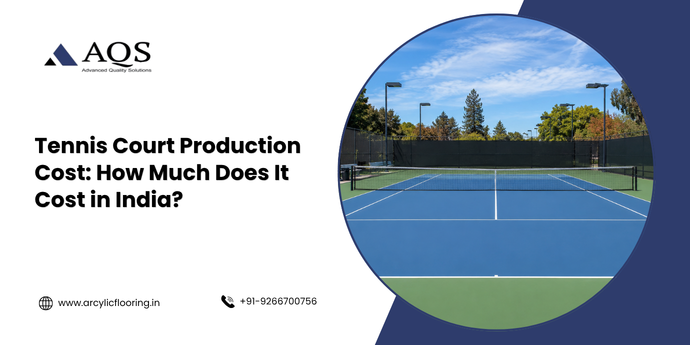
Tennis is one of India’s fastest-growing sports in 2026. Schools, sports academies, housing societies, and private clubs all actively invest in tennis courts. But the most critical question every buyer asks first: What is the real tennis court production cost in India?
This guide gives you a clear, accurate, and updated answer. You will understand every cost factor, every surface type, and every mistake to avoid – before you spend a single rupee.
What Is Tennis Court Production Cost?
One-line answer: Tennis court production cost is the total expense to build a complete, playable tennis court – including base construction, surface materials, fencing, lighting, and accessories.
The production cost covers more than just flooring. It includes civil work, drainage planning, surface system selection, line marking, net posts, and optional add-ons like floodlights and seating. The cost to build a tennis court in India typically ranges from ₹6 lakh to ₹18 lakh or more for a standard outdoor court, which works out to approximately ₹70 to ₹250 per sq. ft., depending on base construction, surface system, location, drainage, lighting, and accessories.
Upgrade Your Sports Court Today
Get premium synthetic acrylic flooring designed for durability, grip, and performance.
Get Free ConsultationUnderstanding these components separately gives you full budget control.
Tennis Court Size: Why It Matters for Cost
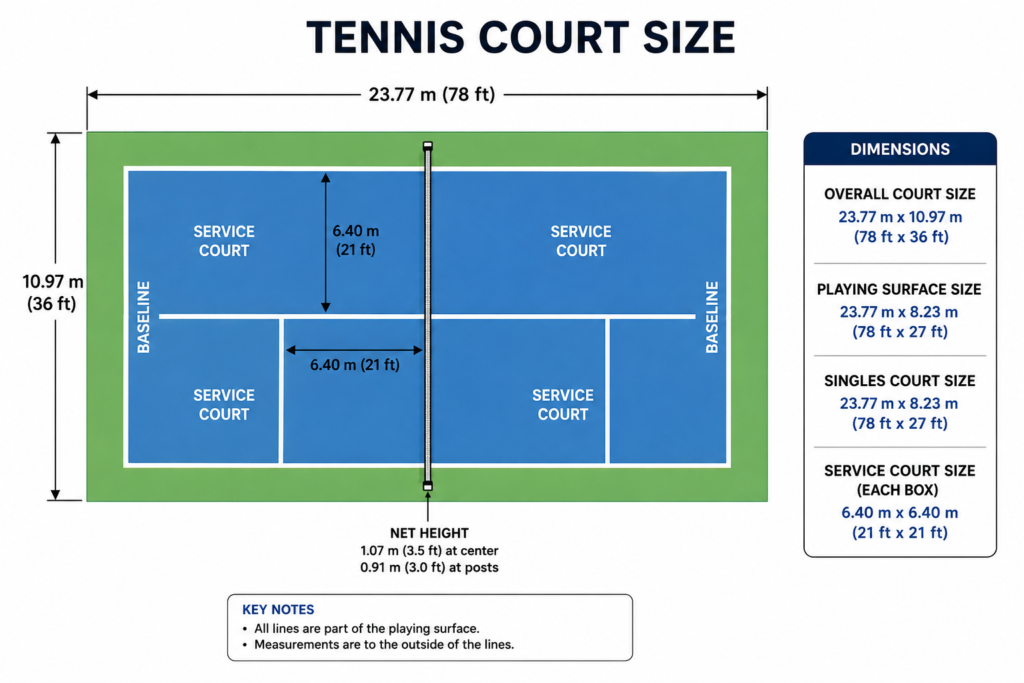
One-line answer: A standard tennis court covers approximately 7,200 sq. ft., and every size decision directly impacts material and labour cost.
The playing area for a doubles Tennis court measures 23.77 m × 10.97 m, and the recommended total area including run-off space is approximately 36.6 m × 18.3 m (120 ft × 60 ft) as per ITF standards.
Builders calculate material quantities based on this total area. A larger court means more base material, more surface coating, more fencing, and higher labour hours. Even minor changes in dimensions can shift your budget meaningfully.
Key Factors That Drive Tennis Court Production Cost in India
One-line answer: Surface type, base quality, site conditions, location, and add-ons are the five main cost drivers.
The cost of tennis court construction in India depends on surface type (acrylic, clay, turf), base construction quality (concrete or asphalt layers), site conditions (soil, leveling, drainage), indoor vs outdoor setup, lighting, fencing and accessories, number of courts, and overall project scale.
Each factor independently changes the final price. A weak soil site increases base cost. A coastal city requires moisture-resistant layers. An indoor court doubles the budget due to roofing and ventilation. Knowing these factors early prevents costly surprises later.
Tennis Court Production Cost: Detailed Cost Information Table (India 2026)
| Cost Component | Budget Range (₹) | Percentage of Total Cost |
| Base Construction (Concrete/Asphalt) | ₹150 – ₹250 per sq. ft. | 25–35% |
| Surface Material (Acrylic/PU/Clay) | ₹90 – ₹160 per sq. ft. | 20–30% |
| Fencing (3–4 m, wire mesh + steel) | ₹1.5 lakh – ₹4 lakh | 10–15% |
| Lighting (LED Floodlights) | ₹1 lakh – ₹3.5 lakh | 8–12% |
| Net Posts, Net & Accessories | ₹25,000 – ₹70,000 | 3–5% |
| Line Marking & Court Painting | ₹20,000 – ₹50,000 | 2–4% |
| Drainage System | ₹50,000 – ₹1.5 lakh | 4–6% |
| Labour (Installation) | Included above | 20–25% of total |
| Total (Outdoor, Standard) | ₹6 lakh – ₹18 lakh+ | 100% |
| Total (Indoor, Premium) | ₹18 lakh – ₹35 lakh+ | 100% |
Prices vary by city, project scale, and soil conditions. Indoor courts cost 30–50% more than outdoor courts.
Surface Type Comparison Table: Cost, Durability & Best Use
| Surface Type | Cost per Sq. Ft. (₹) | Lifespan | Maintenance Level | Best For |
| Acrylic (Basic) | ₹45 – ₹60 | 6–8 years | Low | Schools, Academies |
| Acrylic (Cushioned) | ₹60 – ₹ 80 | 7–10 years | Low | Clubs, Academies |
| PU (Polyurethane) | ₹180 – ₹250+ | 8–12 years | Medium | Indoor Premium Facilities |
| Clay | ₹40 – ₹80 | 5–7 years | Very High | Traditional Training |
| Synthetic Turf | ₹100 – ₹160 | 6–9 years | Medium | Recreational Courts |
| Concrete (Base only) | ₹60 – ₹90 | N/A (Not playable alone) | N/A | Foundation Layer Only |
Source: Market data compiled from leading Indian tennis court contractors, 2026.
Surface-by-Surface Deep Dive: What Does Each Cost You?
1. Acrylic Tennis Courts – Most Popular in India
Acrylic courts dominate India’s tennis construction market in 2026. Most government tenders and private academies now prefer acrylic tennis court flooring due to its durability and predictable play performance.
The acrylic material cost breaks into three tiers: a basic acrylic system costs ₹300–₹450 per sq. m, a standard acrylic system costs ₹450–₹650 per sq. m, and a premium cushioned acrylic system costs ₹700–₹1,000 or more per sq. m. These prices vary based on brand, specifications, and project size.
Acrylic surfaces are UV-resistant, anti-skid, weatherproof, and cost-effective. They suit India’s hot, monsoon-prone climate exceptionally well.
Upgrade Your Sports Court Today
Get premium synthetic acrylic flooring designed for durability, grip, and performance.
Get Free Consultation2. Clay Courts – Traditional but High Maintenance
Clay courts deliver a classic playing experience but demand constant upkeep. They stay wet during monsoons and crack under extreme heat. Clay courts are common in Europe but are less practical for most Indian climates. The initial build cost is lower, but long-term maintenance expenses make clay an expensive choice over time.
3. PU (Polyurethane) Courts – Premium Indoor Choice
PU courts offer superior shock absorption and player comfort. PU systems are preferred for premium indoor facilities and deliver excellent longevity. They cost significantly more than standard acrylic but reduce player fatigue and joint injuries. Sports academies with high usage frequency find PU courts worth the investment.
4. Synthetic Turf Courts – Recreational Option
Synthetic turf works well for recreational play and multi-sport usage. The cost for synthetic tennis court flooring typically ranges between ₹180 to ₹650 per sq. ft., depending on flooring type, base preparation, and location. Turf courts are comfortable underfoot but require infill replacement every few years.
City-Wise Tennis Court Production Cost Variation in India (2026)
Labour rates, material logistics, and climatic conditions all affect city-level pricing.
| City / Region | Estimated Total Cost (Outdoor Acrylic) | Key Cost Factor |
| Delhi / NCR | ₹10 lakh – ₹18 lakh | High labour rates, premium demand |
| Mumbai | ₹12 lakh – ₹20 lakh | Real estate premium, logistics |
| Bengaluru | ₹9 lakh – ₹16 lakh | Skilled contractor availability |
| Chennai | ₹8 lakh – ₹14 lakh | Coastal moisture-resistance needed |
| Hyderabad | ₹8 lakh – ₹15 lakh | Balanced labour & material cost |
| Pune | ₹8 lakh – ₹14 lakh | Growing sports infrastructure |
| Tier 2 Cities | ₹6 lakh – ₹12 lakh | Lower labour, higher transport cost |
Coastal cities such as Mumbai and Chennai may require additional moisture-resistant coating layers, increasing cost by 8–12%.
Outdoor vs Indoor Tennis Court – Cost Comparison
One-line answer: Indoor tennis courts cost 30–50% more than outdoor courts due to roofing, ventilation, and structural requirements.
| Feature | Outdoor Court | Indoor Court |
| Base Cost | ₹6 lakh – ₹18 lakh | ₹18 lakh – ₹35 lakh+ |
| Roofing/Structure | Not required | ₹8 lakh – ₹15 lakh extra |
| Lighting Need | Optional | Mandatory |
| Weather Dependency | High | None |
| Best For | Schools, Clubs, Academies | Premium Urban Facilities |
| Maintenance Frequency | Every 5–7 years | Every 6–8 years |
Outdoor courts suit most Indian institutions and academies. Indoor courts are ideal for year-round professional training unaffected by monsoons or summer heat.
Stage-by-Stage Construction Process and Cost Impact
One-line answer: Professional tennis court construction follows six technical stages, each contributing directly to the final production cost.
Stage 1 – Site Survey and Soil Testing
Engineers check soil strength, water table level, drainage flow, and available slope. In India, weak soil and poor drainage are major reasons courts crack early. A proper survey prevents future repair costs. Budget: ₹15,000 – ₹50,000 depending on site complexity.
Stage 2 – Base Construction
This stage accounts for 25–35% of total cost. Laser leveling is done to maintain slope, with a slope requirement of 1:100 to 1:80 for surface drainage. A concrete base is strongly preferred for Indian conditions over asphalt, as it handles seasonal temperature changes better and prevents cracking.
Stage 3 – Drainage System
Drainage is non-negotiable in India’s monsoon climate. Proper slope of 0.83–1% and efficient drainage systems are necessary to prevent waterlogging, surface cracks, and premature resurfacing. Poorly drained courts crack within 2–3 seasons.
Stage 4 – Surface Application
The surface team applies the chosen flooring system in multiple layers – primer, base coat, and finish coats. Each layer must cure fully before the next application. Quality coating thickness directly determines court life and ball bounce consistency.
Stage 5 – Line Marking and Accessories
Precise ITF-compliant line marking uses durable paint that stays visible for years. Net posts, anchor plates, and the net itself are installed at this stage. All dimensions are verified against ITF standards before the court opens.
Stage 6 – Fencing and Lighting
Fencing prevents ball loss and defines the playing area. LED floodlights enable evening and night play. Fencing typically costs ₹8,000–₹15,000 per court internationally, with LED lighting adding ₹10,000–₹25,000 per court in global markets – proportionally lower in India due to cheaper local labour.
Case Study – Sports Academy in Pune Builds an Acrylic Tennis Court (2025–2026)
Project: Greenfield Sports Academy, Pune Requirement: One standard outdoor doubles court for professional coaching Budget Approved: ₹14 lakh
What They Did
The academy selected a certified contractor with ITF-compliant acrylic flooring systems. Engineers conducted a soil test, found moderately stable soil, and recommended a concrete base with a 1:100 slope for drainage. Construction started in November 2025 and completed in 5.5 weeks.
Cost Breakdown
| Item | Cost (₹) |
| Soil Testing & Site Prep | ₹45,000 |
| Base Construction (Concrete) | ₹4,80,000 |
| Acrylic Surface System (Standard) | ₹3,20,000 |
| Drainage System | ₹75,000 |
| Fencing (3 m height, full perimeter) | ₹2,10,000 |
| LED Floodlights (6 units) | ₹1,40,000 |
| Net Posts + Net + Accessories | ₹55,000 |
| Line Marking | ₹30,000 |
| Contractor Fees | ₹65,000 |
| Total | ₹13,20,000 |
Results
The court opened in January 2026. The academy now runs 4 coaching batches per day. The standard acrylic surface performs consistently and requires zero maintenance in the first year. The court paid for itself within 8 months through coaching fees. This case study proves that a well-planned ₹13–14 lakh investment delivers measurable returns for sports institutions.
Maintenance Cost – The Hidden Long-Term Expense
One-line answer: Annual tennis court maintenance costs between ₹30,000 and ₹1.5 lakh depending on usage and surface type.
Resurfacing is typically required every 5–7 years depending on usage. Acrylic courts need only basic cleaning and periodic crack sealing between resurfacing cycles. Clay courts require daily watering, rolling, and line re-marking – making them far more expensive to maintain annually.
Smart operators budget 10–15% of the original build cost per year for maintenance, inspections, and minor repairs.
Common Mistakes That Increase Tennis Court Production Cost
One-line answer: Cutting corners on base construction and drainage is the costliest mistake in tennis court production.
Avoid these proven budget-killers:
- Skipping proper soil testing before construction
- Using low-quality acrylic coatings to reduce material cost
- Ignoring slope requirements and drainage design
- Hiring general civil contractors instead of sports flooring specialists
- Incorrect court orientation causing sun glare and player discomfort
- Choosing clay surfaces without budgeting for ongoing maintenance
Trying to save money by using poor materials usually increases expenses later. Even the best material will fail if installation is poor.
Frequently Asked Questions
A: The minimum realistic budget for a standard outdoor acrylic court starts at ₹6 lakh for a basic setup in Tier 2 cities.
A complete outdoor tennis court typically takes 4 to 7 weeks to construct, including site work, base construction, curing, acrylic surface application, and installation of fencing and lighting. Monsoon season may extend the timeline.
Synthetic acrylic flooring is the most preferred surface for outdoor tennis courts in India because it is UV-resistant, anti-skid, weatherproof, cost-effective, and low maintenance, and is suitable for Indian climatic conditions.
A: Yes – indoor courts cost 30–50% more due to roofing, structural framing, ventilation, and mandatory artificial lighting requirements.
A: Standard acrylic courts need resurfacing every 5–7 years with regular use, while clay courts need partial resurfacing annually.
A: Yes, with proper structural approval, load-bearing verification, and a specialized waterproof base system, rooftop tennis courts are feasible in India.