Summary
Choosing between a badminton court or tennis court depends on space, budget, surface type, and your sporting goals. In India 2026, badminton courts are smaller (13.4m × 6.1m), cheaper to build (₹4-10 lakh), and preferred indoors. Tennis courts are larger (23.77m × 8.23m), cost ₹15-40 lakh, and suit both indoor and outdoor settings. Badminton dominates urban India; tennis leads in elite clubs.
- Badminton Court Size: 13.4m × 6.1m (singles: 13.4m × 5.18m)
- Tennis Court Size: 23.77m × 8.23m (singles: 23.77m × 8.23m)
- Cost in India 2026: Badminton ₹4-10L | Tennis ₹15-40L
- Best For Indoors: Badminton | Best For Outdoors: Tennis or Both
- Popularity in India: Badminton growing faster in Tier 2 & 3 cities
Table of contents
- Summary
- Court Dimensions and Space Requirements: Badminton vs Tennis in India 2026
- Court Surface Types and Flooring Costs: Indoor & Outdoor Analysis 2026
- Total Construction Cost Comparison: Building a Court in India 2026
- Badminton vs Tennis Popularity Growth in India: Participation Data 2026
- Full Comparison: Badminton Court or Tennis Court – Which Wins in India 2026?
- Indoor Badminton Court vs Outdoor Tennis Court: Climate & Playing Conditions India 2026
- Real Case Study · India 2025
- Physical Fitness and Health Benefits: Badminton vs Tennis for Indian Players 2026
- Multi-Sport Court Conversion: Can One Space Serve Both Sports in India?
- Government Schemes and Sports Policy Support for Court Infrastructure
- Conclusion
- Frequently Asked Questions
Every sports enthusiast, academy owner, or housing society manager in India faces one critical decision in 2026 – should they build a badminton court or tennis court? Both sports have distinct playing environments, infrastructure demands, and long-term investment implications. India’s sporting culture is evolving rapidly, and choosing the right court defines community engagement, physical fitness outcomes, and financial sustainability. This comprehensive guide covers every angle so you make the smartest, most informed choice possible.
Court Dimensions and Space Requirements: Badminton vs Tennis in India 2026
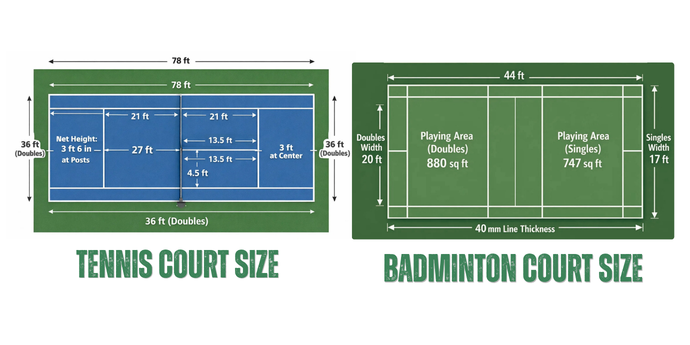
Understanding court dimensions is the first step before any construction or renovation project begins. A standard badminton court measures 13.4 metres in length and 6.1 metres in width for doubles play. Singles badminton uses a narrower 5.18-metre width. The net stands at 1.55 metres at the posts and 1.524 metres at the centre. These compact dimensions make badminton courts highly practical for urban apartments, schools, and community halls across India’s growing cities.
Upgrade Your Sports Court Today
Get premium synthetic acrylic flooring designed for durability, grip, and performance.
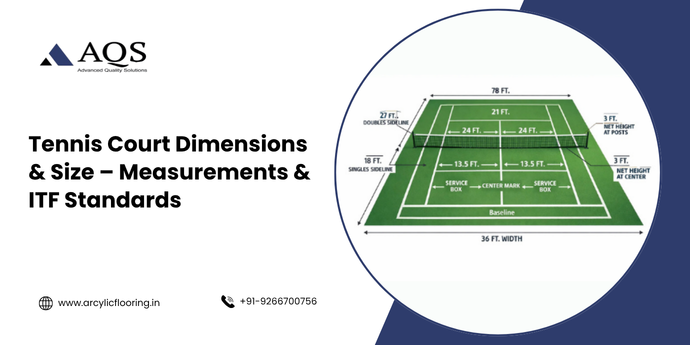
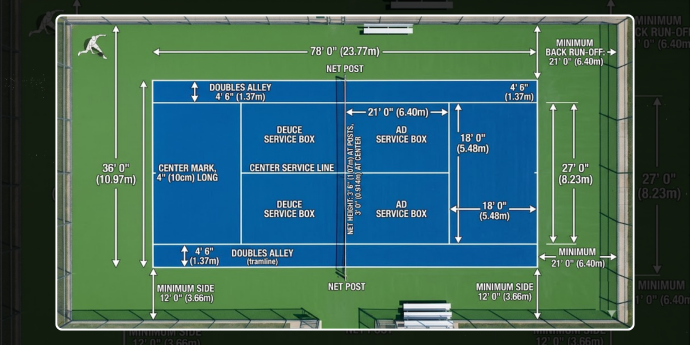
Get Free ConsultationA standard tennis court, by contrast, measures 23.77 metres in length and 8.23 metres in width for singles, expanding to 10.97 metres for doubles. The net height is 0.914 metres at the centre. Tennis courts demand significantly more land area – approximately 260.7 square metres compared to just 81.7 square metres for a badminton court. In land-scarce Indian cities like Mumbai, Delhi, and Bengaluru, this size difference carries enormous cost implications for both builders and players.
| Measurement | Badminton Court | Tennis Court |
| Length | 13.4 m | 23.77 m |
| Width (Doubles) | 6.1 m | 10.97 m |
| Width (Singles) | 5.18 m | 8.23 m |
| Net Height (Centre) | 1.524 m | 0.914 m |
| Total Area (Doubles) | ~81.7 m² | ~260.7 m² |
| Clearance Height (Indoor) | Min. 9 m | Min. 5 m (hard courts) |
| Indoor Suitability | Highly Suitable | Possible but Expensive |
Space Efficiency for Indian Urban Properties in 2026
India’s urban real estate prices continue to rise sharply in 2026. A housing society in Pune or Noida can fit three badminton courts in the same footprint that one tennis court demands. Sports academies and school sports departments across Tier 1 and Tier 2 cities now consistently prioritise badminton courts for this very reason. Space efficiency directly translates into accessibility for more players, generating higher revenue and footfall per square metre of land used.
Court Surface Types and Flooring Costs: Indoor & Outdoor Analysis 2026
Surface selection determines playing quality, player safety, and long-term maintenance costs for both badminton and tennis courts. Badminton courts in India use synthetic wood flooring, PVC sports flooring, or wooden sprung floors. PVC flooring costs between ₹80-₹150 per square foot installed in 2026. Wooden sprung floors, preferred by professional academies and SAI-affiliated training centres, cost ₹200-₹350 per square foot. Proper shock absorption prevents knee injuries and extends athlete careers significantly.
Tennis court surfaces include hard acrylic courts (most popular in India), clay courts, and synthetic grass. Hard courts cost ₹600-₹900 per square foot for full construction in India 2026. Clay courts remain popular in European-influenced clubs but require intense daily maintenance including watering, rolling, and brushing. Synthetic grass courts offer low maintenance but cost ₹450-₹700 per square foot. Outdoor hard courts withstand Indian monsoons better than clay, making them the dominant choice for DLTA-affiliated and state tennis associations.
| Surface Type | Sport | Cost/Sq Ft (2026) | Lifespan | Maintenance |
| PVC Synthetic | Badminton | ₹80-₹150 | 8-12 years | Low |
| Wooden Sprung | Badminton | ₹200-₹350 | 15-25 years | Medium |
| Hard Acrylic | Tennis | ₹600-₹900 | 10-15 years | Low-Medium |
| Clay Court | Tennis | ₹300-₹500 | Ongoing | Very High |
| Synthetic Grass | Tennis | ₹450-₹700 | 10-12 years | Low |
Total Construction Cost Comparison: Building a Court in India 2026
Building costs in India vary by state, contractor, and court specification. A complete single badminton court including PVC flooring, net posts, lighting, and boundary markings costs between ₹4 lakh and ₹10 lakh in 2026. Professional wooden sprung courts for academies can reach ₹15-₹20 lakh per court. Multi-court badminton hall constructions with roofing, ventilation, and LED lighting systems range from ₹40-₹80 lakh for a four-court facility in metro cities. The return on investment is faster due to high urban demand.
Tennis court construction costs significantly more. A standard outdoor hard court including full construction, fencing, floodlights, and surface painting costs ₹15-₹25 lakh in Indian cities in 2026. Premium indoor tennis courts with climate control and spectator seating cost ₹60 lakh to ₹1.5 crore per court. Fencing alone for a tennis facility costs ₹3-₹5 lakh. Annual maintenance – including resurfacing, net replacement, and line repainting – adds ₹1-₹3 lakh per year for an outdoor tennis court operating in Indian climate conditions.
Badminton vs Tennis Popularity Growth in India: Participation Data 2026
India’s badminton ecosystem has exploded since PV Sindhu’s Olympic silver in 2016 and continues growing exponentially in 2026. The Badminton Association of India reports over 3.5 crore active registered players, with Tier 2 cities like Lucknow, Coimbatore, Bhopal, and Nagpur witnessing the sharpest academy enrollment growth. Corporate offices, gated communities, schools, and government sports complexes all prioritise badminton infrastructure investment. India now ranks among the top five badminton nations globally.
Tennis in India maintains strong urban elite appeal but grows at a slower rate. The All India Tennis Association (AITA) reports approximately 1.2 crore registered players as of 2026. Tennis remains strongly associated with premium clubs, defence colonies, and industrial towns with legacy infrastructure. The sport’s growth accelerates wherever junior development programs run under state academies. Leander Paes’s legacy and new ATP Challenger events hosted in India continue to inspire youth participation in metropolitan areas.
India Sports Infrastructure Report 2026
According to the Sports Authority of India (SAI), badminton court construction approvals under the Khelo India programme increased 47% between 2023 and 2025. Tennis infrastructure investment under the same programme grew 18% in the same period, indicating clear policy-level prioritisation of badminton nationwide.
Full Comparison: Badminton Court or Tennis Court – Which Wins in India 2026?
A direct side-by-side comparison across all major parameters helps investors, academy owners, housing societies, and individual sports enthusiasts make the right infrastructure decision for their specific context in India 2026.
| Parameter | Badminton Court | Tennis Court |
| Standard Size | 13.4m × 6.1m | 23.77m × 10.97m |
| Land Required | ~82 m² | ~260 m² |
| Build Cost India 2026 | ₹4-10 Lakh | ₹15-40 Lakh |
| Indoor Viability | Excellent | Limited/Costly |
| Outdoor Viability | Not Ideal (wind) | Excellent |
| Maintenance Cost/Yr | ₹30K-₹80K | ₹1L-₹3L |
| Player Base India | 3.5 Crore+ | 1.2 Crore |
| Equipment Cost | Low (₹500-₹5K) | High (₹3K-₹30K) |
| Age Suitability | All Ages | 8 Years+ |
| Revenue Potential | ₹150-₹400/hr | ₹400-₹1200/hr |
| ROI Timeline | 2-4 Years | 4-8 Years |
| Government Schemes | Khelo India ✓ | Khelo India ✓ |
Upgrade Your Sports Court Today
Get premium synthetic acrylic flooring designed for durability, grip, and performance.
Get Free ConsultationCalculate Your Sports Court Dimensions!
Contact us for Quickly measure and calculate accurate sports court dimensions with this easy-to-use tool!
Indoor Badminton Court vs Outdoor Tennis Court: Climate & Playing Conditions India 2026
India’s diverse climate makes indoor vs outdoor court decisions critically important. Badminton, played with a feather or synthetic shuttlecock, is extremely sensitive to wind. Even a slight breeze disrupts shuttle flight trajectory entirely. This makes badminton a predominantly indoor sport across India. Dedicated badminton halls with proper roof height (minimum 9 metres clearance), ventilation systems, and glare-free LED lighting create optimal conditions for competition and practice. Cities like Hyderabad, Chennai, Bengaluru, and Delhi host world-class indoor badminton facilities.
Tennis thrives outdoors in India’s climate when courts are properly maintained. Hard acrylic courts drain efficiently post-monsoon and dry within two to three hours after heavy rain. Floodlit outdoor tennis courts enable evening sessions throughout the year across most Indian cities. Premium clubs in Delhi, Mumbai, and Kolkata now offer retractable cover systems for clay courts to extend playable days during the monsoon season. The total annual playable days for outdoor tennis courts in South and West India exceed 280 days.
Lighting Requirements and Energy Efficiency for Indian Sports Courts 2026
LED lighting systems for badminton halls require 400-500 lux for recreational play and 750+ lux for tournament-level competition. A four-court badminton hall uses 60-80 LED fixtures consuming approximately 18-24 kW per session. Modern LED systems reduce energy consumption by 40-50% compared to metal halide fixtures. Tennis courts require 300-500 lux for recreational play and 1000+ lux for televised matches. Floodlit outdoor tennis courts consume 30-50 kW depending on court area and fixture count per session.
Real Case Study · India 2025
Greenfield Sports Complex, Lucknow: Converting Tennis Courts to Badminton
In early 2025, the Greenfield Sports Complex in Lucknow, Uttar Pradesh, faced a strategic infrastructure dilemma. The facility owned two outdoor tennis courts occupying 600 square metres with footfall of approximately 40 players per day. Revenue averaged ₹28,000 per month. Management conducted a feasibility study to convert the space into a four-court indoor badminton hall after noting membership inquiries tripled for badminton compared to tennis in 2024.
The conversion cost ₹34 lakh including roofing, PVC flooring, lighting, and ventilation. Within eight months of reopening, the facility recorded 220+ daily players and monthly revenue of ₹1.05 lakh – a 275% increase. Membership subscriptions covered operational costs within 14 months. The case demonstrates how badminton infrastructure delivers faster ROI in Tier 2 Indian cities. The facility now runs morning academies for school students and evening recreational sessions simultaneously across all four courts.
Physical Fitness and Health Benefits: Badminton vs Tennis for Indian Players 2026
Both sports deliver exceptional cardiovascular fitness, agility, and coordination benefits. Badminton demands explosive lateral movement, overhead smashing power, and rapid reflexes. Studies from AIIMS and Indian sports science institutes confirm that a 45-minute badminton session burns 450-550 calories for a 70 kg adult. The sport builds fast-twitch muscle fibres, improves hand-eye coordination, and strengthens rotator cuff muscles. India’s badminton boom has directly contributed to rising participation in structured fitness activities among youth aged 10-35.
Tennis offers sustained aerobic exercise combined with powerful ground stroke mechanics. A standard 60-minute tennis session burns 400-600 calories depending on intensity and court surface. Tennis develops bilateral strength more evenly when players practise both hands or switch disciplines. The longer rally structure in tennis builds mental endurance and strategic thinking. Tennis also delivers excellent bone density benefits due to high-impact running and jumping on hard court surfaces across all age groups in India.
Quick Decision Guide: Which Court Should You Build?
Choose Badminton If…
- You have limited land area (<150 m²)
- Budget under ₹15 lakh
- Building indoors (apartments, schools)
- Targeting Tier 2/3 city audiences
- Want faster ROI (2-4 years)
- Serving families and youth academies
Choose Tennis If…
- Land area exceeds 300 m²
- Premium club or resort setting
- Targeting high-income members
- Want higher per-hour court revenue
- Outdoor location with stable climate
- Long-term prestige branding goals
Multi-Sport Court Conversion: Can One Space Serve Both Sports in India?
Modern sports infrastructure design in India increasingly explores multi-purpose court systems that accommodate both badminton and tennis within a single footprint. A tennis court’s dimensions comfortably host two full badminton courts side by side. Many clubs and resorts now paint dual-line markings on their hard courts to serve both sports using the same surface. Removable net systems with adjustable height posts make switching between sports within minutes completely feasible. This strategy maximises asset utilisation and revenue per square metre significantly.
However, multi-use courts involve compromise. Tennis hard court acrylic surfaces are slightly harder than optimal for badminton players who require better shock absorption during lateral jumps and drops. Badminton shuttlecocks also deteriorate faster on rough textured surfaces. For serious academies and competition-level training, purpose-built dedicated courts remain the gold standard. Multi-use courts work well for recreational clubs, residential complexes, and school playgrounds where variety and accessibility outweigh elite performance priorities.
Calculate Your Sports Court Dimensions!
Contact us for Quickly measure and calculate accurate sports court dimensions with this easy-to-use tool!
Government Schemes and Sports Policy Support for Court Infrastructure
India’s central government actively funds both badminton and tennis infrastructure under the Khelo India programme and the National Sports Development Fund. The Khelo India scheme allocates dedicated grants for sports facility development in schools, colleges, and rural areas. State governments in Telangana, Tamil Nadu, Karnataka, and Odisha have established their own sports infrastructure funds that offer interest-free loans and direct subsidies for court construction projects by registered sports clubs and associations. Athletes and academies can apply through the SAI portal.
Municipal corporations across India increasingly include sports court specifications in new township development approvals. The Real Estate Regulatory Authority (RERA) guidelines in several states now require large residential projects to allocate space for sports courts. Badminton courts qualify under basic recreational requirements given their smaller footprint. Tennis courts, due to their larger area, qualify under premium amenity classifications. Both sports receive equal recognition under the National Sports Policy 2025 framework for talent development.
Conclusion
The decision between a badminton court or tennis court ultimately depends on your available land, budget, target audience, and long-term vision for sports engagement. Badminton courts win decisively on cost-efficiency, space utilisation, player accessibility, and urban relevance in India 2026. They serve a broader demographic and generate faster financial returns. Tennis courts command higher per-session revenue and carry aspirational brand value for premium real estate and hospitality projects. Both sports positively impact India’s fitness culture and economic growth.
India’s sports infrastructure story in 2026 is one of democratisation and growth. Badminton leads this movement with grassroots energy from Tier 2 cities. Tennis anchors the premium segment with legacy clubs and international tournament aspirations. Smart investors and facility managers choose badminton for scale and accessibility, while tennis remains irreplaceable for elite positioning. Build based on your community’s needs, and you build for the long game both literally and strategically.
Frequently Asked Questions
A badminton court is significantly smaller (13.4m × 6.1m) and played indoors, while a tennis court is larger (23.77m × 10.97m) and typically played outdoors.
A badminton court costs ₹4–₹10 lakh to build, making it significantly more affordable than a tennis court, which costs ₹15–₹40 lakh in India.
Yes, a standard tennis court can accommodate two full badminton courts using dual-line markings and adjustable net posts without any major structural changes.
Badminton has over 3.5 crore registered players in India, far exceeding tennis which has approximately 1.2 crore registered players as of 2026.
An indoor badminton court requires a minimum ceiling clearance of 9 metres to ensure proper shuttle flight and avoid structural interference during play.
Badminton courts offer faster ROI of 2–4 years due to lower build costs, higher player volumes, and strong urban demand across Indian cities in 2026.