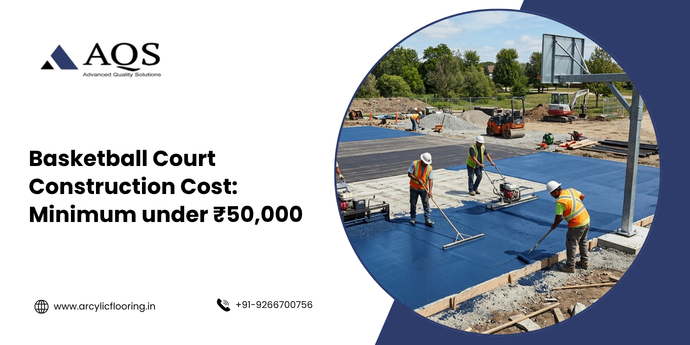
Understanding basketball court construction cost requires a clear breakdown of all contributing variables before you commit a single dollar to the project. The total price you pay depends on numerous factors including court size, surface material, location, labor rates, site conditions, and the level of customization you want in your finished court.
On average, building a full-size outdoor basketball court costs homeowners approximately $35,000, with a typical project range between $8,600 and $75,200. Indoor courts command a higher investment, with costs running from $10,000 for a basic residential half-court to more than $150,000 for a full-size professional-grade facility. The cost per square foot for outdoor construction falls between $4 and $16, while indoor construction ranges from $3.50 to $19 per square foot, depending on the selected flooring system and subfloor construction method.
The basketball court installation cost breakdown typically includes five major components: site preparation, base or foundation work, surface material, line marking, and accessories such as hoops, lighting, and fencing. Skipping or underfunding any of these components can lead to premature surface failure, drainage issues, or unsafe playing conditions. Professional contractors who specialize in sports court construction provide the most accurate cost estimates and ensure each phase of construction meets performance and safety standards.
Key Insight
The single largest cost variable in any court project is the court size. A standard NBA full court measures 94 × 50 feet (4,700 sq ft), while a common residential half-court runs 47 × 50 feet (2,350 sq ft). Choosing a half-court can immediately cut your total budget by 40–55%.
Cost by Court Size: Half Court vs Full Court
Court size is the single most powerful driver of your total basketball court construction cost. Every additional square foot adds to material costs, labor hours, foundation work, and surface treatment expenses. Understanding the price difference between a half-court and a full-size regulation court helps you set a realistic budget from the very beginning of your planning process.
A standard half-court at 47 × 50 feet (2,350 sq ft) offers plenty of space for drills, one-on-one games, and three-player pick-up sessions. The total cost for a half-court ranges from $8,600 to $40,000 depending on the chosen surface material and site conditions. A full regulation-size court at 94 × 50 feet (4,700 sq ft) runs from $17,600 to $75,200 for standard outdoor construction. Indoor full courts demand a higher budget, typically $50,000 to $150,000, because they require specialized flooring systems, enhanced lighting, ventilation, and structural considerations.
For homeowners with budget constraints, a compact shooting court at 30 × 30 feet (900 sq ft) costs between $3,600 and $14,400 an excellent entry point that still allows meaningful practice sessions. Contractors recommend sizing your court based on your primary use case: competitive play demands regulation dimensions, while recreational family use can be well-served by a cost-efficient half-court layout.
| Court Type | Dimensions (ft) | Square Footage | Outdoor Cost Range | Indoor Cost Range | Best For |
|---|---|---|---|---|---|
| Shooting Court | 30 × 30 | 900 sq ft | $3,600 – $14,400 | $6,300 – $17,000 | Solo Practice |
| 3-on-3 Court | 37 × 42 | 1,554 sq ft | $6,200 – $24,000 | $10,000 – $30,000 | Recreational |
| Half Court | 47 × 50 | 2,350 sq ft | $8,600 – $40,000 | $20,000 – $45,000 | Family Use |
| High School Full Court | 84 × 50 | 4,200 sq ft | $16,800 – $67,000 | $40,000 – $100,000 | Club/School |
| NBA Full Court | 94 × 50 | 4,700 sq ft | $17,600 – $75,200 | $50,000 – $150,000 | Professional |
Calculate Your Sports Court Dimensions!
Contact us for Quickly measure and calculate accurate sports court dimensions with this easy-to-use tool!
Indoor vs Outdoor Basketball Court Cost
When comparing indoor vs outdoor basketball court costs, the difference goes far beyond just the price of the surface itself. An outdoor court eliminates the need to construct or modify a physical building, making it significantly cheaper for most homeowners. However, outdoor courts require more robust drainage systems, UV-resistant surface coatings, and weather-resistant materials that maintain playability through rain, heat, and freeze-thaw cycles.
Outdoor courts typically cost between $4 and $16 per square foot and are the most common choice for residential and community installations. They require a solid base (concrete or asphalt), proper site grading for drainage, and a durable surface coating. Maintenance costs are moderate, with occasional resurfacing needed every 8–12 years depending on climate and usage intensity. The lower upfront investment makes outdoor courts the most practical option for families and small organizations.
Indoor courts carry significantly higher costs, running from $3.50 to $19 per square foot for the flooring system alone, not counting construction of the building shell, HVAC, specialized lighting, and other facility costs. Indoor courts offer year-round playability, consistent surface conditions, and superior athlete safety. Schools, sports clubs, and serious training facilities typically invest in indoor courts because the controlled environment maximizes performance outcomes and extends the court’s functional lifespan. Building an entirely new indoor facility including the structure, lighting, ventilation, locker rooms, and court surface can cost up to $5 million for a professional-grade complex.
Outdoor Courts
- Lower upfront cost ($4–$16/sq ft)
- No building construction needed
- Exposed to weather & UV damage
- Requires strong drainage system
- Asphalt or concrete base common
- Resurfacing every 8–12 years
- Best for residential & community use
Indoor Courts
- Higher cost ($3.50–$19/sq ft + building)
- Year-round playability
- Maple hardwood standard surface
- Requires HVAC & ventilation
- Superior athlete safety & performance
- 30–40 year floor lifespan possible
- Best for schools, clubs, professionals
Basketball Court Flooring: Types, Costs & Comparison
Basketball court flooring is the heart of your court’s playability, safety, and long-term durability. The surface you choose directly impacts ball bounce consistency, shock absorption for players’ joints, traction quality, and maintenance requirements over the years. Selecting the right flooring requires balancing your budget, the court’s intended use level, and whether the installation is indoors or outdoors.
For indoor courts, maple hardwood remains the undisputed gold standard. Used in every NBA and NCAA facility, maple flooring offers unmatched ball response, consistent shock absorption, and a lifespan of 30–40 years with proper maintenance. The cost of maple hardwood flooring runs $3.50 to $6 per square foot for materials, plus an additional $3 to $8 per square foot for professional installation. Laminate flooring provides a budget-friendly alternative at $0.70 to $2 per square foot, though it lacks the durability and playing quality of solid hardwood. Epoxy-coated concrete is another indoor option at roughly $6 per square foot installed, offering excellent value for recreational facilities.
For outdoor courts, acrylic-coated concrete delivers the best balance of performance and affordability. Modular interlocking tiles made from high-density polyethylene (HDPE) have grown dramatically in popularity because they install without adhesives, allow for drainage through the tile structure, and resist UV degradation. Premium modular tile systems cost between $12,400 and $80,000 for a full court, depending on tile grade and court dimensions. Rubber surfaces provide superior cushioning and are popular in community parks and training facilities where joint protection is a priority, but they carry a higher installation price of up to $22,900 for a half court.
| Flooring Type | Setting | Cost (Materials) | Install Cost/sq ft | Lifespan | Performance |
|---|---|---|---|---|---|
| Maple Hardwood | Indoor | $3.50–$6/sq ft | $3–$8 | 30–40 yrs | Elite |
| Laminate | Indoor | $0.70–$2/sq ft | $1–$2 | 10–15 yrs | Good |
| Epoxy Concrete | Indoor/Outdoor | ~$6/sq ft total | Included | 8–15 yrs | Moderate |
| Acrylic-Coated Concrete | Outdoor | $8,800–$22,900 HC | $4–$10 | 10–20 yrs | Very Good |
| Asphalt | Outdoor | $14,000–$18,000 FC | $3–$6 | 8–12 yrs | Moderate |
| Modular Tiles (HDPE) | Outdoor/Indoor | $2–$6/sq ft | $1–$3 | 15–25 yrs | Good–Very Good |
| Rubber Surface | Outdoor/Indoor | $8,800–$22,900 HC | $5–$12 | 15–20 yrs | Good (cushioned) |
Transform Your Sports Facility Today!
Contact us for high-quality synthetic sports flooring material and elevate your space!
Basketball Court Material Breakdown
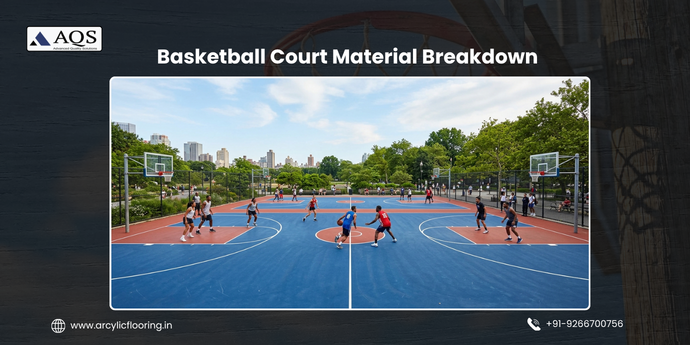
Selecting the right basketball court material is one of the most consequential decisions in the entire construction process. The material you choose affects not only the initial basketball court construction cost but also long-term maintenance expenses, player safety, performance quality, and the court’s ability to withstand environmental stress over time.
Concrete is the most widely used base and surface material for outdoor courts because it delivers excellent structural integrity, dimensional stability, and a long service life. A full-size concrete court costs between $15,000 and $45,800 depending on thickness, rebar reinforcement, and post-tensioning specifications. For premium performance, post-tension concrete which uses embedded steel cables to resist cracking is the industry’s gold standard for bases. It reduces crack risk dramatically and can support surface performance for several decades without major structural intervention.
Asphalt offers a more flexible and lower-upfront-cost alternative to concrete, with full-court asphalt installation ranging from $14,000 to $18,000. The flexibility of asphalt makes it better suited to cold climates where freeze-thaw cycles would otherwise cause concrete cracking. However, asphalt surfaces tend to soften in extreme heat, require resurfacing more frequently, and don’t provide the precision flatness that concrete achieves. For indoor courts, engineered wood subfloor systems such as the DuoBat and UnoBat floating floor systems use resilient pads and sleepers to create controlled shock absorption that protects athletes from long-term joint stress, a critical consideration for facilities with intensive daily use.
Material Warning
Choosing the cheapest surface material without considering your climate, usage frequency, and maintenance capacity can cost far more in the long run. Asphalt courts in hot climates or heavily used concrete courts without proper drainage drainage systems degrade rapidly leading to resurfacing costs that can reach $8,000–$25,000 within just a few years.
Concrete vs Asphalt: Side-by-Side Material Comparison
| Feature | Concrete | Asphalt |
|---|---|---|
| Full Court Cost | $15,000 – $45,800 | $14,000 – $18,000 |
| Durability | Very High (20–30 yrs) | Moderate (8–12 yrs) |
| Heat Resistance | Excellent | Poor (softens in heat) |
| Cold Resistance | Moderate (crack risk) | Better (flexible) |
| Surface Smoothness | Excellent | Good |
| Maintenance | Low (seal every 3–5 yrs) | Higher (resurface 8–12 yrs) |
| Best Climate | Temperate / Hot | Cold / Variable |
Basketball Court Installation Cost Factors
The total basketball court installation cost is never a single fixed number it’s the cumulative result of multiple interconnected decisions made throughout the design and build process. Professional contractors break the installation cost into distinct phases: site evaluation, land preparation, base construction, surface application, line marking, and finishing work. Understanding each phase helps you allocate your budget more intelligently and avoid unpleasant mid-project surprises.
Labor costs represent a significant portion of the total budget. For a standard full outdoor court, labor alone can range from $1,000 to $4,000 for surface-related work but this figure climbs substantially when site grading, excavation, and drainage installation are factored in. Professional sports court contractors possess specialized equipment and experience that directly impact the quality of the final court. Attempting to self-manage complex tasks such as pouring and leveling concrete slabs without professional expertise often leads to uneven surfaces, drainage failures, and premature cracking that ultimately cost more to correct than hiring professionals from the start.
Permits and regulatory compliance are often overlooked cost items. Most jurisdictions require permits for zoning, construction, and electrical work (if lighting is added). Permit fees range from a few hundred dollars to several thousand depending on your municipality and court size. Some homeowners’ associations (HOAs) impose additional approval processes and design restrictions. Budget for permit processing time in your project timeline to avoid construction delays. Post-construction cleanup and site restoration typically add $200 to $1,000 to the final invoice.
| Installation Phase | Cost Range | Notes |
|---|---|---|
| Site Clearing & Leveling | $1,000 – $5,000 | Depends on terrain complexity |
| Grading, Drainage & Stabilization | $2,500 – $5,000 | Critical for long-term surface health |
| Base Construction (Concrete) | $4 – $10/sq ft | 4-inch slab, 3000 PSI, #4 rebar recommended |
| Surface Application | $2 – $12/sq ft | Varies by material type chosen |
| Line Marking | $200 – $350 | Full court; less for half court |
| Labor (Surface & Finishing) | $1,000 – $4,000 | Full court outdoor baseline |
| Permits & Inspections | $200 – $3,000+ | Varies by location and scope |
| Post-Construction Cleanup | $200 – $1,000 | Site restoration and debris removal |
Site Preparation & Foundation Costs
Proper site preparation is the foundation literally of every successful basketball court project. Skipping or rushing through the site prep phase produces a court that shifts, cracks, floods, or develops an uneven surface within just a few seasons of use. Professional court builders invest significant time and resources in this phase because everything installed afterward depends entirely on the stability and flatness of the prepared ground beneath it.
The site preparation process begins with land clearing and leveling, which costs between $1,000 and $5,000 depending on the size of the area and what needs to be removed trees, old concrete, landscaping features, or retaining walls. If the terrain is significantly sloped, retaining walls may be necessary at an additional cost of $5,000 to $20,000 depending on height and complexity. Once cleared, the soil is graded to achieve precise slope measurements (typically 1% to 2%) that channel water away from the playing surface and prevent standing water accumulation.
Drainage installation is a non-negotiable element of outdoor court construction in areas that receive moderate to heavy rainfall. Inadequate drainage leads to standing water that degrades surface coatings, weakens the base structure, and creates hazardous playing conditions. Grading, drainage system installation, and soil stabilization together add $2,500 to $5,000 to the project budget. For the concrete base the most recommended foundation material contractors pour a 4-inch thick slab using 3,000 PSI concrete with #4 rebar reinforcement, with national averages running $4 to $10 per square foot for this foundational layer alone.
Pro Tip
Always request that your contractor use post-tension concrete for the base slab if your budget allows. The use of embedded steel tensioning cables significantly reduces long-term cracking risk, meaning you’ll spend far less on maintenance and repairs over the 20–30 year life of the foundation.
Add-On Costs: Lighting, Fencing, Hoops & More
The base construction cost covers only the playing surface itself. A fully functional, enjoyable basketball court requires several essential accessories that add meaningfully to the total basketball court installation cost. Planning for these add-ons from the start prevents budget overruns and ensures your court is genuinely playable and safe from day one.
Basketball hoops are the most essential accessory. For indoor courts, ceiling-mounted or wall-mounted hoops cost between $400 and $3,000 each for the unit alone, with full installation running $550 to $5,000 per hoop. A full-size court requires two hoops doubling these figures. Outdoor adjustable pole-mounted hoops for residential courts are available at $1,500 to $3,500 for quality systems. Court lighting transforms your court into a year-round, day-to-night facility. Wired LED systems cost between $200 per light source and $10,000 total for a full setup, while solar lighting options carry a 20–30% premium over wired systems. Fencing costs between $1,600 and $4,000 for soft netting to $50–$75 per linear foot for chain-link commercial-grade enclosures.
| Accessory | Cost Range | Priority |
|---|---|---|
| Residential Basketball Hoop | $1,500 – $3,500 | Essential |
| Indoor Mounted Hoop (each) | $550 – $5,000 installed | Essential |
| LED Lighting System | $1,500 – $10,000 | Recommended |
| Court Fencing (soft netting) | $1,600 – $4,000 | Recommended |
| Chain-Link Fencing | $50–$75/linear ft | Optional |
| Scoreboard | $5,000+ | Optional |
| Custom Logos / Graphics | $500 – $3,000 | Optional |
| Multi-Sport Net System | $500 – $1,500 | Optional |
| Rebounder / Ball Return | $300 – $2,000 | Optional |
| Pole Barn / Shelter | $8,000 – $20,000 | Optional |
How to Save on Basketball Court Construction
Building a basketball court is a significant financial investment, but smart planning and strategic decisions can reduce your total basketball court construction cost by thousands of dollars without sacrificing quality or safety. Cost savings come from informed choices at multiple stages from design and sizing to material selection and timing of construction.
The most impactful cost-saving strategy is choosing a smaller court size. Opting for a half-court instead of a full regulation court immediately reduces your material, labor, and foundation costs by 40–55%. For most residential and recreational applications, a half-court provides all the playing space needed for family games, individual skill development, and small group play. Another effective strategy is selecting poured concrete as your base and surface material instead of premium modular tile or rubber systems. Concrete delivers excellent durability at a lower per-square-foot cost and, when properly installed and sealed, provides decades of reliable performance.
Additional savings strategies include: collecting multiple contractor quotes (price variation between contractors can reach 30–40%), scheduling construction during off-peak seasons (fall and winter often carry lower labor rates), sourcing materials locally to avoid long-distance delivery surcharges, and phasing your project building the core surface first and adding accessories like lighting or fencing in later stages as budget allows. Some homeowners with relevant DIY skills take on site clearing or minor grading work themselves to reduce labor costs, though structural work like concrete pouring should always be handled by qualified professionals to ensure a flat, durable result.
Transform Your Sports Facility Today!
Contact us for high-quality synthetic sports flooring material and elevate your space!
ROI & Property Value Impact
A well-built basketball court is not just a recreational asset it’s a genuine financial investment in your property. Understanding the return on investment (ROI) of basketball court construction helps homeowners justify the expense and make more confident decisions about features and budget allocation. Research and market data consistently show that sports courts add meaningful value to residential properties, especially in suburban neighborhoods where outdoor amenities are highly sought by active families.
The average ROI for a home sports court ranges from 5% to 30% depending on court quality, location, local housing market conditions, and neighborhood demographics. In upscale neighborhoods where outdoor sports amenities are in high demand, a premium full-size court with lighting, fencing, and professional surface finishing can recover a substantial percentage of its construction cost in increased home resale value. Compared to swimming pools which carry higher maintenance costs and present insurance and liability considerations basketball courts deliver a compelling combination of lower upkeep and broad recreational appeal across multiple age groups.
| Court Type | Construction Cost | Estimated Value Added | Approx. ROI Range |
|---|---|---|---|
| Basic Half Court (concrete) | $8,600 – $20,000 | $5,000 – $15,000 | 50–75% |
| Full Outdoor Court (concrete/acrylic) | $20,000 – $45,000 | $10,000 – $25,000 | 25–55% |
| Premium Full Court (tile + lights + fence) | $45,000 – $75,000 | $15,000 – $35,000 | 20–45% |
| Indoor Court (existing structure) | $10,000 – $45,000 | $10,000 – $40,000 | 50–90% |
| Multi-Sport Court (basketball + pickleball) | $30,000 – $80,000 | $20,000 – $50,000 | 30–65% |
Frequently Asked Questions (FAQs)
The average residential basketball court construction cost is approximately $35,000, with a typical range of $8,600 to $75,200 for outdoor courts depending on size, surface material, and site conditions.
Laminate flooring is the cheapest indoor option at $0.70–$2 per square foot, while asphalt is the most affordable outdoor surface, starting at approximately $14,000 for a full court.
Basketball court installation cost runs $4 to $16 per square foot for outdoor courts and $3.50 to $19 per square foot for indoor courts, inclusive of base, surface, and labor.
Maple hardwood lasts 30–40 years indoors, while post-tension concrete is the most durable outdoor base material, resisting cracking for 20–30+ years with proper maintenance.
Yes a well-constructed basketball court typically delivers an ROI of 5% to 30% in added home value, with higher returns in active suburban neighborhoods where outdoor amenities drive buyer demand.
Final Thoughts
Building a basketball court is one of the most rewarding investments a homeowner, school, or sports organization can make. From a compact backyard shooting court to a full-size indoor training facility, the range of options ensures that virtually any budget can access the joy and fitness benefits of a private court.
The keys to a successful project are straightforward: understand your total cost drivers (size, material, site conditions, accessories), get multiple professional quotes, never skip site preparation, and choose materials appropriate for your climate and usage intensity. Whether your total basketball court construction cost is $15,000 or $150,000, the result is a lasting asset that serves your family or facility for decades.
Start with a clear plan, invest in quality where it matters most, and build a court that will stay in the game for the long haul.