India’s sports infrastructure boom has made pickleball court installation one of the fastest-growing demands in 2026 – and acrylic flooring sits at the very heart of every professional setup.
Table of contents
- What Is Acrylic Flooring for Sports Courts?
- Why Acrylic Flooring Is the Best Choice for Pickleball Courts
- Pickleball Court Dimensions and Base Requirements (India 2026)
- Acrylic Flooring System: Layer-by-Layer Breakdown
- Acrylic Flooring Cost for Pickleball Court Installation in India
- City-Wise Pickleball Court Installation Cost Comparison (India 2026)
- Additional Cost Components for Pickleball Court Installation
- Imported vs. Domestic Acrylic Brands: Comparison for India 2026
- Factors That Affect Acrylic Flooring Cost for Pickleball Courts
- Maintenance Cost for Acrylic Pickleball Courts in India 2026
- Government Schemes Supporting Sports Court Installation in India 2026
- Step-by-Step Pickleball Court Installation Process
- ROI Analysis: Is Pickleball Court Installation Worth the Investment?
- How to Choose the Right Contractor for Acrylic Pickleball Court Installation
- Conclusion
- Frequently Asked Questions (FAQs)
What Is Acrylic Flooring for Sports Courts?
Acrylic flooring is a water-based, multi-layered coating system applied directly over concrete or asphalt surfaces. Sports facilities across India now install acrylic surfaces because they deliver consistent ball bounce, superior grip, and weather resistance. The system works by bonding multiple layers of acrylic resins, silica sand, and UV-resistant pigments onto a prepared base. Each layer adds durability, cushioning, and colour retention that lasts for years under heavy use.
Acrylic sports surfaces carry official approvals from ITF (International Tennis Federation) and ITF-affiliated bodies, making them the globally accepted standard for racquet sports including pickleball. Courts built with certified acrylic systems qualify for state-level and national-level tournaments. Contractors across Delhi, Mumbai, Bangalore, Hyderabad, and Pune now offer specialised pickleball court installation packages using imported and domestic acrylic compounds.
Why Acrylic Flooring Is the Best Choice for Pickleball Courts
Pickleball demands a surface that balances speed, grip, and joint comfort for players of all ages. Acrylic flooring delivers all three qualities in a single system that requires minimal ongoing maintenance. Players notice immediate improvements in footwork, slide control, and ball trajectory when they switch from concrete to a properly finished acrylic court.
Key Performance Advantages
| Feature | Acrylic Surface | Plain Concrete | PVC/Vinyl Flooring |
| Ball Bounce Consistency | Excellent | Poor | Good |
| UV Resistance | High | N/A | Medium |
| Slip Resistance | High | Low | Medium |
| Cushioning for Joints | Medium | None | High |
| Maintenance Requirement | Low | High | Medium |
| Lifespan | 8–12 Years | Varies | 5–7 Years |
| Tournament Approval | Yes (ITF) | No | Rarely |
| Colour Retention | Excellent | N/A | Medium |
Acrylic surfaces also dry within hours after rain, making outdoor pickleball courts usable again very quickly. The textured finish prevents waterlogging by allowing rapid drainage from the court surface.
Transform Your Sports Facility Today!
Contact us for high-quality synthetic sports flooring material and elevate your space!
Upgrade Your Sports Court Today
Get premium synthetic acrylic flooring designed for durability, grip, and performance.
Get Free ConsultationPickleball Court Dimensions and Base Requirements (India 2026)
Before calculating acrylic flooring costs, you must understand the standard court size requirements. A standard pickleball court measures 13.41 metres wide and 6.1 metres long (44 feet × 20 feet) for the playing area. However, the recommended total installation area including run-off zones is 18.29 metres × 9.14 metres (60 feet × 30 feet).
Standard Court Size Reference Table
| Court Component | Measurement (Metres) | Measurement (Feet) |
| Playing Court Length | 13.41 m | 44 ft |
| Playing Court Width | 6.10 m | 20 ft |
| Total Area with Buffer | 18.29 × 9.14 m | 60 × 30 ft |
| Total Area (sq ft) | ~167 sq m | ~1,800 sq ft |
| Non-Volley Zone (Kitchen) | 2.13 m from net | 7 ft from net |
| Net Height at Centre | 0.86 m | 34 inches |
| Net Height at Posts | 0.91 m | 36 inches |
The base surface requires proper levelling with a tolerance of ±3mm across the entire court. Contractors perform a water drainage test before applying the acrylic system to ensure zero ponding zones exist on the court.
Calculate Your Sports Court Dimensions!
Contact us for Quickly measure and calculate accurate sports court dimensions with this easy-to-use tool!
Acrylic Flooring System: Layer-by-Layer Breakdown
Professional pickleball court installation follows a strict multi-layer application process. Each layer serves a specific structural or performance function. Skipping any layer compromises both the playing quality and the warranty coverage from the manufacturer.
Standard 4-Layer Acrylic System
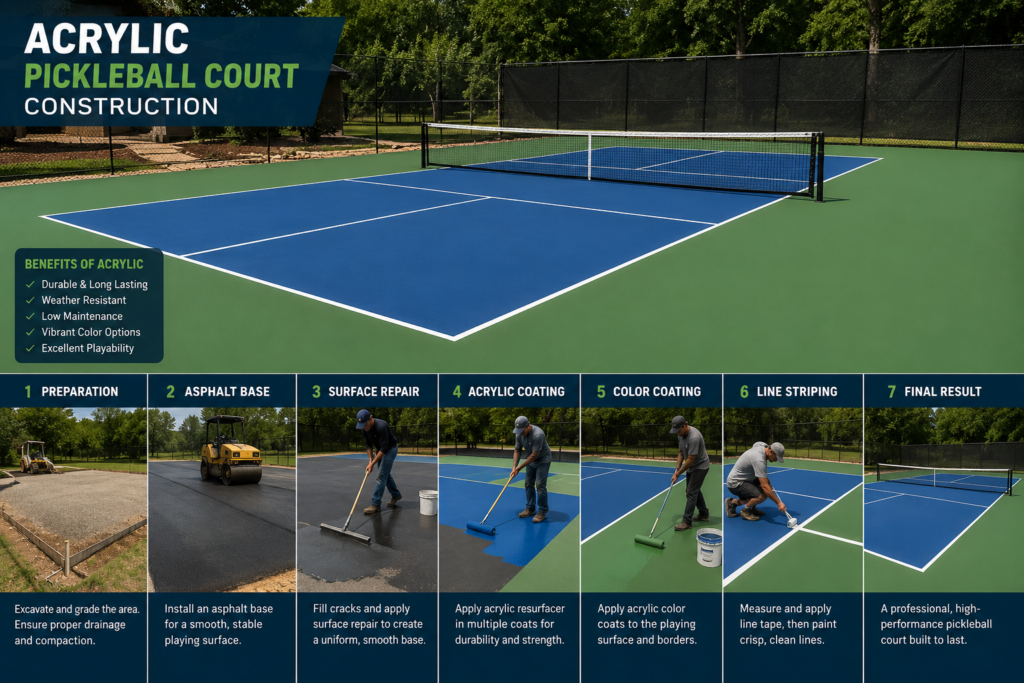
- Layer 1 – Acrylic Resurfacer/Filler: This base layer fills all micro-cracks, surface voids, and imperfections in the concrete or asphalt base. Contractors apply it using a squeegee tool across the full court area. The resurfacer creates a uniform, smooth foundation for subsequent coats.
- Layer 2 – Acrylic Binder Coat: The binder coat bonds the resurfacer to the colour coats above. It adds initial slip resistance through silica sand mixed into the compound. This layer prevents delamination under high-temperature conditions common in Indian summers.
- Layer 3 – Acrylic Colour Coat (2 coats minimum): The colour coat delivers the visual appeal and defines the playing zones. Sports-standard pigments resist fading under UV exposure for 8 to 12 years. Contractors apply a minimum of two colour coats to achieve full opacity and consistent texture across the surface.
- Layer 4 – Line Marking: Professional line painters use contrasting acrylic paint to mark all court boundaries including the kitchen line, baseline, centreline, and sidelines. Lines measure 5 cm wide as per official pickleball rules.
Acrylic Flooring Cost for Pickleball Court Installation in India
Costs vary significantly based on the city, contractor experience, acrylic brand, and the condition of the existing base surface. The following rates reflect current market pricing as of May 2026 across major Indian cities.
Per Square Foot Cost Breakdown
| Work Component | Cost Range (₹ per sq ft) | Notes |
| Base Surface Preparation | ₹15 – ₹30 | Grinding, levelling, crack filling |
| Acrylic Resurfacer (Layer 1) | ₹20 – ₹35 | Imported or domestic brand |
| Acrylic Binder Coat (Layer 2) | ₹18 – ₹28 | With silica sand mix |
| Colour Coats × 2 (Layer 3) | ₹35 – ₹55 | Sports-grade UV-resistant paint |
| Line Marking | ₹5 – ₹10 | Per court, all lines |
| Labour Charges | ₹20 – ₹40 | Skilled contractor team |
| Total per sq ft | ₹113 – ₹198 | Complete 4-layer system |
Upgrade Your Sports Court Today
Get premium synthetic acrylic flooring designed for durability, grip, and performance.
Get Free ConsultationTotal Project Cost by Court Type
| Court Type | Total Area (sq ft) | Estimated Cost (₹) |
| Single Pickleball Court (Outdoor) | 1,800 sq ft | ₹2,03,400 – ₹3,56,400 |
| Single Pickleball Court (Indoor) | 1,800 sq ft | ₹2,50,000 – ₹4,20,000 |
| Double Court Complex (Outdoor) | 3,600 sq ft | ₹4,06,800 – ₹7,12,800 |
| Multi-Court Club (4 Courts) | 7,200 sq ft | ₹8,13,600 – ₹14,25,600 |
| Premium Tournament Court | 2,200 sq ft | ₹3,80,000 – ₹6,00,000 |
Note: These figures cover acrylic flooring work only. Base construction (concrete slab), fencing, net posts, lighting, and drainage are separate cost items.
City-Wise Pickleball Court Installation Cost Comparison (India 2026)
Material costs remain relatively stable across India, but labour charges and contractor overheads vary significantly between metros and Tier-2 cities.
City-Wise Cost Per Square Foot (Complete Acrylic System)
| City | Cost Range (₹/sq ft) | Approximate Total for 1 Court |
| Mumbai | ₹160 – ₹210 | ₹2,88,000 – ₹3,78,000 |
| Delhi NCR | ₹150 – ₹195 | ₹2,70,000 – ₹3,51,000 |
| Bangalore | ₹155 – ₹200 | ₹2,79,000 – ₹3,60,000 |
| Hyderabad | ₹140 – ₹185 | ₹2,52,000 – ₹3,33,000 |
| Pune | ₹145 – ₹190 | ₹2,61,000 – ₹3,42,000 |
| Chennai | ₹145 – ₹188 | ₹2,61,000 – ₹3,38,400 |
| Ahmedabad | ₹130 – ₹170 | ₹2,34,000 – ₹3,06,000 |
| Kolkata | ₹125 – ₹165 | ₹2,25,000 – ₹2,97,000 |
| Tier-2 Cities | ₹110 – ₹155 | ₹1,98,000 – ₹2,79,000 |
Additional Cost Components for Pickleball Court Installation
A complete pickleball court installation project involves multiple cost heads beyond the acrylic flooring surface itself. Facility owners must account for all these components when preparing a project budget.
Complete Project Cost Estimator (Single Outdoor Court)
| Component | Estimated Cost (₹) |
| Land Levelling and Earthwork | ₹30,000 – ₹80,000 |
| Concrete/Asphalt Base (4 inch) | ₹1,20,000 – ₹2,00,000 |
| Acrylic Flooring System | ₹2,03,400 – ₹3,56,400 |
| Perimeter Fencing (Chain Link) | ₹60,000 – ₹1,20,000 |
| Net and Posts (Aluminium) | ₹15,000 – ₹35,000 |
| LED Floodlights (4 poles) | ₹80,000 – ₹1,80,000 |
| Drainage Channel | ₹20,000 – ₹45,000 |
| Benches and Accessories | ₹15,000 – ₹30,000 |
| Grand Total Estimate | ₹5,43,400 – ₹9,46,400 |
Imported vs. Domestic Acrylic Brands: Comparison for India 2026
The Indian market now carries both imported acrylic sports systems and domestically manufactured alternatives. Each category serves a different budget range and performance expectation.
Brand Comparison Table
| Brand | Origin | Type | Cost Range (₹/sq ft) | ITF Certified | Warranty |
| Plexipave | USA | Imported | ₹85 – ₹110 (material only) | Yes | 5 Years |
| Har-Tru SportMaster | USA | Imported | ₹90 – ₹120 (material only) | Yes | 5 Years |
| Laykold (AkzoNobel) | Global | Imported | ₹80 – ₹105 (material only) | Yes | 5 Years |
| Mondo Sport | Italy | Imported | ₹95 – ₹130 (material only) | Yes | 7 Years |
| Courtsports India | India | Domestic | ₹40 – ₹60 (material only) | Partial | 3 Years |
| Sportsurface Pro | India | Domestic | ₹45 – ₹65 (material only) | Partial | 3 Years |
| CourtMaster India | India | Domestic | ₹50 – ₹70 (material only) | No | 2 Years |
Imported brands deliver superior UV stability and consistent ball response across temperature extremes. Domestic brands offer cost-effective solutions for club-level and recreational courts where tournament standards are not required.
Factors That Affect Acrylic Flooring Cost for Pickleball Courts
Several variables directly influence the final project cost beyond the standard material and labour rates. Understanding these factors helps facility owners negotiate better deals and avoid budget overruns.
- Condition of the Existing Base: A poor-quality concrete base with multiple cracks, surface undulations, or drainage problems requires extensive remediation work before acrylic application begins. Contractors charge ₹10 to ₹30 per sq ft extra for heavy base repair.
- Number of Colour Zones: Standard pickleball courts use two colours – one for the playing area and one for the non-volley zone (kitchen). Adding a third colour or custom branded zones increases paint material cost by 15 to 20 percent.
- Indoor vs. Outdoor Installation: Indoor courts require less UV-resistant compounds but may need additional cushioning layers for player safety. Indoor acrylic systems cost 15 to 25 percent more than outdoor systems due to cushion base requirements.
- Number of Layers Applied: A premium 6-layer system offers better cushioning and longer lifespan than a standard 4-layer system. Each additional layer adds ₹18 to ₹30 per sq ft to the final cost.
- Seasonal Timing: Contractors prefer to apply acrylic coatings between October and March in most Indian cities. Summer applications risk blistering, and monsoon seasons delay work entirely. Off-season applications may carry a 10 to 15 percent premium due to scheduling constraints.
- Contractor Experience: Certified acrylic court applicators with ITF training charge premium rates but deliver results that meet warranty conditions. Inexperienced contractors may underquote the job but deliver substandard finishes that require premature resurfacing.
Maintenance Cost for Acrylic Pickleball Courts in India 2026
Acrylic surfaces require minimal but specific maintenance interventions to achieve their full 8 to 12-year lifespan. Facility owners should budget for annual maintenance costs to protect their investment.
Annual Maintenance Cost Estimate
| Maintenance Activity | Frequency | Cost per Court (₹) |
| Pressure Washing and Cleaning | Twice yearly | ₹3,000 – ₹6,000 |
| Line Repainting | Every 2 years | ₹8,000 – ₹15,000 |
| Crack Filling and Patching | As needed | ₹5,000 – ₹20,000 |
| Full Resurfacing (2 colour coats) | Every 5–7 years | ₹70,000 – ₹1,50,000 |
| Net and Post Servicing | Annually | ₹2,000 – ₹5,000 |
Government Schemes Supporting Sports Court Installation in India 2026
The Indian government actively supports sports infrastructure development through multiple schemes available to clubs, schools, municipalities, and private sports academies.
- Khelo India Scheme: The Ministry of Youth Affairs and Sports continues to fund sports infrastructure projects across states. Pickleball courts in schools and government sports complexes qualify for Khelo India grants covering up to 60 percent of construction costs.
- PYKKA (Panchayati Yuva Krida Aur Khel Abhiyan): Rural sports infrastructure projects receive funding under this scheme. Gram Panchayats and block-level sports committees can apply for court construction support including surface funding.
- State Sports Authority Schemes: States like Karnataka, Telangana, Maharashtra, and Tamil Nadu operate their own sports infrastructure grant programmes that independently fund pickleball court installation projects in 2026.
- Corporate CSR Funding: Companies spending CSR funds on sports and health infrastructure have increasingly funded pickleball court construction in schools and community centres across urban India in 2025–2026.
Step-by-Step Pickleball Court Installation Process
Professional contractors follow a systematic installation sequence to deliver a certified acrylic pickleball court. Understanding the process helps facility owners monitor progress and ensure quality compliance.
- Site Survey and Planning: The contractor visits the site, takes measurements, checks soil conditions, and designs the court layout with drainage gradients. This phase takes 1 to 3 days.
- Base Preparation: Workers excavate, compact, and lay the concrete or asphalt base at a minimum thickness of 100mm (4 inches). The base must cure for 28 days before acrylic application begins.
- Surface Preparation: The team grinds, cleans, and repairs the cured base surface. They fill all cracks and voids using polyurethane filler compounds. This phase takes 1 to 2 days.
- Primer Coat Application: The contractor applies an acrylic primer to seal the base and improve adhesion for subsequent coats. The primer dries within 4 to 6 hours under normal conditions.
- Resurfacer and Binder Application: Teams apply the resurfacer and binder coats using squeegees in multiple passes. Each coat dries for 4 to 8 hours before the next application begins.
- Colour Coat Application: Workers apply two to three colour coats in the specified court colours. Each coat adds texture, colour depth, and UV protection to the surface.
- Line Marking: Professional line painters use acrylic line marking paint and precise tape guides to mark all court boundaries, kitchen lines, service boxes, and centrelines.
- Net Post Installation and Final Inspection: The team installs net posts, attaches the pickleball net, and conducts a comprehensive quality inspection. The court is ready for use 24 hours after final line marking dries.
ROI Analysis: Is Pickleball Court Installation Worth the Investment?
Sports facility investors increasingly view pickleball court installation as a high-return investment in 2026. The sport has grown by over 300 percent in urban India between 2022 and 2026, creating strong demand for paid court time.
Revenue Potential for a Commercial Pickleball Court
| Revenue Stream | Monthly Estimate (₹) |
| Hourly Court Rental (6 hrs/day × 30 days × ₹500) | ₹90,000 |
| Membership Fees (50 members × ₹2,000/month) | ₹1,00,000 |
| Coaching Fees (2 coaches × ₹30,000) | ₹60,000 |
| Tournament Hosting (2 events × ₹20,000) | ₹40,000 |
| Total Monthly Revenue | ₹2,90,000 |
A total project investment of ₹7 to ₹9 lakh for a single outdoor court can recover full costs within 3 to 4 months of commercial operation. Club operators managing 4 courts can achieve monthly revenues exceeding ₹10 lakh in premium urban locations.
How to Choose the Right Contractor for Acrylic Pickleball Court Installation
Selecting the right contractor determines the quality, longevity, and warranty coverage of your acrylic court surface. Facility owners must evaluate contractors thoroughly before signing any agreement.
Verify that the contractor holds certification from the acrylic brand they propose to use. Certified applicators receive factory training on proper mixing ratios, application temperatures, and layer thickness requirements. Always ask for ITF certification documentation for the proposed acrylic system.
Inspect previous projects the contractor has completed. Request references from at least three existing clients and physically visit completed courts to assess colour uniformity, line sharpness, and surface texture quality. Evaluate courts that are at least two years old to assess long-term performance.
Insist on a written warranty covering both material defects and workmanship failures. Reputable contractors offer 3 to 5-year comprehensive warranties on acrylic flooring systems. The warranty must specify the resurfacing obligation if premature delamination or colour fading occurs within the warranty period.
Transform Your Sports Facility Today!
Contact us for high-quality synthetic sports flooring material and elevate your space!
Conclusion
Pickleball court installation with a premium acrylic flooring system represents one of the smartest sports infrastructure investments in India in 2026. The total cost for a single outdoor court ranges between ₹5.5 lakh and ₹9.5 lakh depending on location, acrylic brand, and court specifications. Facility owners who select certified acrylic systems, experienced contractors, and maintain the surface annually will achieve a court lifespan exceeding 10 years with minimal operational disruption. The booming popularity of pickleball across Indian metros and Tier-2 cities guarantees strong returns for commercial operators who invest in quality infrastructure today.
Frequently Asked Questions (FAQs)
A complete single pickleball court installation with acrylic flooring costs between ₹5.5 lakh and ₹9.5 lakh including base construction, surface coating, fencing, and net.
A properly installed and maintained acrylic surface lasts 8 to 12 years before requiring full resurfacing on a pickleball court.
Yes, contractors apply acrylic systems directly over sound concrete or asphalt bases after proper surface preparation and crack filling.
Plexipave, SportMaster, and Laykold are the top ITF-certified imported brands, while Courtsports India is the leading domestic option for budget projects.
A complete pickleball court installation including base construction and acrylic surface takes 35 to 45 days from site clearing to final handover.
Yes, the Khelo India Scheme and various state sports authority programmes fund sports court construction and can cover up to 60 percent of eligible project costs.