The right outdoor tennis court flooring material needs to be chosen to provide durability, peak playability, and long-lasting performance. Professional and recreational courts utilize acrylic flooring because it outlasts the others in terms of weather resistance, ball bounce, and ease of maintenance.
AQS is a major manufacturer of tennis court floor coverings and specializes in the production of high-quality acrylic floor coverings designed for different playing conditions. If you are looking to install a new tennis court or resurface an existing one, knowing the advantages of acrylic floors can assist you in making a sound choice.
Why Choose Acrylic Tennis Court Flooring?
Acrylic surfacing has taken over the world as the standard for tennis courts, and for good reason; its ability to last, play consistently, and handle the weather without breaking a sweat is unbeatable. You won’t find a better balance of performance and protection anywhere else, no matter what level you play at.
- Perfect Bounce:
Gives you a uniform bounce that follows a predictable game pattern all over the court, so you can be sure you’re getting a fair game without any surprises. - Weather:
This stuff is built to last, engineered to withstand the crazy conditions India throws at it—from UV rays that’ll make other courts fade in a week to monsoon rains that would soak and crack an ordinary surface. - Make it Your Own:
We’ve got loads of different colors and surface textures to choose from, all ITF-approved. So you can get a finish that looks amazing and plays like a dream. - Low Maintenance:
Compared to clay or grass courts, it’s as easy as can be. Just a quick clean and a resurface every few years, and your court will still be looking and playing like new.
AQS offers the best synthetic acrylic tennis court construction coatings money can buy, with added grip, comfort, and surface longevity. That makes them perfect for schools, clubs, academies, and anyone building a residential tennis court.
Tennis Court Markings and Dimensions
Knowing the official size and markings of a tennis court is sort of a no-brainer—it’s what ensures you get it right and that everyone gets to play by the same rules.
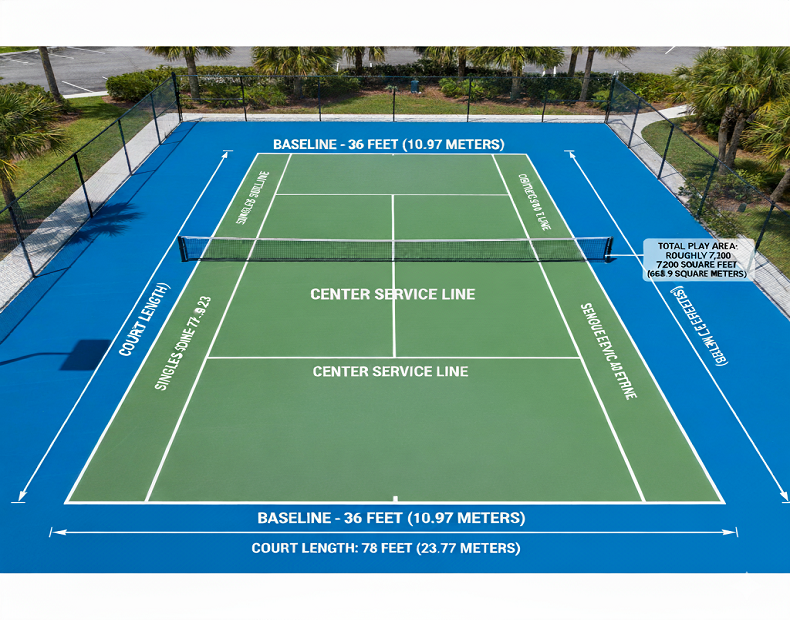
- Court Length—78 feet (23.77 meters): Its length is a standard for both singles and doubles—it gives a fair bounce and decent court space for both sides of the court no matter what the game is.
- Singles Court Width—27 feet (8.23 meters): The singles layout tightens things up a bit, focused on precision and control, but still keeping that standard baseline and net in place for good measure.
- Doubles Court Width—36 feet (10.97 meters): Doubling that width up, you get more room to move around and come up with team strategies, which is just what you need for a game of doubles and especially for any tournament.
- Total Play Area—About 7,200 sq. ft. (668.9 sq. m.): That includes some extra room around the actual court that gives players just enough space to move, helps with the drainage and makes for a whole lot easier setup during the build process.
The Essential Markings on a Tennis Court:
- Baseline: The baseline of a tennis court is the line out at the far end of each side – it basically acts as a boundary marker for where all the action happens. Mainly, it determines where players have to be when they serve and rally during a match.
- Service Line: The service line slices the forecourt right down the middle, creating two service boxes. It’s exactly 21 feet from the net – easy enough to measure out with a bit of tape. Where that lands serve will be where play continues.
- Center Mark: A centre mark – and it’s not much bigger than a single line – right in the middle of the baseline. When someone’s serving, it helps them get lined up properly, meaning they can make sure the ball lands in roughly the right spot each time.
- Singles Sideline: Then there’s the singles sideline, which is that slimmer boundary you see when there’s only one player on each side of the court. Its main job is to shrink the court down a bit, making it fair for one-on-one matches and keeping the action pretty contained.
- Doubles Sideline: The doubles sideline, on the other hand, it’s a bit more of a wide boy – it’s the boundary that gets used when you’ve got two players on each side of the court. It’s a bit like extra leg room – more space to move about and work as a team.
Why Choose ITF-Certified Tennis Court Flooring?
The ITF sets global standards for tennis court flooring to ensure consistency and reliability. AQS provides ITF-certified acrylic tennis court flooring that meets the highest standards for speed, grip, and durability for professional-grade play.
Top Benefits of ITF Certification:
- International Standards: Your tennis court flooring meets global tournament standards, giving you credibility and a professional finish to your facility.
- Consistent Playing Surface: Uniform ball bounce and speed, so players of all levels can enjoy a fair and predictable game.
- Player Safety: ITF-certified acrylic tennis court flooring minimizes surface irregularities, reduces injuries, and maximizes grip and comfort during play.
Looking for an ITF-approved acrylic flooring solution? AQS offers top-of-the-line coatings that meet international performance standards for world-class quality and long-term reliability.
Acrylic Tennis Court Flooring Benefits
Acrylic flooring systems are categorised into different types of tennis court flooring based on performance level, cushioning, and player comfort. These surfaces have an underlying rubberised cushion layer, which reduces joint stress and overall playability, making them perfect for clubs, schools, academies, and professional training centres where safety and durability are key.
Key Benefits:
- Reduces the impact stress on joints, so it feels softer underfoot and less strain on knees and ankles during long rallies and practice sessions.
- Player comfort without compromising on ball bounce maintains performance even during long matches or tournaments.
Perfect for long practice sessions and suitable for all age groups, it provides superior cushioning for long-term physical well-being.
Things to Consider When Choosing Acrylic Flooring for Your Tennis Court
Choosing the right acrylic tennis court flooring is key to long-term performance, comfort, and weather durability. Here’s what to look for before installation:
1. Location and Climate
Outdoor tennis courts need UV-resistant and weatherproof acrylic coatings that can withstand India’s varied climates. AQS provides outdoor tennis court flooring materials that can handle heat, heavy rainfall, and prolonged sun exposure without fading or cracking.
2. Usage and Player Preferences
For competitive players, a hard and fast acrylic tennis court surface gives consistent bounce and quick play. For training academies, clubs, or schools, a cushioned acrylic court is ideal – it absorbs impact, reduces joint stress, and is comfortable during long practice sessions.
3. Budget and Maintenance Costs
The synthetic tennis court cost varies based on surface system, site conditions, and design customization. While acrylic courts require a higher initial investment, their low maintenance and long life make them cost-effective in the long run. Partner with an experienced tennis court contractor to get a flawless installation and minimal repair needs.
Finding Your Dream Tennis Court Contractor
When you’re getting ready to book a tennis court installation, you need to make sure you’re hiring a contractor who really knows their stuff when it comes to acrylic systems and following ITF standards – basically, someone who understands what it takes to deliver a quality court that’ll last for years to come. Here’s what you should be looking for:
- Experience Counts: You want someone with a ton of hands-on experience with acrylic tennis courts to work on your project – years of installing, resurfacing, and maintaining outdoor courts under their belt is a must.
- Grade A Materials: Look for contractors who only use top-notch, long-lasting acrylic coatings that are designed to hold up to the elements and keep your court looking and playing great all year-round.
- Getting It Just Right: Choose a company that lets you design and customize your court to fit your specific needs – from the colour scheme to the line markings, they should be able to work with you to get it just right.
- Keeping Your Court in Shape: Partner with someone who not only installs your court, but also offers maintenance services to keep it looking and playing its best for years to come – think resurfacing, repairs, and all.
AQS partners up with some of the best tennis court contractors in India to make sure your court is installed perfectly, looks fantastic, and provides years of great performance.
Keeping Your Acrylic Tennis Court in Top Condition
If you want to get the most out of your acrylic tennis court, you’ll need to pay attention to a few key things. Here are the must-do maintenance tips:
- Scrubbing regularly: Keep the surface clear of leaves, dirt, and water that’s just sitting there – the kind of stuff that can cause your court to break down way too soon. And if you keep it clean, you’ll find that the synthetic acrylic surface stays grippy and the colors stay looking great.
- Check once a year: Take a good, hard look at your court every 12 months to see if there are any cracks, faded bits, or places where the surface is all wonky. Catching any problems early on is a big help in preventing costly damage and keeping your tennis court flooring in good nick.
- Recoat every 5-7 years: Every few years, slap on a fresh new layer of acrylic, and you’ll be amazed at how it brightens up the color and gets the ball bouncing smoothly again. And it’s not just cosmetic – resurfacing regularly really does help make your court more durable and less prone to weather damage.
- Drainage system: You don’t want water just standing there on your court – that can cause all sorts of problems. A good drainage system will keep your outdoor tennis court flooring dry and safe, and it’ll last a lot longer too.
If you’re not up for doing all that maintenance yourself, don’t worry – AQS offers resurfacing and maintenance services to help keep your court looking and playing its absolute best. They’ll make sure your tennis court is safe and performing at its peak for years to come.
Conclusion
Acrylic flooring is the top choice for tennis courts because of its durability, consistency, and weather resistance. Whether you need a hard-wearing surface for pro matches or a cushioned system for training, we have the right material for your needs. If you’re looking for a tennis court construction company or guidance on choosing the right flooring material, we’re here to help. Our goal is to give you a high-quality, long-lasting tennis court that enhances the player experience and minimizes maintenance. We have the expertise to help you find the right acrylic flooring solution for your needs. Get in touch with us to explore our range of acrylic tennis court flooring materials. We’ll help you build a tennis court that will last.
Frequently Asked Questions
Synthetic acrylic surfaces are the most popular globally due to their durability, weather resistance, and consistent ball bounce. Hybrid surfaces like HybridClay and ClayTech are gaining popularity for performance and ease of maintenance.
Acrylic is best for beginners. It has good grip, shock absorption, and consistent bounce, making it easier to learn and play safely.
Hybrid surfaces combine the characteristics of traditional clay or hard courts with synthetic materials. They have reduced joint impact, consistent ball response, and require less water and maintenance than natural clay.
Modern synthetic acrylic surfaces use recycled materials like rubber and plastic waste. These surfaces are long-lasting, require minimal water, and align with sustainability goals.
In areas with extreme weather (like India), synthetic acrylic is preferred for its heat, rain, and UV resistance. Grass and clay surfaces are not suitable due to high maintenance and weather damage.
Look for ITF (International Tennis Federation) certifications, especially for slip resistance, UV protection, and environmental compliance. These ensure safety and performance standards are met.
Smart courts now use sensors and cameras to track player movement and ball tracking. These innovations help optimize surface wear and maintenance planning.