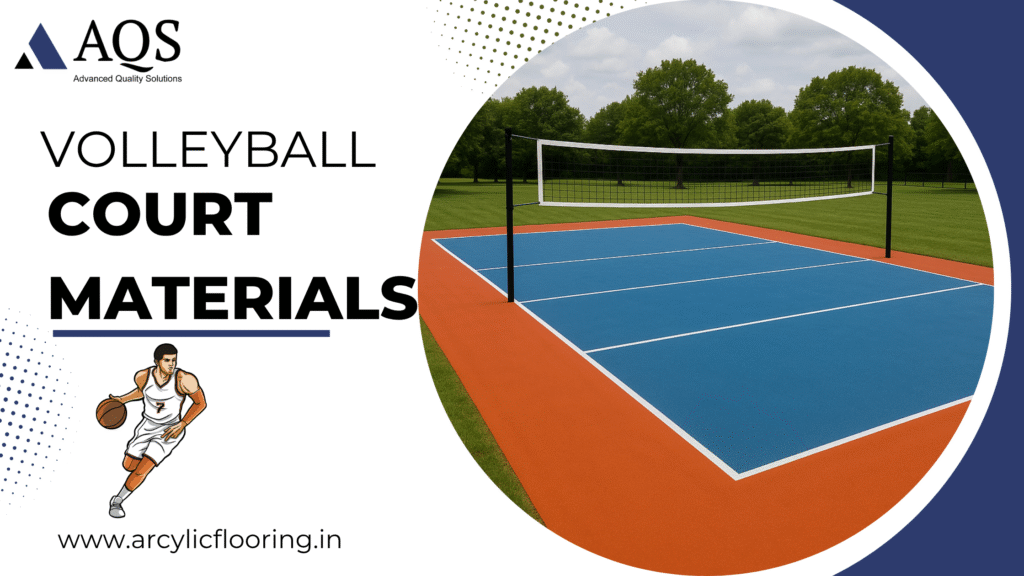
Understanding volleyball court measurement is essential for players, coaches, architects, and facility managers who want to build or maintain a regulation-standard playing surface. Whether you are constructing a new court from scratch, resurfacing an aging facility, or simply verifying compliance with international standards, having precise knowledge of every dimension, zone, and line marking ensures a safe and professional environment. This guide covers every aspect of volleyball court measurement in full depth, including net height, boundary lines, free zones, and the role of quality surface materials such as Concrete Primer, Acrylic Resurfacer, and Cushion Coat.
Table of contents
- Volleyball Court Measurement: Quick Reference Table
- Official Volleyball Court Measurement: Full Dimensions Explained
- Volleyball Court Lines: Specifications and Markings
- The Net: Height, Position, and Structural Standards
- Free Zone and Playing Space Requirements
- Construction and Surface Materials for Volleyball Courts
- Indoor vs Outdoor Volleyball Court Dimensions Compared
- Badminton Court Size: Full Dimensions and Layout
- Step-by-Step Volleyball Court Construction Process
- Common Mistakes in Volleyball Court Measurement and Layout
- Frequently Asked Questions (FAQs)
Volleyball Court Measurement: Quick Reference Table
| Specification | Measurement (Meters) | Measurement (Feet) |
| Court Length (Total) | 18 m | 59.06 ft |
| Court Width (Total) | 9 m | 29.53 ft |
| Each Team’s Side | 9 m × 9 m | 29.53 ft × 29.53 ft |
| Net Height (Men) | 2.43 m | 7 ft 11.7 in |
| Net Height (Women) | 2.24 m | 7 ft 4.2 in |
| Net Height (Mixed/Youth) | 2.35 m | 7 ft 8.5 in |
| Net Width | 1 m | 3.28 ft |
| Net Length | 9.5–10 m | 31.17–32.81 ft |
| Attack Line (from center) | 3 m | 9.84 ft |
| Service Zone Depth | Min 3 m | Min 9.84 ft |
| Free Zone (Sides) | Min 3 m | Min 9.84 ft |
| Free Zone (End Lines) | Min 3 m | Min 9.84 ft |
| Recommended Total Area | 24 m × 15 m | 78.74 ft × 49.21 ft |
| Minimum Ceiling Height | 7 m | 22.97 ft |
| Line Width | 0.05 m | 1.97 in |
Official Volleyball Court Measurement: Full Dimensions Explained
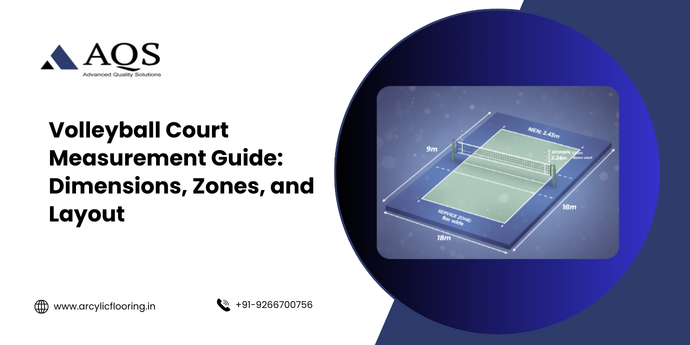
The official volleyball court measurement as defined by the Fédération Internationale de Volleyball (FIVB) establishes the playing court as a rectangle measuring 18 meters in length by 9 meters in width. This total area is divided precisely into two equal halves of 9 meters by 9 meters, one for each competing team. These measurements apply to both indoor and outdoor competitions held under international governing body standards. The court is oriented so that each team defends their own half while attacking across the center net. Accurate volleyball court measurement is not simply a formality it directly influences gameplay balance, player positioning strategy, and referee decision-making on boundary calls.
The court dimensions for competitive play remain consistent from club-level tournaments to Olympic-level championships, ensuring that athletes train and compete on identically proportioned surfaces regardless of geography. For indoor courts, the playing surface must be flat, horizontal, and uniform, made from wood, synthetic material, or a properly prepared concrete base. Outdoor sand volleyball follows the same 16 m × 8 m standard for doubles play, while indoor six-a-side volleyball uses the full 18 m × 9 m court. Every line on the court must be 5 centimeters wide and must be included within the stated court dimensions, meaning they are not added outside the boundary they are part of the measured playing field.
Breaking Down the Court Zones
The volleyball court is divided into several critical functional zones that govern player movement and game rules. The front zone on each side of the net extends from the center line to the attack line, spanning exactly 3 meters. This zone is where front-row players may freely execute attacks and blocks. The back zone stretches from the attack line to the end line, covering the remaining 6 meters of each team’s court half. Back-row players may only attack from behind the attack line unless a specific libero substitution rule is in play. Understanding these zones in the context of volleyball court measurement allows coaches to design tactical plays with spatial precision and ensures referees can quickly identify positional faults.
Volleyball Court Zones: Dimension Breakdown
| Zone Name | Location | Dimensions |
| Front Zone | Center line to attack line (each side) | 3 m × 9 m |
| Back Zone | Attack line to end line (each side) | 6 m × 9 m |
| Service Zone | Behind end line (right side) | Min 3 m deep, 9 m wide |
| Substitution Zone | Attack lines to scorer’s table | Between attack lines |
| Libero Replacement Zone | Attack line to end line | Specific to each team side |
| Free Zone | Outside all boundary lines | Min 3 m on all sides |
Volleyball Court Lines: Specifications and Markings
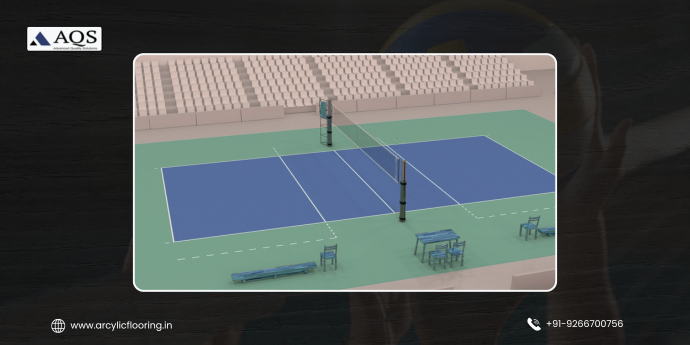
Every line on a volleyball court carries regulatory significance and must comply with FIVB volleyball court measurement standards. The boundary lines consist of two sidelines running the full 18-meter length of the court and two end lines spanning the 9-meter width. The center line runs beneath the net from one sideline to the other, effectively dividing the court into equal halves. The attack lines are drawn parallel to the center line at a distance of 3 meters on each side. All these lines must be exactly 5 centimeters wide and must be a light color that clearly contrasts with the court surface, ensuring visibility during fast-paced gameplay.
In addition to boundary and zone lines, volleyball courts also include service zone markers and optional antenna alignment marks at the net. The service zone is marked with short lines 15 to 20 centimeters long, drawn 20 centimeters behind the end line, extending from the end line outward into the free zone. These lines define the lateral boundaries of the legal serving area. Lines must be painted cleanly and uniformly, and any surface preparation using Concrete Primer before applying marking paints ensures long-lasting adhesion. Poor line quality or faded markings can affect gameplay decisions and create compliance issues during official matches and tournaments.
The Net: Height, Position, and Structural Standards
The net in volleyball is positioned at the exact center of the court, stretched across the full 9-meter width. For men’s competition, the official net height measured from the center of the court to the top of the net is 2.43 meters. For women’s competition, this height is 2.24 meters. Mixed adult games typically use 2.35 meters, while youth categories use lower heights depending on the age group. The net must be 1 meter wide and between 9.5 to 10 meters long to allow it to extend beyond the sidelines on both ends. The top of the net features a 7-centimeter horizontal band of white canvas that doubles over the net and is sewn to its top edge.
Antennae are placed on both sides of the net above the sidelines, rising 80 centimeters above the net top, making them 3.23 meters above the floor for men’s play. These flexible rods help referees judge whether a ball passed inside the lateral boundaries during play. The net posts must be rounded and smooth, set 0.5 to 1 meter outside the sidelines, and padded to prevent player injury. Post height must be adjustable to accommodate different competition levels. Proper installation of net posts and verification of the official volleyball court measurement for net positioning is critical before any sanctioned match begins.
Net Height by Competition Category
| Category | Net Height | Notes |
| Men (Senior) | 2.43 m | FIVB/Olympic Standard |
| Women (Senior) | 2.24 m | FIVB/Olympic Standard |
| Mixed Adult | 2.35 m | Recreational & Club Play |
| Boys (Under 16) | 2.35 m | FIVB Youth Standard |
| Girls (Under 16) | 2.24 m | FIVB Youth Standard |
| Boys (Under 14) | 2.24 m | Junior Development |
| Girls (Under 14) | 2.10 m | Junior Development |
| Beach Volleyball (Men) | 2.43 m | Outdoor FIVB Standard |
| Beach Volleyball (Women) | 2.24 m | Outdoor FIVB Standard |
Free Zone and Playing Space Requirements
The free zone is the unobstructed area surrounding the volleyball court boundary lines that must remain clear during play. According to FIVB regulations, the free zone must extend at least 3 meters from the sidelines and at least 3 meters from the end lines for national competitions. For international competitions held under FIVB World Championships or Olympic standards, the free zone requirement increases to a minimum of 5 meters on the sidelines and 8 meters on the end lines. This larger buffer accommodates the high-speed dives and sprawling defensive plays common at the elite level, reducing injury risk when players chase balls beyond the boundary.
Above the playing surface, the free playing space must be free of obstructions to a height of at least 7 meters from the floor. This minimum ceiling height allows for the full trajectory of high-arching serves, sets, and attacks without interference. Premium indoor arena facilities typically provide ceiling clearance of 12 meters or more to accommodate the natural flight path of the ball in powerful serves and attacks. Outdoor courts, while not bound by ceiling regulations, must ensure that overhead obstacles such as trees, wires, or structures do not interrupt the ball’s flight path within the playing area. Including the free zone in volleyball court measurement planning is essential for both safety and regulatory compliance.
Construction and Surface Materials for Volleyball Courts
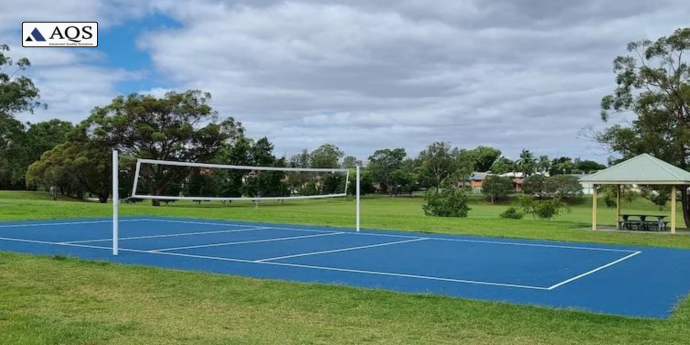
Building a regulation volleyball court requires careful selection of surface materials that balance player safety, durability, and performance. The construction process typically begins with a properly graded and compacted sub-base, followed by a concrete or asphalt base layer. Before applying any surface coating, the application of a high-quality Concrete Primer is essential. Concrete Primer penetrates deep into the substrate, sealing pores and creating a strong bonding layer that prevents moisture infiltration and surface delamination. Without proper priming, subsequent coating layers may peel, crack, or fail prematurely undermining the entire surface investment.
Once the primer has cured, the next phase involves applying an Acrylic Resurfacer to the court surface. Acrylic Resurfacer fills micro-cracks, levels minor surface imperfections, and creates a smooth, even texture that ensures consistent ball bounce and predictable player footing. This layer also contributes to the overall slip-resistance of the court surface, which is a critical safety parameter for volleyball where players make sudden lateral movements, explosive jumps, and rapid directional changes. Acrylic Resurfacer is compatible with all standard court line marking paints, making it ideal for multi-sport facilities that also host tennis or basketball on the same surface.
Also Read: Multipurpose Court Cost in India
Recommended Surface Materials for Volleyball Court Construction
| Material | Application Stage | Primary Function | Key Benefit |
| Concrete Primer | First coat (base prep) | Sealing & bonding agent | Prevents delamination & moisture |
| Acrylic Resurfacer | Second coat (leveling) | Surface leveling & texture | Consistent ball bounce & grip |
| Cushion Coat | Third coat (performance) | Shock absorption layer | Reduces joint stress on landing |
| Acrylic Color Coat | Fourth coat (finish) | Color & UV protection | Durable bright surface finish |
| Line Marking Paint | Final stage | Court boundary & zone lines | High-contrast visibility |
Indoor vs Outdoor Volleyball Court Dimensions Compared
While the core volleyball court measurement remains the same for both indoor and outdoor formats 18 meters by 9 meters for six-a-side play there are meaningful differences in how these dimensions apply across formats. Indoor volleyball played under FIVB rules requires a hard, non-slip surface such as polished wood, rubberized synthetic, or an acrylic-coated concrete floor. The strict surface requirements, lighting standards, and ceiling height minimums of indoor play make construction more complex and expensive. Outdoor six-a-side volleyball may be played on grass or rubberized surfaces with fewer facility constraints, though proper court drainage and level ground preparation remain essential.
Beach volleyball, the most popular outdoor volleyball format globally, uses a significantly smaller court of 16 meters by 8 meters per FIVB regulations. The sand surface must be at least 40 centimeters deep to provide adequate cushioning and player safety. The free zone for beach volleyball is a minimum of 3 meters on all sides, with 5.5 meters or more recommended for elite competitions. The net height for beach volleyball matches the six-a-side standard: 2.43 meters for men and 2.24 meters for women. Beach volleyball courts do not use attack lines or substitution zones since teams consist of only two players each.
Indoor vs Beach Volleyball Court Measurement Comparison
| Feature | Indoor (6-a-side) | Beach (2-a-side) |
| Court Length | 18 m | 16 m |
| Court Width | 9 m | 8 m |
| Net Height (Men) | 2.43 m | 2.43 m |
| Net Height (Women) | 2.24 m | 2.24 m |
| Attack Line | 3 m from center | Not used |
| Free Zone (Min) | 3 m (national) | 3 m (min) |
| Surface Type | Wood / Synthetic / Acrylic | Sand (min 40 cm deep) |
| Players per Side | 6 | 2 |
| Substitutions | Yes (Libero rules) | No substitutions |
Badminton Court Size: Full Dimensions and Layout
Though this guide focuses on volleyball court measurement, many multi-sport facility planners also need comprehensive badminton court size details for shared-use venues. The full official badminton court as governed by the Badminton World Federation (BWF) measures 13.4 meters in length by 6.1 meters in width for doubles play. For singles matches, the court width narrows to 5.18 meters, though the length remains the same. The court is divided into two service courts on each side by a center short service line that runs 1.98 meters from the net. The long service line for doubles is drawn 0.76 meters inside the back boundary line, while singles players use the full back boundary.
The net in badminton is set at a height of 1.55 meters at the posts and 1.524 meters at the center, reflecting the slight natural sag of the net. Net posts are positioned on the doubles sidelines regardless of whether singles or doubles is being played. The service courts in badminton are intricately divided each player’s service court for doubles measures 3.88 meters deep by 2.59 meters wide. All badminton court lines must be 40 millimeters wide and clearly visible, typically painted in white or yellow on wooden, synthetic, or Acrylic Resurfacer-coated surfaces. When planning a shared sports facility, ensuring that the overall floor space accommodates both volleyball court measurement requirements and badminton court dimensions prevents costly layout conflicts.
Transform Your Sports Facility Today!
Contact us for high-quality synthetic sports flooring material and elevate your space!
Badminton Court Dimensions: Official Size Table
| Specification | Doubles | Singles |
| Court Length | 13.4 m | 13.4 m |
| Court Width | 6.1 m | 5.18 m |
| Net Height (Posts) | 1.55 m | 1.55 m |
| Net Height (Center) | 1.524 m | 1.524 m |
| Short Service Line | 1.98 m from net | 1.98 m from net |
| Long Service Line | 0.76 m inside baseline | Full baseline |
| Service Court Depth | 3.88 m | 4.64 m |
| Line Width | 40 mm | 40 mm |
| Recommended Free Zone | Min 1.5 m each side | Min 1.5 m each side |
Step-by-Step Volleyball Court Construction Process
Constructing a volleyball court that meets official volleyball court measurement standards begins with site selection and sub-grade preparation. The ground must be properly excavated, leveled, and compacted to create a stable base that will not shift or settle unevenly over time. A well-engineered sub-base typically consists of 100 to 150 mm of compacted gravel followed by 100 mm of reinforced concrete. Drainage channels or slopes of 0.5 to 1 percent should be incorporated for outdoor courts to prevent water pooling. Indoor courts must be built on a structurally sound building slab with access to conduit paths for net post anchor sleeves.
After the concrete base has cured for a minimum of 28 days, the Concrete Primer is applied to the entire playing surface and free zone area. This critical first step seals the porous concrete and ensures that subsequent coating layers bond correctly. Once the primer is dry, the Acrylic Resurfacer is applied in two or more passes to achieve a uniform surface texture. After resurfacing, the Cushion Coat is applied to provide the performance characteristics required for competitive play. The final step involves applying two or more coats of colored acrylic finish paint, followed by precise line marking using templates that conform exactly to volleyball court measurement standards set by the FIVB.
Common Mistakes in Volleyball Court Measurement and Layout
Even experienced facility builders can make costly errors when measuring and laying out a volleyball court if they are not thoroughly familiar with FIVB standards. One of the most common mistakes is failing to account for line width within the court measurement, resulting in a playing area that is slightly undersized once lines are added. Since all boundary lines must be included within the stated court dimensions, the interior measured edge to measured edge must be 18 meters by 9 meters including the lines themselves. Another frequent error involves the positioning of the net posts too close to the sidelines, restricting the free zone and creating a non-compliant layout that could disqualify a facility from hosting sanctioned matches.
Incorrect attack line placement is another critical measurement error that affects gameplay fairness and player safety. The attack line must be placed exactly 3 meters from the center line, measured from the nearest edge of the center line to the nearest edge of the attack line. Using the wrong reference point such as measuring from the outside edge of the center line or measuring to the far edge of the attack line introduces millimeter errors that accumulate into regulatory non-compliance. Applying a fresh layer of Acrylic Resurfacer before line marking is strongly recommended to ensure that paint adheres cleanly and that lines do not bleed or blur on a worn or porous surface
Frequently Asked Questions (FAQs)
The standard volleyball court measurement for international play is 18 meters long by 9 meters wide, as defined by FIVB regulations.
The official net height is 2.43 meters for men and 2.24 meters for women in senior international competition.
Concrete Primer seals the base layer, prevents moisture infiltration, and ensures that Acrylic Resurfacer and Cushion Coat bond permanently to the surface.
The attack line is positioned exactly 3 meters from the center line on each side of the court, dividing the front zone from the back zone.
Cushion Coat adds a rubberized shock-absorbing layer to the court that reduces joint impact stress for players during jumps, landings, and dives.