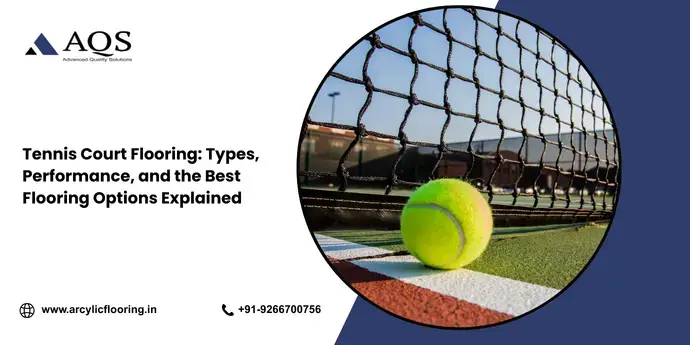
Choosing the right tennis court flooring is one of the most important decisions in tennis court construction. The surface directly affects ball bounce, player movement, injury risk, maintenance cost, and the overall playing experience. Whether the court is being built for schools, clubs, academies, residential societies, or professional tournaments, flooring selection determines how well the court performs over time.
With modern materials and technology, tennis court flooring options have expanded beyond traditional surfaces. Today, synthetic systems offer durability, consistent play, and cost efficiency, making them the preferred choice for most projects.
Table of contents
- What Is Tennis Court Flooring and Why It Matters
- Popular Tennis Court Flooring Options in Use Today
- Indoor vs Outdoor Court
- Tennis Court Flooring Construction Process Explained
- Maintenance Requirements of Court Flooring
- Choosing the Right Tennis Court Flooring Option
- Why Synthetic Tennis Court Flooring Is the Industry Standard
- Tennis Court Flooring and Player Safety
- Final Thoughts
- FAQs
What Is Tennis Court Flooring and Why It Matters
Tennis court flooring refers to the complete surface system applied over a prepared base to create a playable tennis court. It includes the top playing layer, cushioning coats if required, texture layers for grip, and line marking systems. A well-designed tennis court flooring system ensures predictable ball bounce, safe foot grip, weather resistance, and consistent playing conditions. Poor flooring choices often result in cracks, slippery surfaces, uneven bounce, and frequent maintenance issues. In modern court construction, flooring is not just about appearance but about performance engineering.
Evolution of Flooring Systems
Traditionally, tennis was played on natural surfaces like grass and clay. While these surfaces offer unique playing characteristics, they require intensive maintenance and are highly dependent on climate. As tennis expanded globally, the need for low-maintenance, all-weather surfaces led to the development of synthetic flooring systems. Today, synthetic tennis court flooring dominates new installations due to its adaptability, durability, and controlled performance. Modern tennis court flooring options are designed to perform consistently across different weather conditions while reducing operational costs.
Upgrade Your Sports Court Today
Get premium synthetic acrylic flooring designed for durability, grip, and performance.
Get Free ConsultationKey Performance Factors of Court Flooring
Every tennis court flooring system is evaluated on a few critical performance parameters. Ball bounce consistency is essential to ensure fair play. Surface grip must allow quick direction changes without increasing injury risk. Shock absorption helps reduce stress on joints, especially for regular players. Weather resistance ensures the surface remains playable in heat, rain, and UV exposure. Maintenance requirements determine the long-term cost of ownership. A good tennis court flooring solution balances all these factors rather than optimizing only one.
Transform Your Sports Facility Today!
Contact us for high-quality synthetic sports flooring material and elevate your space!
Popular Tennis Court Flooring Options in Use Today
Among all available tennis court flooring options, synthetic surfaces are the most widely used for both outdoor and indoor courts.
Synthetic Acrylic Flooring
Synthetic acrylic flooring is the most common choice for tennis courts worldwide. It consists of multiple acrylic coating layers applied over an asphalt or concrete base. The surface offers excellent ball response, controlled speed, and consistent traction. Acrylic tennis court flooring is suitable for clubs, academies, schools, and professional training courts. It performs well in varying climates and requires minimal maintenance compared to natural surfaces.
Cushioned Acrylic Flooring
Cushioned acrylic systems include elastic layers beneath the acrylic surface to enhance shock absorption. This type of tennis court flooring is ideal for training centers and recreational facilities where player comfort is a priority. Cushioned systems reduce joint stress and fatigue while maintaining predictable ball bounce, making them suitable for long playing hours.
Clay-Style Synthetic Flooring
Clay-style synthetic surfaces replicate the playing characteristics of natural clay without the high maintenance. These tennis court flooring options offer slower ball speed and higher bounce, encouraging longer rallies. They are preferred in academies focused on player development and endurance training.
Modular and Alternative Surfaces
Some facilities explore modular tiles or alternative systems, but these are less common for professional tennis due to limitations in ball response and surface uniformity. For serious tennis applications, continuous synthetic coatings remain the preferred choice.
Indoor vs Outdoor Court
Outdoor tennis court flooring must withstand UV exposure, rain, and temperature variations. Synthetic acrylic systems are specifically formulated with UV-resistant pigments and weatherproof binders to ensure long-lasting performance outdoors. Indoor tennis court flooring focuses more on grip consistency and visual clarity, as weather resistance is less critical. Acrylic systems adapt well to indoor environments with slight adjustments in texture and finish. Choosing the right tennis court flooring depends on whether the court is indoor, outdoor, or semi-covered.
Tennis Court Flooring Construction Process Explained
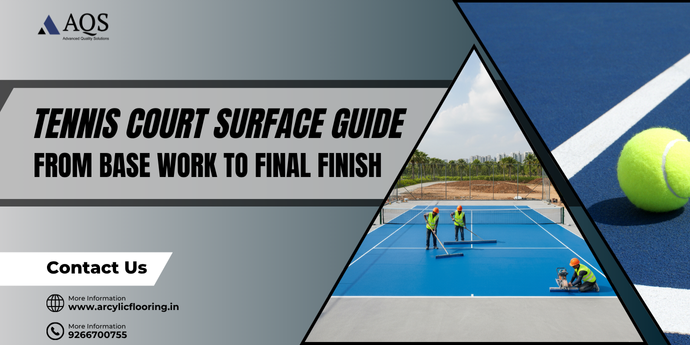
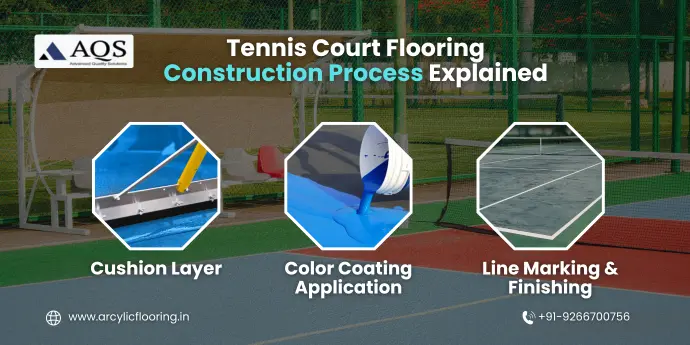
The performance of tennis court flooring depends not only on the surface material but also on how it is constructed. The process begins with base preparation, usually concrete or asphalt, designed with proper slope for drainage. Crack control and leveling are essential before applying any surface layers. Primer coats are applied to ensure adhesion. Acrylic or cushioned layers are built up gradually to achieve the desired texture and thickness. Finally, line markings are applied using high-contrast, non-slip paint. Each step contributes to the longevity and playability of the tennis court flooring system.
Maintenance Requirements of Court Flooring
One of the biggest advantages of modern tennis court flooring is low maintenance. Regular cleaning to remove dust and debris helps preserve surface grip. Occasional inspection ensures early detection of minor wear or cracks. Unlike clay or grass courts, synthetic tennis court flooring does not require daily watering, rolling, or resurfacing. Periodic recoating after several years restores appearance and performance without full reconstruction. This makes synthetic tennis court flooring highly cost-effective over the long term.
Court Flooring Options Comparison Table
| Tennis Court Flooring Type | Ball Bounce | Player Comfort | Maintenance Level | Weather Resistance | Best Use Case |
|---|
| Synthetic Acrylic Flooring | Consistent & Medium-Fast | Moderate | Low | Excellent (UV & rain resistant) | Clubs, schools, residential & professional courts |
| Cushioned Acrylic Flooring | Consistent & Controlled | High (joint-friendly) | Low to Moderate | Excellent | Training academies & high-usage courts |
Upgrade Your Sports Court Today
Get premium synthetic acrylic flooring designed for durability, grip, and performance.
Get Free Consultation| Clay-Style Synthetic Flooring | High & Slow | Moderate | Low | Good | Player development & endurance training |
| Natural Clay Court | Slow & High | Moderate | Very High | Poor (weather-dependent) | Professional tournaments & traditional clubs |
| Grass Court | Fast & Low | Low | Extremely High | Very Poor | Elite tournaments only |
| Modular Sports Tiles | Inconsistent | Moderate | Low | Good | Recreational or multi-purpose areas |
Choosing the Right Tennis Court Flooring Option
Selecting the right tennis court flooring depends on usage intensity, player level, climate conditions, and budget. High-traffic facilities benefit from durable acrylic systems with reinforced layers. Training academies often prefer cushioned surfaces for injury prevention. Recreational courts prioritize ease of maintenance and long-term durability. The best tennis court flooring option is one that aligns performance needs with lifecycle cost rather than initial price alone.
Why Synthetic Tennis Court Flooring Is the Industry Standard
Synthetic systems have become the global standard because they deliver consistent play, predictable maintenance, and adaptability across regions. Unlike natural surfaces, synthetic tennis court flooring maintains uniform performance throughout the year. For most modern projects, synthetic acrylic tennis court flooring offers the best balance of playability, durability, and cost efficiency.
Tennis Court Flooring and Player Safety
Player safety is directly linked to flooring quality. Proper surface texture prevents slipping, while controlled shock absorption reduces strain on knees and ankles. Modern tennis court flooring systems are engineered to meet international safety and performance standards. This is especially important for academies and public facilities where players of all ages use the court.
Transform Your Sports Facility Today!
Contact us for high-quality synthetic sports flooring material and elevate your space!
Final Thoughts
Choosing the right tennis court flooring is an investment in performance, safety, and long-term value. With advanced tennis court flooring options available today, facilities no longer need to compromise between quality and maintenance. Synthetic acrylic systems, with or without cushioning, provide reliable performance for a wide range of applications, making them the preferred choice for modern tennis infrastructure. A well-planned tennis court flooring system ensures consistent play, reduced maintenance, and a better experience for players at every level.
FAQs
Synthetic acrylic tennis court flooring is best for outdoor courts due to weather resistance and durability.
Synthetic acrylic flooring requires minimal maintenance compared to natural surfaces.
Yes, cushioned systems reduce joint impact and improve player comfort.
Well-installed synthetic tennis court flooring can last 7–10 years before recoating.
Yes, concrete is a common and stable base for tennis court flooring systems.
Yes, surface texture and material directly influence ball speed and bounce consistency.