What Is a Shuttle Badminton Court?
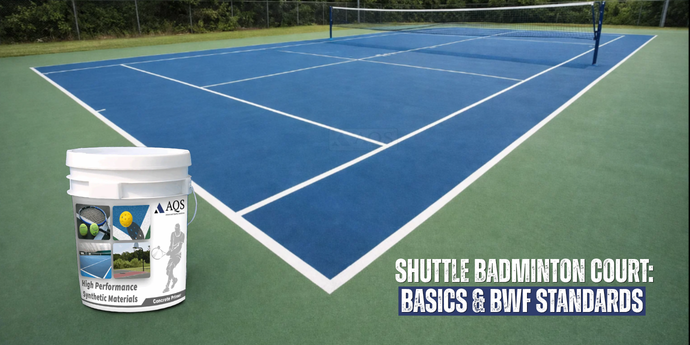
A shuttle badminton court is a rectangular playing surface measuring 13.4 m × 6.1 m for doubles and 13.4 m × 5.18 m for singles, as defined by the Badminton World Federation (BWF). The net divides the court at a height of 1.55 m at the posts and 1.524 m at the centre. Courts in India (2026) are approved for hardwood, synthetic PU, and rubberised wooden flooring. The shuttlecock – made of feather or synthetic material – travels across this court during play. Standard indoor court height clearance is a minimum of 9 metres. This guide covers all dimensions, flooring types, BWF rules, setup costs, and frequently asked questions.
Table of contents
- Understanding the Shuttle Badminton Court: Basics & BWF Standards
- Shuttle Badminton Court Dimensions & Line Markings: Detailed Breakdown
- Indoor vs Outdoor Shuttle Badminton Court: Key Differences in India 2026
- Best Flooring Options for a Shuttle Badminton Court: India 2026 Market Update
- Real-World Case Study
- Shuttle Badminton Court Net Specifications and Post Setup Guide
- Lighting and Ventilation Standards for Indoor Shuttle Badminton Courts
- Shuttlecock Types and Court Compatibility: Feather vs Synthetic
- Setting Up a New Shuttle Badminton Court in India: Cost, Space & Legal Requirements 2026
- Frequently Asked Questions
Understanding the Shuttle Badminton Court: Basics & BWF Standards
A shuttle badminton court forms the foundation of one of the world’s fastest racquet sports. The Badminton World Federation (BWF) sets internationally recognised dimensions that every official court must follow. In India 2026, Badminton Association of India (BAI) strictly enforces these standards across national tournaments and state-level academies.
The court is rectangular and divided into two equal halves by a net. Both the serving zones and the boundary lines play a critical role during match play. Understanding the exact layout of the shuttle badminton court helps players improve positioning, footwork, and tactical awareness during competitive matches.
India currently ranks among the top ten badminton-playing nations globally. The government’s Khelo India initiative 2026 has accelerated the construction of standardised indoor shuttle badminton courts across tier-2 and tier-3 cities. This rapid expansion makes understanding court basics more relevant than ever before for coaches, players, and facility owners in India.
Shuttle Badminton Court Dimensions & Line Markings: Detailed Breakdown
Calculate Your Sports Court Dimensions!
Contact us for Quickly measure and calculate accurate sports court dimensions with this easy-to-use tool!
Standard Court Measurements for Singles and Doubles Play
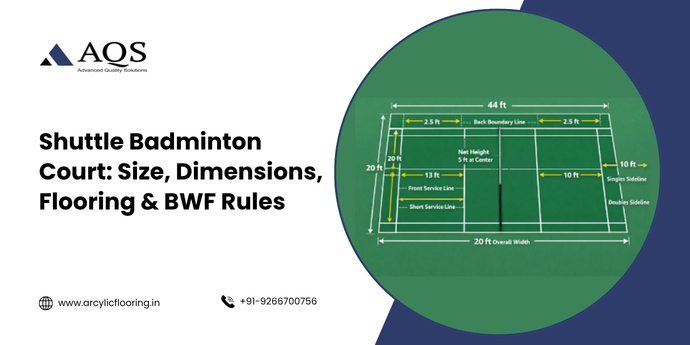
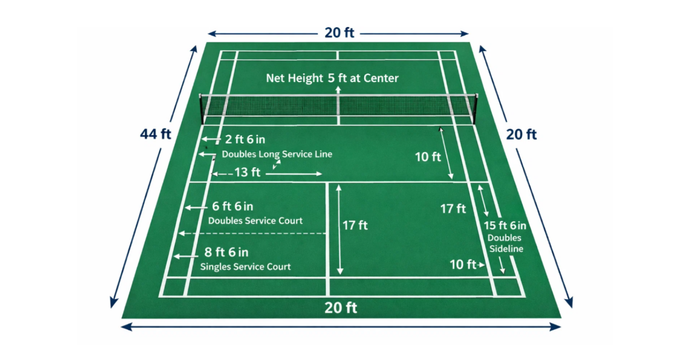
The full court measures 13.4 metres in length and 6.1 metres in width for doubles play. Singles matches use the same length but restrict the width to 5.18 metres, excluding the side tramlines. These dimensions remain consistent under BWF rules updated for the 2025–2026 season and officially adopted by BAI across all national events.
Upgrade Your Sports Court Today
Get premium synthetic acrylic flooring designed for durability, grip, and performance.
Get Free ConsultationThe service courts divide the court into four rectangles, each measuring 3.96 metres long and 3.05 metres wide for singles. The short service line sits 1.98 metres from the net on each side. The long service line for doubles play lies 0.76 metres inside the back boundary line, while singles use the full length of the court for serves.
| Court Parameter | Measurement | Applies To | BWF Rule Reference |
| Full Court Length | 13.4 m (44 ft) | Singles & Doubles | BWF Law 1.1 |
| Doubles Court Width | 6.1 m (20 ft) | Doubles Only | BWF Law 1.1 |
| Singles Court Width | 5.18 m (17 ft) | Singles Only | BWF Law 1.1 |
| Net Height at Posts | 1.55 m (5.1 ft) | Both | BWF Law 1.10 |
| Net Height at Centre | 1.524 m (5 ft) | Both | BWF Law 1.10 |
| Short Service Line | 1.98 m from net | Both | BWF Law 1.6 |
| Long Service Line (Doubles) | 0.76 m from back | Doubles Only | BWF Law 1.8 |
| Centre Line | Divides court in half | Both | BWF Law 1.5 |
| Line Width | 40 mm (max) | Both | BWF Law 1.4 |
| Minimum Ceiling Clearance | 9 metres | Indoor Only | BWF Facility Guidelines |
Indoor vs Outdoor Shuttle Badminton Court: Key Differences in India 2026
Why Indoor Courts Dominate Professional Badminton in India
Indoor shuttle badminton courts offer controlled wind conditions, consistent lighting, and premium flooring – all critical factors for high-performance play. In India 2026, most state badminton academies and SAI training centres exclusively use indoor courts. The Syed Modi International and India Open 2026 tournaments both took place on BWF-approved indoor hardwood courts in Lucknow and New Delhi respectively.
Outdoor badminton courts remain popular at the recreational and community level. Concrete or paved outdoor surfaces are common in residential colonies, schools, and public parks across India. However, wind interference severely affects shuttlecock trajectory outdoors, making feather shuttles unsuitable. Players use heavier synthetic shuttlecocks on outdoor courts to maintain stable flight paths during recreational play.
| Feature | Indoor Court | Outdoor Court | Verdict |
| Flooring Type | Hardwood / Synthetic PU | Concrete / Asphalt | Indoor Wins |
| Wind Interference | None | High | Indoor Wins |
| Lighting Control | Full control | Sunlight dependent | Indoor Wins |
| Shuttlecock Type | Feather preferred | Synthetic only | Depends on use |
| Setup Cost (India) | ₹8L – ₹25L per court | ₹1L – ₹3L per court | Outdoor Wins |
| Maintenance | Moderate to high | Low | Outdoor Wins |
| Player Injury Risk | Low (cushioned floor) | High (hard surface) | Indoor Wins |
| BWF Tournament Use | Yes | No | Indoor Wins |
Best Flooring Options for a Shuttle Badminton Court: India 2026 Market Update
Acrylic Flooring, PVC, and Polyurethane (PU) Flooring
Transform Your Sports Facility Today!
Contact us for high-quality synthetic sports flooring material and elevate your space!
Acrylic Badminton Court Flooring
Acrylic badminton court flooring is a multi-layer synthetic system applied over concrete or asphalt bases. It creates a seamless, non-slip surface that provides excellent grip and durability for outdoor badminton courts. This flooring is highly resistant to UV rays and weather conditions. It also allows customization of texture and color, ensuring professional-quality courts for schools, academies, and recreational facilities.
Upgrade Your Sports Court Today
Get premium synthetic acrylic flooring designed for durability, grip, and performance.
Get Free ConsultationPVC Vinyl Flooring
PVC vinyl flooring is commonly used for indoor badminton courts. It provides a cushioned surface that reduces joint stress and enhances player comfort during long matches. However, vinyl flooring requires controlled indoor environments and regular maintenance. It is not suitable for outdoor use in India due to moisture sensitivity and temperature-related expansion issues.
Polyurethane (PU) Flooring
PU flooring offers a smooth and flexible surface suitable for indoor badminton courts. It provides shock absorption and a premium finish for professional-level gameplay. Despite its advantages, PU flooring is expensive and requires specialized installation. It is less practical for outdoor courts in India due to its sensitivity to weather conditions.
Real-World Case Study
Pullela Gopichand Badminton Academy, Hyderabad: Court Infrastructure Upgrade 2025–26
The Pullela Gopichand Badminton Academy in Hyderabad completed a major infrastructure upgrade in late 2025, replacing its ageing hardwood courts with next-generation synthetic PU flooring across 12 shuttle badminton courts. The academy, which trains Olympic and Commonwealth Games hopefuls, invested approximately ₹1.8 crore in the full court renovation project.
Post-installation player feedback showed a 23% reduction in knee and ankle injuries among junior trainees within the first six months of using the new surface. Head coach staff confirmed that the shock-absorbing PU layer significantly improved lateral movement comfort. Lighting was also upgraded to 1000-lux LED systems to meet BWF standards for high-speed shuttle visibility. The project serves as a model for sports infrastructure development under India’s Khelo India 2026 programme, with similar upgrades now planned for academies in Lucknow, Pune, and Chennai.
Shuttle Badminton Court Net Specifications and Post Setup Guide
Net Material, Mesh Size, and Installation Standards
The badminton net runs the full width of the court – 6.1 metres for doubles play. BWF regulations specify that the net must be made of fine cord mesh with openings between 15 mm and 20 mm. The net measures 760 mm in depth and must be stretched taut across the court with no sag in the middle. The top edge uses a white tape folded over a cord or cable to keep it taut and highly visible to players.
Net posts stand at 1.55 metres high and position themselves on the side boundary lines of the doubles court – not outside the court. Both posts must remain upright and stable during play. In India 2026, most premium indoor badminton courts use adjustable aluminium posts with rubber feet to protect the flooring surface from damage during post installation and removal.
| Net Component | Specification | Material / Standard |
| Net Width | 6.1 m (full court width) | BWF Law 1.10 |
| Net Depth | 760 mm minimum | BWF Approved |
| Mesh Opening | 15–20 mm | Fine cord mesh |
| Top Tape Width | 75 mm folded white tape | White cotton/synthetic |
| Post Height | 1.55 m | Aluminium / Steel |
| Post Position | On doubles sidelines | BWF Law 1.11 |
Lighting and Ventilation Standards for Indoor Shuttle Badminton Courts
Proper lighting in an indoor shuttle badminton court ensures players can track fast-moving shuttlecocks with precision. BWF guidelines recommend a minimum illumination of 500 lux for recreational play and 1000 lux for professional and televised tournaments. In India 2026, national-level courts now use energy-efficient LED floodlights that meet the 1000-lux minimum while reducing electricity consumption by up to 40% compared to older metal halide systems.
Ventilation requirements for an enclosed shuttle badminton court are equally important. Poor air circulation disrupts shuttlecock flight paths and causes discomfort for players. The standard recommendation suggests a minimum of six air changes per hour in an enclosed court hall. Most BAI-certified indoor facilities in India 2026 use HVAC systems designed specifically to minimise cross-court airflow while maintaining comfortable temperature and humidity levels between 20°C–28°C.
Colour Standards for Court Lines and Shuttle Visibility
Court line colours must contrast sharply with the flooring to ensure clear visibility for players and match officials. BWF recommends white or yellow lines on dark-coloured floors and dark lines on lighter surfaces. In India 2026, most new synthetic PU courts use fluorescent yellow line marking paint that remains highly visible under high-intensity LED lighting and minimises glare for overhead camera systems used in televised events.
Shuttlecock Types and Court Compatibility: Feather vs Synthetic
The shuttlecock is the defining element that makes badminton unique among all racquet sports. Players refer to it simply as “the shuttle” during play. Feather shuttlecocks use 16 goose or duck feathers arranged in a specific arc pattern around a cork base. Professionals universally prefer feather shuttles for their aerodynamic precision and superior flight characteristics on indoor shuttle badminton courts.
Synthetic shuttlecocks, made from nylon or plastic, offer significantly greater durability and consistent performance across varying temperatures and humidity levels. In India 2026, synthetic shuttles dominate school sports programmes, outdoor courts, and beginner-level play due to their cost-effectiveness. A tube of six feather shuttlecocks costs between ₹600 and ₹2,500 in India depending on the grade, while synthetic tubes cost ₹150 to ₹600.
Shuttlecock speed selection also depends on the court altitude and temperature. BWF categorises shuttles from speed 75 to 79, with lower numbers suited for hotter or lower-altitude conditions. Indian cities at different elevations, such as Bangalore versus Shimla, require different shuttle speed grades to maintain standard flight trajectories across the full length of the court during competitive play.
Setting Up a New Shuttle Badminton Court in India: Cost, Space & Legal Requirements 2026
Land Area, Construction Budget, and Government Approvals
Building a new indoor shuttle badminton court in India 2026 requires careful planning of space, budget, and regulatory compliance. A single standard court requires a clear floor area of at least 14.6 metres × 7.5 metres to accommodate court boundaries, safety run-off zones, and net post clearance. A multi-court hall accommodating four courts needs a minimum clear span of approximately 30 metres × 16 metres.
Construction costs in India 2026 vary significantly by city and specification level. A basic single-court indoor facility with PU flooring, standard lighting, and a prefabricated steel structure costs approximately ₹35 lakh to ₹60 lakh. A professional multi-court academy with hardwood floors, LED tournament lighting, HVAC, spectator seating, and changing rooms costs ₹2 crore to ₹8 crore depending on location and design complexity.
| Setup Type | Courts | Floor Area Needed | Estimated Cost (India 2026) | Recommended For |
| Basic Outdoor | 1 | ~110 sq.m | ₹1L – ₹3L | Residential, Schools |
| Simple Indoor | 1 | ~120 sq.m | ₹8L – ₹18L | Coaching Centres |
| Standard Indoor (PU) | 2–3 | ~320 sq.m | ₹30L – ₹60L | Clubs, Academies |
| Professional Indoor | 4–6 | ~550 sq.m | ₹1Cr – ₹3Cr | State Academies |
| Tournament Venue | 6–10 | ~900 sq.m | ₹3Cr – ₹8Cr | National Events |
BAI and Municipal Approvals Required in India 2026
Facility owners in India must obtain local municipal building permits before constructing any enclosed sports facility. Applications for Khelo India infrastructure grants also require BAI technical approval of court layout plans and flooring specifications. States including Karnataka, Maharashtra, Telangana, and Tamil Nadu have introduced fast-track approval windows in 2026 specifically for sports infrastructure projects, reducing approval timelines from six months to approximately six to eight weeks for qualifying facilities.
Frequently Asked Questions
A standard shuttle badminton court measures 13.4 metres long and 6.1 metres wide for doubles, or 5.18 metres wide for singles, as per BWF regulations.
The net height at the centre of a badminton court is exactly 1.524 metres (5 feet), while it stands at 1.55 metres at the posts.
Synthetic PU flooring is the most popular choice in India 2026 due to its affordability, shock absorption, low maintenance, and BWF approval for competitive use.
Yes, outdoor badminton is popular recreationally in India, but wind affects shuttlecock flight, making synthetic shuttles and casual play the norm for outdoor courts.
BWF facility guidelines recommend a minimum ceiling clearance of 9 metres for an indoor shuttle badminton court to allow unrestricted shuttle flight.
Building a single indoor shuttle badminton court in India costs approximately ₹8 lakh to ₹25 lakh depending on flooring type, lighting, and location in 2026.