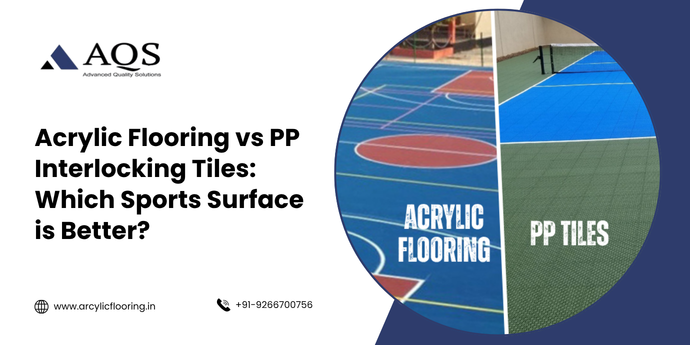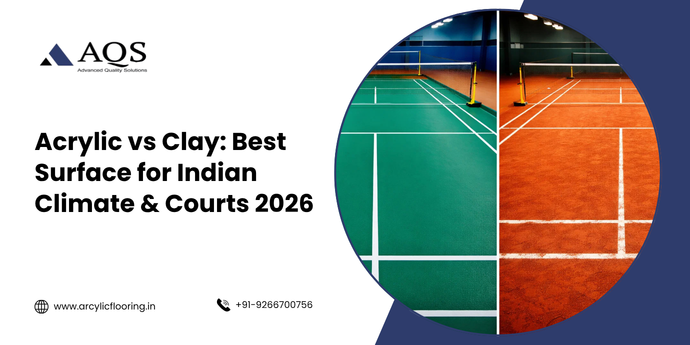
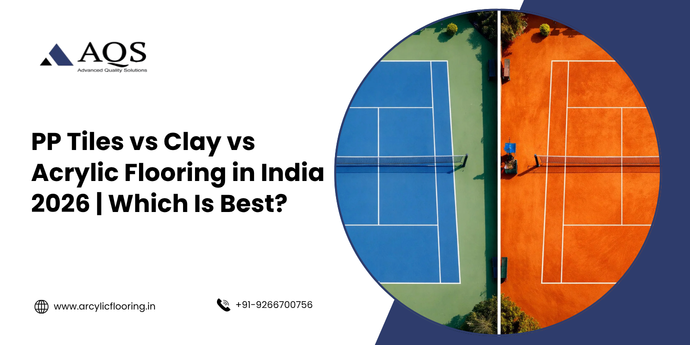
In India 2026, choosing between PP tiles vs clay vs acrylic flooring depends on your budget, location, climate, and use case. Here is what you need to know at a glance:
- PP Tiles (Polypropylene): Most affordable (₹30–₹80/sq ft), easy DIY install, ideal for gyms, warehouses, and sports courts. Weather-resistant but less premium in appearance.
- Clay Flooring (Terracotta/Kota): Natural, eco-friendly, and heat-resistant – best for homes, courtyards, and traditional architecture. Costs ₹40–₹150/sq ft. Requires sealing and regular maintenance.
- Acrylic Flooring: Premium, seamless, and highly durable. Costs ₹80–₹250/sq ft. Best for sports courts, commercial spaces, and areas needing chemical resistance. Longest lifespan (15–20 years).
India’s flooring market is expanding rapidly in 2026, driven by booming real estate, sports infrastructure, and industrial development. Builders, homeowners, gym owners, and sports facility managers across cities like Bengaluru, Pune, Delhi, and Chennai now face a common dilemma: PP tiles vs clay vs acrylic flooring – which material delivers the best value for money, durability, and performance in Indian conditions?
This guide breaks down all three flooring types with deep technical insight, a real-world case study, a side-by-side comparison table, and clear recommendations for every use case in India 2026.
Table of contents
- What Are PP Tiles? (Polypropylene Interlocking Tiles)
- What Is Clay Flooring? (Terracotta, Kota Stone & Natural Clay)
- What Is Acrylic Flooring? (Seamless Polymer Coating System)
- PP Tiles vs Clay vs Acrylic Flooring – Full Comparison Table (India 2026)
- Real-World Case Study: Sports Complex in Pune, Maharashtra (2025)
- Best Flooring Choice by Use Case in India 2026
- Cost Analysis PP tiles vs clay vs acrylic flooring : Total Investment for 1,000 Sq Ft Project
- Performance in India’s Diverse Climate Zones
- Expert Verdict
- Frequently Asked Questions
What Are PP Tiles? (Polypropylene Interlocking Tiles)
PP tiles – short for polypropylene tiles – are modular interlocking floor panels manufactured from high-density polypropylene plastic. They click together without adhesive, making installation fast and reversible. In India 2026, PP tiles have become extremely popular for sports courts, residential gyms, rooftops, garages, and event spaces because of their budget-friendly pricing and DIY-friendly design. Manufacturers now produce UV-stabilised variants specifically engineered for India’s intense summer heat.
Upgrade Your Sports Court Today
Get premium synthetic acrylic flooring designed for durability, grip, and performance.
Get Free ConsultationKey Characteristics of PP Tiles
| Feature | Details (India 2026) |
| Material | Virgin/recycled polypropylene plastic |
| Price Range | ₹30 – ₹80 per sq ft |
| Installation | Interlocking (DIY-friendly, no adhesive) |
| Lifespan | 7–12 years (with UV stabilisation) |
| Water Resistance | Excellent (100% waterproof) |
| Heat Tolerance | Up to 80°C surface (standard grade) |
| Best For | Gyms, playgrounds, rooftops, events, sports courts |
| Maintenance | Very low – sweep & mop |
Deep Insight
PP tiles with open-grid design allow water drainage and airflow – a critical advantage on Indian rooftops during monsoons. Leading Indian brands like AQS and Sportcourt now supply UV-resistant PP tiles rated for 10+ years even in Rajasthan’s extreme heat. Always verify the UV stabiliser rating (UV-8 or higher) before purchasing outdoor PP tiles.
What Is Clay Flooring? (Terracotta, Kota Stone & Natural Clay)
Clay flooring in India encompasses terracotta tiles, Kota stone, and natural fired clay bricks – materials used in Indian architecture for over 3,000 years. In 2026, clay flooring sees a strong revival among eco-conscious homeowners, heritage restoration projects, and sustainable architects. It naturally keeps indoor temperatures 3°C–5°C cooler than synthetic alternatives – a massive advantage in India’s tropical climate. Clay tiles breathe, absorb moisture, and release it gradually, maintaining humidity balance in rooms.
Key Characteristics of Clay Flooring
| Feature | Details (India 2026) |
| Material | Fired clay, terracotta, Kota stone |
| Price Range | ₹40 – ₹150 per sq ft |
| Installation | Professional required (mortar bed, curing: 7–14 days) |
| Lifespan | 25–50+ years if properly sealed |
| Water Resistance | Moderate – requires annual sealing |
| Heat Tolerance | Excellent – natural thermal mass |
| Best For | Homes, courtyards, temples, heritage buildings, kitchens |
| Maintenance | Medium – sealing, stain treatment needed |
“Clay flooring is not just a material – it is a climate solution. In Rajasthan and Gujarat, terracotta has outperformed ceramic tiles by keeping rooms cooler without air conditioning.” – Ar. Suresh Menon, Sustainable Design Forum India, 2025
What Is Acrylic Flooring? (Seamless Polymer Coating System)
Acrylic flooring is a liquid-applied, seamless polymeric coating system that cures into a hard, smooth, and highly durable surface. It is the gold standard for professional sports courts, airports, showrooms, hospitals, and commercial kitchens in India. Acrylic flooring systems consist of multiple layers – a primer coat, a base acrylic layer, colour coats, and a UV-resistant top coat – delivering surfaces that resist chemicals, heavy foot traffic, and extreme weather. In 2026, India’s sports infrastructure boom is the biggest driver of acrylic flooring demand.
Transform Your Sports Facility Today!
Contact us for high-quality synthetic sports flooring material and elevate your space!
Key Characteristics of Acrylic Flooring
| Feature | Details (India 2026) |
| Material | Water-based acrylic polymer (multi-layer) |
| Price Range | ₹80 – ₹250 per sq ft |
| Installation | Professional only (spray/roller, curing: 24–72 hrs) |
| Lifespan | 15–20 years with minimal maintenance |
| Water Resistance | Excellent – seamless, no grout lines |
| Heat Tolerance | Good (up to 60°C surface) |
| Best For | Sports courts, airports, hospitals, showrooms, labs |
| Maintenance | Low – periodic cleaning and recoating every 8–10 yrs |
Deep Insight – Sports Courts in India
ITF (International Tennis Federation) and BWF (Badminton World Federation) approve specific acrylic flooring systems for international competition. Companies like AQS deliver multi-layer acrylic systems with cushion base options that reduce joint stress by up to 30% – critical for India’s growing pickleball, tennis, and basketball infrastructure. India added over 2,400 new outdoor sports courts between 2023–2025, most using acrylic systems.
PP Tiles vs Clay vs Acrylic Flooring – Full Comparison Table (India 2026)
| Parameter | PP Tiles | Clay Flooring | Acrylic Flooring |
| Cost (₹/sq ft) | ₹30–₹80 | ₹40–₹150 | ₹80–₹250 |
| Lifespan | 7–12 years | 25–50+ years | 15–20 years |
| Installation Ease | DIY Friendly | Professional Only | Professional Only |
| Water Resistance | Excellent | Moderate | Excellent |
| Heat Performance | Good | Excellent | Good |
| Maintenance | Very Low | Medium | Low |
| Eco-Friendliness | Moderate | Excellent | Moderate |
| Aesthetic Appeal | Functional | Premium/Natural | Premium/Seamless |
| Slip Resistance | High (textured) | Medium (when dry) | High (textured coat) |
| Sports Use | Very Suitable | Not Suitable | Ideal (ITF/BWF approved) |
| Removability | Yes (modular) | Permanent | Permanent |
| Best Climate | All India climates | Dry & semi-arid zones | All India climates |
Upgrade Your Sports Court Today
Get premium synthetic acrylic flooring designed for durability, grip, and performance.
Get Free Consultation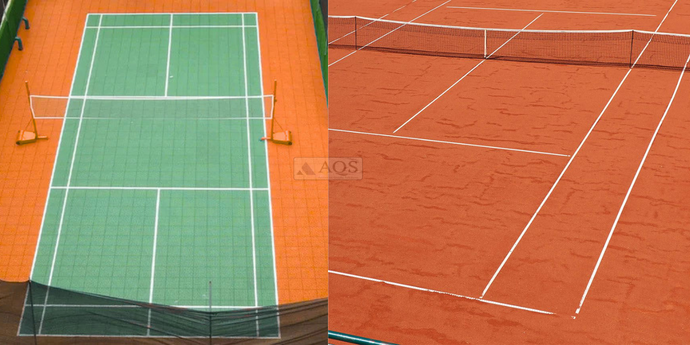
Real-World Case Study: Sports Complex in Pune, Maharashtra (2025)
Pune Sports Hub: Choosing Between PP, Clay & Acrylic for a Multi-Sport Facility
Client: A private sports complex in Hinjewadi, Pune (10,000 sq ft facility) | Year: 2025
The management team evaluated all three flooring types for different zones of their newly built sports complex. They made the following decisions based on functionality and budget:
- Outdoor Basketball & Pickleball Courts (4,000 sq ft): Chose acrylic flooring (₹140/sq ft). Reason: ITF-grade performance, UV stability, seamless finish, and 18-year warranty from the contractor.
- Indoor Gym Area (2,500 sq ft): Chose PP interlocking tiles (₹55/sq ft). Reason: Shock absorption, easy replacement if damaged, and rapid installation within 2 days.
- Reception, Café & Waiting Area (3,500 sq ft): Chose terracotta clay tiles (₹110/sq ft). Reason: Aesthetic warmth, natural cooling effect in Pune’s humid summers, and brand alignment with the eco-conscious positioning of the club.
Outcome after 12 months: Zero complaints about acrylic courts, gym PP tiles replaced 3 panels (impact damage – cost ₹165 total), clay area required one re-sealing session (₹8,000). Overall satisfaction rating: 9.2/10. The management confirmed that matching the flooring type to the specific use case was the key to success.
Best Flooring Choice by Use Case in India 2026
Residential Homes & Apartments
Clay flooring – specifically Kota stone or terracotta – wins decisively for Indian homes. It keeps interiors naturally cool in summer, aligns with Vastu aesthetics, and lasts a lifetime when properly maintained. Builders in Kerala, Tamil Nadu, and Rajasthan increasingly specify terracotta for ground floors and courtyards. Acrylic flooring suits premium apartments that want seamless, stain-proof kitchen and utility floors, while PP tiles work well for home gyms and terrace areas.
Sports Courts – Tennis, Badminton, Pickleball, Basketball
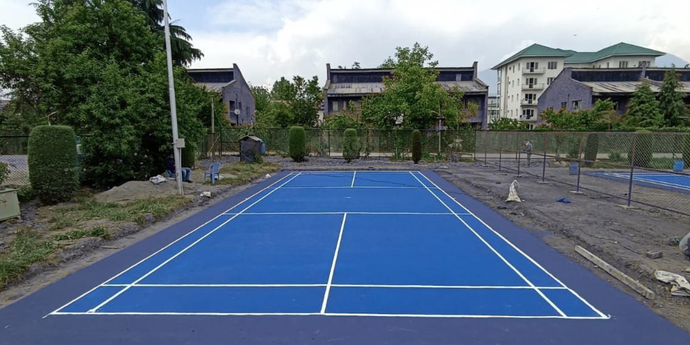
Acrylic flooring is the undisputed champion for any competitive or recreational sports court in India. Its surface texture, uniform ball bounce, shock absorption, and all-weather durability make it the only choice for courts that see regular use. PP tiles serve as a cost-effective alternative for informal or temporary courts, especially for schools and community centres with limited budgets. Clay and terracotta are completely unsuitable for sports courts – they crack under ball impact and become dangerously slippery when wet.
Commercial Spaces – Warehouses, Factories, Showrooms
Acrylic epoxy or acrylic-polyurethane systems dominate Indian industrial and commercial flooring in 2026 due to chemical resistance, load-bearing capacity, and hygiene compliance (ISO, FSSAI for food factories). PP tiles cover warehouses and light industrial spaces efficiently at lower cost. Clay flooring has no commercial utility in this segment.
Outdoor Areas – Rooftops, Driveways, Gardens
PP tiles with open-grid design handle monsoon water drainage brilliantly and require no professional installation. Rooftop terraces across Mumbai, Delhi, and Bengaluru are seeing mass adoption of UV-resistant PP tiles. Clay pavers and terracotta work in garden pathways and courtyards but require annual sealing to prevent moss growth in high-humidity regions. Acrylic coating is less common outdoors in residential settings but excels in outdoor sports and airport apron applications.
Cost Analysis PP tiles vs clay vs acrylic flooring: Total Investment for 1,000 Sq Ft Project
| Cost Component | PP Tiles | Clay Flooring | Acrylic Flooring |
| Material Cost | ₹30,000–₹80,000 | ₹40,000–₹1,50,000 | ₹80,000–₹2,50,000 |
| Installation Labour | ₹0 (DIY) – ₹15,000 | ₹25,000–₹50,000 | ₹30,000–₹60,000 |
| Surface Preparation | Minimal | ₹10,000–₹20,000 | ₹15,000–₹30,000 |
| Annual Maintenance | ₹500–₹2,000 | ₹5,000–₹15,000 | ₹2,000–₹8,000 |
| 10-Year Total Cost | ~₹55,000–₹1,10,000 | ~₹1,25,000–₹3,70,000 | ~₹1,45,000–₹3,90,000 |
| Replacement Frequency | Every 8–12 years | 25–50+ years | Recoat every 8–10 yrs |
Note on GST & Pricing in India 2026
PP tiles attract 18% GST, acrylic flooring systems attract 18% GST on material and services, while natural clay and terracotta tiles attract 5% GST as natural stone products. Factor this into your project budget. Prices above are inclusive of GST at prevailing 2026 rates.
Performance in India’s Diverse Climate Zones
Hot & Dry Climate (Rajasthan, Gujarat, Vidarbha)
Clay and terracotta flooring performs best in hot, dry zones due to its natural thermal mass properties. It absorbs heat during the day and releases it at night, stabilising indoor temperatures. PP tiles in these regions must be UV-rated; standard grades warp above 65°C surface temperature. Acrylic coatings with UV-resistant top layers perform reliably in dry heat and resist surface crazing – a common issue in inferior acrylic products.
Humid & Coastal Climate (Kerala, Mumbai, Chennai, Goa)
Acrylic flooring excels in coastal humidity due to its seamless, moisture-impermeable surface. PP tiles drain water effectively on rooftops and open courts. Clay tiles in high-humidity zones require sealing every 6–12 months to prevent moss, mould, and surface erosion – a significant ongoing cost and maintenance burden that buyers in coastal India must factor into their decision.
Cold Climate (Himachal, Uttarakhand, J&K)
Clay and terracotta retain warmth effectively in cold climates. Acrylic flooring remains durable in sub-zero temperatures if high-quality formulations with freeze-thaw resistance are specified. PP tiles can become brittle in extreme cold (below -10°C) if low-grade polypropylene is used – always verify cold-temperature ratings for high-altitude installations.
Expert Verdict
No single flooring type wins across all applications. The smartest approach – as demonstrated in the Pune case study – is to match each material to its ideal use case:
- PP Tiles win on affordability, speed, and flexibility. They are the best value-for-money solution for sports courts on a budget, gym areas, rooftops, and temporary applications. Choose UV-stabilised grades from certified Indian manufacturers.
- Clay Flooring wins on longevity, eco-friendliness, and natural thermal performance. It is the right investment for Indian homes, courtyards, and heritage spaces – especially in dry climates. The upfront effort pays dividends over 25–50 years.
- Acrylic Flooring wins on performance, durability, and professional-grade quality. It is the definitive choice for sports courts, commercial spaces, and any project where surface performance and long-term reliability outweigh initial cost. India’s sports infrastructure boom makes this segment the fastest-growing flooring category in 2026.
Frequently Asked Questions
Acrylic flooring is better for permanent outdoor sports courts due to its UV resistance and 15–20 year lifespan, while UV-stabilised PP tiles are better for temporary or budget outdoor setups like rooftops and home courts in India.
PP tiles cost ₹30–₹80/sq ft, clay flooring costs ₹40–₹150/sq ft, and acrylic flooring costs ₹80–₹250/sq ft in India 2026, making PP tiles the most affordable and acrylic the most premium option.
Yes – clay and terracotta flooring naturally keeps Indian homes 3°C–5°C cooler than synthetic floors, making it an energy-efficient, eco-friendly choice for ground floors, kitchens, and courtyards in hot Indian climates
Acrylic flooring is the best choice for badminton and pickleball courts in India because it meets BWF and ITF standards, provides consistent ball bounce, offers anti-slip texture, and withstands heavy daily use for 15–20 years.
Yes – PP interlocking tiles are one of the most popular choices for home gyms in India because they are affordable (₹30–₹80/sq ft), shock-absorbing, 100% waterproof, easy to install without adhesive, and individual panels can be replaced if damaged.
PP tiles require the least maintenance – just sweeping and mopping – with no sealing or recoating needed. Acrylic flooring needs recoating every 8–10 years, while clay flooring requires annual sealing and periodic stain treatment, making it the highest-maintenance option of the three.