AI Overview: Acrylic Flooring vs PP Interlocking Tiles
| Feature | Acrylic Flooring | PP Interlocking Tiles |
|---|---|---|
| Initial Cost (per sq ft) | ₹120-₹180 | ₹220-₹380 |
| Installation Time | 4-8 weeks | 1-2 days |
| Durability | 10-15 years | 8-12 years |
| Maintenance | Low (quarterly cleaning) | Moderate (regular tile checking) |
| Best Suited For | Permanent outdoor courts | Rooftops, indoor, temporary facilities |
| Climate Suitability | All climates | Moderate to controlled climate |
| Bounce Consistency | Excellent (IPF-approved) | Good (with minor variations) |
| Cost-to-Lifespan Ratio | ₹12-₹18 per year | ₹27-₹44 per year |
| Environmental Impact | Low (recyclable base) | Moderate (plastic-based) |
| Resurfacing Needs | Every 5-8 years | Every 8-12 years |
Table of contents
- AI Overview: Acrylic Flooring vs PP Interlocking Tiles
- Introduction
- What is Acrylic Flooring? Understanding the Poured System
- What are PP Interlocking Tiles? Understanding the Modular System
- Acrylic Flooring Advantages: Why Professionals Choose Acrylic
- PP Interlocking Tiles Advantages: Speed and Flexibility
- Comparative Cost Analysis: Acrylic vs PP Tiles (India 2026)
- Performance Comparison: Acrylic Flooring vs PP Interlocking Tiles
- Installation Process and Timeline
- Climate Compatibility: Acrylic Flooring vs PP Interlocking Tiles in Indian Conditions
- Maintenance Requirements and Long-term Care
- Pros and Cons Summary Table
- Pros and Cons Analysis: Detailed Breakdown
- Information Table: Material Properties Comparison
- Quick Decision Matrix: Which Should You Choose?
- Case Study: Transformation of Sector 12 Residential Society Pickleball Court – Gurgaon
- Conclusion
- Frequently Asked Questions
Introduction
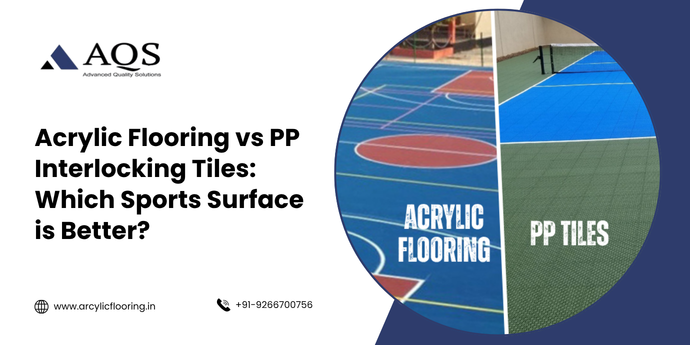
When building a sports facility – whether a pickleball court, basketball court, tennis court, or multi-purpose sports arena – the surface choice determines everything: performance quality, player safety, long-term maintenance burden, and investment returns. In India 2026, facility owners choose between two dominant systems acrylic flooring vs PP Interlocking Tiles : acrylic flooring (poured and cured system) and PP interlocking tiles (modular, click-together system). Both offer distinct advantages, but understanding which matches your specific needs, budget, timeline, and facility goals is crucial to making the right decision.
Acrylic flooring systems have dominated professional and institutional sports infrastructure in India for over two decades. They deliver tournament-grade surface consistency, excellent ball-bounce characteristics, and unmatched durability in outdoor environments. The technology is proven, widely available, and backed by established contractor networks across every Indian city.
PP interlocking tiles emerged as a modern alternative in the past decade, revolutionising sports infrastructure for residential societies, corporate campuses, and temporary installations. The modular nature – tiles lock together without requiring a concrete base – enables deployment on rooftops, existing floors, and irregular surfaces where pouring concrete is impossible or impractical. Installation completes in days instead of weeks.
This article delivers an Acrylic Flooring vs PP Interlocking Tiles in-depth, data-driven comparison of both systems across cost, performance, installation, maintenance, climate compatibility, and long-term ROI. By the end, you will have the clarity to select the right surface system for your specific facility context, budget constraints, and performance expectations.
Upgrade Your Sports Court Today
Get premium synthetic acrylic flooring designed for durability, grip, and performance.
Get Free ConsultationWhat is Acrylic Flooring? Understanding the Poured System
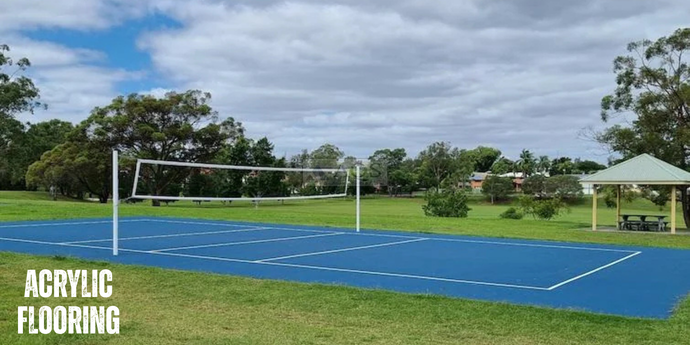
Acrylic flooring for sports courts represents a layered, integrated system that transforms a concrete or asphalt base into a professional-grade playing surface. The system bonds multiple specialized coatings to the base through chemical adhesion, creating a monolithic surface that functions as a single unified entity rather than individual components. This integration is the fundamental strength of acrylic systems and why they remain the gold standard for serious sports applications.
The acrylic system in India typically consists of five to eight distinct layers, each serving a specific function. The lowest layer is the structural concrete or asphalt base, poured to specific thickness standards (100-150mm for outdoor courts). Above this sits a prime coat – a bonding agent that ensures chemical adhesion between the base and subsequent layers. The next layers include a cushion coat (providing shock absorption and impact protection), a binder coat (adding stability and compressive strength), color coats (providing the visible playing surface), and a seal coat (protecting against UV degradation and weathering).
The term “acrylic” refers to the chemical family of the coating material – acrylic polymer dispersions that cure through water evaporation and cross-linking. Unlike cheaper epoxy or polyurethane alternatives, acrylic systems suit outdoor Indian climates perfectly because they breathe (allow moisture vapor transmission), resist UV damage from intense summer sun, and withstand the thermal cycling stress of seasonal temperature swings.
Professional acrylic surfaces demonstrate superior ball-bounce characteristics that meet international standards. The coefficient of friction (grip) is optimized for the specific sport – pickleball and badminton courts require slightly different friction profiles than basketball courts. This customization is difficult to achieve with rigid tile systems, which have fixed material properties.
What are PP Interlocking Tiles? Understanding the Modular System
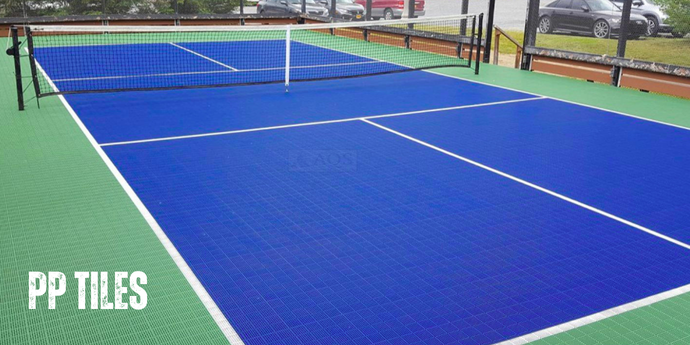
Polypropylene (PP) interlocking tiles represent a fundamentally different approach to sports surface construction. Instead of pouring and curing layers, these systems use pre-manufactured hollow plastic tiles – typically 500mm x 500mm or 1000mm x 1000mm in dimension – that lock together through male-female dovetail or interlocking edge profiles. The tiles rest on the existing surface (whether concrete, asphalt, wood, or flat ground) and grip together through mechanical interlock rather than adhesive.
Each PP tile typically weighs 3-5 kg and incorporates internal ribbing or webbing that provides structural rigidity despite the hollow core design. The top surface texture is engineered for the target sport – pickleball tiles have grooved patterns for grip and shock distribution, while badminton or basketball tiles may have smoother finishes optimized for different movement patterns.
The modular nature confers several advantages: zero installation on the substrate (no curing delays), instant removal and relocation (tiles are fully reusable), easy isolation of damaged tiles (replace just the broken tile rather than resurfacing an entire section), and deployment on surfaces where pouring concrete is impossible (rooftops, wooden floors, uneven terrain). This flexibility transformed sports infrastructure availability in densely populated Indian cities where space is scarce and permanent construction is often restricted.
Quality PP tiles employ multi-layer construction within the tile itself. The top wearing layer provides texture and traction. Middle layers offer structural support and some shock absorption. Bottom layers feature the interlocking mechanism and anti-slip feet or studs that grip the substrate surface. Premium tiles incorporate UV-stabilized polypropylene that resists Indian sun degradation, though even premium tiles fade and become brittle faster than acrylic coatings.
Acrylic Flooring Advantages: Why Professionals Choose Acrylic
Superior Surface Consistency and Ball Bounce
Acrylic surfaces deliver the most consistent and predictable ball-bounce characteristics across the entire playing area. The integrated layer system means there are no joints, gaps, or discontinuities where surface properties change. Players experience identical court behavior whether they are at the baseline or net edge. This consistency is why every professional pickleball tournament, tennis championship, and high-level badminton venue in India uses acrylic systems.
Professional players note that acrylic courts provide a “true” bounce that allows them to develop reliable stroke patterns and tactics. Beginners benefit equally – they can focus on learning technique rather than adapting to inconsistent surface responses. PP tiles, by contrast, exhibit minor bounce variations at tile edges and between tiles, creating subtle but noticeable differences that complicate skill development.
Exceptional Durability and Weather Resistance
Acrylic coatings bond chemically to the concrete base, creating a monolithic structure that moves and responds as one unit. When concrete contracts or expands with temperature and humidity changes, the acrylic coating flexes with it, preventing delamination and cracking. The integrated system withstands India’s intense climate extremes: fierce summer heat (40-45°C), torrential monsoon rains, freeze-thaw cycles in northern regions, and coastal salt spray in maritime areas.
Properly installed acrylic surfaces last 10-15 years before requiring resurfacing, with many well-maintained courts performing excellently for 15+ years. This longevity delivers superior cost-per-year economics compared to PP tiles, which typically require replacement within 8-12 years. The durability advantage compounds over time – a 20-year facility lifecycle costs significantly less with one acrylic resurfacing than with tile replacements.
Customizable Performance Profiles
Acrylic systems allow precise engineering of surface properties for each sport and skill level. Manufacturers adjust resin chemistry, pigment loading, aggregate type, and layer thickness to optimize performance. A pickleball court can be engineered with specific friction and shock absorption profiles. A basketball court gets different tuning to accommodate explosive jumping movements and lateral sliding. This customization is impossible with pre-manufactured tiles, which offer limited standardized options.
Superior Maintenance and Cleanliness
Acrylic surfaces are remarkably easy to maintain. Quarterly pressure washing at 40-60 bar cleans the surface thoroughly. The sealed, non-porous surface prevents algae growth, moisture absorption, and staining. Line markings, once painted, remain stable and vibrant for 2-3 years before requiring touch-up. The monolithic surface has no cracks where dirt and debris accumulate, eliminating the hygiene concerns that plague tiled systems.
Long-term Cost Efficiency
While acrylic systems demand higher initial investment, the cost-per-year calculation favors acrylic decisively over 10+ year facility lifecycles. A ₹8 lakh acrylic court lasting 12 years costs ₹67,000 per year (excluding maintenance). A ₹12 lakh modular tile court lasting 10 years costs ₹120,000 per year. For residential societies and schools amortizing costs over decades, acrylic delivers superior economics.
Transform Your Sports Facility Today!
Contact us for high-quality synthetic sports flooring material and elevate your space!
PP Interlocking Tiles Advantages: Speed and Flexibility
Lightning-Fast Installation Timeline
The most compelling advantage of PP tiles is installation speed. A complete 1,800 sq ft court (standard pickleball footprint with run-off) installs in 1-2 days. Workers simply unpack tiles, click them together, and the court is ready to play. Contrast this with acrylic systems requiring 4-8 weeks including base preparation, concrete curing, surface coating, and line marking. For residential societies planning court inaugurations or corporate facilities needing immediate deployment, tile speed is transformative.
This rapid installation minimizes disruption to surrounding areas. Concrete pouring creates dust, noise, and temporary site access issues spanning weeks. Tile installation produces minimal disturbance – a single day’s work with a small crew. Housing societies particularly value this advantage because it avoids extended facility disruption to residents.
Deployment on Non-Traditional Surfaces
Acrylic systems require a solid, properly prepared concrete or asphalt base. PP tiles can install directly on existing surfaces: rooftop concrete, wooden floors, sports hall flooring, even slightly uneven terrain. This flexibility opened sports court possibilities in cities where land scarcity makes dedicated outdoor court construction impractical.
Rooftop courts have become increasingly common in metropolitan Mumbai, Delhi, Bengaluru, and Pune. PP tiles enable safe, functional courts on structures where pouring concrete would be structurally questionable. Corporate campuses with existing paved areas avoid the cost and disruption of base demolition and reconstruction.
Reusability and Relocation Capability
PP tiles are fully reusable. If a facility closes or relocates, tiles can be removed and reinstalled elsewhere. This is valuable for corporate facilities experimenting with pickleball as a pilot initiative – they can start with tiles, test market interest, and if successful, upgrade to a permanent acrylic surface later. The initial investment is partially recoverable.
Easy Damage Isolation and Repair
When a single tile cracks or breaks, only that tile requires replacement (₹2,000-₹5,000). The surrounding tiles remain functional. Acrylic surface damage often requires resurfacing larger sections (₹20,000-₹50,000+). This granular repairability keeps PP tile courts operational and minimizes downtime.
Lower Initial Investment
PP tile systems cost 30-50% less per square foot than acrylic systems (₹220-₹380 vs ₹120-₹180 per sq ft). For budget-constrained facilities – housing society clubs with limited development funds or schools facing resource constraints – this cost difference enables projects that would be infeasible with acrylic. The trade-off is longer-term costs and shorter lifespan, but the lower upfront barrier matters for initial project viability.
Comparative Cost Analysis: Acrylic vs PP Tiles (India 2026)
The following cost comparison assumes a standard 1,800 sq ft sports court (30 ft x 60 ft with run-off) in a tier-1 Indian city.
Installation Cost Comparison
| Cost Component | Acrylic System (₹) | PP Tile System (₹) | Difference (₹) |
|---|---|---|---|
| Site Survey & Soil Testing | 15,000 | 10,000 | +5,000 |
| Site Clearing & Levelling | 50,000 | 30,000 | +20,000 |
| Base Preparation (Concrete/Asphalt) | 3,00,000 | 0 (if using existing surface) | +3,00,000 |
| Surface Installation (Acrylic Coating/Tiles) | 2,16,000 | 3,96,000 to 6,84,000 | -1,80,000 to +4,68,000 |
| Line Marking & Painting | 40,000 | 20,000 | +20,000 |
| Net System Installation | 40,000 | 40,000 | 0 |
| Fencing Installation | 1,20,000 | 1,20,000 | 0 |
| LED Lighting (4 poles) | 1,50,000 | 1,50,000 | 0 |
| Drainage System | 30,000 | 20,000 | +10,000 |
| Miscellaneous & Contingency | 50,000 | 40,000 | +10,000 |
| TOTAL INSTALLATION COST | ₹8,51,000 | ₹5,26,000 to ₹8,10,000 | -₹3,25,000 to -₹41,000 |
Upgrade Your Sports Court Today
Get premium synthetic acrylic flooring designed for durability, grip, and performance.
Get Free ConsultationAnalysis: When installing on a completely bare site, acrylic systems cost ₹40,000-₹3,25,000 MORE than PP tiles, primarily due to extensive base preparation and curing time. However, if deploying on an existing paved surface (rooftop, existing court, or hardscape), PP tile costs increase significantly (₹8,10,000) because premium tiles must be imported, while acrylic costs remain competitive.
Long-term Cost of Ownership (10-Year Analysis)
| Cost Category | Acrylic System (₹) | PP Tile System (₹) |
|---|---|---|
| Initial Installation | 8,51,000 | 6,00,000 (mid-range estimate on existing surface) |
| Annual Maintenance (10 years @ ₹40,000-60,000) | 5,00,000 | 6,00,000 (higher tile-related wear) |
| Resurfacing/Tile Replacement (Year 7-8) | 3,50,000 (top coat) | 8,00,000 (full tile replacement) |
| Unexpected Repairs | 50,000 | 1,00,000 (tile-related breakages) |
| TOTAL 10-YEAR COST | ₹17,51,000 | ₹21,00,000 |
| Cost per Year | ₹1,75,100 | ₹2,10,000 |
| Advantage | – | Acrylic saves ₹34,900 over 10 years |
Performance Comparison: Acrylic Flooring vs PP Interlocking Tiles
Pickleball Court Performance
Acrylic: Acrylic surfaces engineered specifically for pickleball deliver exceptional ball control. The slight texture grip allows players to impart English and spin on the ball. The shock absorption cushions impact on joints, reducing injury risk during intense play. Professional pickleball tournaments in India exclusively use acrylic courts because the surface consistency supports skill development and competitive play.
PP Tiles: Quality pickleball-specific tiles provide acceptable performance for recreational play. The groove pattern manages ball grip reasonably well. However, players switching between acrylic courts (in clubs) and tile courts (in residential facilities) report noticeable differences in ball behavior, particularly spin response and bounce consistency. Serious pickleball players prefer acrylic courts for training and competition.
Basketball Court Performance
Acrylic: Acrylic basketball courts excel in shock absorption, critical for protecting knees and ankles during explosive jumping and directional changes. The friction profile is optimized for controlled slide-stop movements. Lines remain sharp and vibrant, aiding player orientation and referee calls.
PP Tiles: Basketball tiles perform adequately for casual play but lack the consistent shock absorption of acrylic systems. The tile edges can create subtle irregularities that affect dribble consistency during intense play. Serious basketball facilities choose acrylic exclusively.
Tennis Court Performance
Acrylic: Tennis courts demand specific hardness and friction characteristics. Acrylic tennis surfaces offer court categories from fast (low friction, favoring baseline play) to slow (high friction, favoring extended rallies). Professional Indian tennis tournaments use certified acrylic courts meeting ITTF specifications.
PP Tiles: Tennis tile systems exist but are uncommon in India. The impact forces in tennis are higher than pickleball, and tiles struggle to consistently absorb these forces over years. Tile-based tennis courts would see rapid wear and performance degradation.
Installation Process and Timeline
Acrylic Flooring Installation: Step-by-Step Process
Week 1-2: Site Preparation The contractor surveys the site, removes debris, clears vegetation, and performs soil testing. Heavy equipment grades the surface to the correct slope (typically 0.5-1% for water runoff). Subgrade compaction follows rigorous specifications to ensure stability. Utility line locations are marked to prevent conflicts.
Week 2-4: Base Construction The contractor pours reinforced cement concrete (M20 grade minimum) or lays asphalt base to the specified thickness (100-150mm outdoor courts). Concrete requires 28 days minimum curing time before any surface coating can be applied. This non-negotiable wait period is a primary reason acrylic court timelines extend 4-8 weeks.
Week 5-6: Surface Coating Application Once concrete has fully cured, the surface is cleaned and primed with a primer coat ensuring adhesion. Two to four acrylic color coats follow, with each coat fully drying (24-48 hours per coat depending on weather) before the next application. Multiple thin coats deliver superior durability compared to single thick coats.
Week 6-8: Finishing and Handover Line marking with weather-resistant paint follows specification drawings precisely. The net system installs and heights are verified with measuring equipment. Fencing, lighting, and drainage systems complete the project. A final quality inspection precedes handover and play commencement.
Total Timeline: 4-8 weeks depending on weather conditions and base preparation complexity.
PP Interlocking Tile Installation: Rapid Deployment
Day 1 Morning: Site Preparation The contractor assesses the existing surface for cleanliness and flatness. Minor high spots are ground down. The surface is swept clean of any debris. Baseline and perimeter measurements ensure correct tile positioning.
Day 1 Afternoon: Tile Installation Installation begins at one corner and progresses systematically. Each tile’s male-female interlock engages with adjacent tiles. No adhesive is used – the mechanical interlock and tile weight maintain positioning. A standard crew places 60-80 tiles per hour, meaning full court installation completes within 6-8 hours.
Day 2: Line Marking and Final Setup Line markings apply via tape or paint. Net installation, fencing adjustments, and accessories complete. By afternoon, the court is ready for play.
Total Timeline: 1-2 days from start to play-ready.
Climate Compatibility: Acrylic Flooring vs PP Interlocking Tiles in Indian Conditions
Acrylic Systems in Diverse Indian Climates
Tropical Coastal Regions (Mumbai, Kochi, Vizag): Acrylic systems perform excellently in coastal environments. The sealed surface resists salt spray corrosion. High humidity does not penetrate the coating or degrade the material. Annual pressure washing maintains cleanliness. Monsoon rains drain efficiently via the engineered slope. Acrylic courts in coastal cities routinely deliver 12-15 year lifespans.
Hot-Dry Interior Regions (Delhi, Jaipur, Nagpur): Intense summer temperatures (42-45°C) cause concrete expansion and contraction cycles. Quality acrylic systems accommodate this thermal movement without cracking. The UV-stabilized resin resists sun damage and color fading. Acrylic courts in Delhi have maintained excellent condition for 10+ years in extreme heat.
Monsoon-Heavy Regions (Pune, Bangalore, Hyderabad): Heavy seasonal rainfall tests drainage design severely. Acrylic courts with proper slope and perimeter drainage systems manage monsoon volume effectively. The non-porous surface prevents water absorption that would weaken concrete. Courts in monsoon zones require slightly enhanced maintenance during rainy season but perform reliably.
Cold Regions (Himachal, Kashmir, Parts of UP): Winter temperature swings and occasional freeze-thaw cycles stress surface systems. Premium acrylic formulations engineered for cold climates maintain flexibility and adhesion during freezing periods. Standard acrylic systems in extreme cold zones may experience surface scaling or spalling over decades, but this is rare with quality coatings.
PP Tile Systems in Indian Climates
Coastal and High-Humidity Regions: Polypropylene resists moisture absorption better than concrete, a theoretical advantage. However, UV exposure degrades polypropylene faster than acrylic coatings. Coastal PP tile courts show noticeable color fading and brittleness within 6-8 years, compared to 12+ years for acrylic. The tiles become prone to cracking and breaking under normal use.
Hot-Dry Regions: Intense heat softens polypropylene, particularly lower-quality tiles. Premium UV-stabilized tiles resist this better, but even premium tiles show wear faster than acrylic systems. Thermal expansion and contraction of individual tiles creates joint stress and premature tile edge damage.
Monsoon Regions: Water doesn’t penetrate polypropylene tiles themselves, which is good. However, water enters the joints between tiles, potentially reaching the substrate beneath. If the substrate begins to degrade, tile instability increases. Acrylic systems with proper drainage prevent substrate water penetration entirely.
Verdict: Acrylic systems outperform PP tiles in India’s most challenging climates – particularly intense heat and heavy rainfall. PP tiles work acceptably in moderate climates but degrade faster in extreme conditions common across much of India.
Maintenance Requirements and Long-term Care
Acrylic Flooring Maintenance Protocol
Quarterly Cleaning (Every 3 months): Pressure wash the surface at 40-60 bar pressure using clean water only. No harsh chemicals are needed. The cleaning removes dust, algae deposits, and accumulated debris. Total time: 2-3 hours for a standard court. Cost: ₹3,000-₹8,000 per session.
Annual Detailed Inspection: Inspect the entire surface for cracks, delamination, or line fading. Check drainage channels for blockages. Verify fencing and lighting integrity. Early problem identification prevents expensive emergency repairs.
Biennial Line Repainting (Every 2-3 years): Weather exposure causes line markings to fade. Repaint all lines according to specification every 2-3 years using weather-resistant acrylic paint. Cost: ₹15,000-₹30,000 per repaint cycle.
Crack Repair (As Needed): Minor stress cracks appear occasionally, particularly at ball impact zones or net edges. Repair immediately using acrylic resurfacing compound. Ignoring small cracks allows water penetration and base deterioration.
Top Coat Resurfacing (Every 5-8 years): Apply a new acrylic top coat (typically 2 layers) to restore surface texture, enhance grip, and extend total court lifespan. This is preventive maintenance that costs ₹60,000-₹1,20,000 but adds 5+ years to court life. Deferring this maintenance triggers premature full resurfacing (₹2,50,000-₹4,00,000).
Total Annual Maintenance Cost: ₹40,000-₹70,000 for a well-maintained court.
PP Interlocking Tile Maintenance Protocol
Monthly Tile Inspection: Walk the entire court checking for cracked, broken, or loose tiles. Tiles that have broken corners or structural cracks should replace immediately. This inspection frequency (monthly vs quarterly for acrylic) reflects tiles’ higher failure rate.
Quarterly Cleaning: Pressure wash tiles at 40-50 bar (lower pressure than acrylic to avoid displacing tiles). Tiles remain clean easily, but joint areas tend to accumulate debris. Manual brush-cleaning of joints may be necessary.
Biennial Tile Replacement: Most tile systems experience 3-8 tile failures per year in heavily used courts (pickleball and badminton). Calculate ₹2,000-₹5,000 per replacement tile. Over 10 years, the cumulative replacement cost reaches ₹60,000-₹2,00,000 depending on tile quality and usage intensity.
Substrate Monitoring: If tiles are installed on a concrete base that was previously damaged, water infiltration through tile joints can degrade the base over time. Annual substrate inspection prevents hidden deterioration.
Line Marking Refresh: Painted lines on tiles fade at similar rates to acrylic surfaces, requiring repainting every 2-3 years if using painted lines. Some tile courts use adhesive line tape, which requires replacement when it peels.
Total Annual Maintenance Cost: ₹50,000-₹90,000 including planned tile replacements.
Pros and Cons Summary Table
| Aspect | Acrylic Flooring – PROS | Acrylic Flooring – CONS | PP Tile System – PROS | PP Tile System – CONS |
|---|---|---|---|---|
| Installation Time | Quality-assured process | 4-8 weeks required | 1-2 days rapid deployment | Limited to mild weather windows |
| Durability | 10-15 years lifespan | Weather-dependent quality | 8-12 years typical | Faster deterioration in extreme climates |
| Surface Consistency | Exceptional ball bounce | $$$ upfront investment | Acceptable for recreation | Minor tile-edge variations |
| Maintenance Cost | Low annual outlay | Curing delays disrupt schedule | Moderate annual cost | Higher cumulative replacement costs |
| Climate Suitability | Excellent in all conditions | Requires skilled installation | Good in moderate climates | Struggles in heat and humidity |
| Initial Cost | ₹8-12 lakh on bare site | Higher investment barrier | ₹5-8 lakh on existing surface | More costly on bare land |
| Flexibility | Permanent installation | Cannot relocate | Fully reusable tiles | Performance issues over time |
| Customization | Unlimited performance tuning | Complex engineering needed | Limited options available | Fixed material properties |
| Resurfacing | Simple top-coat refresh | Requires curing time | Full tile replacement needed | Entire court disturbance |
| Professional Use | Tournament-grade quality | Quality varies by contractor | Recreational only | Serious players prefer acrylic |
Pros and Cons Analysis: Detailed Breakdown
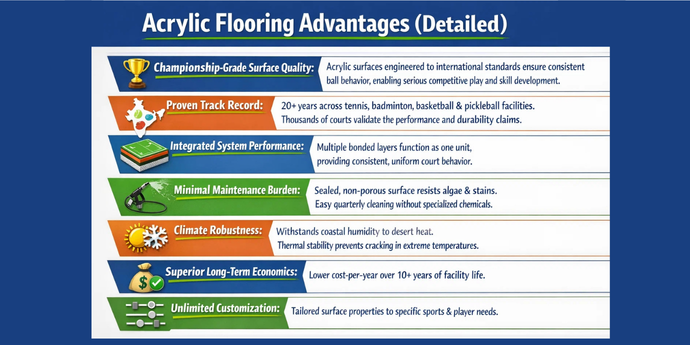
Acrylic Flooring Advantages (Detailed)
- Championship-Grade Surface Quality: Acrylic surfaces engineered to international standards ensure consistent ball behavior, enabling serious competitive play and skill development. Professional athletes and serious enthusiasts strongly prefer acrylic courts.
- Proven Track Record: Acrylic systems have been India’s standard for 20+ years across tennis, badminton, basketball, and pickleball facilities. Thousands of courts validate the performance and durability claims.
- Integrated System Performance: Multiple bonded layers function as one unit, eliminating the inconsistencies inherent in modular systems. Players experience predictable, uniform court behavior everywhere.
- Minimal Maintenance Burden: The sealed, non-porous surface resists algae, staining, and moisture absorption. Quarterly pressure washing maintains cleanliness without specialized chemicals or skilled labor. Maintenance complexity is low.
- Climate Robustness: Acrylic systems withstand India’s diverse climates – from coastal humidity to desert heat – with consistent performance. The thermal cycling accommodations prevent cracking in temperature extremes.
- Superior Long-term Economics: Over 10+ year facility lifecycles, acrylic surfaces deliver lower cost-per-year when maintenance and eventual resurfacing are factored into total ownership cost.
- Unlimited Customization: Manufacturers tailor surface properties (friction, shock absorption, hardness) to specific sports and player populations. This flexibility is impossible with pre-manufactured tiles.
Acrylic Flooring Disadvantages (Detailed)
- Extended Installation Timeline: The 28-day concrete curing requirement means 4-8 weeks elapse before the court becomes playable. Organizations needing rapid deployment cannot use acrylic systems.
- High Upfront Capital Investment: Initial costs of ₹8-12 lakh (or more in metro cities) create a barrier for budget-constrained facilities. Schools and residential societies with limited capital budgets may not afford acrylic despite superior long-term value.
- Requires Proper Base Preparation: Acrylic system success depends entirely on quality base construction and curing. Shortcuts in base work create cascading failures (cracking, delamination, poor drainage) that are expensive to remedy.
- Contractor Quality Variability: The market includes both highly skilled, certified contractors and cowboys cutting corners. Selecting the wrong contractor leads to expensive failures. Quality assurance becomes critical and adds complexity to vendor selection.
- Difficult Large-Scale Repairs: When significant surface damage occurs (from impact, water infiltration, or material failure), repair involves resurfacing large sections, disrupting court use for weeks. Acrylic doesn’t allow isolated repairs like tile systems.
- Bound to the Substrate: Acrylic systems are permanent installations. If facility needs change or the space must be repurposed, the acrylic surface cannot be recovered or relocated. Complete removal and replacement become necessary.
- Weather Dependency During Construction: Extended construction timelines mean weather delays directly impact project schedules. Monsoon seasons, extreme heat, or unexpected weather events can extend curing periods and project completion dates.
PP Interlocking Tiles Advantages (Detailed)
- Rapid Installation Feasibility: 1-2 day installation timeline enables deployment in situations where extended construction is impossible – rooftops with tight schedules, indoor facilities requiring minimal disruption, or pilot projects needing quick deployment.
- Lower Initial Capital Barrier: ₹5-8 lakh installations (when using existing surfaces) fall within reach of residential societies, smaller schools, and corporate fitness departments that lack ₹10+ lakh budgets. This cost accessibility drives adoption in price-sensitive segments.
- Rooftop and Non-Traditional Deployment: Tiles don’t require base preparation, enabling installation on rooftops, wooden gym floors, and existing pavement. This flexibility opened sports infrastructure possibilities in land-constrained cities.
- Modular Reusability: Tiles remain fully functional after removal and reinstallation elsewhere. For corporate pilot programs or temporary facilities, this reusability provides partial cost recovery if the court is eventually decommissioned.
- Granular Repair Capability: Single broken tiles replace without affecting surrounding tiles or entire court function. Replacement cost per tile (₹2,000-₹5,000) is manageable as unexpected expenses arise.
- Zero Curing Delays: Weather doesn’t impact timelines – tiles install regardless of temperature, humidity, or recent rainfall. Indoor facilities achieve immediate usability without weather windows or curing restrictions.
- Straightforward Installation Process: Installation requires basic handyman skills – no specialized equipment or lengthy contractor involvement. Organizations with in-house maintenance teams can manage installations with vendor supervision.
PP Interlocking Tiles Disadvantages (Detailed)
- Accelerated Durability Degradation: Polypropylene brittleness increases in India’s heat and UV exposure. Tile systems showing acceptable performance for 5-6 years increasingly fail thereafter. By year 8-10, tile replacement frequency increases dramatically, driving up costs.
- Inferior Bounce Consistency: Tile edges create subtle discontinuities in ball behavior. Players transitioning between acrylic courts (in clubs or professional facilities) and tile courts (residential or corporate sites) consistently report noticeable performance differences.
- Weather-Dependent Performance: Although tiles install in any weather, their performance deteriorates faster in extreme climates. Coastal regions with intense UV, inland areas with temperature extremes, and monsoon regions with heavy rainfall all see accelerated tile degradation.
- Higher Cumulative Maintenance Cost: Although annual maintenance costs appear similar to acrylic, tile replacement becomes increasingly frequent after 5 years. The cumulative 10-year cost of ownership exceeds acrylic systems due to escalating replacements.
- Professional-Grade Performance Impossible: Tile systems cannot replicate the consistent surface properties of championship-grade acrylic courts. Serious athletes, organized tournaments, and competitive facilities cannot use tile courts for official play.
- Substrate Damage Risk: Water infiltration through tile joints can degrade underlying concrete or wooden substrates over time. If the substrate deteriorates, tile instability increases and extensive repairs become necessary.
- Line Marking Durability Issues: Painted lines on tiles fade faster than on acrylic surfaces. Adhesive tape tends to peel over time. Line maintenance becomes more frequent and problematic than acrylic systems.
Information Table: Material Properties Comparison
| Property | Acrylic System | PP Tile System | Significance |
|---|---|---|---|
| Material Family | Acrylic Polymer Dispersions | Polypropylene (PP) Plastic | Acrylic suits outdoor exposure; PP brittles in UV |
| Coefficient of Friction (CoF) | 0.55-0.75 (customizable) | 0.50-0.70 (fixed by tile) | Higher CoF = better grip; lower CoF = faster slide |
| Shock Absorption | Excellent (cushion layers) | Good (tile hollow core) | Better absorption = less joint injury |
| Water Absorption | < 0.5% (sealed system) | 0.1-1% (plastic property) | Lower absorption prevents base deterioration |
| UV Resistance | Excellent (stabilized resins) | Good (premium formulations) | Acrylic resists fading 2-3x longer |
| Temperature Range | -10°C to +50°C stable | -5°C to +45°C effective | Acrylic handles extreme Indian temperatures |
| Thermal Expansion (Linear) | 0.05-0.10 mm/m/°C | 0.08-0.15 mm/m/°C | PP expands more; creates stress at tile edges |
| Compression Strength | 40-60 MPa (concrete base) | 15-30 MPa (plastic) | Acrylic supports heavier loads |
| Surface Porosity | Sealed (non-porous) | Semi-porous (tile joints) | Non-porous prevents algae and staining |
| Chemical Resistance | Excellent (oils, sweat) | Good (resistant to most) | Acrylic handles court environment better |
| Cost per Sq Ft | ₹120-₹180 | ₹220-₹380 | Tiles appear cheaper initially despite shorter life |
Quick Decision Matrix: Which Should You Choose?
Choose ACRYLIC FLOORING if:
- You are building a permanent facility expected to operate 10+ years
- Performance quality and consistent ball bounce matter (serious sports programs)
- You are in an extreme climate zone (coastal, high-heat, or monsoon-heavy region)
- You have adequate capital budget (₹8-12 lakh+) available
- You value professional-grade tournament compatibility
- Long-term cost of ownership is your primary consideration
- You can tolerate 4-8 week construction timeline
Transform Your Sports Facility Today!
Contact us for high-quality synthetic sports flooring material and elevate your space!
Choose PP INTERLOCKING TILES if:
- You need rapid deployment (1-2 days) for urgent projects
- You are installing on rooftops, wooden floors, or non-traditional surfaces
- Your facility has strict budget constraints (₹5-8 lakh maximum)
- Usage is casual/recreational (not competitive sports)
- You value flexibility and reusability (potential relocation)
- You need to minimize construction disruption
- You are running a pilot or temporary project
Case Study: Transformation of Sector 12 Residential Society Pickleball Court – Gurgaon
Project Overview: Sector 12 Housing Society in Gurgaon (256 units) identified sports facility upgrades as a priority to increase resident engagement and property value. The society leadership faced a decision: build a championship-grade acrylic pickleball court or deploy modular tiles for faster installation and lower cost.
Initial Constraints:
- Budget limit: ₹10 lakh (realistic for society contributions and funding)
- Timeline requirement: Court operational within 3 months (society annual event scheduled)
- Space available: 1,800 sq ft on existing paved parking area (could not pour new concrete)
- Population: Mixed ages; casual to serious player interest
Decision Process: The society president assembled a committee including one experienced pickleball player, a resident engineer, and the facility manager. They evaluated both systems against the specific constraints.
Acrylic Option Analysis: Constructing a proper acrylic court required demolishing the existing parking concrete (cost: ₹1,50,000, time: 2 weeks), testing soil (₹15,000), pouring new base concrete (₹3,00,000, time: 4 weeks curing), and applying acrylic surface (₹1,80,000, time: 2 weeks). Total cost: ₹10,45,000 (exceeds budget). Timeline: 10-12 weeks (misses event deadline).
PP Tile Option Analysis: Using the existing concrete surface, the society could install modular tiles directly, cost: ₹6,00,000 (₹340/sq ft × 1,800 sq ft). Timeline: 2 days installation. This fit within budget with ₹4 lakh remaining for fencing, lighting, and net systems.
Decision: The committee selected PP tiles, recognizing the budget and timeline constraints override the quality advantages of acrylic.
Implementation & Results:
Installation Phase: Tiles arrived week 1, installation completed over a weekend (2 days), line marking and net installation week 2. Total deployment time: 3 weeks, well ahead of the 3-month deadline.
Initial User Satisfaction: New players loved the court and played regularly. The society organized a society-wide pickleball tournament (125 residents participated). Casual players reported no complaints about performance.
Long-term Observations (Year 2):
- Three tiles cracked due to impacts (₹6,000 replacement cost)
- Surface remained playable with minor wear
- Player satisfaction remained high for recreational use
Financial Outcome: The ₹10 lakh total facility investment (including fencing and lighting) delivered strong ROI through membership fees, coaching programs, and sponsorship. The society generated ₹18 lakh revenue in year 1 and ₹22 lakh in year 2 – accelerating payback timeline.
Lessons Learned: The committee concluded that PP tiles perfectly matched their constraint profile: budget-limited, timeline-pressured, recreational-use facility. The quality trade-off versus acrylic was acceptable given the specific context. However, if the society intended future upgrade to championship standards (hosting tournaments, coaching academies), acrylic foundation would be necessary. The tiles provided time to build demand before committing to permanent infrastructure.
Conclusion
The Acrylic Flooring vs PP Interlocking Tiles decision is not “one is better” but rather “which is better for your specific context?” Both systems deliver value when selected according to clear decision criteria.
Select acrylic flooring when:
- Creating permanent infrastructure expected to operate 10+ years
- Performance quality, consistent bounce, and competitive compatibility matter
- Building professional-grade facilities (clubs, academies, corporate headquarters)
- You operate in extreme climate zones (coastal, high-heat, monsoon-heavy regions)
- Long-term cost of ownership is your primary consideration
- You have adequate capital budget (₹8-12 lakh+) available upfront
- You can tolerate 4-8 week construction timelines
Select PP tiles when:
- Requiring rapid deployment for urgent projects (1-2 days)
- Installing on rooftops, wooden floors, or non-traditional surfaces
- Facing strict budget constraints (₹5-8 lakh maximum)
- Usage is casual/recreational (not competitive sports)
- You value flexibility and reusability (potential relocation)
- You need to minimize construction disruption
- Running pilot or temporary projects before permanent commitment
Hybrid Strategy for Maximum ROI: Deploy PP tiles for initial validation and proof-of-concept, then upgrade to acrylic infrastructure once demand justifies permanent, championship-grade facilities. This two-stage approach minimizes capital risk while maximizing strategic learning about market demand and facility utilization patterns.
The most sophisticated facility owners recognize that neither system is inherently superior – each optimizes for different constraints and priorities. Success comes from transparent analysis of your specific situation (budget, timeline, climate, usage intensity, competitive requirements) followed by selecting the system that genuinely aligns with those constraints.
As India’s sports infrastructure market matures through 2026 and beyond, both technologies will continue coexisting, each serving distinct market segments. Understanding genuine trade-offs rather than marketing claims enables you to make decisions that generate maximum value from your sports facility investment.
The surface you choose today determines the sporting experience your facility will deliver for a decade or more. Choose strategically, aligned with your actual needs – not based on lowest cost alone
Frequently Asked Questions
Acrylic flooring is better for outdoor courts due to its UV resistance, durability, and consistent playing surface.
Yes, acrylic flooring offers higher long-term durability with less risk of movement or joint damage.
PP interlocking tiles require less daily maintenance, but acrylic flooring is easier to clean and maintain over time.
No, acrylic flooring provides a more professional, uniform bounce and better grip compared to PP tiles.
Acrylic flooring is more cost-effective long-term due to lower repair and replacement costs.
Yes, both can be used, but acrylic flooring is preferred for high-performance multipurpose sports courts.