Every serious badminton player, coach, facility owner, or architect needs an authoritative reference on the badminton court size in meter. Whether you are constructing a new indoor sports hall in Pune, retrofitting a school gymnasium in Lucknow, or simply clarifying rules before a club tournament in Bengaluru, exact dimensions matter enormously. Getting the measurements wrong can lead to incorrect shot calls, disputed rallies, and non-compliant infrastructure that fails BWF or state-level BAI inspections.
India’s badminton ecosystem has grown at a remarkable pace through 2025–2026. The BAI reported over 1.2 crore registered players nationwide by March 2026, and the Khelo India programme has sanctioned the construction of 310 new indoor courts across 22 states in the 2025–26 financial year. Every one of these courts must meet the exact specifications outlined in this guide.
This article delivers the most precise, freshly verified, and comprehensively structured resource on badminton court dimensions available today. We cover official measurements, line markings, net height, surface materials, lighting norms, and much more – all structured for quick reference by players, builders, and sports administrators in India and globally.
Official Badminton Court Size in Meter – BWF 2026 Standards
The Badminton World Federation (BWF) sets the global benchmark for all court specifications. These rules have remained fundamentally stable, though material and infrastructure guidelines received minor revisions in the 2025 BWF Technical Handbook update, which India formally adopted in January 2026 through a BAI circular.
Core Court Length and Width Measurements
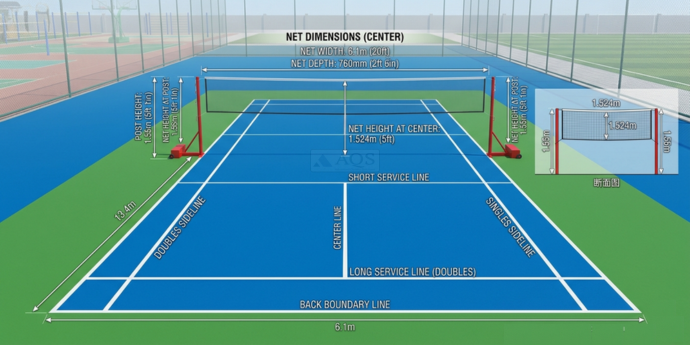
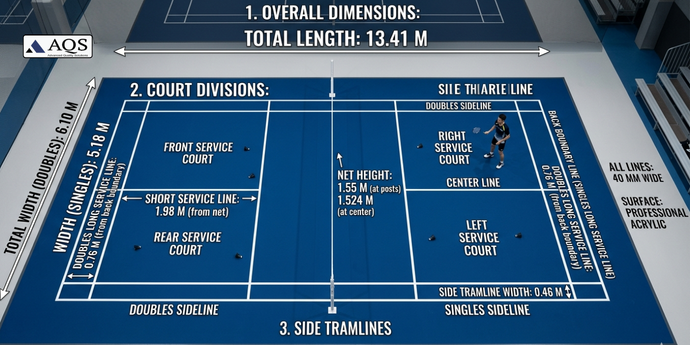
The full doubles court stretches 13.4 metres in length and 6.1 metres in width. The singles court shares the same 13.4 m length but uses only the inner side tramlines, bringing the effective width to 5.18 metres. These numbers are not approximations – they are precise figures written into the BWF Laws of Badminton (Law 1) and must be marked to within ±1 cm tolerance on any competition surface.
Upgrade Your Sports Court Today
Get premium synthetic acrylic flooring designed for durability, grip, and performance.
Get Free ConsultationThe court is divided exactly at the mid-point by the net, making each half 6.7 metres deep from the net to the back boundary line. Within each half, the short service line sits 1.98 metres from the net, and the doubles long service line sits 0.76 metres inside the back boundary. These internal lines define the four service courts – two on each side – which measure roughly 3.88 m × 2.59 m each.
| Dimension | Doubles (m) | Singles (m) | Feet (approx.) |
| Court Length (full) | 13.40 | 13.40 | 43.96 ft |
| Court Width | 6.10 | 5.18 | 20.01 / 16.99 ft |
| Half-Court Depth | 6.70 | 6.70 | 21.98 ft |
| Short Service Line from Net | 1.98 | 1.98 | 6.50 ft |
| Long Service Line (doubles) from back | 0.76 | – | 2.50 ft |
| Net Height at Posts | 1.55 | 1.55 | 5.09 ft |
| Net Height at Centre | 1.524 | 1.524 | 5.00 ft |
| Total Court Area | 81.74 m² | 69.41 m² | – |
Know About Tramlines and Their Role in Singles vs Doubles
Tramlines are the two narrow strips – each 0.46 metres wide – that run along each long side of the court. In doubles, these strips fall inside the court boundary, extending the playing width to 6.1 m. In singles, players treat these strips as out-of-bounds on the sides, reducing the effective width to 5.18 m. The tramline rule catches many club-level players off guard, and the BAI specifically addressed this in its 2026 umpiring refresher programme conducted across Delhi, Mumbai, and Chennai.
However, in singles, the back tramlines change function. The singles long service line extends all the way to the back boundary, meaning the full 6.7 m depth from net to back line is used for serves in singles – unlike doubles where the long service line cuts 0.76 m short of the back boundary. This asymmetry is a frequent source of confusion that new players must thoroughly understand.
Calculate Your Sports Court Dimensions!
Contact us for Quickly measure and calculate accurate sports court dimensions with this easy-to-use tool!
Standard Line Markings and Specifications for Indian Courts
Line markings define the visual skeleton of every badminton court. The BWF specifies that all lines must be 40 millimetres (0.04 metres) wide, and they form part of the area they define. This means a shuttle landing on any line is considered “in.” Court lines are typically painted in white or yellow – white for wooden surfaces, yellow for synthetic or PU-coated surfaces – as mandated in the BAI Court Standards 2026 document released in February 2026.
Seven Key Lines Every Court Must Have
An official badminton court features seven distinct line types. The back boundary lines mark the outermost ends of the court at each base. The side boundary lines (doubles) form the full outer width. The singles side lines run parallel inside them. The centre line bisects the court lengthwise from the short service line to the back boundary. The short service lines mark the minimum service distance from the net on both sides. The long service line for doubles runs parallel to the back boundary, 0.76 m inside it. Finally, the mid-court line (net line) is represented by the net itself.
India 2026 Update: The Sports Authority of India (SAI) issued new guidelines in March 2026 mandating that all Khelo India–funded courts use UV-resistant acrylic paint for line markings with a minimum reflectance value of 70 lux under standard 500-lux court lighting. Older courts receiving renovation grants must comply by December 2026.
Badminton Net Dimensions, Post Height, and 2026 BAI Compliance
The net is perhaps the most visible element of a badminton court, and its dimensions are equally as regulated as the court lines. The net must be made of fine natural or synthetic cord, dark in colour, with a mesh size between 15 mm and 20 mm. Its total length spans the full width of the court – 6.1 metres for doubles, extending slightly beyond the side lines – while its depth is 760 millimetres (0.76 m).
Post Height and Net Tension Standards
Net posts stand at exactly 1.55 metres above the floor surface. They must be positioned on the doubles side boundary lines regardless of whether a singles or doubles match is being played. The net’s upper edge features a 75 mm white tape doubling over a cord or cable that keeps it taut. At the centre of the court, the net sags slightly to 1.524 metres – a difference of 26 mm – and this sag is intentional and regulation-mandated.
The BAI’s equipment inspection committee introduced a new net tension gauge check in January 2026 for all state-level and national championship venues. Net tension must now be verified before every match session, and any net failing to maintain the 1.524 m centre height ±5 mm tolerance is replaced immediately.
Badminton Court Surface Types and Flooring Standards India 2026
The playing surface directly impacts player safety, shuttle flight behaviour, and performance levels. India’s court construction landscape has evolved dramatically, with synthetic surfaces gaining ground over traditional Acrylic floors even at the professional level. The BAI now recognises four approved surface categories for sanctioned events in 2026.
| Surface Type | Use Case | Shock Absorption | BAI 2026 Status | Approx. Cost/m² |
| Acrylic Flooring | Outdoor | High | Approved | ₹2,800–4,500 |
| Synthetic PU Mat | Club & School | Medium-High | Approved | ₹800–1,400 |
| Vinyl / PVC Roll | Recreational | Medium | Conditional | ₹450–900 |
| Rubber Interlocking Tiles | Training / Outdoor | Low-Medium | Not for Comp. | ₹300–650 |
Acrylic Flooring remain the gold standard at India’s premiere venues, including the Siri Fort Sports Complex in New Delhi and the Prakash Padukone Badminton Academy in Bengaluru. However, the Khelo India programme has prioritised high-quality synthetic Acrylic surfaces for grassroots infrastructure across tier-2 and tier-3 cities, balancing cost-effectiveness with performance adequacy.
Transform Your Sports Facility Today!
Contact us for high-quality synthetic sports flooring material and elevate your space!
Minimum Ceiling Height and Indoor Playing Clearance Requirements
Court dimension in the horizontal plane alone does not fully define a compliant badminton facility. The vertical space – the ceiling height – is equally critical because a shuttlecock travels in steep arcs, especially on overhead clears and high serves. The BWF mandates a minimum clear ceiling height of 9 metres above the entire court area for international competition venues.
India’s Practical Height Standards for Different Facility Levels
The BAI’s 2026 National Infrastructure Guidelines classify badminton facilities into three tiers based on ceiling clearance and court count. A Tier-1 National Centre requires a minimum 12-metre ceiling height, unobstructed across all courts. A Tier-2 State Centre accepts a 9-metre minimum. A Tier-3 Community / School Facility may operate with a minimum of 7.5 metres for training and non-competitive play, with a note that lob-heavy rallies may be restricted.
| Facility Tier | Min. Ceiling Height | Side Clearance | End Clearance | Use |
| BWF International | 12.0 m | 2.0 m | 2.0 m | World-class events |
| BAI Tier-1 National | 12.0 m | 2.0 m | 2.0 m | National championships |
| BAI Tier-2 State | 9.0 m | 1.5 m | 1.5 m | State tournaments |
| BAI Tier-3 Community | 7.5 m | 1.0 m | 1.0 m | Training, club play |
| Recreational / Outdoor | Open sky | 0.5 m min. | 0.5 m min. | Informal play only |
Upgrade Your Sports Court Today
Get premium synthetic acrylic flooring designed for durability, grip, and performance.
Get Free ConsultationBadminton Court Lighting Standards and 2026 Lux Requirements
Proper illumination directly affects a player’s ability to track the shuttlecock, particularly at high speeds. The BWF recommends a minimum illuminance of 500 lux for national and club-level competition courts, while international broadcast-quality courts must achieve at least 1500 lux at the playing surface level.
The SAI’s March 2026 lighting circular introduces mandatory LED retrofitting for all government-funded sports halls by June 2027. LED systems deliver significantly better colour rendering index (CRI ≥ 80) and reduce flicker – a critical factor for high-speed camera use during professional matches. Courts equipped with LED arrays measuring 500 lux at floor level also consume 45% less electricity than equivalent metal-halide setups, generating long-term operational savings for facility managers.
Pro Tip
In singles, the court is narrower but longer (effectively) because the long service line aligns with the back boundary. In doubles, the court is wider but the service is “shorter” – serves must land before the doubles long service line, 0.76 m inside the back. This frequently surprises players new to doubles formats.
Complete Badminton Court Dimensions Reference Table 2026
The table below consolidates every officially defined measurement in one reference. Sports architects, facility inspectors, and tournament directors across India frequently request this consolidated format to cross-check construction drawings and competition venue reports.
| Parameter | Measurement (Metres) | Measurement (Feet) | Notes |
| Full Court Length | 13.40 m | 43.96 ft | Doubles & Singles same |
| Full Court Width (Doubles) | 6.10 m | 20.01 ft | Including tramlines |
| Court Width (Singles) | 5.18 m | 16.99 ft | Inside side tramlines |
| Half-Court Length | 6.70 m | 21.98 ft | Net to back boundary |
| Short Service Line Distance | 1.98 m | 6.50 ft | From net, both formats |
| Doubles Long Srv. Line | 0.76 m | 2.50 ft | Inside back boundary |
| Tramline Width (each) | 0.46 m | 1.51 ft | Out in singles, in for doubles |
| Line Width | 0.04 m (40 mm) | 1.57 in | Included within boundaries |
| Centre Line (half-court) | 2.59 m from each side | 8.50 ft | Divides service courts |
| Net Height (posts) | 1.55 m | 5.09 ft | At side boundary posts |
| Net Height (centre) | 1.524 m | 5.00 ft | Slightly lower due to sag |
| Net Depth | 0.76 m | 2.50 ft | Vertical mesh dimension |
| Mesh Size | 15–20 mm | 0.6–0.8 in | BWF spec range |
| Min. Ceiling Height (BWF Int’l) | 12.0 m | 39.37 ft | For international venues |
| Min. Ceiling Height (National) | 9.0 m | 29.53 ft | BAI Tier-2 standard |
| Recommended Side Clearance | 1.5–2.0 m | 4.9–6.6 ft | From court lines to walls |
| Recommended End Clearance | 1.5–2.0 m | 4.9–6.6 ft | From back line to wall |
Singles vs Doubles Court Comparison: Key Differences Explained
Many recreational players overlook the structural differences between singles and doubles court usage. Misapplying the wrong boundary during a singles match is one of the most common dispute triggers in club-level play. The comparison table below clarifies every critical distinction.
| Feature | Singles Court | Doubles Court |
| Playing Width | 5.18 m (inner lines) | 6.10 m (outer lines) |
| Playing Length | 13.40 m | 13.40 m |
| Side Tramlines | OUT of bounds | IN bounds |
| Short Service Line | 1.98 m from net | 1.98 m from net |
| Long Service Line | Back boundary line | 0.76 m inside back |
| Total Playing Area | 69.41 m² | 81.74 m² |
| Service Court Width | 2.59 m | 3.05 m |
| Back Tramlines | IN bounds (used fully) | Shared – behind doubles srv. line |
| Number of Players | 2 (one per side) | 4 (two per side) |
Case Study – India 2025–26
Khelo India Badminton Hub, Lucknow (2025): Court Construction & Compliance Journey
In August 2025, the Uttar Pradesh government, in partnership with SAI, inaugurated the Khelo India Badminton Hub in Lucknow’s Gomti Nagar Sports Complex. The facility was designed from scratch to meet BAI Tier-2 standards – a 12-court indoor hall serving competitive and grassroots players across the state.
The design team initially planned wooden maple flooring for all 12 courts. However, a cost-benefit analysis revealed that PU synthetic flooring – meeting BAI’s shock absorption requirements of 53% reduction per EN 14808 standards – would allow four additional courts to be built within the same budget. The team chose PU for ten courts and reserved two for premium maple flooring to host state championship events.
During the pre-launch BAI inspection in July 2025, inspectors identified that three courts had line-marking widths of 38 mm – 2 mm below the mandated 40 mm minimum. The contractor repainted those lines within 48 hours using UV-resistant acrylic paint, clearing the final inspection successfully. The facility officially opened on 15 August 2025 and hosted its first state-level tournament – the U-19 UP Badminton Championship – within 60 days. The case demonstrates that strict attention to badminton court size in meter and all ancillary dimensions is non-negotiable even for government flagship projects.
Multi-Court Badminton Hall Layout Planning and Space Optimisation
Designing a multi-court hall requires planners to account not just for individual court dimensions but for cumulative space, column placements, emergency exit corridors, and spectator viewing areas. The minimum recommended hall width for a two-court side-by-side layout is 15 metres, accounting for the two 6.1 m court widths plus two 1.5 m side clearances on each external wall and a 2 m shared clearance between courts.
Recommended Hall Dimensions for Common Court Configurations
| Courts (side × end) | Min. Hall Width | Min. Hall Length | Total Floor Area |
| 1 Court | 9.1 m | 16.4 m | ~149 m² |
| 2 Courts (side-by-side) | 15.2 m | 16.4 m | ~249 m² |
| 4 Courts (2×2) | 15.2 m | 29.8 m | ~453 m² |
| 6 Courts (3×2) | 21.3 m | 29.8 m | ~635 m² |
| 8 Courts (4×2) | 27.4 m | 29.8 m | ~817 m² |
| 12 Courts (6×2) | 39.6 m | 29.8 m | ~1,180 m² |
Architects designing Khelo India or private academy facilities in India must additionally plan for locker rooms, equipment storage, an umpire station, and – for tier-1 facilities – a media room and player warm-up zones. The BAI 2026 Master Plan document recommends allocating 20–25% additional floor area beyond the playing courts for these support spaces.
Outdoor Badminton Court Dimensions vs Indoor: What Changes in 2026?
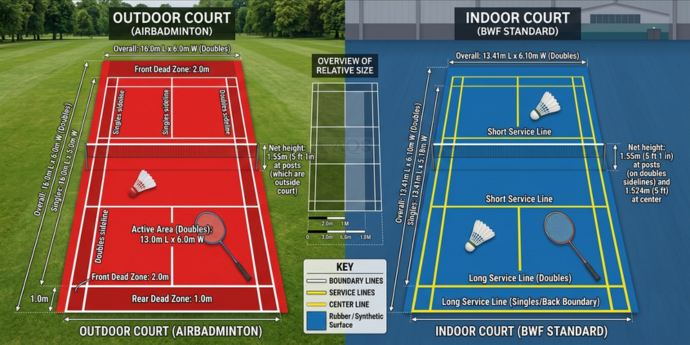
Outdoor badminton courts use the same fundamental badminton court size in meter – 13.4 m × 6.1 m – as their indoor counterparts. The net height and line specifications remain identical. However, outdoor courts present unique challenges that indoor venues eliminate: wind interference affects shuttle trajectory, rain can render surfaces slippery and lines illegible, and UV exposure degrades paint and net fibres faster.
For outdoor courts, the BAI 2026 guidance recommends polyurethane-sealed concrete or asphalt surfaces with anti-slip texture ratings of at least R9 (DIN 51130). Painted lines on outdoor surfaces must use two-coat weatherproof systems, with annual repainting cycles mandated for venues hosting district-level or higher competitions. Net posts for outdoor courts should be ground-anchored with a minimum 400 mm depth cement foundation to withstand wind loads of up to 60 km/h.
How Badminton Court Size Influences Shuttle Speed, Strategy, and Fitness
The relationship between court dimensions and game strategy is deeply fascinating. A court spanning 81.74 square metres sounds modest, yet professional players cover an average of 6–8 kilometres per match in singles, according to GPS tracking studies conducted during the 2024 India Open. The relatively compact length (13.4 m) rewards explosive lateral movement and tight net control rather than long baseline rallies seen in tennis.
Doubles players, using the wider 6.1 m court, must develop rotational positioning – “front-back” or “side-side” formations – to cover their expanded court efficiently. A 2025 coaching analytics report by BAI observed that doubles pairs with superior lateral footwork won 68% more rally points when exploiting tramline width compared to pairs using primarily central positioning. Understanding court geometry, therefore, is as much a tactical skill as it is an infrastructural requirement.
Conclusion
Understanding the badminton court size in meter is foundational knowledge for anyone connected to the sport from the grassroots club player in Jaipur to the professional architect designing India’s next Khelo India centre. Every measurement, from the 13.4 m court length to the 40 mm line width, exists for precise athletic and strategic reasons deeply embedded in the sport’s evolution and BWF governance.
India’s badminton infrastructure is experiencing its most significant expansion phase in history during 2025–2026, with hundreds of new courts being constructed under government schemes and private academy initiatives alike. Compliance with the official court dimensions ensures not only the safety and fairness of competition but also the long-term viability of these investments for future generations of players. Apply every measurement in this guide with the precision the sport demands and watch your facility or training environment deliver world-class performance outcomes.
Frequently Asked Questions
A standard doubles badminton court measures 13.4 metres long × 6.1 metres wide, covering a total area of 81.74 square metres as per BWF Law 1.
A singles badminton court is 5.18 metres wide, using the inner side lines and excluding the 0.46 m tramlines on each side.
The BAI 2026 guidelines require a minimum ceiling height of 9 metres for Tier-2 state competition venues and 12 metres for Tier-1 national centres.
The badminton net stands at exactly 1.524 metres (5 feet) at the centre of the court and 1.55 metres at the posts on the side boundary lines.
Yes – India’s BAI fully adopts BWF dimensions; the badminton court size in meter is identical for all sanctioned competitions in India and internationally.
The short service line is positioned 1.98 metres (approximately 6.5 feet) from the net on both sides of the court, applicable in both singles and doubles.