India’s badminton industry has witnessed explosive growth in 2026, driven by government initiatives like Khelo India, increasing sports literacy, and rising demand for professional-grade facilities across schools, housing societies, clubs, and academies. At the heart of every high-performance badminton court lies one critical decision – the choice of flooring. The right surface determines player safety, game quality, court longevity, and overall return on investment.
Selecting the right badminton court flooring manufacturer is not merely a procurement decision; it is a commitment to athlete safety, competitive performance, and long-term infrastructure value. Poor flooring leads to joint injuries, inconsistent shuttle bounce, slippery surfaces, and costly premature replacements. Conversely, premium flooring from a certified manufacturer transforms an ordinary facility into a world-class playing arena that athletes love and institutions take pride in.
This comprehensive guide covers everything you need to know about badminton court flooring in India – from material types and construction standards to costs, installation processes, and manufacturer comparisons. Most importantly, it introduces you to AQS (Advanced Quality Solutions), India’s No.1 badminton court flooring manufacturer in 2026, whose acrylic flooring systems set the benchmark for performance, durability, and value across the country.
“The floor is not just a surface – it is the silent coach, the first line of defence against injury, and the foundation of every champion’s game.”
Table of contents
- Why Badminton Court Flooring Matters More Than You Think
- Types of Badminton Court Flooring – A Complete Comparison
- India’s No.1 Badminton Court Flooring Manufacturer
- Synthetic Acrylic Flooring for Badminton Courts – Science & Structure
- BWF & BAI Standards for Badminton Court Flooring – 2026 Compliance Guide
- Badminton Court Flooring Cost in India
- Outdoor vs. Indoor Badminton Court Flooring – Expert Comparison 2026
- Badminton Court Flooring Industry
- Badminton Court Flooring Installation Process – Step-by-Step Guide
- Maintenance Best Practices for Acrylic Badminton Court Flooring
- Conclusion
- Frequently Asked Questions
Why Badminton Court Flooring Matters More Than You Think
Badminton is one of the world’s fastest racket sports, with shuttlecocks reaching speeds exceeding 300 km/h at professional levels. Players execute explosive lateral movements, sudden stops, high jumps, and deep lunges – all within milliseconds. The flooring surface absorbs, redirects, and supports every one of these movements, making it the single most critical physical element of any badminton court infrastructure.
Upgrade Your Sports Court Today
Get premium synthetic acrylic flooring designed for durability, grip, and performance.
Get Free ConsultationA substandard floor creates multiple problems simultaneously. Hard concrete without proper surface treatment causes severe knee and ankle injuries over time. Slippery surfaces increase fall risk dramatically. Uneven bounce patterns disrupt shuttle trajectory and compromise fair play. Faded or peeling court lines confuse players and referees alike. All these issues stem from one root cause – a poor-quality or incorrect flooring choice at the construction stage.
Modern acrylic badminton court flooring addresses every one of these concerns with engineered precision. It provides the ideal balance of grip and glide, superior shock absorption to protect joints, consistent surface texture for predictable shuttle response, and vibrant colour retention that lasts years under heavy use and harsh Indian weather conditions. Understanding the science behind flooring selection empowers facility owners, school administrators, sports academy managers, and contractors to make informed, long-term decisions.
Key Performance Parameters Every Badminton Floor Must Meet
| Performance Parameter | BWF Standard Requirement | AQS Acrylic Rating | Importance |
| Shock Absorption | ≥ 25% | 30–45% | Injury Prevention |
| Surface Friction (COF) | 0.4 – 0.6 | 0.45–0.58 | Traction & Grip |
| Ball/Shuttle Bounce | Consistent across surface | Uniform | Fair Play |
| UV Resistance | Required for outdoor | Class A UV Stable | Colour Longevity |
| Water Drainage | Rapid surface drainage | Micro-textured drainage | All-weather Use |
| Surface Flatness | ± 3mm/3m tolerance | ± 2mm/3m | Game Consistency |
| Lifespan | Minimum 5 years | 5–10 years | ROI |
Types of Badminton Court Flooring – A Complete Comparison
The Indian market in 2026 offers five primary types of badminton court flooring, each suited to specific use cases, budgets, and environments. Understanding the differences between these materials helps facility planners allocate resources wisely and avoid costly mistakes. From traditional wooden courts to modern synthetic systems, each option carries distinct advantages and limitations.
1. Synthetic Acrylic Flooring – The Gold Standard
Synthetic acrylic flooring dominates India’s badminton court construction landscape in 2026. Manufacturers like AQS use a multi-layer acrylic system applied over a concrete or asphalt base. The system typically includes a primer coat, acrylic resurfacer layers, cushion coats for shock absorption, colour coats with embedded silica sand for texture, and finally precise line-marking paint. This construction method delivers outstanding performance across all parameters – grip, durability, weather resistance, and visual appeal – at a cost that makes it accessible for schools, clubs, housing societies, and professional academies alike.
Transform Your Sports Facility Today!
Contact us for high-quality synthetic sports flooring material and elevate your space!
2. Wooden Maple Flooring – Indoor Professional Standard
Wooden maple flooring remains the preferred choice for elite indoor badminton facilities and international tournament venues. It delivers superior natural shock absorption, excellent foot comfort, and an aesthetically premium appearance. However, wooden courts require humidity-controlled indoor environments to prevent warping, cracking, and dimensional instability. Installation costs are significantly higher than acrylic systems, and maintenance demands are intensive. For most Indian clients – particularly those building outdoor courts or facilities without climate control – wooden flooring is impractical and economically inefficient.
3. PU (Polyurethane) and PVC Flooring – Indoor Recreational Use
PU and PVC flooring systems offer a soft, cushioned surface well-suited for school gymnasiums, fitness centres, and beginner-level recreational courts. These materials roll out as prefabricated sheets that are glued or clicked into place over existing subfloors, making installation fast and relatively inexpensive. However, PU/PVC surfaces do not perform well outdoors, degrade significantly under UV exposure, and lack the surface texture consistency required for competitive play. For professional training and tournament facilities, these materials fall short of BWF standards.
4. Rubber Flooring – Limited Badminton Application
Rubber flooring offers outstanding cushioning and is widely used in gymnasiums and weightlifting areas. Some outdoor courts use rubber tiles as a quick-installation solution. However, rubber surfaces tend to create excessive friction for badminton – a sport where controlled glide is essential for footwork patterns. Shuttle bounce consistency on rubber is also below standard compared to acrylic systems. Rubber remains a niche choice in badminton infrastructure, primarily used in multi-sport setups where badminton is a secondary activity.
5. Concrete with Acrylic Topcoat – Budget Outdoor Solution
Many budget outdoor badminton courts use a bare concrete base with a thin acrylic topcoat as the finished surface. While this approach reduces initial construction costs, it compromises shock absorption significantly, increasing player injury risk over time. A full multi-layer acrylic system from a reputable badminton court flooring manufacturer provides vastly superior performance compared to a single-coat application over plain concrete. The additional investment in a quality layered system pays dividends through reduced maintenance costs and extended court life.
| Flooring Type | Indoor | Outdoor | Cost Range | Lifespan | BWF Approved | Best For |
| Synthetic Acrylic Top Pick | ✔ | ✔ | ₹80–₹250/sq.ft | 5–10 years | ✔ | All facilities |
| Wooden Maple | ✔ | ✖ | ₹300–₹600/sq.ft | 15–25 years | ✔ | Pro indoor courts |
| PU/PVC Sheet | ✔ | ✖ | ₹60–₹150/sq.ft | 3–6 years | ✖ | Gyms, beginners |
| Rubber Tiles | ✔ | ✔ | ₹50–₹120/sq.ft | 4–8 years | ✖ | Multi-sport areas |
| Concrete + Acrylic | ✔ | ✔ | ₹40–₹80/sq.ft | 3–5 years | ✖ | Budget courts |
India’s No.1 Badminton Court Flooring Manufacturer
AQS (Advanced Quality Solutions) stands as India’s most trusted and technologically advanced badminton court flooring manufacturer in 2026. The company manufactures and supplies high-performance synthetic acrylic flooring systems specifically engineered for the Indian climate, competitive sports standards, and diverse facility requirements – from school playgrounds to elite national academies.
AQS delivers ITF-certified, ISO-compliant, and BWF-standard acrylic court flooring solutions backed by a pan-India dealer network, expert installation teams, and comprehensive after-sales support. The company has successfully completed projects across schools, universities, residential complexes, sports clubs, government sports facilities, and professional badminton academies throughout India.
Why AQS Leads the Indian Badminton Flooring Market
AQS earns its position as India’s number one badminton court flooring manufacturer through a combination of technical excellence, material quality, customer-first service, and deep understanding of the Indian sports market. The company’s research and development team continuously refines acrylic formulations to withstand India’s extreme climatic diversity – from the scorching 48°C summers of Rajasthan to the heavy monsoon humidity of Kerala and the coastal salt exposure of Mumbai and Chennai.
- ITF-Certified & ISO-Compliant: AQS flooring systems meet International Tennis Federation standards and ISO quality management benchmarks, ensuring every court delivers performance athletes and facility managers can trust.
- BWF-Standard Acrylic Surfaces: AQS manufactures courts to Badminton World Federation specifications, making facilities eligible for hosting sanctioned tournaments and official competitions.
- 5-Layer Acrylic System: The premium AQS system includes primer, resurfacer, cushion coats, colour coat with embedded silica, and professional line marking – engineering superior performance at every layer.
- Pan-India Dealer Network: AQS reaches facilities across all states through an extensive network of trained dealers and certified installation partners, ensuring consistent quality nationwide.
- All-Weather Outdoor Performance: AQS outdoor badminton court surfaces are UV-stable, moisture-resistant, and slip-resistant – engineered to perform flawlessly through Indian summers, monsoons, and winters.
- Customised Court Designs: AQS offers multi-colour court layouts, customised line markings for dual-sport use, logo integration, and branding options tailored to academies, schools, and clubs.
- Low Maintenance & High Durability: AQS courts require only periodic sweeping and washing, saving facility operators significant maintenance costs compared to wooden or PU alternatives.
AQS Product Range & Specifications (2026)
| Product | Application | Layers | Colour Options | Warranty | Certification |
| AQS Premium Acrylic System | Outdoor badminton courts | 5 layers | 9 standard colours | 4–7 years | ITF, ISO, BWF |
| AQS Indoor Acrylic System | Indoor courts | 5 layers | 9 standard colours | 4–7 years | ITF, ISO, BWF |
| AQS Multi-Sport Acrylic | Multipurpose courts | 5 layers | Dual-colour custom | 4–7 years | ITF, ISO |
| AQS Resurfacing System | Court renovation | 2–3 layers | All colours | 2–4 years | ISO |
Upgrade Your Sports Court Today
Get premium synthetic acrylic flooring designed for durability, grip, and performance.
Get Free ConsultationAQS Colour Range (2026): Royal Blue | Grass Green | Traffic Red | Grey | Light Blue | Dark Blue | Violet | Orange | Dark Green. Custom dual-tone and logo-embedded finishes available for branded court installations.
Synthetic Acrylic Flooring for Badminton Courts – Science & Structure
Synthetic acrylic flooring represents decades of sports surface engineering condensed into a precision-layered system. Understanding the construction of a quality acrylic badminton court surface demystifies the investment and clarifies why AQS’s multi-layer system outperforms cheaper single-coat alternatives by a significant margin.
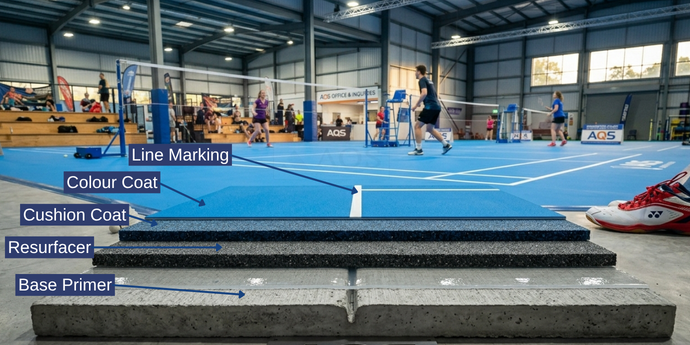
The 5-Layer AQS Acrylic Construction Process
AQS builds every badminton court floor using a rigorously sequenced five-layer application process on a prepared concrete or asphalt base. Each layer serves a specific functional purpose, and skipping or thinning any layer directly compromises overall court performance and lifespan.
| Layer | Material | Function | Thickness |
| Layer 1 – Base Primer | Acrylic Primer | Seals concrete base, improves adhesion | 0.1–0.2mm |
| Layer 2 – Resurfacer | Acrylic Resurfacer | Levels surface imperfections, fills cracks | 1–3mm |
| Layer 3 – Cushion Coat | Cushion + Rubber Granules | Shock absorption, joint protection | 2–4mm |
| Layer 4 – Colour Coat | Acrylic Paint + Silica Sand | Surface texture, traction, UV protection | 0.5–1mm |
| Layer 5 – Line Marking | White & Yellow Line Paint | Court boundaries, net line, service zones | 0.1–0.2mm |
The silica sand embedded in the colour coat layer is especially critical for badminton courts. It creates a micro-textured surface that provides optimal shoe-to-surface friction – enough grip to prevent slipping during explosive lateral movements, yet smooth enough to allow the controlled glide footwork that badminton technique demands. AQS calibrates its silica particle size specifically for badminton surface requirements, distinguishing its courts from tennis or badminton surfaces that use different friction profiles.
Acrylic Flooring Performance in Indian Climate Conditions
India’s diverse climate creates unique challenges for outdoor sports surfaces. UV radiation in northern plains regularly exceeds 1200 W/m² during summers. Monsoon rainfall in coastal regions delivers 2000–4000mm annually. Temperature swings between 5°C and 48°C create thermal expansion stress on surface materials. AQS acrylic systems are specifically formulated to handle all of these conditions simultaneously without cracking, peeling, fading, or losing surface friction characteristics.
The UV stabilisers incorporated into AQS acrylic colour coats prevent photodegradation – the primary cause of colour fading and surface brittleness in substandard outdoor court surfaces. Moisture-resistant primers prevent water infiltration that causes delamination and bubbling. Flexible acrylic binders accommodate thermal expansion and contraction without surface cracking. This climate-engineered approach explains why AQS outdoor courts consistently outperform imported products not designed for tropical conditions.
Case Study: Delhi Sports Academy – Acrylic Court Installation 2025
Client: A mid-sized sports academy in South Delhi with four existing concrete badminton courts requiring complete resurfacing and standardisation to BWF competitive standards.
Challenge: The existing plain concrete surfaces showed severe surface erosion, significant level variations, multiple large cracks, faded and partially invisible line markings, and a history of player ankle injuries attributed to surface harshness. The academy aimed to qualify for hosting state-level Badminton Association of India (BAI) tournaments within six months.
AQS Solution: AQS conducted a comprehensive site survey, crack-filled and levelled the base concrete, then applied the full 5-layer Premium Acrylic System across all four courts. Royal Blue colour coat with white line markings was chosen. The team completed all four courts within 14 working days, including curing time between layers, with zero disruption to the academy’s coaching schedule during the process.
Transform Your Sports Facility Today!
Contact us for high-quality synthetic sports flooring material and elevate your space!
BWF & BAI Standards for Badminton Court Flooring – 2026 Compliance Guide
Every regulated badminton court in India must conform to standards established by two governing bodies – the Badminton World Federation (BWF) at the international level, and the Badminton Association of India (BAI) at the national level. Facilities that aspire to host sanctioned tournaments, apply for Khelo India infrastructure grants, or attract serious competitive players must ensure their court flooring meets these specifications precisely.
| Court Specification | BWF Standard | BAI India Standard | AQS Compliance |
| Court Length | 13.4 metres | 13.4 metres | ✔ Exact |
| Width (Doubles) | 6.1 metres | 6.1 metres | ✔ Exact |
| Width (Singles) | 5.18 metres | 5.18 metres | ✔ Exact |
| Line Width | 40mm | 40mm | ✔ Exact |
| Net Height (Centre) | 1.524 metres | 1.524 metres | ✔ Guidelines |
| Short Service Line | 1.98m from net | 1.98m from net | ✔ Marked |
| Back Doubles Line | 0.76m from boundary | 0.76m from boundary | ✔ Marked |
| Surface Shock Absorption | ≥25% | ≥25% | ✔ 30–45% |
| Surface Friction | 0.4–0.6 COF | 0.4–0.6 COF | ✔ 0.45–0.58 |
| Indoor Ceiling Height | 9 metres minimum | 9 metres minimum | ✔ Advisory |
AQS builds every badminton court to precise BWF and BAI dimensional requirements, using calibrated line-marking tools and certified measurement protocols. This ensures that every court produced by AQS is ready for competitive play from day one, meeting all regulatory requirements for official tournament hosting.
Badminton Court Flooring Cost in India
Cost is invariably one of the first questions facility planners ask when evaluating badminton court construction. The total investment depends on multiple variables – court dimensions, number of courts, flooring system type, site preparation requirements, location, and whether the project involves new construction or resurfacing of an existing court.
| Project Type | Estimated Cost Range (2026) | Flooring System | Timeline |
| Single outdoor court (new) | ₹3 – ₹6 lakh | 5-layer acrylic | 10–14 days |
| Single indoor court (new) | ₹8 – ₹25 lakh | Acrylic or PU | 15–25 days |
| 4-court outdoor complex | ₹12 – ₹30 lakh | 5-layer acrylic | 20–30 days |
| Professional indoor hall (4 courts) | ₹40 – ₹1.5 crore | Wooden / Premium PU | 45–90 days |
| Court resurfacing (per court) | ₹1.5 – ₹4 lakh | 2–3 layer acrylic | 5–8 days |
| Multipurpose court (dual sport) | ₹4 – ₹10 lakh | 5-layer acrylic | 12–18 days |
AQS maintains a strong commitment to competitive pricing without compromising on material quality or installation standards. The company offers detailed cost quotations based on actual site surveys, ensuring clients receive accurate project estimates rather than misleading ballpark figures. AQS’s transparent pricing model, combined with premium material quality, makes it the most cost-effective premium badminton court flooring solution available in India in 2026.
Outdoor vs. Indoor Badminton Court Flooring – Expert Comparison 2026
The choice between outdoor and indoor badminton court flooring involves multiple technical, financial, and operational considerations. Both environments have specific requirements that directly influence material selection, system design, and long-term maintenance protocols. AQS provides engineered solutions for both environments, with product formulations specifically optimised for each application type.
Outdoor Badminton Court Flooring Priorities
Outdoor badminton courts in India face constant environmental challenges that indoor courts never encounter. UV radiation, monsoon rain, airborne dust, temperature extremes, and biological growth from algae and moss all attack outdoor surfaces continuously. AQS outdoor acrylic systems incorporate Class A UV stabilisers, hydrophobic surface treatments, anti-algae additives, and high-flexibility acrylic binders designed to withstand these conditions for 5–10 years without significant degradation in appearance or performance.
Indoor Badminton Court Flooring Priorities
Indoor courts prioritise consistent surface performance, controlled lighting interaction, acoustic comfort, and enhanced shock absorption since players typically train for longer durations with more intense repetitive movements on indoor surfaces. AQS indoor acrylic systems use thicker cushion coat layers and finer silica particle sizes for a more refined surface texture that delivers slightly higher shock absorption values appropriate for extended indoor training sessions and competitive tournament play.
Badminton Court Flooring Industry
Understanding how clients and players search for badminton court flooring services in India reveals important market trends. In 2026, the following organic keyword categories show high search volumes and strong commercial intent across Google India searches:
| Keyword Category | Example Search Terms | Search Intent | 2026 Trend |
| Manufacturer Searches | badminton court flooring manufacturer India, acrylic court manufacturer Delhi | Commercial | Rising |
| Material Searches | synthetic acrylic badminton flooring, BWF approved court surface India | Informational | Rising |
| Cost Searches | badminton court construction cost India 2026, court resurfacing price | Transactional | High |
| Standard Searches | BWF badminton court dimensions, BAI court specifications India | Informational | Stable |
| Contractor Searches | badminton court construction contractor near me, sports court builder India | Transactional | Rising |
| Comparison Searches | acrylic vs wooden badminton court, PU vs acrylic sports flooring India | Informational | Rising |
| Maintenance Searches | badminton court resurfacing India, court maintenance tips India | Mixed | Stable |
Badminton Court Flooring Installation Process – Step-by-Step Guide
Understanding the installation process helps facility owners evaluate contractors, set realistic timelines, and ensure quality oversight throughout the project. AQS follows a disciplined, multi-phase installation protocol that prioritises surface preparation, curing time compliance, and final quality verification before handover.
- Site Survey & Assessment: AQS engineers conduct a comprehensive site evaluation covering base surface condition, drainage profile, soil bearing capacity, level variations, existing crack mapping, and facility-specific requirements before finalising the project specification.
- Surface Preparation: The team cleans the base surface thoroughly, repairs all cracks and voids with appropriate fillers, grinds high spots, and ensures surface level tolerance meets ±3mm/3m requirement before any coating application begins.
- Primer Application: Acrylic primer coats seal the prepared base, prevent moisture vapour transmission from below, and establish strong mechanical adhesion for subsequent layers. Primer cures for 24 hours minimum before resurfacer application.
- Acrylic Resurfacer Layers: Multiple resurfacer applications build up a consistent, level base that eliminates remaining surface irregularities. Each layer cures fully before the next application, ensuring proper inter-coat adhesion.
- Cushion Coat Application: The rubber granule-enriched cushion coat provides the system’s shock absorption functionality. Thickness determines shock absorption values – AQS applies cushion coats to achieve client-specified performance targets.
- Colour Coat with Silica: The final colour coat – incorporating calibrated silica sand particles – establishes surface texture, traction characteristics, colour identity, and UV protection. Two colour coat applications ensure complete, even coverage.
- Professional Line Marking: Certified line-marking technicians apply BWF/BAI-standard court lines using precision templates, measuring every dimension to exact specification before, during, and after application.
- Final Quality Inspection: AQS quality managers conduct comprehensive post-installation inspection covering surface flatness, colour consistency, line accuracy, friction testing, and drainage verification before client handover.
Maintenance Best Practices for Acrylic Badminton Court Flooring
A well-maintained acrylic badminton court retains its performance characteristics, visual appeal, and safety standards for the full extent of its design lifespan. Proper maintenance protects the investment, reduces long-term costs, and keeps the facility operating at peak performance year-round. AQS recommends the following maintenance protocol for all acrylic court installations.
Daily Maintenance
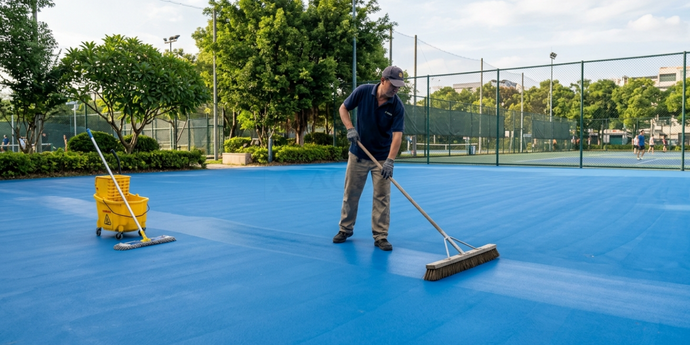
Sweep the court surface daily using a soft-bristle broom or mechanical sweeper to remove dust, leaves, and airborne debris that accumulate and create slip hazards when wet. Remove standing water immediately after rain using a squeegee to prevent algae growth and surface saturation. Conduct a quick visual inspection for any new cracks, surface lifting, or line damage and report immediately for early-stage repair.
Monthly Maintenance
Wash the court surface using mild pH-neutral detergent and clean water, applied with a soft brush or low-pressure washer. Avoid high-pressure washing which can dislodge silica particles from the colour coat surface. Inspect line markings for fading or chipping and arrange touch-up work promptly to maintain court compliance and visual clarity for players.
Annual Maintenance
Schedule a professional inspection by an AQS-certified technician annually. The inspection covers surface friction testing, crack assessment, drainage evaluation, and colour coat integrity analysis. Based on inspection findings, AQS technicians recommend targeted repairs, spot resurfacing, or full resurfacing schedules to maintain optimal performance and extend court lifespan effectively.
Pro Tip
Courts that receive routine annual professional maintenance consistently achieve the upper end of the 5–10 year lifespan range. Neglected courts typically require complete resurfacing within 3–4 years, effectively doubling long-term maintenance costs compared to properly maintained installations.
Conclusion
Selecting the right badminton court flooring manufacturer determines the long-term success, safety, and reputation of your sports facility. In India’s rapidly growing sports infrastructure market of 2026, AQS (Advanced Quality Solutions) stands uncontested as the No.1 manufacturer and installer of premium synthetic acrylic badminton court flooring systems. With BWF-standard certifications, a pan-India service network, climate-engineered material formulations, and an unwavering commitment to quality, AQS transforms every badminton court into a world-class playing surface that players, coaches, and facility administrators trust completely.
Frequently Asked Questions
AQS (Advanced Quality Solutions) is India’s No.1 badminton court flooring manufacturer in 2026, delivering ITF-certified, BWF-standard synthetic acrylic flooring systems across the country.
Synthetic acrylic flooring is the best material for badminton courts in India because it offers superior grip, UV resistance, all-weather durability, low maintenance, and BWF-compliant performance at a cost-effective price point.
A single outdoor badminton court with full 5-layer acrylic flooring costs approximately ₹3–₹6 lakh in India in 2026, depending on site conditions, location, and specific product specifications chosen.
AQS acrylic badminton court flooring lasts 5–10 years with basic routine maintenance before resurfacing is required, offering excellent long-term value for facility operators.
Yes, AQS provides complete badminton court flooring solutions including site survey, material supply, expert installation by certified teams, and comprehensive after-sales support across India.
A standard BWF badminton court measures 13.4m × 6.1m for doubles and 13.4m × 5.18m for singles, with 40mm line widths and a net height of 1.524m at the centre.