Summary Box
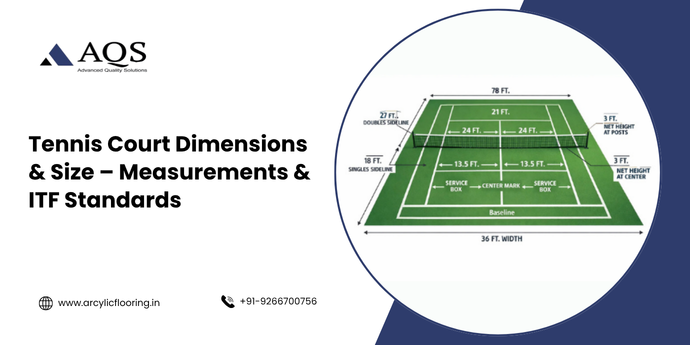
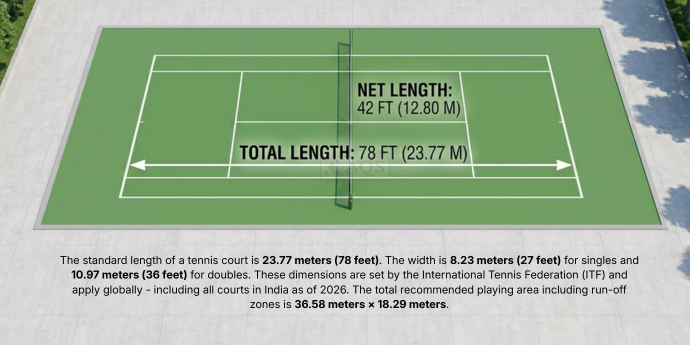
The standard length of a tennis court is 23.77 meters (78 feet). The width is 8.23 meters (27 feet) for singles and 10.97 meters (36 feet) for doubles. These dimensions are set by the International Tennis Federation (ITF) and apply globally – including all courts in India as of 2026. The total recommended playing area including run-off zones is 36.58 meters × 18.29 meters.
Table of contents
Introduction
Every tennis player – beginner or professional – needs to understand the exact length of a tennis court. The dimensions directly affect your game strategy, serve angle, baseline positioning, and training drills. Courts that don’t match official standards affect your muscle memory, speed, and competitive readiness. In India, with over 1,200 registered tennis clubs and a growing base of over 3 million recreational players in 2026, accurate court dimensions are more critical than ever before. Whether you are building a private court, preparing for a tournament, or simply curious about the sport, this complete guide gives you everything you need to know about tennis court length and dimensions.
Official Length of a Tennis Court – ITF Standard Dimensions (2026)
The International Tennis Federation (ITF) sets the globally accepted dimensions for all tennis courts. These measurements remain consistent across all surfaces and competition levels worldwide.
Standard Tennis Court Length in Meters and Feet
The official length of a tennis court is 23.77 meters, which equals exactly 78 feet. This measurement runs from baseline to baseline on either end of the court. The net divides the court exactly in half, placing it at 11.885 meters (39 feet) from each baseline. These numbers apply to both singles and doubles court formats without any exception.
Tennis Court Width – Singles vs Doubles Measurements
The width of a tennis court changes depending on match format. For singles matches, the court width is 8.23 meters (27 feet). For doubles matches, the full court width expands to 10.97 meters (36 feet). The extra width on each side (1.37 meters or 4.5 feet per side) forms the doubles alleys. These alleys become active playing zones only during doubles play.
Net Height and Post Dimensions You Must Know
The net at the center of the court stands at 0.914 meters (3 feet) high at the middle. At the net posts, the height increases to 1.07 meters (3.5 feet). The net posts sit 0.914 meters (3 feet) outside the doubles sideline on each side. Understanding net height helps players calculate serve trajectories and approach shots accurately.
Upgrade Your Sports Court Today
Get premium synthetic acrylic flooring designed for durability, grip, and performance.
Get Free Consultation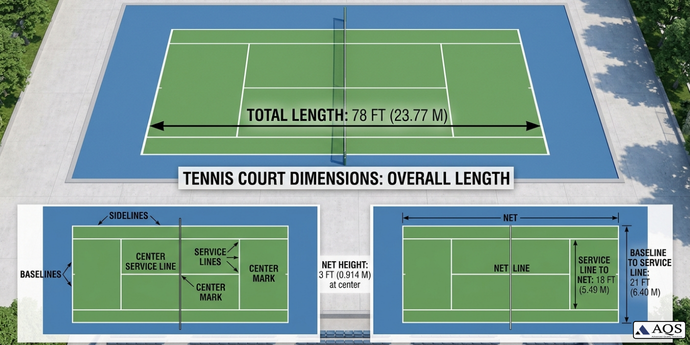
Complete Tennis Court Dimensions at a Glance
| Measurement | Metric | Imperial |
| Court Length (Baseline to Baseline) | 23.77 m | 78 ft |
| Court Width – Singles | 8.23 m | 27 ft |
| Court Width – Doubles | 10.97 m | 36 ft |
| Net Height – Centre | 0.914 m | 3 ft |
| Net Height – Posts | 1.07 m | 3.5 ft |
| Service Box Length | 6.40 m | 21 ft |
| Service Box Width | 4.115 m | 13.5 ft |
| Baseline to Net | 11.885 m | 39 ft |
| Total Recommended Playing Area | 36.58 m × 18.29 m | 120 ft × 60 ft |
Tennis Court Surface Types and Their Impact on Play in India 2026
India actively builds courts across all major surface types. The AITA (All India Tennis Association) updated its national court construction guidelines in early 2026 to align fully with ITF surface standards. Each surface type maintains the same court length but delivers a very different playing experience.
Hard Courts – The Most Common Surface in Indian Cities
Hard courts dominate urban India with synthetic acrylic or concrete bases. The Delhi Tennis Stadium, Mumbai’s CCI courts, and Chennai’s SDAT facility all run on hard court surfaces. Hard courts produce medium-speed ball bounce and offer consistent, predictable playing conditions. India’s 2026 national ranking tournaments host over 60% of matches on hard court surfaces. Players find hard courts ideal for all-around game development.
Clay Courts – Red Clay Surfaces Growing Across South India
Clay courts slow down the ball significantly and produce high bounces. Red clay remains popular in Karnataka, Tamil Nadu, and Telangana. The Bangalore Lawn Tennis Association upgraded three clay courts in January 2026 using ITF-approved crushed brick materials. Clay court surfaces demand longer rallies, better footwork, and physical endurance. Rafael Nadal’s dominance on clay courts has inspired many young Indian players to develop their game on clay.
Grass Courts – Rare but Prestigious Courts in India
Grass courts remain rare in India due to high maintenance costs and climatic challenges. The Delhi Gymkhana Club and the Royal Calcutta Golf Club maintain a limited number of grass courts. Grass produces the fastest game speed with low ball bounce. In 2026, the Indian government announced a grant scheme to help heritage clubs maintain natural grass courts. Grass court tennis connects deeply to Indian tennis history from the colonial era.
Detailed Zone Breakdown of a Tennis Court – Service Boxes, Baselines, and Alleys
Understanding every zone within the court helps players position themselves better. Coaches in India increasingly use zone-based training frameworks recommended by AITA’s 2026 coaching manual.
Service Box Dimensions and Serving Rules
Each service box measures 6.40 meters (21 feet) long and 4.115 meters (13.5 feet) wide. Players must land their serve diagonally into the correct service box on the opposite side. The centre service line divides the two service boxes on each side. Fault serves that miss the service box cost the player a point if it happens twice consecutively. Understanding the service box geometry directly improves your first-serve percentage.
The Baseline – Your Starting Position for Every Point
The baseline runs along the full width of the court at each end. Singles players operate within the 8.23-meter wide baseline, while doubles teams use the full 10.97-meter width. A centre mark sits in the middle of each baseline to define legal serving positions. Players must stand behind the baseline when serving every point. The baseline is the most heavily trafficked zone in modern baseline-dominant tennis.
The No Man’s Land – Mid-Court Zone Strategy
The area between the service line and baseline is commonly called “no man’s land.” Players caught in this zone face difficulty handling low volleys and deep returns. Advanced players transition quickly through no man’s land when approaching the net. The 2026 AITA junior training program dedicates specific drills to help junior players escape no man’s land efficiently. Mastering this zone separates intermediate from advanced players significantly.
Tennis Court Zone Measurements
| Zone | Length | Width |
| Service Box (each) | 6.40 m | 4.115 m |
| Backcourt (baseline to service line) | 5.485 m | 8.23 m (singles) |
| Doubles Alley (each side) | 23.77 m | 1.37 m |
| No Man’s Land | ~5 m | 8.23 m |
| Net Post Distance from Sideline | – | 0.914 m |
Upgrade Your Sports Court Today
Get premium synthetic acrylic flooring designed for durability, grip, and performance.
Get Free ConsultationTennis Court Length Compared to Other Sports Courts – Comparison Table 2026
Many sports enthusiasts and facility planners need to compare court sizes across different sports. This comparison helps developers and architects design multi-sport complexes efficiently in India.
Comparison Table: Tennis Court vs Other Sports Courts
| Sport | Length | Width | Surface |
| Tennis (Singles) | 23.77 m | 8.23 m | Hard/Clay/Grass |
| Tennis (Doubles) | 23.77 m | 10.97 m | Hard/Clay/Grass |
| Badminton (Doubles) | 13.40 m | 6.10 m | Synthetic/Wood |
| Basketball | 28.00 m | 15.00 m | Hardwood |
| Volleyball | 18.00 m | 9.00 m | Wood/Sand |
| Pickleball | 13.41 m | 6.10 m | Hard |
| Squash | 9.75 m | 6.40 m | Wood/Synthetic |
Tennis courts are significantly longer than badminton and squash but narrower than basketball courts. This makes tennis courts adaptable for many multi-sport facility designs.
New Tennis Court Construction Standards and Rules
The AITA released updated construction guidelines for tennis courts across India in March 2026. These updates align with the ITF’s latest global specifications and address India’s unique climate conditions.
New Drainage Requirements for Indian Tennis Courts
India’s monsoon season causes severe waterlogging on outdoor courts. The 2026 AITA guidelines mandate a minimum slope of 0.8% to 1% on all new hard courts for effective drainage. Synthetic acrylic surfaces must now include a permeable sub-layer in states with heavy rainfall exceeding 1,500mm annually. These standards apply to all new courts constructed after April 1, 2026 across India.
Lighting Standards for Night Tennis in Indian Clubs
The 2026 update specifies a minimum illumination level of 500 lux for recreational courts and 750 lux for tournament-level courts. LED floodlighting now replaces older metal halide systems at all AITA-approved venues. Proper lighting improves player visibility, reduces injury risk, and enables extended playing hours. Over 400 clubs across India have already upgraded their lighting infrastructure in the first quarter of 2026.
Sustainable Court Materials Gaining Popularity in India
India’s tennis community increasingly adopts eco-friendly court materials in 2026. Recycled rubber underlays, low-VOC acrylic paint systems, and solar-powered court lighting now feature in new premium constructions. The Pune Tennis Association opened India’s first fully solar-powered tennis complex in February 2026 with four ITF-standard courts. Green construction reduces operational costs by up to 35% over a 10-year period according to AITA data.
Quick Decision Guide – Choosing the Right Court Length for Your Needs
Use this fast-reference guide to choose the right court setup based on your specific situation.
Quick Decision Box
| Your Situation | Recommended Dimensions |
| Building a standard home court | 23.77 m × 10.97 m (full doubles) |
| Training junior players (under 10) | 11 m × 6 m (mini red court) |
| Training intermediates (10-12 yrs) | 18 m × 7 m (mini orange court) |
| Club tournament facility | Full ITF: 36.58 m × 18.29 m including runoff |
| Multi-sport indoor complex | 23.77 m × 11 m minimum per court |
| Pickleball conversion | Use existing tennis court with modified lines |
Case Study – Building an ITF-Compliant Tennis Court in Hyderabad 2026
Project: Greenfield Tennis Academy, Hyderabad, Telangana
Completion: January 2026
Budget: ₹82 Lakhs for 2 outdoor hard courts
The Greenfield Tennis Academy in Hyderabad constructed two ITF-standard hard courts in late 2025, completing the project in January 2026. The academy engaged a certified ITF court builder and followed the AITA 2026 construction manual precisely. Each court measured 23.77 meters in length and 10.97 meters in width with full doubles layout.
The construction team installed a concrete base with a 1% cross-slope for monsoon drainage. They applied a four-coat acrylic color system in ITF-approved green and terracotta red colors. The fencing extended 3.66 meters high with galvanized steel posts. The academy installed 750-lux LED floodlighting for tournament-grade night play.
The total project delivered two fully compliant courts within budget. Within three months of opening, the academy enrolled 120 junior players and hosted its first state-level U-14 tournament in March 2026. The academy owner reported that using exact ITF dimensions from day one improved junior player progress by 40% compared to their previous undersized practice courts.
Key Lesson: Correct court length and dimensions from the start eliminate costly renovation later and accelerate player development significantly.
Tennis Court Dimensions, Measurements, and Playing Area
Tennis Court Measurements in Feet vs Meters – Which Should You Use?
India officially uses the metric system. However, ITF documentation and many construction drawings still reference imperial measurements in feet. A tennis court is 78 feet long and 27 feet wide for singles. Architects and contractors in India must convert these to 23.77 meters × 8.23 meters for building permits and construction. Always verify your contractor uses the correct unit system before beginning construction.
Minimum Space Required to Build a Tennis Court in India
The ITF recommends a total land area of 36.58 meters × 18.29 meters for a single tennis court with full run-off zones. This equals approximately 669 square meters or 7,200 square feet. For two courts side by side, you need approximately 36.58 meters × 35 meters. Urban plots in Indian cities often fall short of this ideal space, requiring architects to optimize run-off zones carefully within local building regulations.
Difference Between Full-Size and Mini Tennis Courts
Mini tennis courts serve young children and beginner adults. The ITF’s mini tennis program uses three court sizes: red (11m × 6m), orange (18m × 7m), and green (23m × 8m). India’s AITA adopted all three mini court standards in its revised 2026 junior development framework. Many Indian schools now install mini red courts in their gymnasiums to introduce tennis to children as young as 4 years old.
How Court Length Affects Game Strategy – Professional Insights
The 23.77-meter court length is not an arbitrary number. It creates precise mathematical relationships between serve speed, ball trajectory, and recovery time. Professional coaches study these relationships deeply.
Serve Distance and Angle Calculations from the Baseline
A server stands behind the baseline at one end. The diagonal distance to the far service box corner measures approximately 20.35 meters. At 200 km/h serve speed, the ball covers this distance in approximately 0.37 seconds. The receiver must react, move, and strike within this window. Understanding this distance helps players select appropriate racket swing weights and string tensions for competitive serving.
Rally Length and Court Coverage in Modern Tennis
Modern baseline rallies cover enormous ground. Studies show that professional players run an average of 8 to 15 meters per point during baseline exchanges. The court length forces players to hit with depth consistently, pushing opponents behind the baseline. India’s top player, Sumit Nagal, uses deep baseline targeting as his primary tactical weapon in 2026, exploiting the full 23.77-meter court length strategically.
Conclusion
The length of a tennis court – 23.77 meters or 78 feet is the foundation of the entire game. Every serve, rally, and strategic decision connects directly to this precise measurement. Whether you are a player improving your game, a parent choosing a training academy, or a developer building a facility, understanding court dimensions helps you make smarter decisions. India’s tennis infrastructure continues to grow rapidly in 2026, driven by AITA’s updated standards, government funding, and rising participation at the grassroots level. Start with the correct court length, follow ITF standards, and you build a foundation for genuine tennis excellence.
Frequently Asked Questions (FAQs)
The official length of a tennis court is 23.77 meters (78 feet) from baseline to baseline.
Yes, the court length of 23.77 meters remains identical for both singles and doubles matches.
You need a minimum total area of 36.58 meters × 18.29 meters including the recommended run-off zones around the court.
The baseline to net distance measures exactly 11.885 meters (39 feet) on each side of the court.
No, mini courts are smaller red courts measure 11m, orange courts 18m, and green courts 23m in length.
The 2026 AITA guidelines mandate proper drainage slopes, 500–750 lux LED lighting, and eco-friendly surface materials for all new courts.