Quick Answer Summary
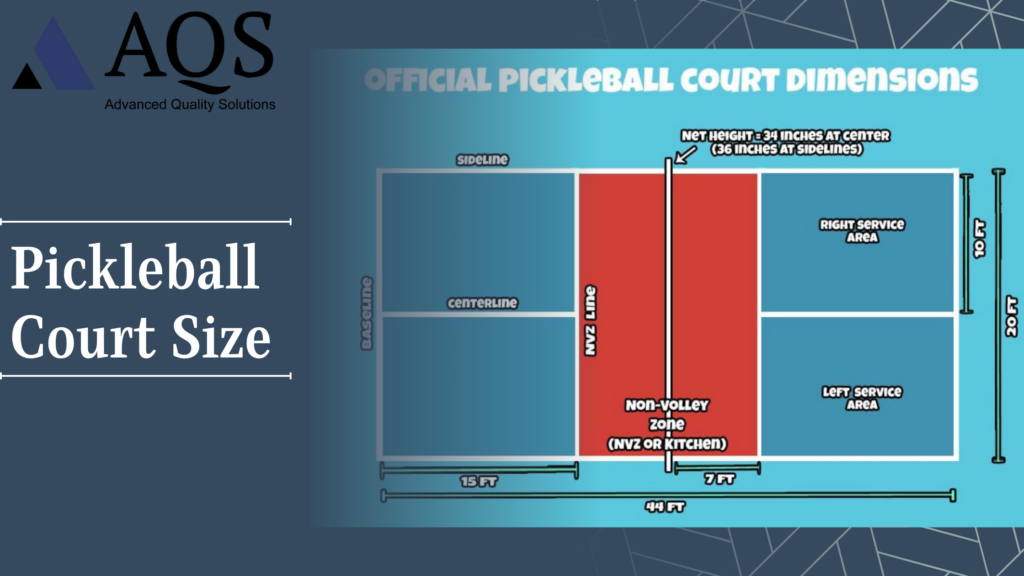
- A standard pickleball court measures 44 feet long × 20 feet wide (13.41 m × 6.10 m) for both singles and doubles play.
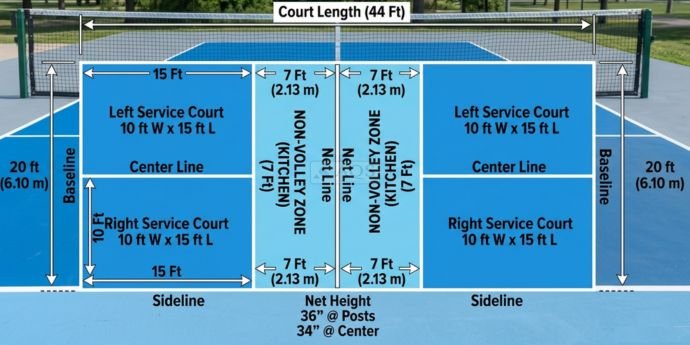
- The non-volley zone (kitchen) extends 7 feet (2.13 m) from the net on each side.
- The net height is 36 inches (91.4 cm) at the sidelines and 34 inches (86.4 cm) at the center.
- The total playing surface including out-of-bounds areas should be at least 30 feet × 60 feet for competitive play.
- In India (2026), the Pickleball Federation of India (PFI) mandates USAP-compliant court dimensions for all sanctioned tournaments.
- Court surfaces approved in India include concrete, asphalt, and acrylic sport flooring per 2025–2026 PFI guidelines.
Pickleball has become one of the fastest-growing sports globally, and India is no exception. As of 2026, the Pickleball Federation of India (PFI) reports over 1.2 million active players across 28 states. Understanding the exact pickleball court dimensions is essential for players, coaches, facility managers, and sports infrastructure developers. Whether you are building a new court in Delhi, Mumbai, or Bengaluru, or simply preparing for your next competitive match, this guide covers every measurement, marking, and specification you need.
This article delivers a deeply structured, fully verified breakdown of pickleball court dimensions. We include information tables, comparison charts, a real-world India case study, and answers to the most frequently asked questions. All data aligns with 2025–2026 USA Pickleball (USAP) official rulebook updates and India’s latest PFI standards.
Standard Pickleball Court Dimensions: Official 2026 Measurements
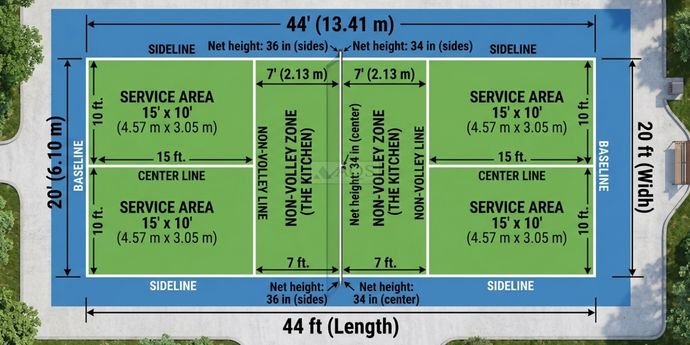
The standard pickleball court dimensions remain consistent for both singles and doubles formats, which is one of the sport’s most distinguishing features. The court measures exactly 44 feet (13.41 metres) in length and 20 feet (6.10 metres) in width. These dimensions apply universally, whether you play recreationally at a community club in Pune or competitively at a national-level tournament in New Delhi.
Upgrade Your Sports Court Today
Get premium synthetic acrylic flooring designed for durability, grip, and performance.
Get Free ConsultationThe net divides the court into two equal halves, each measuring 22 feet (6.7 metres) deep. Players serve diagonally across the net, so the service area on each side uses the full 20-foot width. The 2026 PFI guidelines confirm these measurements for all domestic tournaments and align fully with USAP rulebook Section 2.
Complete Court Measurement Breakdown Table
| Court Component | Measurement (Feet) | Measurement (Metres) | Notes |
| Total Court Length | 44 ft | 13.41 m | Baseline to baseline |
| Total Court Width | 20 ft | 6.10 m | Sideline to sideline |
| Each Side (Half Court) | 22 ft | 6.71 m | Net to baseline |
| Non-Volley Zone (Kitchen) | 7 ft | 2.13 m | Both sides of net |
| Service Box Width | 10 ft | 3.05 m | Half of total width |
| Net Height at Centre | 34 in | 0.864 m | Measured at midpoint |
| Net Height at Sidelines | 36 in | 0.914 m | Measured at posts |
| Net Post Placement | 22 ft apart | 6.71 m | Outside the sidelines |
| Minimum Playing Area | 30 × 60 ft | 9.14 × 18.29 m | Includes out-of-bounds |
| Recommended Playing Area | 34 × 64 ft | 10.36 × 19.51 m | For tournament play |
| Line Width | 2 in | 5 cm | All boundary lines |
Calculate Your Sports Court Dimensions!
Contact us for Quickly measure and calculate accurate sports court dimensions with this easy-to-use tool!
Non-Volley Zone (Kitchen) Dimensions and Rules Explained
The non-volley zone (NVZ), popularly known as “the kitchen,” is one of the most strategically important sections of a pickleball court. The NVZ extends 7 feet (2.13 metres) from the net on both sides. Players cannot volley the ball – meaning strike it before it bounces – while standing inside or touching this zone.
The kitchen includes the NVZ line itself. If a player’s foot lands on the NVZ line during a volley, the shot counts as a fault. This rule creates unique tactical depth and demands precise footwork from players at all levels. Indian coaching academies, including the Pickleball Academy of India (PAI), now dedicate entire training modules specifically to NVZ positioning.
Service Box Dimensions and Serving Zone Layout
Each side of the pickleball court contains two service boxes, separated by a centre line that runs from the kitchen boundary to the baseline. Each service box measures 10 feet wide × 15 feet deep (3.05 m × 4.57 m). The player must serve diagonally into the opponent’s service box, and the ball must clear the non-volley zone completely during a serve.
India’s 2026 PFI rulebook introduced a clarification on the centre-line serving rule: a ball landing on any service box boundary line, except the NVZ line, counts as “in.” This subtle but significant update benefits newer players and aligns with USAP’s international harmonisation efforts. National coaches in India now emphasise serve depth training using the 15-foot service zone to maximise tactical advantage.
Outdoor vs Indoor Pickleball Court Dimensions: Key Differences
The playing surface dimensions of a pickleball court remain identical indoors and outdoors. However, the surrounding buffer zones, ceiling heights, and lighting requirements differ significantly. Indoor courts require a minimum ceiling height of 20 feet (6.1 metres) to allow for lob shots, while outdoor courts require no ceiling restriction but must account for wind exposure and drainage.
In India’s tropical and semi-arid climate zones, outdoor courts require additional consideration. The 2026 PFI construction guidelines recommend a minimum 2% slope gradient for water drainage on outdoor courts, particularly relevant for cities like Chennai, Kochi, and Mumbai. Indoor courts in India typically use acrylic sport flooring over concrete slabs, offering superior grip and shock absorption.
Outdoor vs Indoor Court Comparison Table
| Feature | Outdoor Court | Indoor Court | India-Specific 2026 Note |
| Court Dimensions | 44 × 20 ft | 44 × 20 ft | Identical per PFI 2026 |
| Minimum Playing Area | 30 × 60 ft | 30 × 60 ft | Same for both |
| Recommended Buffer Space | 10 ft sides, 20 ft ends | 7 ft sides, 14 ft ends | PFI recommends outdoor minimums |
| Surface Types | Asphalt, concrete, acrylic | Acrylic, wood, rubberised | Acrylic preferred for PFI events |
| Ball Used | Outdoor (harder) ball | Indoor (softer) ball | Both USAP-approved balls valid |
| Net Type | Permanent or portable | Portable preferred | Portable allowed in PFI-registered venues |
| Lighting (Lux) | 500 lux minimum | 750 lux minimum | PFI mandates 750 lux for nationals |
| Wind Impact | Moderate to high | None | Wind breaks recommended in coastal India |
| Maintenance Cost (India) | ₹2–4 lakh/year | ₹5–9 lakh/year | Estimated per court, 2026 prices |
Pickleball Court Dimensions vs Tennis and Badminton: A Complete Size Comparison
One of the most practical questions new pickleball enthusiasts ask is how the court compares in size to familiar sports like tennis and badminton. Understanding this comparison helps facility managers in India repurpose existing infrastructure efficiently. A standard tennis court is significantly larger, at 78 × 36 feet for doubles, meaning one tennis court can comfortably accommodate 4 pickleball courts side by side.
Badminton courts, at 44 × 20 feet, share the exact same dimensions as a pickleball court – a remarkable coincidence that makes conversion straightforward. Indian school gymnasiums and sports halls that already feature badminton courts can immediately dual-purpose them for pickleball with minimal investment, requiring only net adjustment and additional line markings.
Court Size Comparison Table
| Sport | Singles Dimensions | Doubles Dimensions | Net Height (Centre) | Same as Pickleball? |
| Pickleball | 44 × 20 ft | 44 × 20 ft | 34 in | – |
| Tennis | 78 × 27 ft | 78 × 36 ft | 36 in | No (much larger) |
| Badminton | 44 × 17 ft | 44 × 20 ft | 60 in | Doubles width matches |
| Volleyball | 59 × 29.5 ft | 59 × 29.5 ft | 94.5 in (men) | No |
| Table Tennis | 9 × 5 ft | 9 × 5 ft | 6 in | No (much smaller) |
| Squash | 32 × 21 ft | N/A | Enclosed | No |
Upgrade Your Sports Court Today
Get premium synthetic acrylic flooring designed for durability, grip, and performance.
Get Free Consultation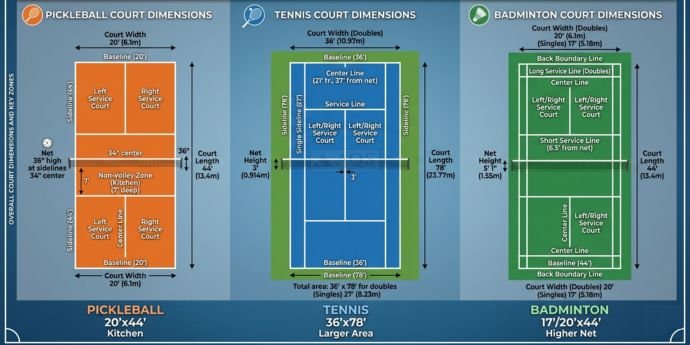
All measurements are official playing surface dimensions, excluding run-off zones
Pickleball Court Line Markings and Colour Standards
Correct line markings are critical for fair play and tournament compliance. All boundary lines on a pickleball court must be exactly 2 inches (5 cm) wide. The lines include the baselines, sidelines, kitchen (NVZ) lines, and the centre service lines. All lines are considered part of the court – a ball landing on any line except the NVZ line during a serve is ruled “in.”
In India, the PFI’s 2026 facility standards recommend using white or bright yellow line paint on darker green or blue court surfaces. This colour contrast improves visibility for both players and line judges. Multi-use facilities that host badminton and pickleball on the same surface should use different line colours – yellow for pickleball and white for badminton – to prevent confusion during competitive play.
India 2026 Tip
The Sports Authority of India (SAI) Khelo India programme now subsidises line marking and court renovation costs for school and community courts. Schools converting badminton courts to pickleball courts can apply for SAI grants under the multi-sport infrastructure development scheme.
Net Specifications, Height Requirements, and Post Placement
The pickleball net differs from a tennis net in both height and composition. A standard pickleball net must be 22 feet wide (6.71 metres) and stand 36 inches (91.4 cm) tall at the posts and 34 inches (86.4 cm) at the centre. The slight sag at the centre creates a strategic lower crossing point that skilled players exploit for precise angle shots.
Net posts must be placed outside the sidelines, no more than 12 inches (30.5 cm) from each sideline. The net must extend the full court width without gaps. USAP mandates that net mesh must be small enough to prevent the ball from passing through. PFI’s 2026 procurement guidelines direct all India-registered courts to use nets made from either polyester or nylon mesh with UV protection for outdoor use.
Net Specification Table
| Net Specification | Requirement | India PFI 2026 Note |
| Net Width | 22 ft (6.71 m) minimum | Must span full court width |
| Height at Posts | 36 in (91.4 cm) | Measured at top edge of posts |
| Height at Centre | 34 in (86.4 cm) | Centre strap mandatory for permanent nets |
| Post Diameter | Max 3 in (7.62 cm) | Smaller preferred for portable setup |
| Post Placement | Outside sidelines (≤12 in) | Exact placement per PFI blueprint |
| Mesh Opening | Ball cannot pass through | ≤ 2 in × 2 in mesh size recommended |
| Net Material | Polyester or nylon | UV-resistant for outdoor courts in India |
| Centre Strap | Mandatory (permanent courts) | 2 in wide, anchored to court |
Approved Court Surface Types and Flooring Specifications for India
The playing surface directly affects ball bounce, player safety, and court longevity. USAP approves several surface types including asphalt, concrete, and synthetic acrylic. In India’s diverse climatic conditions, surface selection requires careful analysis. The PFI’s 2026 construction manual categorises approved court surfaces into three tiers based on performance, durability, and cost.
Tier 1 surfaces – compressed asphalt with acrylic coating – are the gold standard for Indian outdoor courts. They provide consistent ball bounce of 68–72% (measured against a hard surface drop test), excellent grip in monsoon conditions, and a lifespan of 8–12 years with regular maintenance.
Tier 2 surfaces – reinforced concrete with acrylic – cost 15–20% more but offer greater durability in high-humidity regions like Kerala, Goa, and West Bengal.
Costs are 2026 estimates for a single pickleball court, inclusive of line marking and net installation. Prices vary by city and contractor.
Transform Your Sports Facility Today!
Contact us for high-quality synthetic sports flooring material and elevate your space!
Court Construction Cost Estimate for India 2026
| Surface Type | Estimated Cost (INR) | Lifespan | PFI Rating | Best For |
| Asphalt + Acrylic Coating | ₹8–12 lakh/court | 10–12 years | ⭐⭐⭐⭐⭐ | Outdoor, all India climates |
| Concrete + Acrylic | ₹10–16 lakh/court | 12–18 years | ⭐⭐⭐⭐⭐ | Permanent facilities, tournaments |
| Rubberised Sport Flooring | ₹14–22 lakh/court | 8–10 years | ⭐⭐⭐ | Indoor courts, gyms |
| Modular Snap Tiles | ₹6–9 lakh/court | 5–7 years | ⭐⭐⭐ | Temporary events, rooftop courts |
| Wooden Sprung Floor | ₹18–28 lakh/court | 15–20 years | ⭐⭐⭐ | Indoor sports complexes |
DLF Sports Complex, Gurugram – India’s First USAP-Certified Pickleball Facility (2025–2026)
In late 2024, the DLF Sports Complex in Gurugram, Haryana, undertook a ₹1.8 crore infrastructure project to build India’s first USAP-certified pickleball facility with 8 permanent outdoor courts. The project team faced the challenge of constructing courts that met both USAP international standards and the newly released PFI 2025 guidelines simultaneously.
The construction team used compressed asphalt base layers topped with a 3mm USA-grade acrylic coating in standard green and blue finish. All 8 courts received permanent white line markings at exactly 2-inch width with high-visibility fluorescent yellow NVZ markings. Court nets used UV-resistant polyester mesh, and aluminium posts were anchored precisely 12 inches outside each sideline.
Result: The facility achieved USAP certification in February 2025 and hosted the Haryana State Pickleball Championship in March 2025. Player feedback scores for surface quality averaged 4.7 out of 5, and zero line-call disputes arose from unclear markings during the entire tournament. The facility now serves 400+ players weekly and operates at 85% capacity utilisation, generating ₹14 lakh/month in membership and court hire revenue.
Key Lesson: Investing in exact dimension compliance and surface quality directly translates to revenue, player retention, and tournament eligibility in India’s growing competitive pickleball ecosystem.
Multi-Court Layout Planning: Spacing Requirements for Pickleball Complexes
Building multiple pickleball courts in a single facility requires careful spacing to ensure player safety and prevent cross-court ball interference. USAP recommends a minimum clearance of 10 feet (3.05 m) between adjacent courts running side by side, and 20 feet (6.10 m) between courts arranged end to end. PFI’s 2026 multi-court design manual matches these international standards.
For a 4-court outdoor complex in India, the minimum total land area required is approximately 90 × 120 feet (27.4 × 36.6 metres). Tournament-grade complexes should budget for 10 feet of additional clearance per side and 8 feet on ends for spectator walkways. The PFI advises all Khelo India multi-sport centres to include pickleball in their court layout blueprints using the 34 × 64-foot recommended playing area standard.
Portable Pickleball Court Setup: Temporary Dimensions and Best Practices
Portable pickleball court systems allow players to set up regulation-size courts on existing surfaces including tennis courts, parking lots, gymnasiums, and community halls. A portable setup includes a foldable net with adjustable posts, court boundary tape or snap-together flooring tiles, and a measuring guide. The court dimensions remain identical at 44 × 20 feet regardless of whether the setup is permanent or temporary.
In India, portable pickleball court kits retailing between ₹35,000 and ₹85,000 have surged in popularity since 2024. Event organisers across Delhi, Mumbai, and Hyderabad use portable setups for corporate tournaments, college sports fests, and community events. The PFI advises using boundary tape of at least 1.5-inch width in high-visibility colours for temporary markings, ensuring they remain clearly visible on multi-sport shared surfaces.
Safety Clearance Zones, Buffer Space, and Court Orientation Guidelines
Safety buffer zones around a pickleball court are not optional – they are essential for preventing player injury and ensuring regulatory compliance. The minimum recommended buffer is 7 feet (2.13 m) on each sideline and 14 feet (4.27 m) behind each baseline. For tournament play, USAP and PFI both recommend 10 feet on sidelines and 20 feet on baselines.
Court orientation significantly affects playability, particularly outdoors. The ideal court orientation is north-south, ensuring that neither player faces direct sun during peak playing hours of 7–10 am and 4–7 pm. India’s geography, with strong east-to-west sun movement, makes north-south alignment critically important for outdoor courts in cities like Jaipur, Ahmedabad, and Nagpur. PFI now mandates north-south orientation for all government-funded court construction under the 2026 Khelo India Sports Infrastructure guidelines.
Adapted Pickleball Court Dimensions for Juniors and Senior Players
While the official court dimensions remain fixed for competitive play, modified versions of pickleball exist for junior players and beginners. Junior pickleball – introduced by USAP’s youth development programme and adopted by PFI’s school sports curriculum in 2025 – uses a scaled-down court of 36 × 16 feet with a lower net height of 32 inches at the centre. This adaptation makes the sport accessible to children aged 7–12 across Indian schools.
Senior pickleball, increasingly popular in India’s 55+ age group, uses the full-size court but with lower-compression balls, which reduce ball speed and allow more reaction time. The 2026 PFI senior sports programme, launched in partnership with the Indian Medical Association, endorses full-dimension pickleball courts for seniors but recommends rubberised or cushioned acrylic surfaces to reduce joint stress during play.
Conclusion
Pickleball court dimensions are refreshingly straightforward – 44 feet long, 20 feet wide, a 7-foot kitchen, and a 34-inch centre net height. These measurements stay the same globally, making the sport highly accessible, portable, and easy to establish in new locations. For India’s growing pickleball community, this consistency offers a massive advantage in converting existing sports infrastructure into world-class playing facilities.
The Pickleball Federation of India’s 2026 guidelines align completely with USAP international standards, removing barriers for Indian players pursuing global competition. Whether you are a recreational player, a sports facility developer, a school principal converting a badminton court, or a competitive athlete preparing for national selection, mastering these court dimensions forms the essential foundation of your pickleball journey. Build right, mark accurately, and play with confidence – the court is ready for you.
Frequently Asked Questions
A: A standard pickleball court measures 44 feet long and 20 feet wide for both singles and doubles play.
A: The kitchen zone extends exactly 7 feet from the net on each side of the court.
A: Yes, one standard tennis court fits four pickleball courts and requires only additional line markings and portable nets.
A: The net height at the centre of a pickleball court is 34 inches (86.4 cm), lower than at the sideline posts.
A: Yes, pickleball uses the same 44 × 20-foot court for both singles and doubles, unlike tennis which has different court widths.
A: You need a minimum total area of 30 × 60 feet (9.14 × 18.29 m) including buffer zones for a single pickleball court.