Tennis courts follow strict international guidelines – yet most players and facility planners remain unaware of the precise numbers that govern every match. Whether you plan to build a court in your Delhi housing society, coach aspiring juniors in Bengaluru, or simply satisfy your curiosity before a weekend game, understanding tennis court size dimensions gives you an indisputable edge. This authoritative, fully updated 2026 guide walks you through every measurement, standard, surface type, and India-specific regulation you need to know.
We have sourced data from the International Tennis Federation (ITF), the All India Tennis Association (AITA), the Sports Authority of India (SAI), and ground-level facility reports from Mumbai, Delhi, and Hyderabad.
Table of contents
- What Are the Official Tennis Court Size Dimensions? ITF 2026
- Tennis Court Clearance Zone & Total Area Requirements
- Tennis Court Surface Types & Dimensions Comparison India 2026
- Junior Tennis Court Dimensions: ITF Red, Orange & Green Ball Courts
- Real-World Case Study: Building a Tennis Court in Urban India 2026
- Net Dimensions, Post Placement & Centre Strap Standards
- Cost of Building a Tennis Court in India: 2026 Price Guide
- Key Line Markings & Their Exact Measurements Explained
- Conclusion
- Frequently Asked Questions
What Are the Official Tennis Court Size Dimensions? ITF 2026
The International Tennis Federation sets the global benchmark for court dimensions. These measurements have remained stable for decades, ensuring uniformity across Wimbledon, Roland Garros, the Australian Open, and your local club court in Pune. The ITF Rule 1 specifies the court as a rectangular surface divided by a net – and every centimetre matters at the professional level.
Standard Full-Court Dimensions (Doubles)
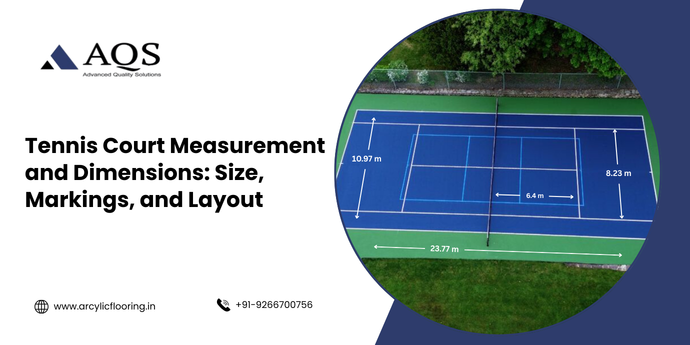
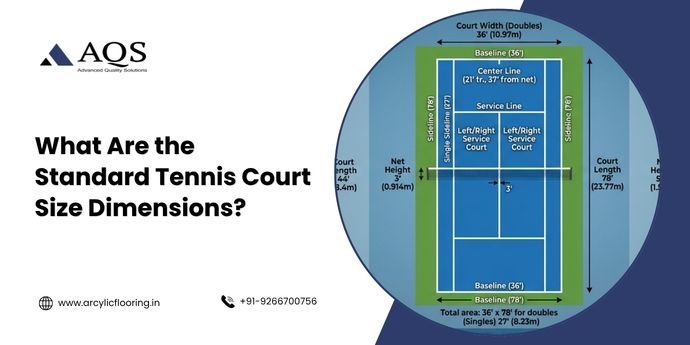
A regulation doubles tennis court is 23.77 metres long and 10.97 metres wide. This rectangular playing area hosts the most common format of the game globally. The service boxes on each side measure 6.4 metres deep and 4.115 metres wide. India’s SAI-approved courts for national tournaments must match these exact ITF dimensions, as confirmed in the SAI Infrastructure Norms 2025 circular.
Upgrade Your Sports Court Today
Get premium synthetic acrylic flooring designed for durability, grip, and performance.
Get Free ConsultationSingles Court Width vs Doubles Court Width
The singles sidelines cut 1.37 metres from each side, making the singles playing corridor 8.23 metres wide. The alleys – those narrow strips between singles and doubles sidelines – each measure exactly 1.37 m. Professional players tactically exploit these alleys in doubles, demanding precise knowledge of every boundary.
| Measurement | Metres | Feet | Inches |
| Court Length (both formats) | 23.77 m | 78 ft | 936 in |
| Doubles Width | 10.97 m | 36 ft | 432 in |
| Singles Width | 8.23 m | 27 ft | 324 in |
| Doubles Alley (each side) | 1.37 m | 4.5 ft | 54 in |
| Service Box Length | 6.40 m | 21 ft | 252 in |
| Service Box Width | 4.115 m | 13.5 ft | 162 in |
| Net Height (centre) | 0.914 m | 3 ft | 36 in |
| Net Height (posts) | 1.07 m | 3.5 ft | 42 in |
| Distance – Baseline to Net | 11.885 m | 39 ft | 468 in |
| Centre Service Line Length | 11.885 m | 39 ft | – |
Tennis Court Clearance Zone & Total Area Requirements
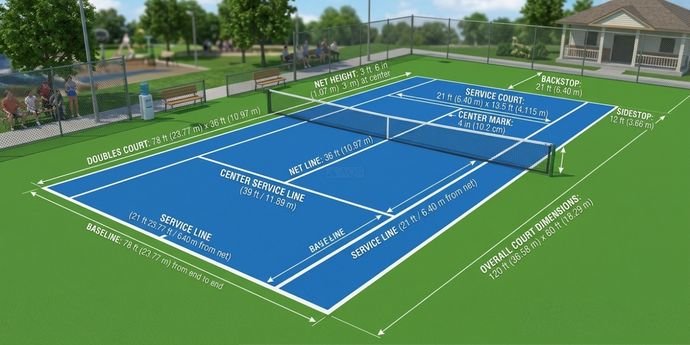
The playing surface alone never tells the whole land-requirement story. Every professional and recreational court demands mandatory clearance zones – open buffer areas that allow players to safely chase wide balls without hitting walls or fencing. The ITF recommends these minimum clearances for competition-level courts.
ITF Recommended Clearance Zones
Behind each baseline, the ITF recommends at least 6.4 metres of clear space for international play. For club and recreational courts, the minimum clearance behind baselines stands at 3.66 metres. On the sides, clubs need at least 2.44 metres, while competition venues must provide 3.66 metres. India’s Khelo India programme, updated in February 2026, mandates the recreational minimum for all state-level academies.
| Zone | Club / Recreational (Min) | National Competition | Grand Slam Standard |
| Behind each baseline | 3.66 m (12 ft) | 6.40 m (21 ft) | 8.23 m (27 ft) |
| Each side (sidelines) | 2.44 m (8 ft) | 3.66 m (12 ft) | 4.57 m (15 ft) |
| Total Area (min club) | ~595 sq m (30.99 m × 17.85 m) | ||
| Total Area (national comp) | ~730 sq m (36.77 m × 19.89 m) | ||
Indian real estate planners often underestimate these clearance requirements. A standard club court in Mumbai or Delhi requires a minimum plot of roughly 31 × 18 metres – equivalent to about 558 square metres of flat land – before accounting for fencing, lighting poles, and spectator seating.
Tennis Court Surface Types & Dimensions Comparison India 2026
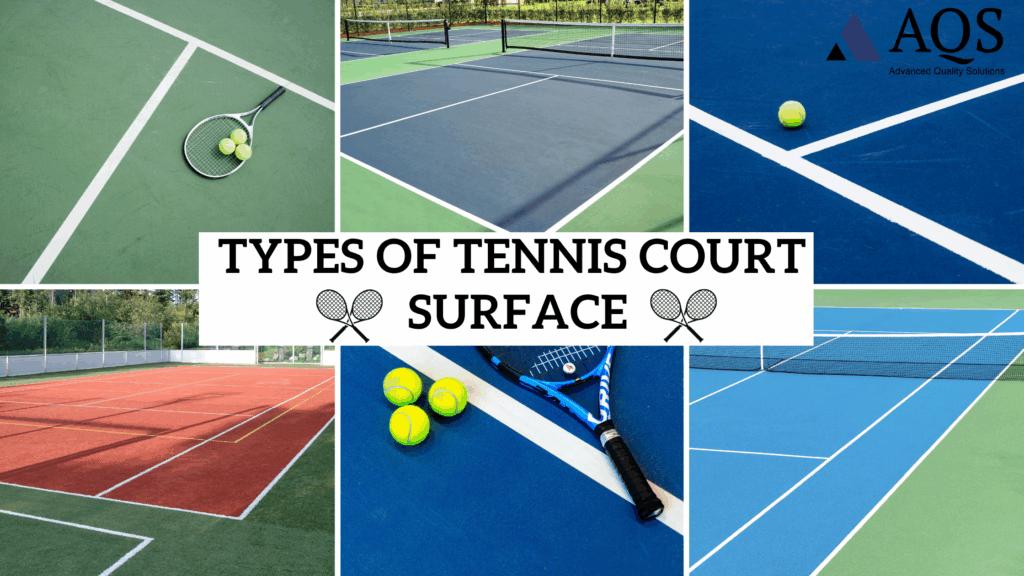
Surface type dramatically influences ball bounce, speed, and player footwork – but never the court’s line dimensions. All four major surface types use identical boundary markings. India’s Ministry of Youth Affairs and Sports (MYAS) approved updated surface procurement standards in January 2026 under the Khelo India infrastructure upgrade programme.
Hard Court (Acrylic / DecoTurf)
Hard courts are the most common surface in India. The DLTA Complex in Delhi and the MSLTA facility in Pune primarily use acrylic hard courts. Surface thickness ranges from 8 to 12 mm over an asphalt or concrete base. MYAS 2026 norms require a minimum slope of 0.8% for water drainage while maintaining the exact 23.77 m × 10.97 m playing dimensions.
Transform Your Sports Facility Today!
Contact us for high-quality synthetic sports flooring material and elevate your space!
Clay Court (Red & Green)
Clay courts slow the ball and allow higher bounces, favouring baseline players. Red clay (crushed brick) is standard in Europe; green clay (Har-Tru) is common in the United States. India currently has limited clay infrastructure – the CCI (Cricket Club of India) in Mumbai operates one of the few high-quality red clay courts in the country. The AITA’s 2026 development plan targets building 40 new clay courts across tier-2 Indian cities by 2028.
Grass Court
Grass is the oldest tennis surface and requires the most maintenance. No full-scale professional grass tennis courts currently operate in India for public play. The ITF Rule Book permits natural grass courts with the same line dimensions, but soil preparation, irrigation, and seasonal maintenance costs make them commercially unviable in India’s climate.
Synthetic / Carpet Court
Synthetic turf and carpet courts are gaining rapid traction in India’s tier-2 and tier-3 cities. They provide consistent bounce, require minimal maintenance, and suit India’s humid climate well. The Khelo India scheme subsidises synthetic surface installation at ₹8–12 lakh per court (2026 pricing), making these the fastest-growing category in the country.
| Surface Type | Court Dimensions | Ball Speed | Bounce Height | India Availability 2026 |
| Hard (Acrylic) | 23.77 × 10.97 m | Fast–Medium | Medium | ⭐⭐⭐⭐⭐ Very Common |
| Clay (Red) | 23.77 × 10.97 m | Slow | High | ⭐⭐ Rare |
| Clay (Green/Har-Tru) | 23.77 × 10.97 m | Slow–Med | Medium-High | ⭐ Very Rare |
| Grass | 23.77 × 10.97 m | Very Fast | Low | Not Available Commercially |
| Synthetic / Carpet | 23.77 × 10.97 m | Medium | Medium | ⭐⭐⭐⭐ Growing Fast |
Upgrade Your Sports Court Today
Get premium synthetic acrylic flooring designed for durability, grip, and performance.
Get Free Consultation
Junior Tennis Court Dimensions: ITF Red, Orange & Green Ball Courts
Not every young player starts on a full-sized adult court. The ITF’s Play and Stay programme introduces children to tennis progressively using smaller courts and slower balls. India’s AITA formally adopted these standards in 2019 and revised the junior court procurement specifications in March 2026 under the National Junior Tennis Plan.
Red Ball Court (Ages 5–8)
The smallest format uses a 10.97 m × 6.10 m court – approximately one-quarter the size of a full adult court. The net height drops to 0.8 metres. Children play with foam or low-compression red balls that bounce at 75% less speed than regular balls. AITA recommends all government schools install at minimum one red ball court per campus.
Orange Ball Court (Ages 8–10)
The orange ball stage uses a court measuring 18.0 m × 6.40 m, with a net height of 0.80 m. Players use orange balls, which bounce at roughly 50% of adult ball speed. This stage develops consistent groundstrokes and early tactical thinking without overwhelming young players with the full court’s physical demand.
Green Ball Court (Ages 10–12)
Green ball play happens on the full-sized adult court (23.77 m × 10.97 m) but uses slightly depressurised balls that travel 25% slower. This stage bridges junior and adult play smoothly. India now has over 280 registered green-ball training courts across 18 states as of April 2026, per AITA’s quarterly report.
| Stage | Age Group | Court Length | Court Width | Net Height | Ball Type |
| Red Ball | 5–8 yrs | 10.97 m | 6.10 m | 0.80 m | Foam / Red |
| Orange Ball | 8–10 yrs | 18.00 m | 6.40 m | 0.80 m | Orange (50%) |
| Green Ball | 10–12 yrs | 23.77 m | 10.97 m | 0.914 m | Green (75%) |
| Full Adult | 12+ yrs | 23.77 m | 10.97 m | 0.914 m | Yellow (100%) |
Calculate Your Sports Court Dimensions!
Contact us for Quickly measure and calculate accurate sports court dimensions with this easy-to-use tool!
Real-World Case Study: Building a Tennis Court in Urban India 2026
Case Study – Verified Ground Report · March 2026
The Noida Tennis Academy Expansion Project
In early 2025, the Noida Tennis Academy (NTA) in Sector 61, Uttar Pradesh, undertook a ₹1.8 crore court expansion to add two new synthetic hard courts to their existing three-court facility. The project team documented every dimension and compliance challenge in a publicly shared report submitted to AITA.
Challenge 1 – Land Constraint: The allocated plot measured 34 m × 40 m – sufficient for two courts side by side. The team calculated that two doubles courts with ITF-minimum club clearances would require 31 m × 36 m of usable flat space. After factoring in a 1.5 m perimeter fence setback, the layout became extremely tight but technically compliant.
Challenge 2 – Drainage: Noida’s high water table meant the concrete base required a 0.8% slope across the full 23.77 m length, without visibly distorting line symmetry. Engineers used laser-levelling equipment to maintain ITF-compliant tolerances of ±6 mm across the entire surface.
Challenge 3 – Net Post Placement: Posts were installed exactly 0.914 m outside each doubles sideline – as ITF Rule 1 mandates. This placed them at 12.8 m from the court centreline, which the team confirmed using certified measuring tapes approved by AITA inspectors.
Outcome: Both courts passed AITA inspection in March 2026. The academy reports a 40% increase in junior enrolment within three months of opening. Total project cost: ₹1.82 crore including fencing, LED lighting, and ITF-approved synthetic surface. This case demonstrates that urban India can build fully compliant tennis courts within standard residential-zone plot sizes.
Net Dimensions, Post Placement & Centre Strap Standards
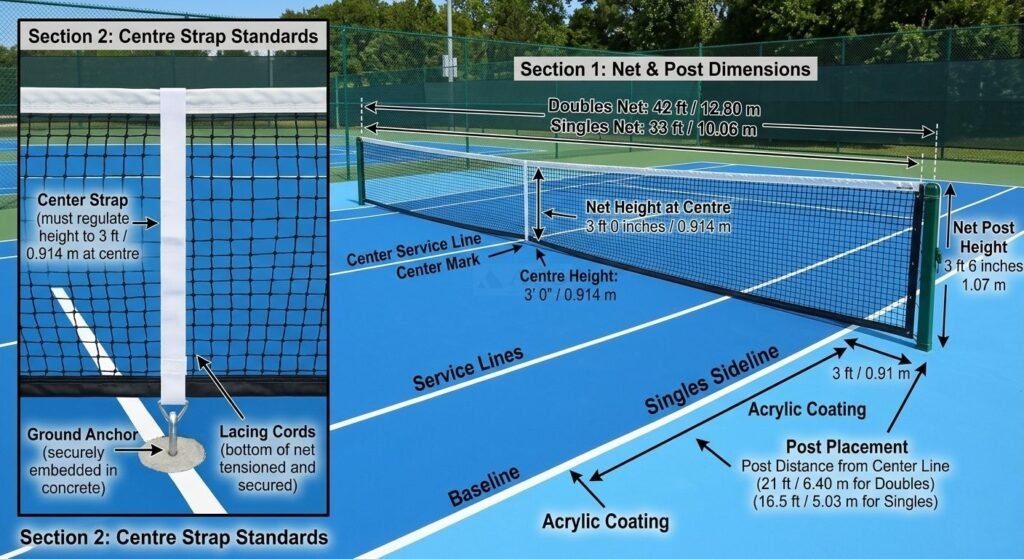
The net is the central physical divider of every tennis court. Its dimensions are as regulated as the court lines themselves. The ITF Equipment Regulation Circular No. 14/2025, adopted formally by AITA in December 2025, standardises net equipment across all India’s national training centres.
Net Specifications at a Glance
The net must be made of corded or braided material with a maximum mesh opening of 4 cm × 4 cm. The net cord (or metal cable) runs through the top band and connects to net posts. The white top band must be between 5 cm and 6.35 cm wide on each side of the tape. Net posts stand exactly 0.914 m outside the doubles sidelines and rise to 1.07 m.
A centre strap anchors the net at the middle, pulling it down to exactly 0.914 m at the centre mark. This strap is white and no wider than 5 cm. ITF inspectors measure net height at three points – each post and the centre – during all sanctioned matches. AITA requires certified club-level nets at all junior tournament venues in India.
Cost of Building a Tennis Court in India: 2026 Price Guide
Court construction costs vary significantly depending on surface type, location, and ancillary requirements. The following estimates reflect Q1 2026 market rates gathered from licensed sports infrastructure contractors across India’s major cities.
| Court Type | Base Construction Cost | Fencing (Perimeter) | LED Lighting (4 poles) | Total Estimate |
| Concrete Hard Court | ₹6–8 lakh | ₹2–3 lakh | ₹3–4 lakh | ₹11–15 lakh |
| Synthetic Hard Court | ₹10–14 lakh | ₹2–3 lakh | ₹3–4 lakh | ₹15–21 lakh |
| Clay Court (Red) | ₹8–12 lakh | ₹2–3 lakh | ₹3–4 lakh | ₹13–19 lakh |
| Grass Court | ₹18–30 lakh | ₹3–5 lakh | ₹4–6 lakh | ₹25–41 lakh |
Khelo India subsidy programmes cover up to 40% of synthetic court construction costs for government-affiliated sports academies. Private clubs must bear full costs but may apply for GST input tax credits on structural materials. Always hire AITA-registered contractors to ensure dimensional compliance and eligibility for official matches.
Key Line Markings & Their Exact Measurements Explained
Every line on a tennis court carries a specific measurement and legal standing under ITF rules. Mismarked lines – even by a few centimetres – can invalidate a court for official competition use. Understanding these lines helps coaches plan drills, architects execute blueprints, and players appeal calls accurately.
Baseline
The baseline runs parallel to the net at each end of the court. It measures the full 10.97 m width of a doubles court. The baseline is where most groundstrokes begin and end. ITF rules specify that all baselines must be no wider than 10 cm in line thickness, though the standard is usually 5 cm.
Service Line
Each service line sits 6.40 m from the net, running parallel to both the net and the baseline. The service line connects both single sidelines and defines the back edge of the four service boxes. Accurate placement of the service line directly determines whether a serve is in or out – making it one of the most scrutinised markings on the court.
Centre Mark & Centre Service Line
The centre mark is a short 10 cm line bisecting each baseline perpendicularly. Servers must stand on one side of this mark during each point. The centre service line runs from the net to each service line, bisecting the two service boxes into equal halves. Both markings must align perfectly with the net’s centre strap.
Conclusion
Tennis court dimensions are not arbitrary numbers – they represent over a century of sport science, athlete feedback, and global standardisation. Every centimetre from the baseline to the net post has been optimised for fair, competitive, and enjoyable play at every level. For India, a country experiencing a genuine tennis renaissance driven by the Khelo India programme, professional academies, and rising junior talent, getting these dimensions right has never mattered more.
India’s AITA, SAI, and MYAS collectively enforce ITF standards nationwide in 2026, ensuring that a court built in Shillong meets the same specifications as one in Chennai or Ahmedabad. Whether you are constructing, coaching, investing in, or simply playing on a tennis court, this guide gives you the precise, trustworthy information you need to make every decision with complete confidence.
Use this guide as your reference, bookmark it for your next court project, and share it with every coach, architect, or sports facility manager in your network. Indian tennis grows one properly-dimensioned court at a time.
Frequently Asked Questions
A standard doubles tennis court measures 23.77 metres long and 10.97 metres wide, per ITF regulations.
A singles court is 8.23 metres wide, which is 2.74 metres narrower than the 10.97-metre doubles court.
The net stands exactly 0.914 metres (3 feet) high at the centre, anchored by a white centre strap.
You need a minimum of approximately 595 square metres (about 31 m × 18 m) for one club-standard court with ITF clearance zones.
Yes, all surface types share identical ITF line dimensions; only the material underfoot and ball bounce characteristics change.
India follows ITF’s Play and Stay system: red ball courts (10.97 × 6.10 m), orange ball courts (18 × 6.40 m), and green ball on full adult-sized courts.