If you’re planning to build a padel court, the padel court cost in India usually falls between ₹15 lakh and ₹45 lakh, depending on size, glass quality, turf, and whether you build indoor or outdoor. That’s a wide range, and there’s a good reason for it. Two courts on neighbouring plots can differ by ₹15-20 lakh simply because of glass thickness or the base work underneath. This guide breaks down what actually goes into padel court construction cost in India, what a fair quote looks like, and where contractors quietly cut corners. Housing societies, gym owners, and entrepreneurs chasing the padel boom all ask the same question first: what’s this really going to cost? Here’s the honest answer.
Padel Court Cost By Dimensions
A standard 20m x 10m outdoor padel court with tempered glass, synthetic turf, and LED lighting costs between ₹15 lakh and ₹35 lakh, fully installed, in most Indian cities. Indoor or covered courts cost ₹32 lakh to ₹45 lakh because of the added roof structure. Budget setups with thinner glass and basic turf can go as low as ₹9-14 lakh, but they often skip drainage and steel galvanising, which shows up as rust and turf problems within a few years.
| Court Type | Typical Padel Court Price | What’s Usually Included |
| Budget outdoor | ₹9L – 14L | Thinner glass, basic turf, minimal drainage |
| Standard outdoor | ₹15L – 25L | Tempered glass, branded turf, LED lights, proper base |
| Premium/panoramic outdoor | ₹25L – 35L | Thicker glass, post-free design, high-grade turf |
| Indoor/covered | ₹32L – 45L | Roof structure, weather protection, year-round play |
What Decides Padel Court Cost in India
No two padel court quotes look alike, and that’s because six or seven variables move the final number. Here’s what actually matters.
Outdoor Court vs Indoor Court
An Acrylic Flooring Outdoor Court skips the roof, so it’s cheaper and faster to build. Adding a covered structure typically adds ₹8-15 lakh, but it lets you book the court through the monsoon and peak summer heat, which matters if you’re running it as a business.
Upgrade Your Sports Court Today
Get premium synthetic acrylic flooring designed for durability, grip, and performance.
Get Free ConsultationGlass Type and Thickness
Padel courts use tempered safety glass on the back and side walls, usually 10mm for a standard build or 12mm for panoramic courts that remove the corner posts for cleaner sightlines. Thicker, post-free glass adds roughly 15-25% to the total cost, but it plays and looks better, which commercial clubs care about.
Turf Quality
Synthetic turf with silica sand infill is the standard playing surface. It’s priced by pile height, fibre thickness, and density. Cheaper turf might save you ₹50,000-1 lakh upfront, but it wears out faster and changes how the ball bounces over time.
Location and Site Conditions
Labour and material costs vary by 15-25% across Indian cities. Metro hubs like Delhi NCR and Mumbai sit at the higher end because of labour rates, while coastal sites need hot-dip galvanised steel to resist salt air, adding roughly ₹1-1.2 lakh per court.
Number of Courts
Building two or more courts together brings the per-court cost down by 15-25%, since you share civil work, transport, and installation crews. This is one reason most commercial operators start with at least two courts instead of one.
Padel Court Construction Cost Breakdown
Here’s roughly how a single standard outdoor court’s budget splits up, component by component:
| Component | Approximate Cost |
| Structural steel frame | ₹2L – 4L |
| Tempered glass panels | ₹2L – 3L |
| Synthetic turf and sand infill | ₹1.5L – 2.5L |
| Civil work and concrete base | ₹1.5L – 2.5L |
| Drainage system | ₹0.5L – 0.8L |
| LED lighting | ₹0.8L – 1.5L |
| Installation and labour | ₹0.7L – 1.2L |
Add these up and a no-frills build lands close to ₹9-14 lakh. The number climbs once you move to panoramic glass, premium imported turf, or brighter tournament-grade lighting.
Padel Court Installation Cost: What the Price Actually Covers
Padel court installation cost refers to the on-site work: erecting the steel frame, fitting the glass and mesh panels, laying the turf, and wiring the lighting. Fabrication of the frame and glass usually happens off-site first and takes four to six weeks. On-site installation for a single court then takes another 10-15 days once the base is ready.
A genuine turnkey quote should cover site survey, design, foundation, structure, surface, lighting, and a final walk-through before handover. If a quote only mentions “supply and fix” for the glass and turf, you’re likely still paying for the civil base separately. Always ask what’s excluded, not just what’s included.
Additional Costs Most Quotes Don’t Include
A padel court price tag rarely covers everything you’ll actually spend. Budget for these separately:
- Land cost or lease, if you don’t already own the plot
- Society or RWA approval, for courts inside residential complexes
- GST on materials and services
- Annual maintenance: sand top-up, glass and mesh checks, turf brushing
- Insurance for the structure and glass panels
- Seating, gates, signage, and a booking system if you’re running it commercially
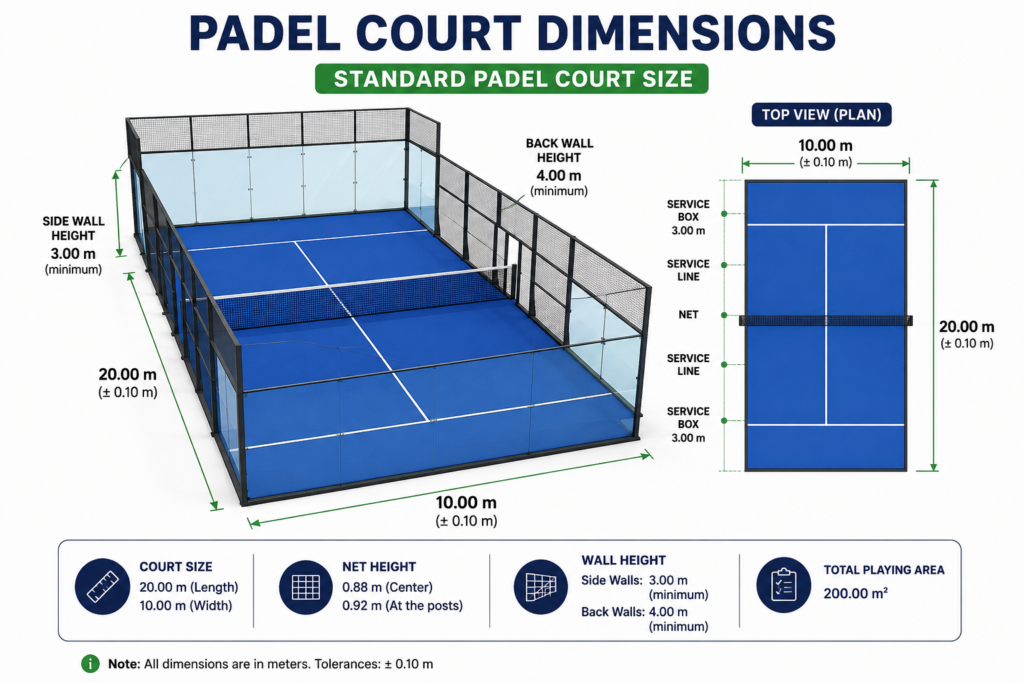
A standard padel court needs about 200 square metres of playing area, plus a metre or two of buffer space on each side for safe movement and access. Factor that buffer into your land cost before you commit to a design.
Padel Court Business Cost and Return on Investment
If you’re building to run a paid facility rather than for personal use, the economics look promising, though they aren’t automatic. Padel court booking rates in India typically range from ₹800-1,500 per hour off-peak to ₹1,500-3,500 per hour during evenings and weekends, with metro cities like Mumbai commanding the top end.
Industry estimates put payback for a well-run commercial court at 18 to 30 months, assuming decent occupancy during peak hours. A two-court facility with basic amenities usually needs ₹60-80 lakh in total investment, while a larger multi-court club with a cafe, pro shop, and coaching setup can run ₹50 lakh to ₹1.5 crore.
Demand is genuinely growing. India’s padel courts went from roughly 80-100 in 2023 to close to 500 by 2025, with players approaching 100,000, according to Huddle’s India Padel Report 2026. That’s fast growth, but it also means competition is building quickly in the same metro pockets, so location and pricing strategy matter as much as the build itself.
Padel Court Cost vs Other Sports Courts
People weighing sports infrastructure often ask how padel stacks up against tennis or badminton. A padel court takes up about a third of the footprint of a tennis court, roughly 200 square metres against 600 square metres, so the land, base, and drainage all cost less to begin with.
What padel adds that tennis and badminton don’t is the glass-and-steel enclosure, and that’s a real cost. So a single padel court and a basic tennis court can land in a broadly similar price band once you add it all up. The difference shows up in usage. A padel court fits into plots that could never take a full tennis court, and it puts more players on court per hour, which matters if bookings are your revenue.
For badminton, the comparison is different again. A badminton court is far cheaper to build, but it also earns far less per hour because doubles play means only four players share the cost of a much smaller space. On a per-booking basis, padel usually comes out ahead once you account for footprint and player turnover.
Upgrade Your Sports Court Today
Get premium synthetic acrylic flooring designed for durability, grip, and performance.
Get Free ConsultationCommon Mistakes When Budgeting for a Padel Court
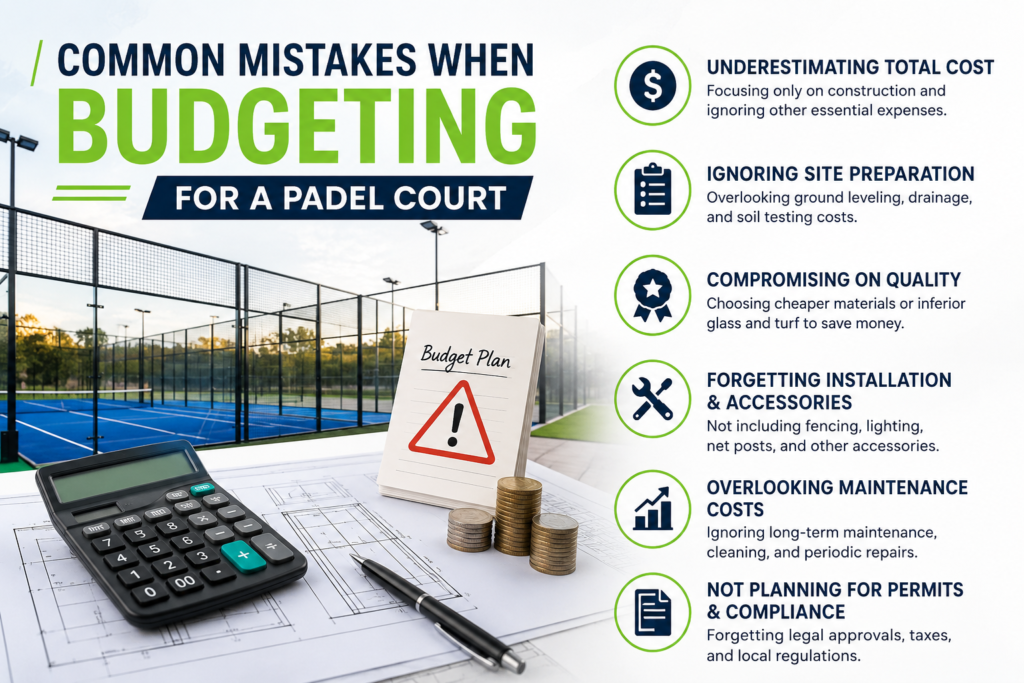
- Comparing quotes without checking glass thickness. A ₹9 lakh quote and a ₹20 lakh quote aren’t the same product if one uses thin glass and the other uses certified 10-12mm tempered glass.
- Skipping the site survey. Sloped or soft-soil plots need extra foundation work that a generic quote won’t cover.
- Ignoring drainage. Poor drainage causes waterlogging and turf damage within a monsoon or two.
- Forgetting galvanising in coastal cities. Untreated steel starts rusting within a few years near the coast.
- Underestimating land buffer. Courts need clearance space around the enclosure, not just the bare 20m x 10m playing area.
- Not asking about the warranty. A structural and workmanship warranty of three to five years is standard from established contractors.
How to Get an Accurate Padel Court Cost Quote
- Get your site surveyed before asking for a final number. Soil type and slope change the foundation cost.
- Ask for an itemised quote, not a single lump sum, so you can compare glass, turf, and civil work line by line.
- Confirm the glass is certified tempered safety glass, not just “toughened” without a standard mentioned.
- Decide indoor versus outdoor early. It’s the single biggest lever on price.
- Get at least three quotes from different contractors and compare like-for-like specifications.
- Ask what’s excluded. Land prep, approvals, and amenities are often billed separately.
Final Thoughts
Padel court cost in India isn’t one fixed number. It’s a range shaped by the choices you make on glass, turf, location, and whether you build indoor or outdoor. A standard outdoor court will likely land between ₹15 lakh and ₹35 lakh, and knowing what drives that number puts you in a stronger position when you sit down with a contractor. Get your site surveyed, ask for an itemised quote, and compare specifications before you compare prices. That’s the difference between a court that lasts a decade and one that needs repairs by year two.
Frequently Asked Questions
A standard outdoor padel court costs between ₹15 lakh and ₹35 lakh, fully installed. Indoor courts cost ₹32-45 lakh because of the added roof structure.
It can be, with payback typically in 18-30 months for well-located, well-managed courts. Profitability depends more on peak-hour occupancy than on the construction cost alone.
The playing area is 20 metres by 10 metres, or about 200 square metres. You’ll also need buffer space around the enclosure for safe access, so plan for slightly more than the bare minimum.
Indoor courts cost ₹8-15 lakh more than outdoor courts because of the roof structure, but they allow year-round bookings regardless of weather.
Yes, in most residential complexes you’ll need RWA or society approval before construction begins, along with basic structural sign-off depending on local building rules in your state.
Maintenance stays fairly low: regular turf brushing, an annual sand top-up, and quarterly checks on the glass and mesh. Well-maintained turf typically lasts 8-10 years before it needs replacing.
Yes, but keep expectations realistic. Budget builds around ₹9-14 lakh usually mean thinner glass and basic turf, and may skip drainage or galvanising, which costs more to fix later than to build right the first time.
From order to handover, a single court typically takes six to eight weeks. That includes four to six weeks of off-site fabrication and 10-15 days of on-site installation.