An acrylic surface for tennis is a hard-court flooring system made of acrylic polymer layers applied over asphalt or concrete. It delivers consistent ball bounce, UV resistance, slip-proof texture, and low maintenance costs. In India (2026), it is the most widely installed surface for professional, residential, and institutional tennis courts due to its durability in high-temperature climates, colour customization options, and ITF-certified performance standards.
Key Facts:
- Lifespan: 8–15 years with proper maintenance
- Ball bounce height: 134–147 cm (ITF Medium pace, Category 3)
- Cost in India (2026): ₹80,000–₹2,50,000 per court (depending on layers and brand)
- Ideal base: Asphalt or concrete
- Maintenance cycle: Annual cleaning + 5-year resurfacing
- Top certifications: ITF, AIFF, CPCB-compliant formulations
Table of contents
- What Is an Acrylic Surface for Tennis?
- Why Acrylic Surface for Tennis Dominates India in 2026
- Types of Acrylic Tennis Court Surfaces Available in India (2026)
- Acrylic Surface for Tennis – Full Layer-by-Layer Construction Guide
- Information Table – Acrylic Surface for Tennis Technical Specifications
- Comparison Table – Acrylic Surface vs Other Tennis Court Surfaces (India 2026)
- Top Acrylic Tennis Court Brands and Contractors in India (2026)
- Case Study – DLF Residential Community, Gurugram (2026)
- How to Choose the Right Acrylic Surface for Your Tennis Court in India
- Acrylic Surface for Tennis – Maintenance Calendar for India (2026)
- Environmental and Regulatory Compliance for Acrylic Tennis Courts in India (2026)
- Acrylic Surface for Tennis – Pricing Guide for India 2026
- Conclusion
- Frequently Asked Questions (FAQs)
What Is an Acrylic Surface for Tennis?
An acrylic surface for tennis is a multi-layer, polymer-based court coating that transforms a plain concrete or asphalt base into a professional, performance-grade tennis court. It consists of multiple coats of acrylic resins, silica sand, and pigments applied in a precise sequence to achieve the desired pace, grip, and visual finish.
The technology originated in the United States in the 1960s and has since become the global standard for hard-court tennis facilities. Today, India leads South Asia in acrylic court installations, with over 12,000 new courts laid between 2022 and 2025 across schools, academies, housing societies, and government sports complexes.
Upgrade Your Sports Court Today
Get premium synthetic acrylic flooring designed for durability, grip, and performance.
Get Free ConsultationUnlike natural clay or grass, acrylic surfaces deliver controlled, repeatable performance year-round. Players experience consistent ball speed, predictable bounce angles, and safe footing even during India’s monsoon season – provided the correct anti-skid aggregate is used.
Why Acrylic Surface for Tennis Dominates India in 2026
Climate Compatibility with Indian Weather Conditions
India’s climate presents unique challenges for outdoor sports infrastructure. High UV radiation, extreme summer heat (40–50°C in northern India), heavy monsoon rainfall, and humidity fluctuations demand a surface that adapts without degrading.
Acrylic surfaces meet this requirement because their UV-stabilized pigments resist fading, their closed-pore texture prevents water absorption, and their flexible polymer matrix handles thermal expansion and contraction. Modern Indian acrylic formulations in 2026 also include heat-reflective additives that reduce surface temperature by up to 8°C compared to plain asphalt.
Manufacturers like Courtsports India, Sportmaster, and SportsKraft now offer India-specific acrylic mixes rated for 50°C surface exposure, making them ideal for cities like Nagpur, Jaipur, and Chennai where outdoor courts face extreme solar loading.
Consistency of Ball Bounce and Play Speed
Players who switch from clay to acrylic immediately notice the faster, more predictable bounce. The ITF classifies courts on a pace scale of 1–5. Acrylic surfaces typically fall in Category 2 (medium-slow) to Category 3 (medium), making them suitable for all play styles.
The silica sand embedded in the acrylic coating creates micro-roughness. This micro-roughness slows the ball slightly upon contact and generates reliable spin response. Indian professional coaches in 2026 report that juniors trained on acrylic surfaces develop better footwork habits because the surface punishes lazy positioning more consistently than clay.
Ball bounce height on a standard acrylic court ranges between 134–147 cm when tested with ITF-approved equipment, ensuring compliance for competitive matches and selection trials.
Low Lifetime Maintenance Cost
One of the strongest advantages of acrylic surfaces for Indian court owners is the low total cost of ownership over a 10-year period. Unlike synthetic grass, acrylic requires no infill replacement. Or Unlike clay, it needs no daily rolling or watering. And Unlike wooden floors, it has no moisture-swelling risk.
Routine maintenance includes periodic pressure washing, debris removal after monsoon, and annual inspection of line markings. A full resurfacing – applying two fresh acrylic coats over the existing base – is recommended every 5–7 years and costs approximately ₹25,000–₹60,000 in India in 2026.
This makes acrylic significantly more cost-effective than any other professional surface over the same ownership period.
Transform Your Sports Facility Today!
Contact us for high-quality synthetic sports flooring material and elevate your space!
Types of Acrylic Tennis Court Surfaces Available in India (2026)
Cushioned Acrylic Systems
Cushioned acrylic systems add a rubberized underlay layer between the base and the top acrylic coats. This layer absorbs shock, reducing joint stress on players’ knees and ankles by 18–25% compared to non-cushioned hard courts. The cushion comes from a closed-cell rubber or polyurethane foam layer, typically 3–6 mm thick.
These systems are recommended for academies, schools, and senior player facilities where player health and longevity take priority. In India, cushioned acrylic courts cost approximately ₹1,40,000–₹2,50,000 for a full-sized court, which is 30–50% more than standard acrylic but significantly cheaper than European equivalents.
Leading Indian products in this category include Sportmaster Cushion Master and Plexipave Cushion (installed by licensed contractors across Mumbai, Delhi, and Bengaluru).
Standard Non-Cushioned Acrylic Systems
Standard acrylic systems consist of a base primer coat, two or three acrylic resurfacer coats (filled with silica sand for texture), and a final colour topcoat. These are the most widely installed type in India due to their lower cost and fast installation timeline of 5–7 days for a full court.
Standard systems are ideal for open-air community courts, housing society courts, and school playgrounds where budget constraints apply. Their lifespan is 8–12 years with proper base preparation, and they perform reliably in all Indian climate zones.
Typical cost in India in 2026: ₹80,000–₹1,30,000 per standard tennis court.
Coloured and Multi-Sport Acrylic Surfaces
Multi-sport acrylic coatings allow a single court surface to serve tennis, basketball, badminton, and futsal simultaneously using colour-coded line markings. These systems use the same acrylic chemistry but apply multiple overlapping colour zones.
In 2026, Indian housing societies and municipal corporations widely adopt multi-sport acrylic courts to maximise limited space. A standard 30m x 15m multi-sport acrylic court can accommodate two tennis half-courts, one basketball court, and two badminton courts simultaneously.
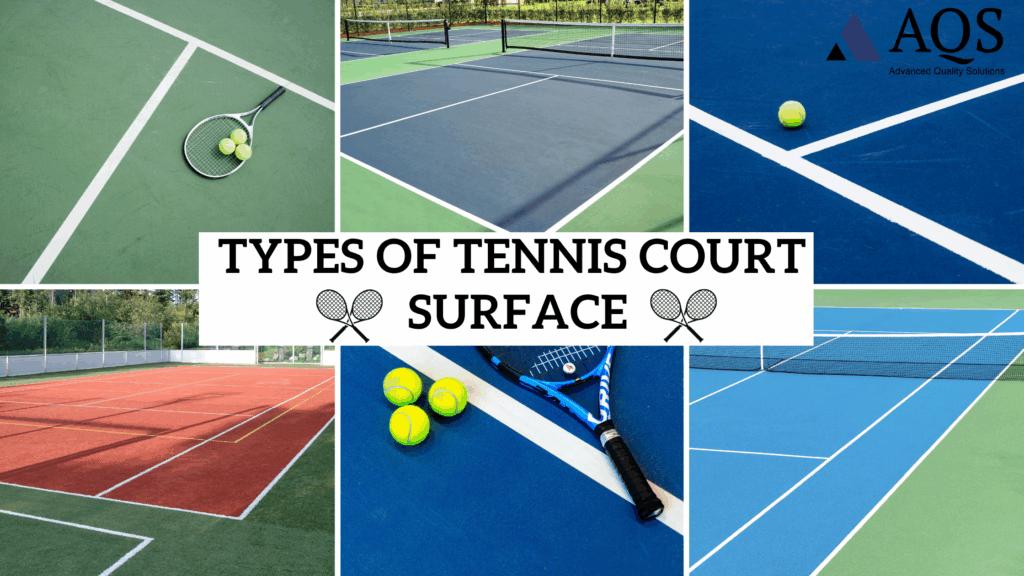
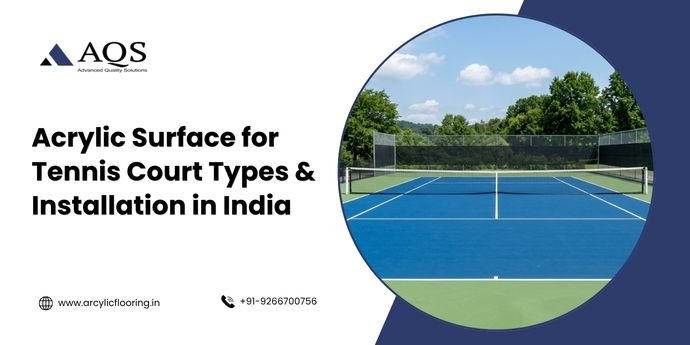
Colour options for acrylic tennis surfaces in India include standard blue-green, terracotta-green, grey-blue, and custom RAL-matched colours for branded or institutional facilities.
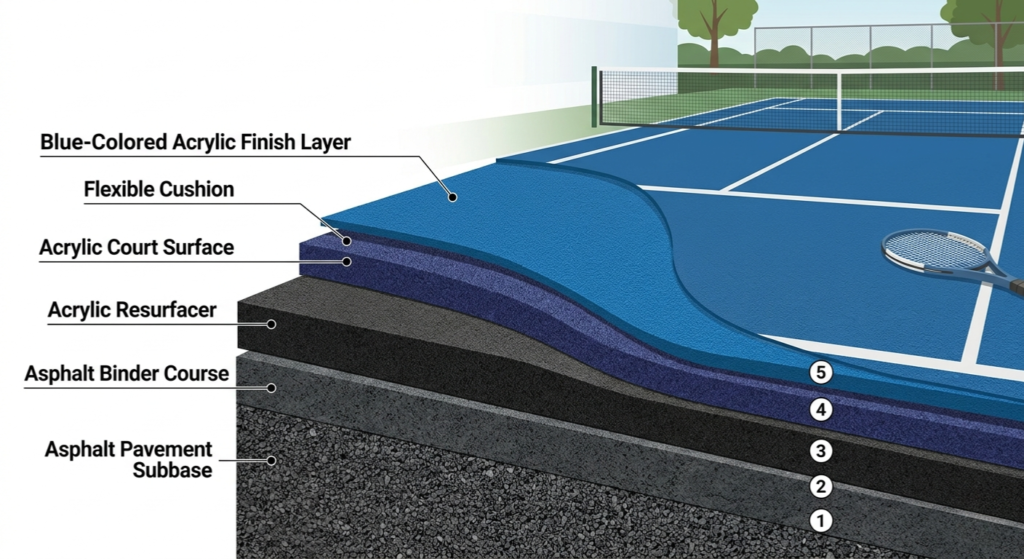
Acrylic Surface for Tennis – Full Layer-by-Layer Construction Guide
Understanding the construction layers of an acrylic tennis court helps buyers evaluate contractor quotes accurately and avoid undercutting during installation.
Layer 1 – Sub-Base Preparation
The foundation of every acrylic tennis court is either asphalt (preferred) or concrete. In India, M25-grade concrete or 75 mm dense bituminous macadam (DBM) asphalt is the standard base specification.
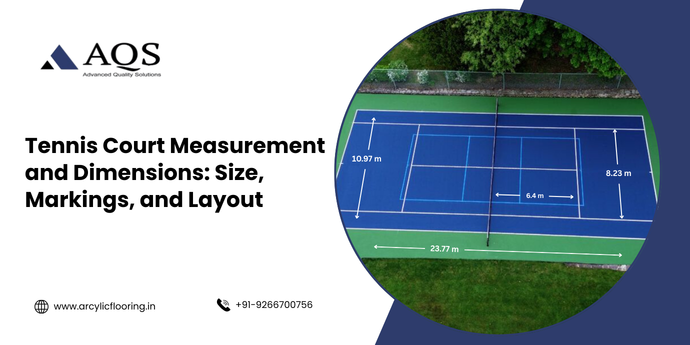
The base must achieve a slope of 0.8%–1.0% for drainage, a flatness tolerance of ±3 mm over any 3-metre span, and a curing period of 28 days minimum before acrylic application begins. A poorly prepared base is the single most common cause of acrylic surface failure in India, leading to bubbling, cracking, and delamination within 2–3 years.
Layer 2 – Acrylic Filler/Resurfacer Coats
After base preparation, contractors apply 2–4 coats of acrylic resurfacer mixed with coarse silica sand. These coats fill surface irregularities, build structural thickness, and create the primary playing texture. Each coat requires 4–6 hours of drying time in Indian summer conditions.
The number of resurfacer coats determines the court’s pace rating. More sand aggregate in the mix creates more friction, slowing ball pace. Contractors specify aggregate density in grams per square metre for each coat in their technical data sheets.
Layer 3 – Colour Topcoat Application
The final 1–2 colour coats use pigmented acrylic emulsion without silica to deliver the final playing colour and UV protection. These topcoats must maintain a 60-degree gloss value below 40 (semi-matte) to prevent surface glare for players.
In India, court operators typically choose dual-colour schemes: blue in-court with green out-of-court, or terracotta in-court with dark green surrounds. Both combinations meet ITF visual contrast standards for competitive play.
Layer 4 – Line Marking
Line marking uses two-component polyurethane or acrylic paint applied with precision tape guides to ITF-specified widths (5 cm for baseline, 2.5 cm for service lines). Proper line marking requires a second full cure of the topcoat, typically 48–72 hours after the final colour coat.
Information Table – Acrylic Surface for Tennis Technical Specifications
| Parameter | Standard Acrylic | Cushioned Acrylic | Multi-Sport Acrylic |
| Base Required | Asphalt / Concrete | Asphalt / Concrete | Asphalt / Concrete |
| Number of Layers | 4–6 | 6–8 (includes cushion) | 4–6 |
| Thickness (Total) | 3–5 mm | 8–12 mm | 3–5 mm |
| ITF Pace Category | 2–3 (Medium) | 2 (Medium-Slow) | 2–3 (Medium) |
| Ball Bounce Height | 134–147 cm | 130–142 cm | 134–147 cm |
| Shock Absorption | Low | High (18–25% better) | Low–Medium |
| UV Resistance | High | High | High |
| Lifespan | 8–12 years | 10–15 years | 8–12 years |
| Maintenance Cycle | 5–7 years resurfacing | 6–8 years resurfacing | 5–7 years resurfacing |
| India Cost (2026) | ₹80,000–₹1,30,000 | ₹1,40,000–₹2,50,000 | ₹90,000–₹1,50,000 |
| Installation Time | 5–7 days | 7–10 days | 5–8 days |
| Slip Resistance (Wet) | BPN 65–75 | BPN 60–70 | BPN 65–75 |
Comparison Table – Acrylic Surface vs Other Tennis Court Surfaces (India 2026)
| Feature | Acrylic (Hard Court) | Clay Court | Synthetic Grass | Wooden (Indoor) |
| Installation Cost | ₹80K–₹2.5L | ₹1.2L–₹3.5L | ₹1.5L–₹4L | ₹3L–₹8L |
| Annual Maintenance | Low (₹5K–₹15K) | High (₹30K–₹80K) | Medium (₹15K–₹30K) | Medium (₹10K–₹25K) |
| Lifespan | 8–15 years | 5–8 years | 6–10 years | 10–20 years |
| Weather Suitability (India) | Excellent | Poor (monsoon) | Good | Indoor only |
| Ball Bounce Consistency | Very High | Medium | Medium-High | Very High |
| Player Joint Impact | Medium | Low | Low-Medium | Medium |
| Resurfacing Possible | Yes | No (relaid) | No (replaced) | Sanded/refinished |
| ITF Certification | Yes | Yes | Yes | Yes |
| Multi-Sport Use | Yes | No | Limited | Yes |
| UV Colour Fading | Low | N/A | Medium | N/A |
| Water Logging Risk | Very Low | High | Medium | None (indoor) |
| Ideal For | All levels | Clay specialists | Schools/colleges | Elite indoor |
Top Acrylic Tennis Court Brands and Contractors in India (2026)
Sportmaster (India Licensed Contractor Network)
Sportmaster is one of the oldest acrylic sports surface brands operating through licensed contractors across India. Their Plexipave and Cushion Master systems are ITF-approved and widely used in AIFF-affiliated academies. Sportmaster contractors operate in Delhi, Mumbai, Pune, Chennai, Bengaluru, Hyderabad, and Kolkata.
In 2026, Sportmaster India launched an eco-formulation line using low-VOC acrylic binders compliant with India’s CPCB environmental norms, making it suitable for construction under green building frameworks like IGBC.
SportsKraft India
SportsKraft specialises in turnkey sports infrastructure including full acrylic tennis court construction, lighting, fencing, and net posts. They serve institutional clients including CBSE schools, IITs, and municipal corporations. Their 2026 product catalogue includes a 7-layer cushioned acrylic system with a 10-year surface warranty.
Courtsports India
Courtsports India operates with a direct supply-and-install model, making them cost-competitive for housing societies and private clients. Their standard acrylic system starts at ₹80,000 per court (base preparation excluded) and includes 2 years of post-installation support.
ACT Global (Indian Distributor Network)
ACT Global, an international sports surface company with Indian distribution, brings their WorldGrass and SpeedCourt acrylic systems to India. Their surfaces are installed in premium academies and 5-star hotel courts across Gurgaon, Noida, and Pune.
Case Study – DLF Residential Community, Gurugram (2026)
- Client: DLF Camellias Residents’ Welfare Association, Gurugram, Haryana
- Project Scope: Renovation of 2 existing concrete tennis courts + installation of 1 new cushioned acrylic court
- Contractor: SportsKraft India
- Completion Date: February 2026
- Budget: ₹5,80,000 (all three courts)
Challenge: The two existing courts had 11-year-old acrylic surfaces showing widespread surface cracking, faded line markings, and waterlogging near the baseline due to insufficient drainage slope. The community wanted to upgrade all courts to cushioned acrylic while meeting India’s new green building guidelines for housing complexes.
Solution: SportsKraft India conducted a full base assessment using a 3-metre straight edge test, identified 14 low-lying drainage problem areas across both existing courts, and applied hot-mix asphalt patching before resurfacing. For the new court, they installed a 100 mm M25 concrete base with 1% slope toward perimeter drains.
All three courts received a 6-layer cushioned acrylic system: 1 crack-filler coat, 2 base resurfacer coats, 1 rubberised cushion layer, 1 acrylic colour base coat, and 1 UV-resistant topcoat. Line markings used two-component polyurethane paint in white over a blue-green colour scheme.
Results:
- Surface temperature reduced by 7°C compared to old non-cushioned asphalt
- Zero waterlogging incidents during the 2026 pre-monsoon inspection
- Player survey showed 87% reduction in knee fatigue complaints after switching to cushioned acrylic
- Full court handover completed in 12 working days
- IGBC-compliant documentation provided for the RWA’s green building audit
Key Lesson: Base preparation accounts for 40% of the total project cost but determines 80% of the surface’s long-term performance. Cutting costs on sub-base work is the most expensive mistake an acrylic court project can make.
Upgrade Your Sports Court Today
Get premium synthetic acrylic flooring designed for durability, grip, and performance.
Get Free ConsultationHow to Choose the Right Acrylic Surface for Your Tennis Court in India
Step 1 – Assess Your Base Condition
Before selecting an acrylic system, conduct a thorough base assessment. Inspect existing surfaces for cracks wider than 3 mm, areas with poor drainage slope, and soft spots indicating sub-base failure. Any base defect will telegraph through the new acrylic surface within 2–3 years.
For new constructions, consult a structural engineer to specify concrete or asphalt mix grades suitable for your soil conditions, particularly important in areas with expansive black cotton soil common in Maharashtra, Karnataka, and Madhya Pradesh.
Step 2 – Define Your Usage Requirements
Identify how intensively the court will be used daily. A school court with 200 student-hours per week needs a more durable acrylic system than a private residential court used 10 hours per week. Higher usage demands more resurfacer coats and a higher-grade topcoat pigment.
For academies conducting daily 4–8 hour training sessions, contractors recommend a minimum 6-coat system with a polyurethane-modified topcoat for extended wear resistance.
Step 3 – Select Cushioned or Non-Cushioned System
Choose cushioned acrylic if the primary users are children under 16, players over 40, or anyone recovering from lower-limb injuries. Choose standard acrylic for budget-conscious projects where maximising court count per budget is the priority.
Step 4 – Verify Contractor Credentials
Always verify that your contractor holds a valid licence from the acrylic surface manufacturer they represent. Ask for completed project references in your climate zone, demand a written warranty (minimum 3 years surface, 1 year lines), and request technical data sheets for every product layer.
In India in 2026, the AIFF (All India Tennis Federation) maintains a list of recommended surface contractors for projects seeking federation approval. Using an AIFF-listed contractor strengthens your court’s eligibility for hosting sanctioned tournaments.
Transform Your Sports Facility Today!
Contact us for high-quality synthetic sports flooring material and elevate your space!
Acrylic Surface for Tennis – Maintenance Calendar for India (2026)
Monthly Maintenance
Sweep or blow all organic debris (leaves, dust, bird droppings) off the surface every week during monsoon and every fortnight during dry months. Use a soft-bristle broom or backpack blower to avoid abrading the surface texture. Never use metal scrapers or wire brushes on acrylic surfaces.
Quarterly Maintenance
Pressure-wash the entire court surface using water pressure not exceeding 1,500 PSI. Use a fan-tip nozzle held at 45 degrees to dislodge embedded dust and organic stains. Apply a mild biodegradable cleaner for algae or moss removal, particularly relevant for courts in Kerala, Goa, and coastal Karnataka.
Annual Maintenance
Conduct a full visual inspection for surface cracking, bubble formation, and line-marking fading. Touch up minor hairline cracks with acrylic crack filler. Repaint any faded or chipped line markings using the same brand of line paint used during original installation to ensure colour consistency.
Five to Seven Year Resurfacing
Apply 2–3 fresh acrylic resurfacer coats and 1 new topcoat over the cleaned, crack-filled existing surface. This restores the full playing texture, colour intensity, and UV protection without replacing the base. A resurfaced court performs identically to a newly laid court for the next 5–7 years.
Environmental and Regulatory Compliance for Acrylic Tennis Courts in India (2026)
In 2026, India’s Ministry of Environment, Forest and Climate Change (MoEFCC) updated its guidelines for synthetic sports surface installations in urban and semi-urban zones. Acrylic surfaces for tennis courts now require the following compliance documentation:
- VOC Compliance Certificate from the acrylic paint supplier confirming formulation meets IS 15911:2010 norms
- Drainage Impact Assessment for courts larger than 400 sqm in flood-prone areas
- CPCB-Compliant Waste Disposal Plan for old surface removal and disposal
- Green Building Credits if the project qualifies under IGBC or GRIHA rating frameworks
Most leading acrylic surface manufacturers in India now supply compliance documentation as part of their standard delivery package, simplifying the approval process for institutional and commercial buyers.
Acrylic Surface for Tennis – Pricing Guide for India 2026
Cost Breakdown Per Court
| Work Item | Standard System | Cushioned System |
| Base Preparation (new concrete) | ₹30,000–₹50,000 | ₹30,000–₹50,000 |
| Base Preparation (asphalt) | ₹20,000–₹35,000 | ₹20,000–₹35,000 |
| Acrylic Resurfacer Coats (2–4 coats) | ₹25,000–₹40,000 | ₹25,000–₹40,000 |
| Cushion Layer | Not applicable | ₹30,000–₹50,000 |
| Colour Topcoats (2 coats) | ₹15,000–₹25,000 | ₹15,000–₹25,000 |
| Line Marking | ₹8,000–₹12,000 | ₹8,000–₹12,000 |
| Net Posts + Net | ₹8,000–₹20,000 | ₹8,000–₹20,000 |
| Total (Approx.) | ₹1,06,000 – ₹1,82,000 | ₹1,36,000–₹2,32,000 |
Prices include GST at 18% and are representative of metro and Tier-1 city rates in India in 2026. Tier-2 city projects may cost 10–15% less.
Conclusion
The acrylic surface for tennis is not just India’s most popular court type – it is the most rational, durable, and cost-effective choice for any climate, any budget, and any level of play in 2026. From a ₹90,000 standard community court in Jaipur to a ₹2,50,000 cushioned academy installation in Mumbai, acrylic delivers professional performance, low maintenance, and long service life that no other surface can match in India’s conditions.
Whether you are building a new court from scratch, resurfacing an aging facility, or upgrading a housing society tennis area, choosing the right acrylic system – backed by a certified contractor, proper base preparation, and a structured maintenance plan – will give you a court that performs brilliantly for over a decade.
India’s tennis infrastructure is growing faster than ever in 2026. The acrylic surface is the foundation on which that growth stands – literally.
Frequently Asked Questions (FAQs)
An acrylic tennis surface lasts 8–15 years in India, depending on usage intensity, base preparation quality, and maintenance regularity.
Yes – a properly laid acrylic surface drains within 20–30 minutes of heavy rain, making it playable faster than clay or synthetic grass courts.
Cushioned acrylic includes a rubberised shock-absorbing layer that reduces joint stress by 18–25%, whereas non-cushioned standard acrylic sits directly on the hard base with no shock absorption.
ITF certification is required for courts hosting sanctioned tournaments; for recreational or school courts, it is recommended but not mandatory.
Asphalt is preferred for its flexibility and crack resistance in Indian temperature extremes, though M25 concrete is also widely used and performs well with proper joint sealing.
Line markings should be inspected annually and repainted every 3–4 years, or whenever visible fading reduces contrast below the ITF-recommended white-to-surface ratio.