Badminton enthusiasts and facility builders across India increasingly search for the exact badminton court size in meters to ensure compliance with international standards. Whether you play recreationally, train competitively, or plan to construct a court in 2026, understanding precise measurements helps you optimize performance and avoid common errors. This comprehensive guide covers official BWF and BAI standards, detailed breakdowns, comparisons, construction tips tailored for India, and practical tables for quick reference.
What Is the Standard Badminton Court Size in Meters?
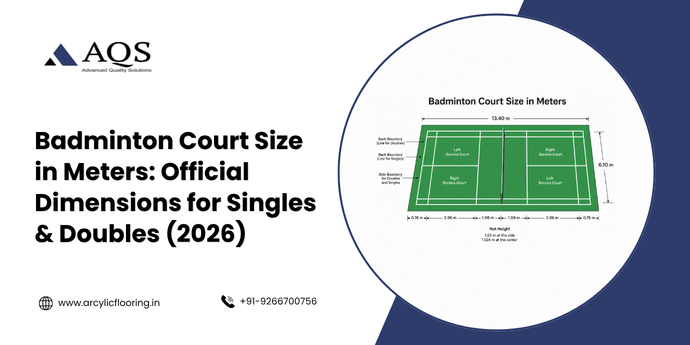
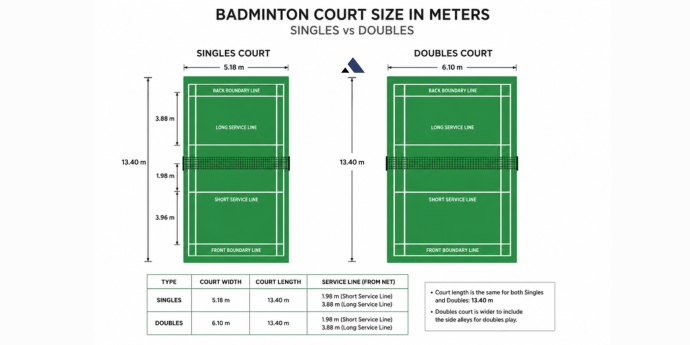
The official badminton court measures 13.4 meters in length and 6.1 meters in width for doubles play (full court), while singles use the same length but a narrower 5.18 meters width. The Badminton World Federation (BWF) sets these global standards, which the Badminton Association of India (BAI) fully adopts for all national and international events in 2026. These dimensions ensure fair, consistent play worldwide.
Official Badminton Court Dimensions in Meters (BWF/BAI Standards)
Players and builders rely on these precise figures:
- Full Court (Doubles): Length 13.4 m × Width 6.1 m
- Singles Court: Length 13.4 m × Width 5.18 m
- Diagonal (Full Court): Approximately 14.72 m
- Court Area (Doubles): 81.74 m²
- Court Area (Singles): 69.41 m²
- Line Width: 40 mm (4 cm) – white or yellow for high visibility
- Net Height: 1.55 m at the sides, dipping to 1.524 m at the center
- Net Width: Minimum 6.1 m, depth 760 mm
These measurements remain unchanged in 2026, providing stability for players transitioning between local clubs and international tournaments.
Upgrade Your Sports Court Today
Get premium synthetic acrylic flooring designed for durability, grip, and performance.
Get Free Consultation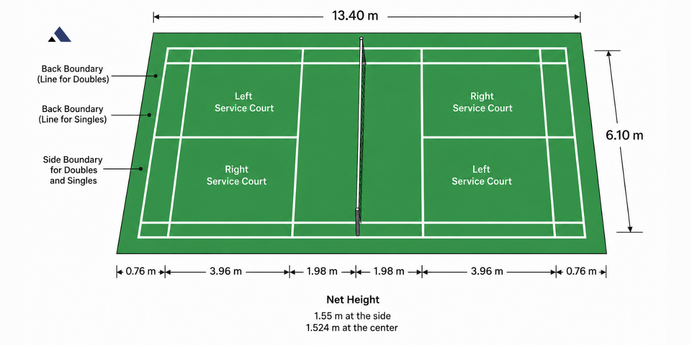
Why the Court Size Differs for Singles and Doubles
Doubles courts are wider (6.1 m) to accommodate four players and lateral movement, while singles courts narrow to 5.18 m for faster, more precise rallies between two players.The extra 0.46 m on each side in doubles creates side alleys used only in doubles play. This design difference significantly influences strategy: doubles emphasize teamwork and coverage, while singles demand greater speed and endurance across the full length.
Detailed Court Markings and Layout Explained
Understanding markings helps players make accurate line calls and builders mark courts correctly.
Key Lines and Distances (from the net):
- Short Service Line: 1.98 m from the net (same for both formats)
- Long Service Line (Doubles): 0.76 m inside the baseline
- Baseline: 6.7 m from the net on each side (total length 13.4 m)
- Center Line: Divides the court into left and right service courts
- Side Lines: Inner for singles (5.18 m total width), outer for doubles (6.1 m total width)
Each half of the court measures 6.7 m long. Service courts are roughly 3.88 -3.96 m deep depending on the format. Proper marking with 40 mm lines ensures visibility under various lighting conditions common in Indian indoor halls.
Comparison Table: Singles vs Doubles Badminton Court
| Measurement | Singles Court | Doubles Court | Difference |
| Length | 13.4 m | 13.4 m | Same |
| Width | 5.18 m | 6.1 m | +0.92 m (doubles wider) |
| Area | 69.41 m² | 81.74 m² | +12.33 m² |
| Diagonal | ~14.37 m | ~14.72 m | Varies |
| Service Court Width | 2.59 m (half) | 3.05 m (half) | Wider in doubles |
| Ideal For | Speed & precision | Teamwork & coverage | Strategic variation |
This table highlights why players must adjust footwork when switching formats.
Badminton Court Size vs Other Sports (Comparison Table)
| Sport | Length (m) | Width (m) | Area (m²) | Key Difference from Badminton |
| Badminton (Doubles) | 13.4 | 6.1 | 81.74 | Fastest racket sport |
| Tennis (Singles) | 23.77 | 8.23 | ~195 | Much larger, slower rallies |
| Volleyball | 18 | 9 | 162 | Higher net, team positioning |
| Table Tennis | 2.74 | 1.525 | ~4.2 | Miniature scale |
| Squash | 9.75 | 6.4 | ~62 | Enclosed walls |
Upgrade Your Sports Court Today
Get premium synthetic acrylic flooring designed for durability, grip, and performance.
Get Free ConsultationBadminton courts remain compact yet demand explosive movement, making them ideal for urban India where space is premium.
Net and Post Specifications
The net stands 1.55 meters high at the posts and 1.524 meters in the center, stretched across the full 6.1 m width.Posts must be 1.55 m high and vertical. The net features a white tape at the top for visibility. In Indian conditions, durable, weather-resistant nets suit both indoor and semi-outdoor setups.
Clearance and Space Requirements for Safe Play
Builders must provide extra space beyond the court lines:
- Side Clearance: Minimum 1.5–2 m on each side
- Back Clearance: Minimum 2 m behind baselines
- Ceiling Height (Indoor): Minimum 9–12 m for overhead clears (higher preferred for elite play)
- Between Courts: Adequate separation to prevent interference
For multi-court facilities in India, planners often allocate 15–18 m length and 8–10 m width per court including margins.
Badminton Court Construction in India 2026: Practical Guide
India’s booming badminton scene, fueled by stars like PV Sindhu and Lakshya Sen, drives demand for quality courts. Key Steps for Construction:
- Site selection with level ground and good drainage.
- Sub-base preparation for stability.
- Flooring: Acrylic (Cushion Layer) or synthetic PVC/PU mats (cost-effective, durable in varying climates).
- Accurate marking per BWF standards.
- Installation of posts, nets, and lighting (minimum 500–1000 lux).
- Ventilation and safety features.
Approximate Costs in India (2026 estimates):
- Basic synthetic Acrylic single court: ₹5–8 lakhs
- Premium wooden indoor court: ₹10–15 lakhs+
- Multi-court facilities with amenities: Significantly higher, varying by location (metros cost more).
Factors like location (e.g., Delhi vs smaller cities), material quality, and additional facilities influence final costs. Always consult BAI-approved contractors for tournament-standard courts.
Future Trends in Indian Badminton Infrastructure (2026)
With growing popularity and events like the India Open, more air-conditioned indoor arenas with multiple standard courts emerge in cities. Hybrid outdoor AirBadminton courts (slightly different dimensions: 16 m x 6 m for doubles) gain traction for community play. Investing in proper court dimensions supports grassroots development and helps India produce more world-class talent.
Conclusion
The standard badminton court size in meters 13.4 m long by 6.1 m wide for doubles and 5.18 m for singles forms the foundation of fair and exciting play. Whether building a new facility, training at a club, or simply understanding the game better, these precise measurements matter.For the latest BAI updates or construction projects in your city, refer to official sources. Accurate dimensions elevate gameplay, reduce injuries, and create professional-standard experiences across India in 2026 and beyond.
Frequently Asked Questions
The official badminton court measures 13.4 meters in length and 6.1 meters in width for doubles, with singles using the same length but 5.18 meters width.
Singles courts are narrower at 5.18 meters wide, while doubles courts extend to 6.1 meters wide to accommodate four players.
The net stands 1.55 meters high at the sides and dips to 1.524 meters at the center.
You need at least 15.4 meters by 7.1 meters (including clearances) for one comfortable standard court.
No, the official BWF and BAI dimensions remain 13.4 m × 6.1 m for doubles and 13.4 m × 5.18 m for singles.
The short service line sits 1.98 meters from the net, and the doubles long service line lies 0.76 meters inside the baseline.