AI Overview
- Standard Size: A single indoor badminton court measures 13.4m × 6.1m; a full regulation hall requires 15m × 8m minimum with 9m ceiling clearance.
- Construction Cost in India (2026): ₹15 lakh – ₹1.5 crore depending on flooring, structure, and number of courts.
- Best Flooring Options: Synthetic PU flooring, wooden maple courts, and acrylic sports surfaces are the top three choices in India.
- Booking Cost: ₹200–₹600/hour per court in Tier-1 cities; ₹100–₹300 in Tier-2 towns.
- Regulatory Body: Badminton Association of India (BAI) sets the official court specifications.
- Top Reason to Build Indoors: Climate control eliminates wind interference, ensuring consistent competitive play year-round.
- ROI Timeline: A 4-court indoor facility typically breaks even in 3–5 years with consistent occupancy above 60%.
Table of contents
- AI Overview: Key Takeaways
- Introduction
- Standard Dimensions & BAI Court Specifications India 2026
- Badminton Court Flooring Types – Performance Comparison & Best Choice India
- Indoor Badminton Court Construction Cost in India 2026
- Lighting, Ventilation & Acoustic Standards for Indoor Badminton Courts
- Comparison Table – Indoor vs Outdoor vs Multi-purpose Badminton Court
- Court Maintenance, Booking & Management – What Every Owner Must Know
- Frequently Asked Questions
- Final Verdict
Introduction
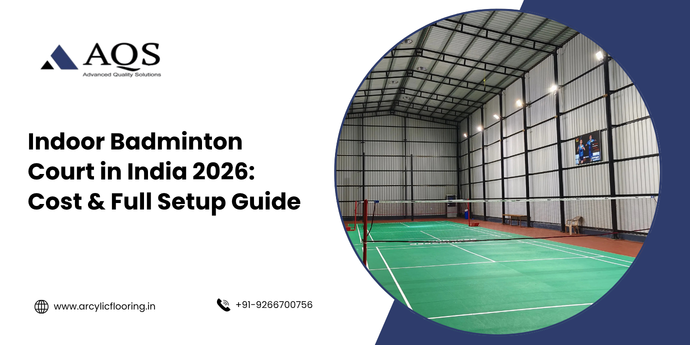
An indoor badminton court is a purpose-built, enclosed playing area designed specifically for badminton – one of the fastest-growing racket sports in India. Unlike outdoor setups, an indoor court provides a fully controlled environment where wind, rain, extreme heat, and dust cannot interfere with the shuttlecock’s trajectory, which travels at speeds exceeding 300 km/h at elite levels. India’s rising sports awareness, increasing government investment under the Khelo India initiative, and the surge in recreational fitness culture have made indoor badminton courts one of the most demanded sports infrastructure assets across the country in 2026.
The core function of an indoor badminton court goes far beyond just a painted rectangle on a floor. It involves precisely engineered flooring systems that absorb impact and protect players from joint injuries, a ceiling of minimum 9 metres to allow full lob shots, calibrated non-glare LED lighting, and walls treated to eliminate shuttlecock-distorting air currents. Whether you are a club owner, a school administrator, a township developer, or a sports entrepreneur, understanding what constitutes a proper indoor badminton court is the essential first step before making any investment decision in this space.
Did You Know?
India currently has over 8.5 lakh registered badminton players, making it the second-largest badminton nation after China. Demand for indoor courts is growing at 18% annually.
The Badminton Association of India (BAI), affiliated with the Badminton World Federation (BWF), mandates specific standards for courts used in official tournaments. However, recreational and club-level indoor courts often follow slightly relaxed specifications, making them more accessible to build. In 2026, with the rise of private sports academies, co-working sports clubs, and integrated township developments in cities like Hyderabad, Pune, Bengaluru, and Noida, the market for indoor badminton court construction has witnessed a dramatic expansion that shows no signs of slowing down.
Standard Dimensions & BAI Court Specifications India 2026
Getting the dimensions right is absolutely non-negotiable when you plan an indoor badminton court. The Badminton World Federation (BWF) and the Badminton Association of India (BAI) define the official court dimensions that every serious facility must adhere to. A singles court measures 13.4 metres in length and 5.18 metres in width, while a doubles court – the more commonly used format – measures 13.4 metres × 6.1 metres. These measurements define the playing area itself, but the total court footprint including buffer zones is significantly larger and must be carefully planned during the architectural phase.
Minimum Hall Dimensions for a Single Indoor Court
For a single indoor badminton court to function safely and allow players to dive, slide, and lunge without hitting walls, the hall must provide at least 1.5-2 metres of buffer space on all four sides of the playing lines. This means the minimum internal hall dimensions for a single court are approximately 15.5 metres in length and 9.0 metres in width. The ceiling clearance above the court surface must be a minimum of 9 metres, which allows a high clear shot to complete its parabolic arc without obstruction. Many elite indoor badminton courts in India now opt for a 12-metre ceiling to accommodate floodlight installations and ventilation systems without compromising the playing zone.
| Measurement Parameter | Doubles Court | Singles Court | Minimum Hall Space |
| Court Length | 13.40 m | 13.40 m | 15.50 m (with buffer) |
| Court Width | 6.10 m | 5.18 m | 9.00 m (with buffer) |
| Ceiling Height | Minimum 9.0 m | Recommended 12 m | |
| Net Height (Centre) | 1.524 m | 1.524 m | – |
| Net Height (Posts) | 1.550 m | 1.550 m | – |
| Service Line (Short) | 1.98 m from net | – | |
| Back Service Line (Doubles) | 0.76 m from baseline | – | – |
Multi-Court Facility Planning – Space Calculation for 4 Courts
Most commercial indoor badminton facilities in India are built for four to six courts to achieve optimal land utilisation and financial viability. A 4-court indoor badminton hall requires a minimum built-up area of approximately 3,200 to 4,000 square feet per court, meaning a total floor area of roughly 12,800 to 16,000 sq ft for four courts, not including changing rooms, reception, lobby, equipment storage, and spectator areas. In major metro cities of India, developers typically acquire 20,000-30,000 sq ft of built-up space to create a full-fledged multi-court badminton complex with support amenities.
Badminton Court Flooring Types – Performance Comparison & Best Choice India
The flooring of an indoor badminton court is the single most critical technical decision in the construction process. It directly affects player safety, game performance, long-term maintenance cost, and the overall reputation of the facility. India’s climate – characterised by extreme heat in summer, high humidity in coastal cities, and temperature swings – demands a flooring solution that performs consistently across these variations. In 2026, four primary flooring types dominate the indoor badminton court market in India, each with distinct advantages and trade-offs that facility owners must evaluate carefully before committing capital.
1. Synthetic PU Sports Flooring – Most Popular Choice
Polyurethane (PU) synthetic flooring has emerged as the most widely installed flooring type for indoor badminton courts in India as of 2026. PU flooring is laid in multiple layers – typically a sub-base of concrete or asphalt, followed by foam cushioning and a finished polyurethane top coat. The surface provides excellent shock absorption (reducing knee and ankle stress by up to 40%), outstanding traction, and consistent ball rebound. PU floors are available in BAI/BWF-approved colours, are easy to clean, resist moisture better than wood, and cost significantly less than premium maple alternatives – making them the top choice for school courts, township facilities, and mid-budget sports clubs across India.
2. Maple Hardwood Flooring – The Elite Standard
Maple hardwood flooring represents the gold standard for elite and professional indoor badminton courts worldwide, and India’s national-level and BWF-approved tournament venues mandate it. The spring-loaded panel system beneath maple planks – often called a “floating floor” – delivers superior energy return and shock absorption that professional players strongly prefer. Maple courts also carry a premium aesthetic value, making them popular in high-end sports clubs and five-star hotel recreational facilities. However, maple floors demand strict climate control (recommended 45-65% humidity), are highly sensitive to water damage, require professional maintenance including periodic sanding and refinishing, and carry a significantly higher cost – typically 2.5 to 3 times more expensive than PU flooring for the same court area.
3. Acrylic Hard Court Surface – Budget-Friendly Option
Acrylic sports surfaces applied over concrete provide the most cost-effective option for indoor badminton courts in India, particularly for schools, municipal facilities, and community sports complexes operating under budget constraints. The installation process involves applying multiple coats of acrylic coating in approved badminton court colours – typically green or blue with white line markings – directly over a well-prepared concrete sub-base. Acrylic courts are durable, low-maintenance, and resistant to Indian climate conditions. However, they offer minimal cushioning compared to PU or wood, placing a higher stress load on players’ joints over extended sessions, which makes them less suitable for daily high-intensity training environments.
4. Vinyl / PVC Roll Flooring – Temporary & Flexible Installations
Vinyl or PVC roll-out flooring designed specifically for badminton has gained significant traction in India’s event and multi-purpose hall market. These portable, roll-out surfaces – often 4mm to 8mm thick – can convert any flat surface into a temporary badminton court in under an hour and can be rolled up and stored when the space is needed for other purposes. They are ideal for multi-purpose auditoriums, school gymnasiums, and event venues that cannot dedicate a permanent space to badminton. However, vinyl roll floors are not recommended as a permanent solution for high-frequency club use as the joins and edges tend to curl over time, and they do not provide the joint-protection performance of PU or wood systems.
| Flooring Type | Cost/Sq Ft (2026) | Durability | Shock Absorption | Maintenance | Best For |
| Synthetic PU | ₹180-₹320 | 15-20 Years | High | Low | Clubs, Academies |
| Maple Hardwood | ₹450-₹900 | 20-30 Years | Highest | High | Elite Tournaments |
| Acrylic Hard | ₹60-₹120 | 8-12 Years | Low | Very Low | Schools, Budget |
| Vinyl / PVC Roll | ₹80-₹180 | 5-8 Years | Medium | Low | Multi-purpose halls |
Indoor Badminton Court Construction Cost in India 2026
One of the most frequently asked questions from prospective court owners and investors is: How much does it cost to build an indoor badminton court in India? The honest answer is that the total project cost is highly variable and depends on a wide range of factors including the number of courts, land/building costs (if applicable), flooring choice, structural type (pre-engineered steel shed vs. RCC building), lighting quality, HVAC systems, and the level of finishing. In 2026, construction material costs have stabilised after the post-COVID price surge, but labour costs and steel prices remain elevated compared to pre-2022 levels.
Cost of a Single Indoor Badminton Court – Basic to Premium
For a single indoor badminton court constructed within an existing building space requiring only flooring, net posts, line marking, and lighting, the investment can be as low as ₹3 lakh to ₹8 lakh depending on flooring type. However, if you are constructing a dedicated hall from scratch with a pre-engineered steel structure, the cost for a single-court facility rises to ₹15 lakh to ₹35 lakh. A premium single-court facility with maple flooring, professional LED lighting, full HVAC, spectator gallery, and premium finishing can cost upwards of ₹60-80 lakh. These figures do not include land cost, which varies enormously by location.
Basic Setup
Acrylic flooring, basic LED lights, no HVAC. Ideal for schools and municipalities.
₹3L – ₹8L / court
Standard Club
PU synthetic floor, full LED, basic ventilation. Most popular format in India.
₹15L – ₹35L / court
Premium / Tournament
Maple wood floor, professional lighting, HVAC, spectator seating, BAI/BWF approved.
₹60L – ₹1.5Cr / court
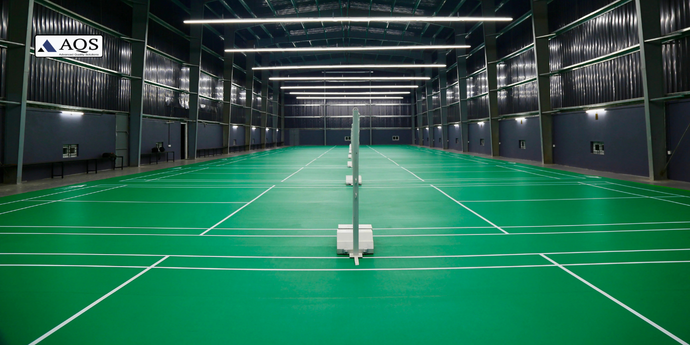
Court Indoor Badminton Complex – Full Cost Breakdown India 2026
| Cost Component | Basic (₹) | Standard (₹) | Premium (₹) |
| Pre-engineered Steel Structure | 18,00,000 | 30,00,000 | 55,00,000 |
| Flooring (4 courts) | 8,00,000 | 22,00,000 | 90,00,000 |
| LED Sports Lighting | 3,50,000 | 8,00,000 | 18,00,000 |
| Net Posts, Nets & Accessories | 80,000 | 1,60,000 | 4,00,000 |
| Ventilation / HVAC | 2,00,000 | 6,00,000 | 20,00,000 |
| Civil Works & Plumbing | 4,00,000 | 8,00,000 | 15,00,000 |
| Changing Rooms, Reception | 2,00,000 | 5,00,000 | 12,00,000 |
| Total Estimated Cost | ₹38.3 Lakh | ₹80.6 Lakh | ₹2.14 Crore |
Important:
The above figures are estimates for 2026 and exclude land costs, legal fees, local authority approvals, and GST. Always obtain at least 3 quotes from certified contractors before finalising your project budget.
Lighting, Ventilation & Acoustic Standards for Indoor Badminton Courts
Beyond flooring and dimensions, three technical systems define the quality and usability of an indoor badminton court: lighting, ventilation, and acoustics. These systems are often underestimated during the planning phase, leading to costly retrofits post-construction. India’s climate, characterised by extreme heat (35-48°C in summers across many states), adds an additional layer of complexity to ventilation design that court designers must address proactively and thoroughly from day one.
LED Sports Lighting Requirements – Lux Levels & Placement
The BWF and BAI specify minimum lux levels for different competition categories of indoor badminton courts. For recreational and club-level courts, a minimum illumination of 500 lux uniformly across the playing surface is mandatory. State and national level competition courts must achieve 750-1000 lux, while international BWF-grade venues require 1,500 lux or above with uniformity ratios exceeding 0.7. In India’s indoor badminton court installations in 2026, LED sports flood lights with a colour temperature of 5,000-6,500K (cool white) and a high CRI (Color Rendering Index) of 80+ are the recommended specification. Proper lighting also eliminates glare, which can fatally disrupt a player’s tracking of the fast-moving shuttlecock during overhead smash plays.
Ventilation Design – Fighting India’s Heat in Indoor Courts
Ventilation is arguably the most India-specific engineering challenge in indoor badminton court design. A fully sealed, air-conditioned court eliminates wind interference entirely but carries very high HVAC capital and operating costs. Most cost-conscious Indian facility developers opt for a hybrid ventilation approach – positioning high-capacity exhaust fans at ceiling level on the sidewalls, supplemented by HVLS (High-Volume Low-Speed) fans positioned above the court. This system maintains air movement for player comfort while keeping velocities below the 0.2 m/s wind speed limit that begins to affect shuttlecock flight. Full air-conditioned courts, common in high-end metro clubs, cost ₹15-25 lakh extra for a 4-court setup but justify the cost through extended peak-hour usage in India’s intense summer months.
Comparison Table – Indoor vs Outdoor vs Multi-purpose Badminton Court
Choosing between an indoor, outdoor, or multi-purpose badminton court setup is often the most consequential decision for facility developers and institutional buyers. Each option carries fundamentally different cost structures, user experiences, and long-term performance characteristics. The following comprehensive comparison table is designed to help you make a data-driven decision aligned with your specific goals, budget, and location constraints in India’s 2026 market environment.
| Feature | Indoor Court | Outdoor Court | Multi-purpose Hall |
| Weather Dependency | None | High | None |
| Wind Interference | Zero | Significant | Low |
| Construction Cost | High | Low | Medium |
| Flooring Quality | Premium | Basic | Medium |
| Year-round Usability | 100% | 60-70% | 95%+ |
| Player Injury Risk | Low | Higher | Medium |
| Revenue Potential | Highest | Low | Medium |
| Tournament Eligibility | Full | Limited | Partial |
| Maintenance Cost | Medium | Low | Medium |
Quick Decision Guide – Which Indoor Court Is Right for You?
School / College / Municipal Body
Choose acrylic hard court or basic PU flooring. Budget ₹5-12 lakh per court. Focus on safety markings and basic LED lighting rather than premium finishes.
Private Sports Club / Academy
Standard PU synthetic flooring is ideal. Budget ₹20-40 lakh per court. Invest in good ventilation and 750-lux LED lighting to attract serious players and membership.
Tournament / State-Level Facility
Maple hardwood flooring is mandatory for BAI-recognised events. Budget ₹60 lakh-₹1.5 crore per court. Full HVAC and 1,000+ lux professional lighting required.
Residential Township / Hotel
2-4 PU courts with premium finishing and lounge area. Budget ₹50-80 lakh total. High aesthetic value drives resident satisfaction and brand differentiation.
Commercial Sports Entrepreneur
4-8 PU courts with coaching services, café, and membership model. Budget ₹1-3 crore. Target 60%+ occupancy within 6 months for a healthy 3-5 year ROI.
Court Maintenance, Booking & Management – What Every Owner Must Know
Building a world-class indoor badminton court is only the beginning of the journey. The long-term performance of your facility depends equally on how well you maintain the courts, manage bookings, train staff, and market your services in the highly competitive 2026 Indian sports facility market. Operators who invest proactively in maintenance and digital booking infrastructure consistently outperform those who treat these aspects as afterthoughts, achieving occupancy rates that are 25-30% higher than the industry average.
Indoor Badminton Court Maintenance Schedule – India Climate-Adapted
India’s climate – particularly the monsoon humidity and summer heat – demands a disciplined, structured maintenance protocol for indoor badminton courts that differs from global best practices. PU synthetic floors should be dry-mopped daily to remove dust and sweat deposits that reduce traction and accelerate surface degradation. A wet clean with a pH-neutral sports floor cleaner should be performed weekly. Quarterly, the court surface should be inspected for micro-cracks, lifting edges, or discolouration – common in humid coastal cities like Mumbai, Chennai, and Kochi. The net tension, post anchors, and line marking should be inspected monthly and refreshed annually. Maple hardwood courts require additional humidity monitoring (45-65% RH year-round) and professional sanding and re-sealing every 7-10 years in Indian conditions.
Digital Court Booking Systems & Revenue Optimisation India 2026
In 2026, successful indoor badminton courts in India operate through integrated digital booking platforms. Apps like Playo, Sportz Village, Hudle, and BookMyCourt have become standard channels through which urban players discover and book courts, eliminating the walk-in booking model that dominated just five years ago. Facility owners who list on multiple platforms while also maintaining their own booking website and WhatsApp group report 35-45% higher occupancy than those relying on walk-ins alone. Dynamic pricing – charging 20-30% premium during peak hours (6-8am, 6-10pm on weekdays; all day on weekends) – is now a widely adopted revenue maximisation strategy among premium indoor badminton facilities in metro India.
| City / Tier | Peak Hour Rate (₹/hr) | Off-Peak Rate (₹/hr) | Monthly Membership | Coaching Fee/hr |
| Mumbai / Delhi / Bengaluru | ₹500-₹700 | ₹250-₹400 | ₹2,500-₹6,000 | ₹600-₹1,500 |
| Hyderabad / Pune / Chennai | ₹400-₹550 | ₹200-₹350 | ₹2,000-₹4,500 | ₹500-₹1,200 |
| Tier-2 Cities (Jaipur, Indore, Lucknow) | ₹250-₹400 | ₹150-₹250 | ₹1,200-₹2,500 | ₹300-₹700 |
| Tier-3 / Small Towns | ₹150-₹250 | ₹100-₹175 | ₹700-₹1,500 | ₹200-₹500 |
Government Subsidies & Khelo India Funding for Indoor Courts
India’s national sports infrastructure push under the Khelo India programme and the Ministry of Youth Affairs and Sports provides significant grant-in-aid for building indoor sports facilities, including badminton courts, across states. Under various Khelo India schemes operational in 2026, eligible institutions – including schools, universities, state sports authorities, and registered sports clubs – can access grants ranging from ₹5 lakh to ₹5 crore for sports infrastructure development. The Sports Authority of India (SAI) also operates the Urban Sports Infrastructure Scheme (USIS), which has approved indoor badminton court projects in over 200 cities across India. Private entities and PPP (Public-Private Partnership) models are increasingly being recognised for grant eligibility, making government funding a viable option for commercial sports entrepreneurs with the right project structure.
Pro Tip for Entrepreneurs
Partnering with a registered school or university for a PPP indoor badminton court model significantly improves your chances of qualifying for Khelo India subsidies, which can reduce your capital investment by 20-40%.
Your Indoor Badminton Court’s Online Discoverability
If you operate or are planning an indoor badminton court facility in India, targeting the right LSI (Latent Semantic Index) keywords in your digital content strategy is essential to ensure your facility appears in local Google searches. Beyond the primary keyword “indoor badminton court,” players and clients in India consistently search for terms like badminton court near me, badminton court booking online, badminton court on rent per hour, badminton flooring cost India, synthetic sports flooring badminton, badminton court construction contractor, Khelo India sports facility grant, BWF approved court India, indoor sports complex near me, badminton academy with indoor court, and badminton flooring manufacturer India. Embedding these terms naturally into your website, Google Business profile, and social media content can dramatically increase organic footfall to your facility.
Frequently Asked Questions
A standard doubles indoor badminton court measures 13.4 metres × 6.1 metres, with a minimum ceiling height of 9 metres as per BWF and BAI specifications.
Building a single indoor badminton court in India costs between ₹3 lakh (basic acrylic) and ₹80 lakh+ (premium maple wood), depending on flooring, structure, and amenities.
PU synthetic flooring is the best all-round choice for Indian conditions, offering excellent shock absorption, climate resistance, and affordability at ₹180-₹320 per sq ft.
Yes – schools, universities, and registered sports clubs can apply for grants under the Khelo India programme and SAI’s Urban Sports Infrastructure Scheme (USIS) for up to ₹5 crore.
A standard 4-court indoor badminton complex using a pre-engineered steel structure takes approximately 12–20 weeks from groundbreaking to court-ready completion.
Court booking rates range from ₹150-₹300/hr in Tier-3 towns to ₹400-₹700/hr during peak hours in metro cities like Mumbai, Delhi, and Bengaluru
Final Verdict
The answer, backed by market data, government policy trends, and real-world case studies, is an emphatic yes provided you plan intelligently. India’s badminton infrastructure remains significantly underdeveloped relative to its population of badminton enthusiasts. With over 8.5 lakh registered players and tens of millions of casual players nationwide, the demand for quality indoor badminton courts in 2026 far outstrips the supply in most cities. The combination of a growing health-conscious urban middle class, government sports funding, rising youth sports participation, and the inspirational effect of Indian badminton champions on the global stage creates a uniquely favourable investment environment for indoor badminton court development.
Whether you invest ₹8 lakh in a basic school court or ₹2 crore in a premium 6-court commercial complex, the key to success lies in three non-negotiable elements: the right flooring system for your use case, professional-grade lighting and ventilation, and a smart occupancy-driving digital strategy. Facilities that get these three pillars right consistently outperform their financial projections and become anchor sports facilities in their communities delivering both commercial returns and meaningful social impact for India’s growing sporting culture.