What Are the Length and Breadth of a Badminton Court?
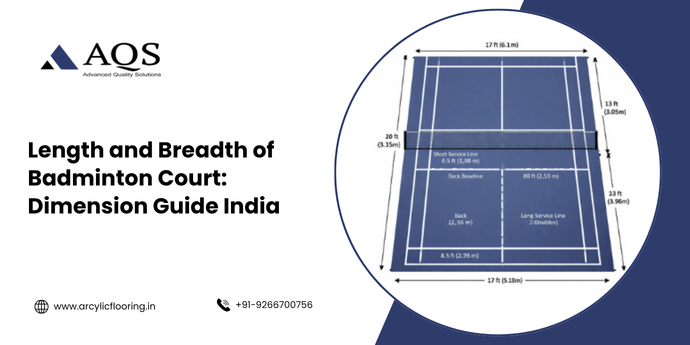
The standard length and breadth of a badminton court is 13.40 metres (44 feet) long and 6.10 metres (20 feet) wide for doubles play. For singles matches, the length remains 13.40 metres but the width reduces to 5.18 metres (17 feet). These dimensions are set by the Badminton World Federation (BWF) and are followed uniformly across India and the world. The net stands at 1.55 metres at the posts and 1.524 metres at the centre. All court lines must be 40 mm wide, painted in white or yellow. In India in 2026, a professional indoor badminton court installation costs between ₹15 lakh to ₹60 lakh depending on flooring choice, structure type, and amenities. Outdoor courts cost between ₹3 lakh to ₹12 lakh.
Table of contents
- What Are the Length and Breadth of a Badminton Court?
- Introduction
- Official Length and Breadth of Badminton Court – BWF Standards 2026
- Badminton Court Layout – Line Markings and Zones Explained
- Badminton Court Flooring – Materials, Types & Performance
- Badminton Court Material – Net, Posts & Boundary Markers
- Badminton Court Installation Cost in India 2026
- Space Planning – Total Area Required for a Badminton Court
- Common Mistakes to Avoid When Building a Badminton Court in India
- Understanding Related Concepts for Badminton Court Specification
- Comparison Table – Indoor vs Outdoor Badminton Court India 2026
- Maintenance of Badminton Court Flooring in India
- Government Schemes Supporting Badminton Court Construction in India 2026
- Frequently Asked Questions (FAQs)
- Conclusion
Introduction
Badminton is one of India’s most widely played indoor sports. From school gymnasiums in Delhi and Mumbai to professional academies in Hyderabad and Bengaluru, the demand for correctly built badminton courts has skyrocketed in 2026. Understanding the length and breadth of a badminton court is not merely an academic exercise – it directly affects player performance, safety, and the commercial viability of a sports facility.
India follows the Badminton World Federation (BWF) standards for all competitive and semi-professional courts. These dimensions ensure that a player trained in Lucknow performs on the exact same surface geometry as an athlete competing at the All England Open in Birmingham. Whether you are a facility developer, school administrator, sports architect, or a passionate player planning a home court, this guide delivers every measurement, material specification, flooring option, and installation cost you need – all updated for India in 2026.
The explosive growth of badminton in India has been accelerated by champions like PV Sindhu, Lakshya Sen, and Saina Nehwal. The government’s Khelo India programme has further fuelled demand for certified courts across Tier 1, Tier 2, and Tier 3 cities. In this environment, getting the court dimensions right from the start is not optional – it is the foundation of everything else.
Official Length and Breadth of Badminton Court – BWF Standards 2026
The Badminton World Federation (BWF) defines the official dimensions for badminton courts used in all national and international competitions. India’s Badminton Association of India (BAI) mandates these same standards for registered facilities. The measurements below apply to both indoor and outdoor courts across India.
Standard Badminton Court Dimensions (BWF 2026)
| Parameter | Metres | Feet / Inches | Applies To |
| Court Length | 13.40 m | 44 ft | Singles & Doubles |
| Court Width (Doubles) | 6.10 m | 20 ft | Doubles only |
| Court Width (Singles) | 5.18 m | 17 ft | Singles only |
| Net Height – Posts | 1.55 m | 5 ft 1 in | Both sides |
| Net Height – Centre | 1.524 m | 5 ft | Centre |
| Short Service Line from Net | 1.98 m | 6 ft 6 in | Both sides |
| Long Service Line (Doubles) | 0.76 m from back | 2 ft 6 in | Doubles only |
| Half-Court Length | 6.70 m | 22 ft | Each half |
| Total Playing Area (Doubles) | 81.74 sq.m | 880 sq.ft | Doubles |
| Line Width | 40 mm | 1.57 in | All lines |
| Minimum Ceiling Height | 9.10 m | ~30 ft | Indoor courts |
| Safety Run-Off Zone | ≥ 0.61 m | ≥ 2 ft | All sides |
Key Rule: The length of a badminton court (13.40 m) stays the same for both singles and doubles play. Only the width changes – from 6.10 m (doubles) to 5.18 m (singles). Courts in India must maintain these BWF-certified measurements to qualify for BAI-affiliated tournaments.
Understanding the Diagonal Measurement
Professional court installers in India use the diagonal measurement as the single most reliable way to verify a perfectly rectangular court. A properly laid doubles court must have a diagonal of approximately 14.72 metres. If both diagonals match this figure, the court is geometrically accurate. A mismatch means the court is a parallelogram, which affects gameplay angles and may disqualify the facility from hosting registered tournaments. This technique is standard practice among certified badminton court builders in Bengaluru, Hyderabad, and Delhi in 2026.
Upgrade Your Sports Court Today
Get premium synthetic acrylic flooring designed for durability, grip, and performance.
Get Free ConsultationSingles vs Doubles Court – Key Differences
Many players confuse the boundary rules when switching between singles and doubles. The most critical difference is the width usage. In singles, players use the narrow court (5.18 m width) but use the full back boundary line for service. In doubles, players use the wider court (6.10 m) but must observe the shorter service line – 0.76 m from the back boundary. These distinctions significantly alter the tactical shape of each match and are the primary reason most professionally built courts in India mark all boundary lines simultaneously to support both game formats.
Badminton Court Layout – Line Markings and Zones Explained
A complete understanding of the badminton court layout goes beyond just the outer boundary. Every line on the court carries a specific tactical and regulatory function. All lines are 40 mm wide, form part of the playing zone they define, and should contrast sharply with the surface colour – typically white or yellow on green or blue acrylic courts across India.
Badminton Court Line Markings and Their Functions
| Line Name | Position / Measurement | Purpose |
| Back Boundary Line | End of court – 13.40 m from opposite end | Outer boundary for all play |
| Long Service Line (Singles) | Back boundary line itself | Max service distance for singles |
| Long Service Line (Doubles) | 0.76 m inside the back boundary | Max service distance in doubles |
| Short Service Line | 1.98 m from the net | Minimum service distance – both formats |
| Centre Line | Divides court lengthwise | Splits service courts (left & right) |
| Singles Sideline | 5.18 m width boundary | Outer edge for singles play |
| Doubles Sideline | 6.10 m width boundary | Outer edge for doubles play |
| Net Line | Centre of court length | Indicates net position |
Service Courts – Left and Right Boxes
The centre line divides each half of the court into a right service court and a left service court. In singles play, the serve travels diagonally – from the right box on one side to the right box on the other when the server’s score is even, and left-to-left when the score is odd. In doubles, the same diagonal rule applies, but the service area is bounded by the short service line at the front and the doubles long service line at the back. Indian academies invest in high-contrast line markings specifically to help young players visualise these zones quickly during fast-paced rally transitions.
Badminton Court Flooring – Materials, Types & Performance
The badminton court flooring you choose determines player safety, ball (shuttlecock) bounce, joint stress, and the lifespan of the facility. In India 2026, the sports flooring market offers four primary badminton court flooring options – each with distinct performance and cost profiles. Selecting the right flooring is one of the most consequential decisions in any court construction project.
Synthetic Acrylic Flooring
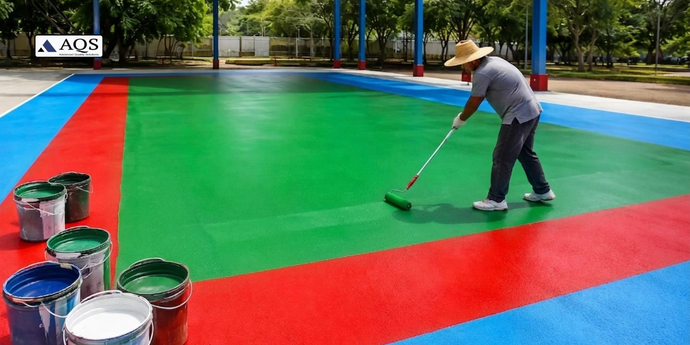
Synthetic acrylic flooring has emerged as the most widely installed badminton court material in India for both outdoor and semi-professional indoor courts. The multi-layer acrylic system – typically consisting of a concrete base, cushioning layer, and multiple acrylic coats – delivers consistent ball speed, excellent grip, and UV resistance. Facilities across Chennai, Pune, and Jaipur report that acrylic surfaces require resurfacing only every five to seven years. The surface provides the ideal balance of player comfort and competitive playability. Most BWF-affiliated tournaments in India use this surface for outdoor events and training academy courts.
Wooden (Maple/Teak) Flooring
Wooden courts – particularly those made from Canadian Hard Maple or FSC-certified Teak – represent the gold standard for professional and premium indoor badminton courts. The natural spring of wood significantly reduces knee and ankle stress over long training sessions. Professional badminton halls in Delhi, Mumbai, and Bengaluru prefer engineered wood flooring systems with an air-cushion sub-floor layer that absorbs impact up to 65%. The primary drawback is moisture sensitivity: wooden courts in India require dehumidifiers during monsoon months and polishing every one to two years. The higher upfront cost is justified by the superior playing experience and durability of 15–25 years.
PVC / Vinyl Flooring
PVC vinyl badminton court flooring is a cost-effective alternative popular in school gymnasiums, residential buildings, and recreational facilities. Available in rolls or interlocking tiles, PVC flooring is quick to install, waterproof, and easy to maintain. Thicknesses typically range from 4.5 mm to 9 mm, with thicker variants offering better cushioning. The surface provides reasonable grip and consistent shuttlecock flight, though it does not match the playing feel of wood or premium acrylic for competitive play. PVC courts are particularly common in Tier 2 and Tier 3 cities in India where budget constraints limit capital expenditure.
Rubber PU Flooring
Rubber PU (polyurethane) flooring is a specialised option that provides outstanding shock absorption – making it highly suitable for multipurpose sports halls and academies focusing on injury prevention. The material’s density can be customised to match BWF impact absorption standards. While rubber PU flooring costs more than PVC and is softer underfoot than wood or acrylic, it significantly reduces the risk of stress fractures and shin splints in young players. Several Khelo India-funded centres across states like Uttar Pradesh, Maharashtra, and Tamil Nadu have adopted rubber PU surfaces for their junior badminton programmes in 2025–2026.
Badminton Court Flooring Comparison
| Flooring Type | Best For | Cost/Sq.Ft (₹) | Lifespan | Maintenance | BWF Level |
| Synthetic Acrylic | Outdoor & Training Courts | ₹150–₹250 | 8–12 years | Low | BWF Approved |
| Maple/Teak Wood | Professional Indoor | ₹350–₹600 | 15–25 years | Medium-High | BWF Approved |
| PVC/Vinyl | Schools & Recreation | ₹80–₹150 | 5–8 years | Very Low | Training Level |
| Rubber PU | Injury Prevention / Juniors | ₹200–₹350 | 10–15 years | Low | Conditional |
Upgrade Your Sports Court Today
Get premium synthetic acrylic flooring designed for durability, grip, and performance.
Get Free ConsultationBadminton Court Material – Net, Posts & Boundary Markers
The badminton court material conversation extends beyond just the floor. Every structural and boundary component plays a specific role in ensuring regulation play. A court built to BWF standards requires careful selection of nets, posts, shuttlecock types, and lighting systems – all of which directly impact the experience of players and the reputation of the facility.
Net Specifications
The official badminton net must be made of fine cord natural or synthetic fibre – the mesh must be 15 mm to 20 mm in size. The top of the net carries a white tape (75 mm wide) folded over a cord or cable running through it. Net posts stand exactly on the doubles sideline (6.10 m apart) and must be firm enough that the net does not sag during play. The post height is fixed at 1.55 metres. In India, imported professional nets from brands like Yonex, Victor, and Li-Ning are widely used for tournament courts, while domestic manufacturers supply entry-level nets for school and community facilities.
Lighting Requirements for Indoor Courts
Lighting is a critical but often underestimated component of badminton court material planning in India. Professional indoor courts require a minimum of 500 lux of uniform illumination at the floor level for competitive play, and 300 lux for training courts. LED sports lighting systems – glare-free and uniformly distributed across the court – are the industry standard in 2026. A typical 2-court badminton hall in India needs 16 to 24 LED fixtures at the correct angle and height to eliminate shadows on the shuttle’s flight path. Poor lighting is one of the top reasons shuttlecocks are missed in the back court, particularly in high-ceiling halls.
Badminton Court Installation Cost in India 2026
The badminton court installation cost in India varies significantly based on the type of court (indoor or outdoor), choice of flooring, structural requirements, city, and additional amenities. In 2026, rising construction material prices and increased demand from private academies, housing societies, and government sports schemes have pushed project budgets upward. However, strategic planning and the right choice of materials can still deliver a high-quality court within a defined budget.
Badminton Court Installation Cost Guide
| Court Type | Flooring | Cost per Court | Total Project Cost* |
| Outdoor Basic | Concrete + Acrylic | ₹3–₹5 lakh | ₹3–₹8 lakh |
| Outdoor Premium | Multi-layer Acrylic | ₹5–₹12 lakh | ₹8–₹15 lakh |
| Indoor Basic | PVC / Synthetic | ₹15–₹25 lakh | ₹20–₹35 lakh |
| Indoor Mid-Range | Acrylic + Steel Structure | ₹25–₹45 lakh | ₹35–₹60 lakh |
| Indoor Premium | Maple Wood + AC + Gallery | ₹50–₹80 lakh | ₹80 lakh–₹1.2 cr |
| Multi-Court Complex (3+ courts) | Mixed | ₹20–₹40 lakh/court | ₹60 lakh–₹2.5 cr |
Total project cost includes civil work, flooring, lighting, net posts, line markings, and basic ventilation. Excludes land cost.
Key Cost Components Breakdown
Building a badminton court in India involves six primary cost heads. First, civil and base work – levelling, compaction, and laying a concrete sub-base accounts for 25–35% of the total budget. Second, flooring material and installation forms 30–40% of costs, with wooden floors being the most expensive and PVC the most affordable. Third, steel structure or shed for indoor courts – a critical cost, ranging from ₹800 to ₹1,500 per sq.ft for a minimum 30-foot clear height – often represents the single largest expense line item. Fourth, LED lighting adds ₹1 lakh to ₹3 lakh per court. Fifth, ventilation and air circulation systems cost between ₹1 lakh and ₹5 lakh. Sixth, finishing work including line markings, net posts, boundary walls, and changing rooms rounds out the investment.
ROI Potential – Can a Badminton Court Be a Business?
India’s rapidly expanding recreational sports market makes badminton courts a viable commercial investment in 2026. A single indoor badminton court in a metro city like Delhi, Bengaluru, or Hyderabad can generate between ₹50,000 to ₹2 lakh per month through hourly bookings, coaching programmes, tournament hosting, and annual memberships. A well-managed 3-court indoor facility with proper marketing can achieve full return on investment within four to seven years, depending on land cost and operational efficiency. Cities with a high density of IT professionals and school-going children – like Pune, Gurugram, and Navi Mumbai – report the highest court utilisation rates.
Quick Decision Guide – Which Badminton Court Setup Should You Build?
School / Community
Choose outdoor acrylic or PVC indoor. Budget: ₹3–₹15 lakh. Focus on BWF dimensions, 300 lux lighting, and low-maintenance flooring.
Academy / Club
Choose indoor with acrylic or PVC synthetic surface. Budget: ₹25–₹45 lakh per court. Prioritise ceiling height, LED lighting, and proper ventilation.
Residential / Personal
Outdoor acrylic or indoor PVC. Budget: ₹5–₹20 lakh. Focus on safety run-off zones, drainage, and UV-resistant materials.
Professional / Tournament
Indoor maple wood floor with full amenities. Budget: ₹60 lakh–₹1.2 cr. Requires BWF inspection, 500 lux lighting, and spectator seating.
Space Planning – Total Area Required for a Badminton Court
Many facility planners in India make the critical mistake of calculating only the playing area (13.40 m × 6.10 m) when planning their court. BWF regulations and practical safety standards require substantial additional clearance. The total recommended area for a single badminton court – including minimum safety run-off on all sides – is approximately 15.5 metres long × 8.1 metres wide, giving a minimum footprint of roughly 125 square metres (approximately 1,350 sq.ft).
For multi-court facilities – the standard in Indian badminton academies – a buffer zone of at least 1 metre between adjacent courts is mandatory, with 2 metres preferred. A three-court indoor hall in India typically requires a minimum floor area of 500 to 600 sq.ft per court for the playing area, with an overall hall size of at least 25 metres × 18 metres to accommodate three full doubles courts comfortably with safety clearance, spectator walkways, and equipment storage.
Critical Warning: Never build a badminton court with less than 0.61 metres of safety run-off on any side. Insufficient clearance around the court is one of the leading causes of player injury during competitive play in India. Courts built without proper run-off zones will not receive BAI tournament certification.
The Pune Badminton Academy: From Empty Warehouse to BWF-Certified Facility in 2025
In early 2025, a group of three badminton enthusiasts in Pune’s Wakad locality decided to convert a 7,500 sq.ft industrial warehouse into a professional four-court indoor badminton facility. Their goal was to serve the growing population of IT professionals and school students in the area with a BWF-standard training environment.
The Challenge: The warehouse had an existing concrete floor with uneven levels and a ceiling height of only 28 feet – two feet below the BWF-recommended 30 feet. The owners had a total construction budget of ₹1.2 crore, including building modifications, flooring, lighting, and amenities.
The Solution: Working with a certified sports flooring contractor from Pune, the team chose synthetic acrylic flooring over a resurfaced concrete base – a cost-effective decision that saved approximately ₹15 lakh compared to wooden flooring. The steel structure was modified at the roof to achieve the 30-foot minimum clearance at a cost of ₹12 lakh. Professional-grade LED lighting (500 lux, 24 fixtures) was installed for ₹4.2 lakh. All four courts were marked with singles and doubles lines in high-contrast white on a dark green acrylic surface, exactly as per BWF specifications of 13.40 m × 6.10 m with 40 mm line width.
The Result: The facility opened in October 2025 with all four courts certified by the Maharashtra Badminton Association. Within three months of opening, it achieved 80% daily utilisation through hourly bookings and three coaching batches. Revenue in the first operational quarter exceeded ₹4.5 lakh, putting the facility on track to recover its investment within six years. The owners report that the decision to invest in proper court dimensions and certified flooring – rather than cutting corners – directly resulted in attracting a professional coaching partnership with a national-ranked player as the head coach.
Key Lesson: Correct court dimensions and certified flooring materials are not a cost – they are the primary marketing differentiator for any badminton facility in India’s increasingly competitive sports infrastructure market in 2026.
Common Mistakes to Avoid When Building a Badminton Court in India
Across India, hundreds of badminton courts are built each year that fail to meet BWF standards due to avoidable planning and execution errors. Understanding these pitfalls helps facility owners save time, money, and player trust. The most common mistakes include ignoring the minimum ceiling height requirement of 9.1 metres (30 feet) for indoor courts – a specification that directly affects shuttlecock trajectory during overhead clears and smashes. Many developers discover this error only after the steel structure is already erected, leading to expensive modifications.
Another frequent error is using non-certified flooring materials to reduce initial cost. Courts built with standard ceramic tiles, regular PU paint, or rough concrete offer zero shock absorption, cause premature joint injuries in regular players, and do not produce the correct shuttlecock rebound characteristics. Such courts cannot receive BAI affiliation. A third mistake is building without adequate drainage for outdoor courts – India’s monsoon season makes proper slope and drainage channels essential to prevent waterlogging and surface cracking. Finally, many court builders underestimate the importance of a consistent playing surface temperature – acrylic surfaces in outdoor courts can become dangerously slippery when wet and need textured anti-slip top coats as standard in all Indian installations.
Understanding Related Concepts for Badminton Court Specification
Badminton Court Size in Feet and Metres
Players and architects across India search for badminton court dimensions in multiple unit systems. The badminton court size in feet is 44 feet × 20 feet for doubles and 44 feet × 17 feet for singles. In metres, the same measurements are 13.40 m × 6.10 m and 13.40 m × 5.18 m respectively. The total area of a doubles court is 880 square feet (81.74 square metres). These figures are fixed globally – whether you plan a court in Chandigarh or Chennai, the measurements never change as per BWF regulations.
Standard Size of Badminton Court for Schools in India
Schools across India increasingly incorporate badminton as part of their Physical Education curriculum under the National Education Policy 2020. A standard school badminton court follows the identical BWF dimensions – there is no separate “school size” badminton court. However, school halls with limited space often accommodate a reduced-clearance singles court (5.18 m × 13.40 m) with at least 0.5 m of peripheral clearance on each side. Khelo India guidelines recommend that all new school sports halls include provisions for at least two full doubles courts. PVC flooring is the most common choice for school courts in India due to its low cost and easy maintenance.
Badminton Court Net Height – Why Precision Matters
The net height in badminton is precise by design – 1.55 metres at the posts and 1.524 metres at the centre. This slight sag of 26 mm creates a strategic geometry: net shots played down the centre carry a marginally lower net than those played down the line. Elite Indian players like Lakshya Sen and HS Prannoy deliberately exploit this geometry with deceptive cross-net drops. For facility developers, net post anchoring must be firm and permanent – adjustable or wobbly posts are a common cause of net height variation that compromises fair play.
Indoor vs Outdoor Badminton Court – Which Is Right for India?
India’s diverse climate creates a strong case for indoor courts wherever competitive play is intended. Badminton shuttlecocks are extraordinarily sensitive to air movement – even a 1 km/h breeze at ground level can alter the flight path of a feather shuttle by up to 30 cm. This makes outdoor badminton genuinely unplayable in windy conditions. However, outdoor courts serve an important purpose for community play, school grounds, and residential societies where indoor construction is not feasible. Nylon shuttlecocks – more durable and wind-resistant than feather – are the pragmatic choice for outdoor play across India.
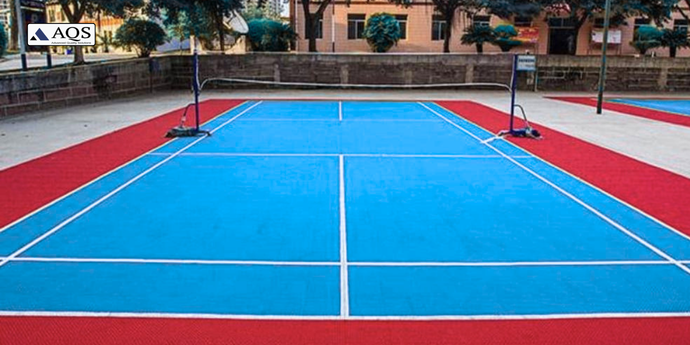
Comparison Table – Indoor vs Outdoor Badminton Court India 2026
| Parameter | Indoor Court | Outdoor Court |
| Court Dimensions | 13.40 m × 6.10 m (same) | 13.40 m × 6.10 m (same) |
| Flooring | Wood, Acrylic, PVC, Rubber PU | Acrylic, Concrete, PVC tiles |
| Construction Cost | ₹15–₹80 lakh per court | ₹3–₹12 lakh per court |
| Weather Dependency | None – all-season play | High – rain and wind disruptive |
| Suitable For | Competitive, academy, professional | Recreational, community, school |
| Maintenance (Annual) | ₹1–₹5 lakh | ₹30,000–₹1 lakh |
| Lifespan | 15–25 years (with maintenance) | 5–10 years |
| Revenue Potential | High – ₹50K–₹2L/month | Low to Moderate |
| BAI Tournament Eligibility | Yes (with certification) | Limited |
| Ideal Indian Cities | Delhi, Mumbai, Bengaluru, Hyderabad | Tier 2 & 3 cities, residential areas |
Maintenance of Badminton Court Flooring in India
Proper maintenance of badminton court flooring is as important as the initial installation quality. In India’s climate – characterised by extreme heat in summer, high humidity in monsoon months, and dust in winter – surfaces degrade faster than in temperate countries. Acrylic surfaces require annual inspection for cracks, blistering, and colour fade, with full resurfacing every five to seven years. Wooden floors need polishing every one to two years and a dehumidification protocol during monsoon to prevent warping and mould growth. PVC surfaces require weekly cleaning with pH-neutral cleaners and immediate repair of cuts or bubbles. The annual maintenance budget for a three-court indoor facility in India ranges from ₹1 lakh to ₹5 lakh, depending on surface type and usage intensity. Facilities that neglect maintenance report significantly higher player injury rates and faster surface degradation.
Government Schemes Supporting Badminton Court Construction in India 2026
The Government of India has significantly increased its investment in sports infrastructure through 2025 and 2026. The Khelo India Urban Sports Infrastructure Development Scheme allocates funds for constructing and upgrading sports facilities in urban local bodies, including badminton courts. Under this scheme, state governments receive grants to build multi-court indoor badminton halls in district sports complexes, following BWF-certified dimensions and approved flooring specifications. Additionally, the Sports Authority of India (SAI) maintains technical standards documents that specify the exact length and breadth of badminton courts for all government-funded projects. Private schools and coaching academies that partner with state badminton associations can access subsidised material procurement through approved suppliers in 2026.
Frequently Asked Questions (FAQs)
The standard length is 13.40 metres (44 feet) and the breadth is 6.10 metres (20 feet) for doubles, or 5.18 metres (17 feet) for singles as per BWF standards followed in India.
Synthetic acrylic flooring is the most popular and cost-effective choice for Indian courts in 2026, offering UV resistance, low maintenance, and consistent performance; maple wood flooring is preferred for professional indoor facilities.
Outdoor badminton courts cost between ₹3 lakh and ₹12 lakh, while indoor courts range from ₹15 lakh to over ₹1 crore depending on flooring type, structure, lighting, and amenities.
The length (13.40 m) remains the same for both formats; only the width changes – 5.18 m for singles and 6.10 m for doubles, with different service line rules applying to each format.
The BWF-recommended minimum ceiling height for indoor badminton courts is 9.1 metres (approximately 30 feet) to ensure shuttlecocks travel freely during overhead smashes and high clears.
All lines on a BWF-standard badminton court must be exactly 40 mm (approximately 1.57 inches) wide, painted in white or yellow to contrast with the court surface colour.
Conclusion
The length and breadth of a badminton court – 13.40 metres × 6.10 metres for doubles and 13.40 metres × 5.18 metres for singles form the non-negotiable foundation of every badminton court project in India. These BWF-certified dimensions are fixed, universal, and directly tied to player safety, competitive fairness, and facility certification. Getting them right from the beginning is the most important decision any court developer, school administrator, or sports entrepreneur will make.
Beyond dimensions, the choices around badminton court flooring, badminton court material, and overall badminton court installation cost define the long-term value of the facility. Synthetic acrylic flooring delivers the best cost-to-performance ratio for most Indian conditions. Wooden courts are the premium choice for serious academies and professional halls. PVC serves recreational and school environments effectively. In every case, investing in certified materials and professional installation pays back through player satisfaction, tournament eligibility, and reduced long-term maintenance expense.
India’s badminton ecosystem in 2026 is stronger than ever – driven by government schemes, world-class Indian players, and a rapidly growing middle class with disposable income for premium sports experiences. Whether you build one court or ten, aligning with BWF standards and investing in quality flooring is not a luxury – it is the smartest business decision you can make in India’s booming sports infrastructure market.