Every athlete deserves a world-class surface beneath their feet – and every stadium builder deserves the clearest cost picture before breaking ground. Running Track Construction Cost in India (2026)
- Standard 400m synthetic track: ₹1.2 Crore – ₹4.5 Crore
- Polyurethane (PU) track per sq. metre: ₹1,800 – ₹3,500
- EPDM rubber track per sq. metre: ₹1,200 – ₹2,200
- Cinder/clay basic track per sq. metre: ₹300 – ₹700
- Land preparation & base layer cost: ₹15 – ₹40 Lakh (varies by location)
- Maintenance cost (annual): ₹2 – ₹8 Lakh
- Timeline for construction: 45 – 120 days
- Key certifying bodies: Athletics Federation of India (AFI), World Athletics (WA)
Table of contents
- Types of Running Tracks and Their Base Costs in India
- Running Track Construction Cost Breakdown Table
- State-Wise Running Track Construction Cost Variation
- Case Study – Khelo India State Centre of Excellence, Bhubaneswar (2024–2025)
- Government Schemes and Funding for Running Track Construction in India
- Conclusion
- Frequently Asked Questions
What Is a Running Track and Why Does Construction Cost Matter?
A running track is a purpose-built athletic surface that supports sprint events, middle-distance running, hurdles, and relay races. Builders, sports authorities, educational institutions, and municipalities across India invest in running tracks every year. The running track construction cost directly affects project feasibility, funding approvals, and long-term return on investment. Understanding the actual cost breakdown helps project managers avoid budget overruns, select the right materials, and meet national or international standards.
India’s sports infrastructure spending has jumped significantly since the government launched the Khelo India Programme. The Ministry of Youth Affairs and Sports allocated ₹3,700 crore to sports infrastructure in the 2025–26 Union Budget, with a significant portion directed toward track and field facilities. This funding push has made accurate cost estimation even more critical for state governments, school boards, and private sports clubs.
Types of Running Tracks and Their Base Costs in India
1. Synthetic Polyurethane (PU) Running Track
Polyurethane tracks represent the gold standard for competitive athletics in India today. These tracks use a full-pour or sandwich system to deliver superior shock absorption and energy return. Most state-level and national-level stadiums now install PU tracks because they meet World Athletics certification requirements.
Upgrade Your Sports Court Today
Get premium synthetic acrylic flooring designed for durability, grip, and performance.
Get Free Consultation- Construction cost per square metre: ₹1,800 – ₹3,500 (2026 rates)
A standard 400-metre, 8-lane PU track covers approximately 10,000 to 11,000 square metres of surface area. At current rates, the surface layer alone costs between ₹1.8 Crore and ₹3.85 Crore. When contractors add the base preparation, drainage system, and lane markings, the total project cost reaches ₹2.5 Crore to ₹4.5 Crore for a full-specification competitive track.
2. EPDM Rubber Running Track
Ethylene Propylene Diene Monomer (EPDM) tracks use granulated rubber bound with polyurethane binders. These tracks suit school campuses, municipal sports grounds, and training academies that need durable surfaces without the premium price tag of full PU systems.
- Construction cost per square metre: ₹1,200 – ₹2,200 (2026 rates)
EPDM tracks offer better UV resistance than older rubber surfaces and require less intensive maintenance. A 400-metre EPDM track typically costs ₹1.3 Crore to ₹2.5 Crore for the complete project, making it a popular choice for Khelo India district-level facilities.
3. Acrylic (Hard Court) Running Track
Acrylic tracks use multiple layers of acrylic coating applied over an asphalt or concrete base. Builders primarily install these tracks in schools, recreational parks, and budget sports complexes. Acrylic tracks cost significantly less than PU or EPDM options but deliver lower performance standards.
- Construction cost per square metre: ₹800 – ₹1,400 (2026 rates)
A complete 400-metre acrylic track project costs approximately ₹90 Lakh to ₹1.6 Crore. These tracks suit non-competitive environments where durability and cost control take priority over athletic performance standards.
4. Cinder and Clay Running Track
Cinder and clay tracks represent the most basic track type used in rural districts, small towns, and schools with tight budgets. These tracks use compacted cinder, clay, or red ant hill soil to create a running surface. They do not meet AFI or World Athletics standards for official competition.
- Construction cost per square metre: ₹300 – ₹700 (2026 rates)
A 400-metre cinder track costs roughly ₹35 Lakh to ₹80 Lakh for a full project, depending on soil preparation needs and local labour rates.
5. Tartan (All-Weather) Track
Tartan tracks use prefabricated rubber sheets bonded to a prepared base. Several Indian stadium projects have used this system because installation speed is faster than full-pour PU systems.
- Construction cost per square metre: ₹2,000 – ₹4,000 (2026 rates)
Running Track Construction Cost Breakdown Table
| Track Type | Cost per Sq. Metre (₹) | Total 400m Track Cost (Approx.) | Lifespan | Best For |
| Polyurethane (PU) Full Pour | ₹2,500 – ₹3,500 | ₹3.0 Cr – ₹4.5 Cr | 10–15 years | National/State competitions |
| Polyurethane (PU) Sandwich | ₹1,800 – ₹2,500 | ₹2.0 Cr – ₹3.0 Cr | 8–12 years | District/University level |
| EPDM Rubber | ₹1,200 – ₹2,200 | ₹1.3 Cr – ₹2.5 Cr | 8–10 years | Schools, training centres |
| Acrylic Hard Court | ₹800 – ₹1,400 | ₹90 L – ₹1.6 Cr | 5–8 years | Recreational, school use |
| Tartan (Prefabricated) | ₹2,000 – ₹4,000 | ₹2.2 Cr – ₹4.5 Cr | 10–12 years | Multi-use stadiums |
| Cinder / Clay | ₹300 – ₹700 | ₹35 L – ₹80 L | 3–5 years | Rural, basic training |
Detailed Cost Components of Running Track Construction
Land Preparation and Earthwork
Before contractors lay any track surface, they must prepare the ground thoroughly. Land preparation includes site clearing, grading, levelling, soil compaction, and sub-base formation. In India, this phase costs between ₹8 Lakh and ₹25 Lakh depending on existing ground conditions, soil type, and site location. Rocky terrain or waterlogged sites significantly increase earthwork costs.
Base Layer and Sub-Base Construction
A proper running track requires multiple structural layers beneath the surface. The base layer typically consists of a compacted granular sub-base (100–150mm thick), followed by a dense bituminous macadam layer, and finally an asphalt wearing course. In 2026, Indian contractors charge ₹600 – ₹1,200 per square metre for complete base layer construction, including material and labour. For a full 400-metre track, base construction alone costs ₹65 Lakh to ₹1.35 Crore.
Drainage System Installation
Poor drainage destroys track surfaces within a few monsoon seasons. A properly designed perimeter and sub-surface drainage system adds ₹8 Lakh to ₹20 Lakh to the total project cost. Contractors install perforated pipes, drainage channels, and catch basins to keep the track surface dry throughout India’s heavy monsoon season, particularly in coastal and northeastern states.
Surface Material and Application
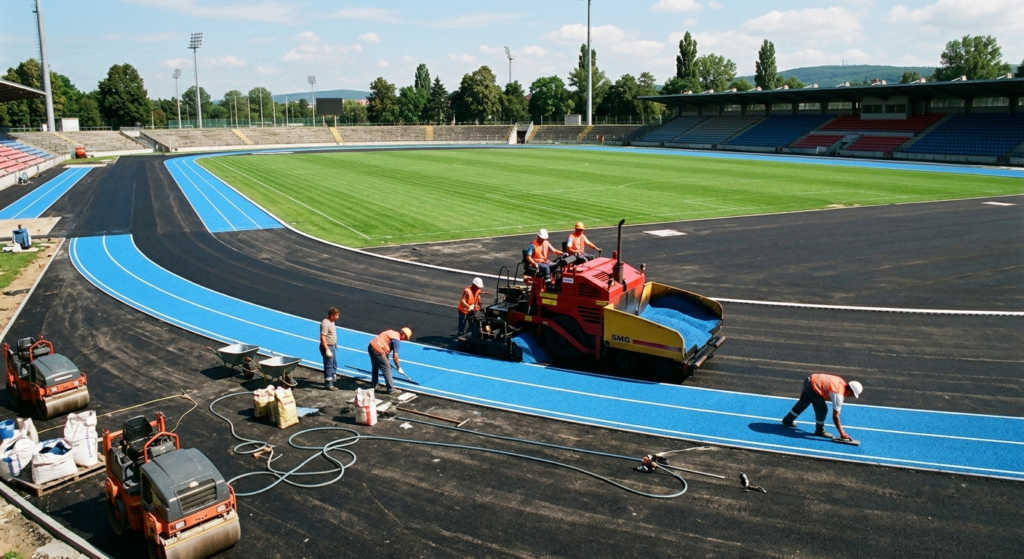
The surface layer represents the single largest cost component in any synthetic track project. In 2026, material costs for PU systems have increased by approximately 12% compared to 2024, primarily due to rising crude oil prices affecting polyurethane raw material costs. Contractors apply the surface in multiple layers using spray machines or hand-trowel methods. Surface application labour costs range from ₹80 – ₹180 per square metre across India.
Lane Marking and Field Event Markings
Lane markings use weather-resistant paint systems designed specifically for synthetic track surfaces. A complete set of markings for a standard 8-lane track with stagger marks, finish lines, hurdle positions, and relay zones costs ₹1.5 Lakh to ₹4 Lakh depending on the paint quality and scope of markings required.
Lighting and Electrical Infrastructure
Flood lighting for evening training and competition adds ₹15 Lakh to ₹60 Lakh to the project cost. LED sports lighting systems have become the standard choice in 2026 because they consume 40–60% less electricity than traditional metal halide systems. Many state sports authorities now mandate LED lighting for Khelo India projects.
Fencing and Perimeter Security
A galvanised steel or chain-link perimeter fence protects the track surface from unauthorized access and vandalism. Fencing for a full stadium perimeter costs ₹5 Lakh to ₹18 Lakh depending on fence height, material quality, and total perimeter length.
Detailed Cost Components Table
| Component | Cost Range (₹) | Notes |
| Land Preparation & Earthwork | ₹8 L – ₹25 L | Varies by soil condition |
| Sub-base & Base Layer | ₹65 L – ₹1.35 Cr | Granular + bituminous layers |
| Drainage System | ₹8 L – ₹20 L | Essential for monsoon regions |
| Surface Material (PU) | ₹1.8 Cr – ₹3.85 Cr | Per 10,500 sq. metre surface |
| Lane Markings | ₹1.5 L – ₹4 L | 8-lane full markings |
| LED Flood Lighting | ₹15 L – ₹60 L | Optional, recommended |
| Perimeter Fencing | ₹5 L – ₹18 L | GI or chain link |
| Grandstand / Seating | ₹25 L – ₹2 Cr | Optional spectator seating |
| Project Management & Supervision | ₹5 L – ₹20 L | Engineering & QA costs |
Factors That Affect Running Track Construction Cost in India
Geographic Location
Construction costs vary sharply across Indian states. Metro cities like Mumbai, Delhi, Bengaluru, and Chennai carry 20–35% higher labour and logistics costs compared to Tier-2 and Tier-3 cities. Remote locations in northeastern states or hilly terrain areas of Himachal Pradesh and Uttarakhand add further transportation premiums for raw materials.
Track Dimensions and Lane Count
A standard competition track measures 400 metres with 8 lanes and is approximately 84.39 metres wide on straights. However, many school projects build 200-metre tracks or 6-lane configurations to reduce land requirements and costs. A 6-lane, 400-metre track saves approximately 15–20% on surface material costs compared to a standard 8-lane track.
World Athletics Certification Requirements
Projects seeking World Athletics Class 1 or Class 2 certification must meet strict specifications for surface thickness (minimum 13mm for full-pour PU), shock absorption values (35–50% energy restitution), and tensile strength. Meeting these standards increases construction costs by 15–25% compared to non-certified tracks but enables the facility to host sanctioned competitions.
Contractor Experience and Material Brand
Experienced track construction contractors command higher fees but deliver more reliable results. Top-tier contractors in India use materials from brands like Mondo (Italy), Conica (Germany), or Indian manufacturers like Banas and Polytan. Premium international materials cost 30–50% more than domestically produced alternatives but offer longer warranties of 8–12 years.
Climate and Weather Conditions
Coastal areas require tracks with enhanced UV resistance and anti-fungal treatments, adding ₹80–₹120 per square metre to the surface cost. High-altitude locations like Ladakh, Shimla, or Auli require specially formulated compounds that remain flexible in sub-zero temperatures.
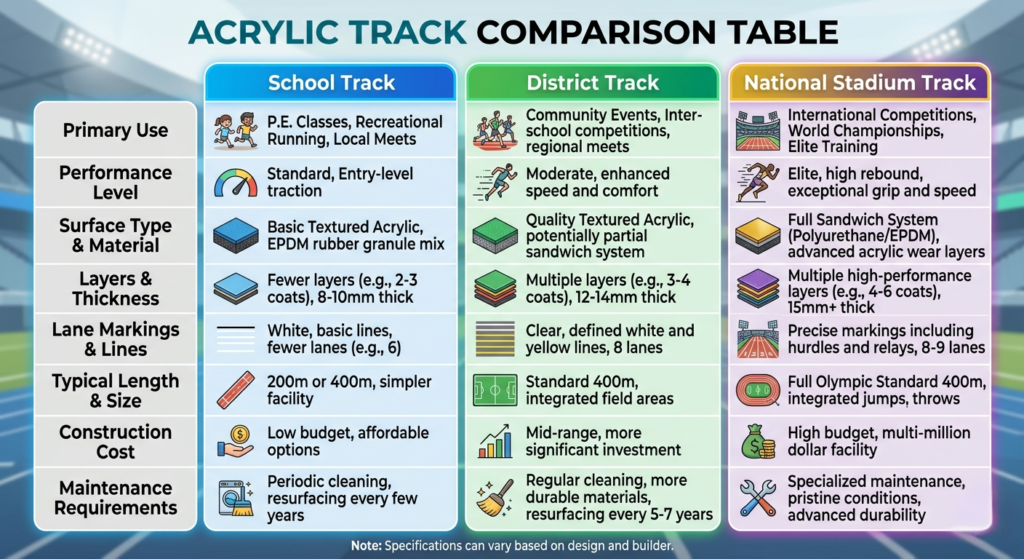
Comparison Table – School Track vs. District Track vs. National Stadium Track
| Parameter | School/College Track | District-Level Track | National/State Stadium Track |
| Track Length | 200m – 400m | 400m | 400m |
| No. of Lanes | 4 – 6 | 6 – 8 | 8 – 10 |
| Surface Type | Acrylic / EPDM | EPDM / PU Sandwich | PU Full Pour |
| Total Cost | ₹50 L – ₹1.6 Cr | ₹1.5 Cr – ₹2.8 Cr | ₹3.0 Cr – ₹5.5 Cr |
| Certification | Not required | AFI State level | World Athletics Class 1/2 |
| Lifespan | 5–8 years | 8–12 years | 10–15 years |
| Annual Maintenance | ₹2 L – ₹4 L | ₹4 L – ₹6 L | ₹6 L – ₹10 L |
| Lighting Required | Optional | Recommended | Mandatory |
| Drainage Complexity | Basic | Moderate | Advanced |
Upgrade Your Sports Court Today
Get premium synthetic acrylic flooring designed for durability, grip, and performance.
Get Free Consultation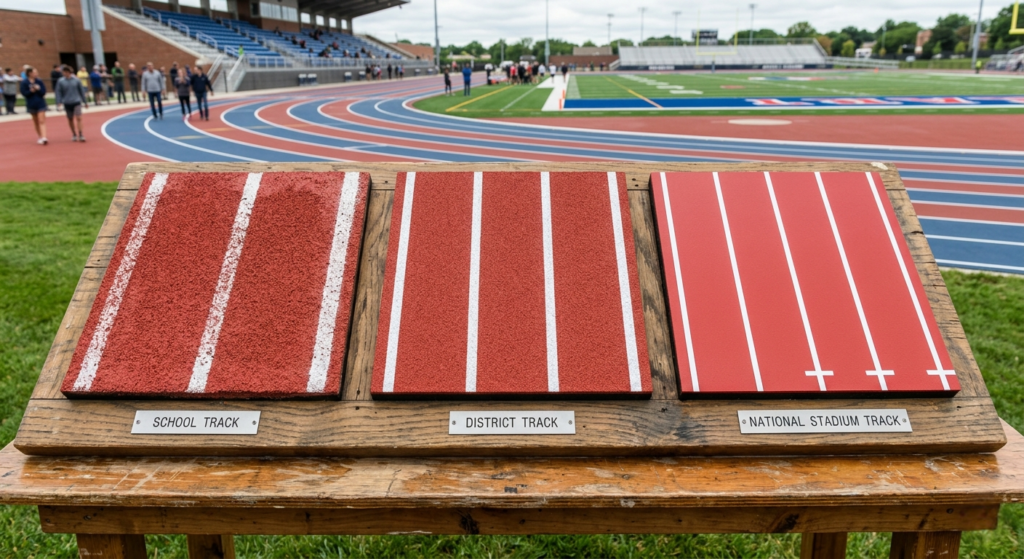
State-Wise Running Track Construction Cost Variation
Different Indian states show significant cost variation due to material availability, labour markets, and local government policies. Maharashtra and Delhi show the highest construction costs, while states like Madhya Pradesh, Chhattisgarh, and Odisha offer more competitive rates. The following overview captures the general cost landscape across major states for a standard 400-metre PU track project.
Tamil Nadu and Karnataka have emerged as competitive markets due to the presence of multiple certified synthetic surface contractors. Gujarat has seen a surge in track construction activity following investment by the state’s sports authority under the Chief Minister’s Sports Complex scheme. Punjab and Haryana remain strong markets driven by traditional athletics culture and regular state games.
The northeastern states receive central government subsidies for sports infrastructure under the North East Special Infrastructure Development Scheme (NESIDS), which effectively reduces net project costs by 50–90% for state government projects. Contractors in these regions face logistical challenges that add 10–20% to material costs, but government subsidies more than offset this premium.
Maintenance Cost of Running Tracks in India
Annual Maintenance Requirements
Running tracks require systematic maintenance to achieve their rated lifespan. Annual maintenance activities include surface cleaning and pressure washing, crack sealing, joint repairs, re-marking of lanes, and UV protection coating applications. These activities collectively cost ₹2 Lakh to ₹8 Lakh per year for a full 400-metre synthetic track.
Major Repair and Resurfacing Costs
After 8–12 years, synthetic tracks require either partial resurfacing (overlay) or full replacement. A resurfacing overlay that applies a fresh 4–6mm layer of PU material over the existing track costs ₹600 – ₹1,200 per square metre, or roughly ₹65 Lakh to ₹1.35 Crore for a full 400-metre track. This approach extends track life by another 5–8 years and costs significantly less than a complete rebuild.
Case Study – Khelo India State Centre of Excellence, Bhubaneswar (2024–2025)
Project Overview: The Odisha government, in collaboration with the Sports Authority of India (SAI), constructed a new 400-metre, 8-lane polyurethane running track at the Kalinga Stadium complex in Bhubaneswar as part of the Khelo India State Centre of Excellence (KISCE) programme.
Project Specifications: The project covered 10,800 square metres of PU full-pour surface to meet World Athletics Class 2 certification standards. Contractors installed a complete sub-base drainage system, 500-lux LED sports lighting, and full competition lane markings. The project also included hammer, javelin, and long jump approach areas within the infield.
Cost Breakdown:
| Item | Cost |
| Land preparation and base layer | ₹1.45 Crore |
| PU surface material and application | ₹2.90 Crore |
| Drainage system | ₹18 Lakh |
| LED sports lighting (12 towers) | ₹42 Lakh |
| Lane markings and field event zones | ₹3.5 Lakh |
| Project management and certification | ₹12 Lakh |
| Total Project Cost | ₹5.10 Crore |
- Outcome: The track received World Athletics Class 2 certification in March 2025. The facility hosted the 2025 Odisha State Athletics Championship within four months of completion, demonstrating the real-world utility of proper construction planning. The project created local employment for 180 labourers over a 90-day construction period.
- Key Lesson: The project team saved approximately ₹35 Lakh by sourcing EPDM granules from a certified domestic manufacturer in Pune rather than importing from Europe, without compromising quality standards. This approach offers a model for other state governments seeking to optimise running track construction costs without sacrificing performance.
How to Reduce Running Track Construction Cost Without Compromising Quality
Builders can adopt several smart strategies to reduce running track construction costs while maintaining acceptable standards. Choosing a PU sandwich system instead of a full-pour system saves ₹600–₹900 per square metre while still delivering performance suitable for district-level competitions. Opting for 6-lane instead of 8-lane configurations reduces material quantities by approximately 18%.
Project managers should invite competitive bids from at least three certified track construction contractors and verify their previous project credentials through the Athletics Federation of India’s approved contractor list. Timing the project outside India’s peak construction season (October to March) often yields better pricing from contractors who face lower workload demand during summer months.
Using domestic PU and EPDM materials certified by BIS (Bureau of Indian Standards) instead of imported products reduces material costs by 25–40%. Several Indian manufacturers now produce track surfaces that match international quality benchmarks and carry AFI approval, making this substitution both economical and technically sound.
Government Schemes and Funding for Running Track Construction in India
The Indian government operates several active schemes that fund running track construction at district, state, and national levels. The Khelo India Infrastructure Development scheme provides grants of ₹1 Crore to ₹5 Crore per facility to state governments for creating new sports infrastructure, including running tracks. The Sports Authority of India (SAI) manages the National Sports Development Fund (NSDF), which offers project-linked grants to universities and sports academies.
The PYKKA (Panchayat Yuva Krida Aur Khel Abhiyan) scheme, restructured in 2024 under the Fit India umbrella, provides funding for cinder and basic rubber tracks in rural gram panchayats. The Smart Cities Mission has funded running track construction in 18 Indian cities between 2022 and 2025 as part of public park and recreational infrastructure projects. State-level schemes such as Odisha’s Mo Khela, Maharashtra’s Balasaheb Thackeray Sports Infrastructure Mission, and Punjab’s Sports Policy 2025 provide additional layers of financial support.
Step-by-Step Running Track Construction Process
Building a quality running track requires careful execution across multiple phases. Contractors typically follow this sequence for a full synthetic track project.
First, surveyors conduct a detailed topographical survey and soil testing to determine bearing capacity and drainage characteristics. The design team then prepares a layout plan conforming to World Athletics or AFI geometry specifications. Earthwork and grading begin after project authorities approve the design, and contractors compact the sub-grade to 95% Proctor density. Workers then lay geotextile fabric, followed by a crushed aggregate sub-base layer.
Asphalt pavers install the bituminous base layer in two passes, and QA engineers conduct core-cutting tests to verify thickness and density. After the asphalt base cures for a minimum of seven days, the synthetic surface applicators move in. For PU systems, they apply a base coat, mid-layer, and top wearing coat over three to five days. Lane markings go on last, after the surface achieves full cure at 25°C ambient temperature.
Conclusion
Running track construction cost in India spans a wide range from ₹35 Lakh for a basic cinder track in a rural school to over ₹5 Crore for a World Athletics-certified polyurethane stadium track. The right choice depends on the intended use level, available funding, land area, and long-term maintenance capacity of the managing institution.
Decision-makers should prioritise EPDM or PU sandwich systems for most school and district-level projects because these surfaces deliver competitive performance at manageable cost points and benefit from India’s growing domestic synthetic surface manufacturing base. For national and state-level facilities, only full-pour PU systems meeting AFI and World Athletics standards deliver the performance and certification status that competitive athletics demand.
Smart procurement practices, domestic material sourcing, phased construction, and active use of government schemes can significantly reduce effective project costs. India’s sports infrastructure investment cycle has never been stronger, and running track construction represents one of the most visible and impactful ways to translate that investment into real athlete development outcomes.
Frequently Asked Questions
A standard 400-metre PU running track costs between ₹2.5 Crore and ₹4.5 Crore in India in 2026, including base preparation and surface installation.
EPDM rubber tracks offer the best balance of durability and cost for school projects, typically costing ₹1,200 – ₹2,200 per square metre.
A standard 400-metre synthetic track takes 45 to 90 days for construction, depending on weather, contractor capacity, and material availability.
Yes, the Khelo India Infrastructure Development scheme and SAI grants provide ₹1 Crore to ₹5 Crore for eligible state and district-level track projects.
Annual maintenance for a 400-metre synthetic track typically costs ₹2 Lakh to ₹8 Lakh depending on track type, usage frequency, and local climate conditions.
A properly constructed and maintained PU running track lasts 10 to 15 years before requiring full resurfacing or replacement.