Every serious pickleball player, coach, and court builder must understand the exact size of pickleball court before stepping onto the playing surface. Pickleball has become one of the fastest-growing sports globally, and India is no exception. From corporate campuses in Bengaluru to residential societies in Mumbai and school playgrounds in Delhi, pickleball courts are appearing everywhere in 2026. Whether you plan to build a new court, convert a badminton court, or simply improve your game strategy, knowing the precise dimensions of a pickleball court gives you a decisive edge. This comprehensive guide covers every measurement, zone, line, and surface detail you need – updated with the latest India 2026 standards from the Pickleball Federation of India (PFI).
Table of contents
- What Is the Standard Size of Pickleball Court?
- Detailed Court Dimensions: A Zone-by-Zone Breakdown
- Pickleball Court Dimensions Table
- Comparison: Pickleball Court vs Other Sports Courts
- India 2026 Update: Pickleball Court Standards by the Pickleball Federation of India
- How to Mark a Pickleball Court: Step-by-Step
- Outdoor vs Indoor Pickleball Court: Key Differences
- Multi-Court Facilities: Space Planning for India 2026
- Case Study: Converting a Badminton Court to Pickleball in Pune, 2025
- Surface Materials and Their Impact on Court Performance
- Common Mistakes When Building or Marking a Pickleball Court
- Pickleball Court Dimensions in Metric Units (India Reference)
- Frequently Asked Questions
What Is the Standard Size of Pickleball Court?
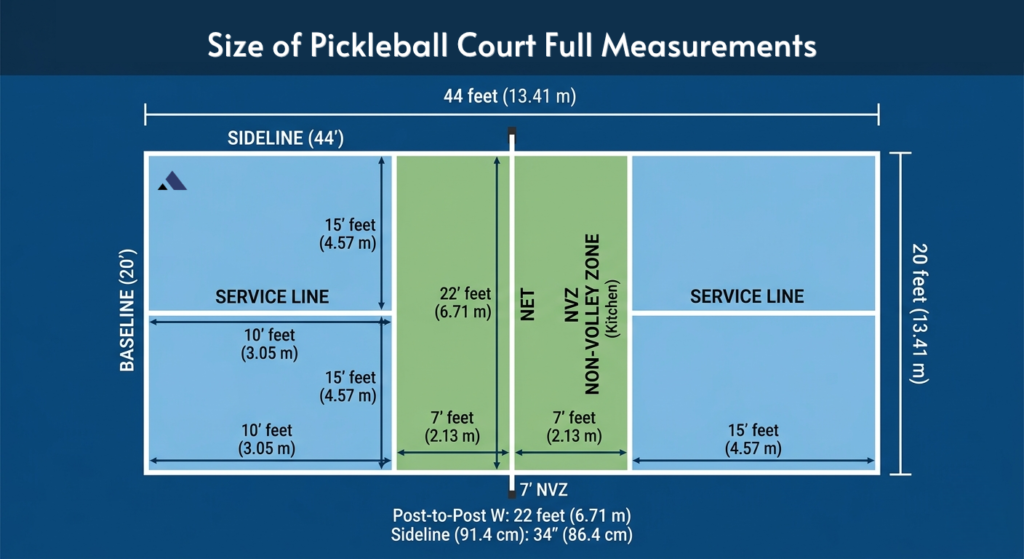
The standard size of pickleball court measures 20 feet wide and 44 feet long for both singles and doubles play. This single measurement covers the entire playing area within the boundary lines. The USA Pickleball Association (USAPA) officially established these dimensions, and the International Federation of Pickleball (IFP) adopted them globally. India follows the same international standard, as confirmed by the Pickleball Federation of India in its 2026 national infrastructure guidelines.
The court occupies a total area of 880 square feet within the boundary lines. However, players and builders must account for safety buffer zones around the court. The recommended total space for a regulation pickleball court, including out-of-bounds buffer areas, measures 30 feet wide and 64 feet long. This total footprint of 1,920 square feet ensures player safety during lateral movements, dives, and fast-paced rallies.
Detailed Court Dimensions: A Zone-by-Zone Breakdown
Baseline and Sideline Measurements
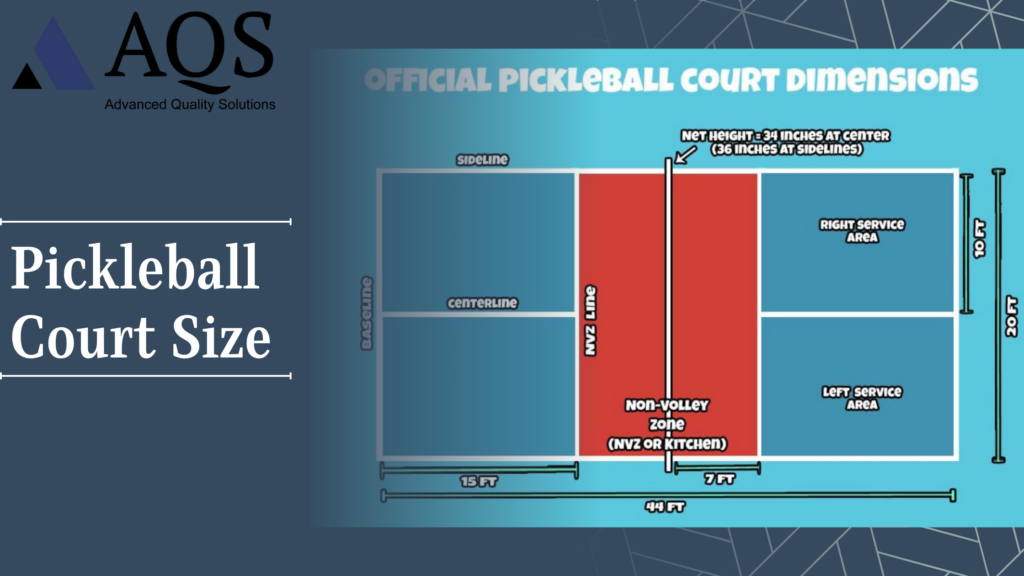
The baseline runs along the full 20-foot width at each end of the court. The sidelines run the entire 44-foot length on both sides. These four boundary lines define the playing surface. Players serve and return within these boundaries. Any ball landing outside these lines results in a fault during live play.
Upgrade Your Sports Court Today
Get premium synthetic acrylic flooring designed for durability, grip, and performance.
Get Free ConsultationThe Non-Volley Zone (The Kitchen)
The non-volley zone, popularly called “the kitchen,” extends 7 feet from the net on each side. This zone spans the full 20-foot width of the court. The kitchen line, also called the non-volley line, runs parallel to the net and marks the front boundary of this zone. Players cannot volley – hit the ball before it bounces – while standing inside or touching the kitchen line. This rule fundamentally shapes pickleball strategy and court positioning.
Service Courts and Centerline
The area beyond the kitchen on each side divides into two service courts through a centerline. Each service court measures 10 feet wide and 15 feet long. The centerline runs from the kitchen line to the baseline, splitting the court into left and right service areas. During a serve, the ball must land in the diagonal service court opposite the server. Understanding these service court dimensions helps players develop accurate serving techniques.
Net Position and Height
The net stretches across the full 20-foot width of the court at the center. Net height at the sidelines measures 36 inches. Net sags slightly at the center, reaching 34 inches in height at the middle. This 2-inch difference influences shot selection near the sidelines versus the center. Players frequently aim low shots over the middle of the net to increase clearance margin.
Pickleball Court Dimensions Table
| Court Section | Measurement |
| Total Court Length | 44 feet (13.41 meters) |
| Total Court Width | 20 feet (6.10 meters) |
| Total Playing Area | 880 sq. ft. (81.74 sq. meters) |
| Non-Volley Zone Depth | 7 feet (2.13 meters) from net |
| Non-Volley Zone Width | 20 feet (6.10 meters) |
| Service Court Width | 10 feet (3.05 meters) |
| Service Court Length | 15 feet (4.57 meters) |
| Centerline Length | 15 feet (4.57 meters) |
| Net Height at Sideline | 36 inches (0.91 meters) |
| Net Height at Center | 34 inches (0.86 meters) |
| Recommended Buffer Zone | 5 feet each side, 10 feet each end |
| Total Recommended Space | 30 ft × 64 ft (1,920 sq. ft.) |
Comparison: Pickleball Court vs Other Sports Courts
Understanding how the size of a pickleball court compares to other familiar courts helps in planning conversions and choosing venues.
| Sport | Court Length | Court Width | Total Area | Can Convert to Pickleball? |
| Pickleball | 44 ft | 20 ft | 880 sq. ft. | – |
| Badminton (Doubles) | 44 ft | 20 ft | 880 sq. ft. | Yes (1:1 match) |
| Tennis | 78 ft | 36 ft | 2,808 sq. ft. | Yes (4 courts fit) |
| Table Tennis | 9 ft | 5 ft | 45 sq. ft. | No |
| Volleyball | 59 ft | 29.5 ft | 1,740 sq. ft. | Yes (with adjustment) |
| Basketball (Half) | 47 ft | 50 ft | 2,350 sq. ft. | Yes (2 courts fit) |
This comparison clearly shows that a standard badminton doubles court and a pickleball court share identical dimensions of 44 feet by 20 feet. This compatibility makes badminton-to-pickleball court conversions extremely common and cost-effective across India in 2026.
India 2026 Update: Pickleball Court Standards by the Pickleball Federation of India
The Pickleball Federation of India released its updated national court infrastructure guidelines in early 2026. These guidelines align with IFP international standards while addressing India-specific requirements for climate, surface materials, and construction costs.
PFI 2026 Approved Surface Materials
The PFI now officially recognizes four surface categories for tournament-grade pickleball courts in India. Acrylic hard courts with anti-slip coating rank as the top recommendation for outdoor installations, particularly in high-temperature regions like Rajasthan and Tamil Nadu. Synthetic rubber surfaces receive approval for indoor facilities, offering superior cushioning for players aged 40 and above. Polypropylene interlocking tiles now qualify for semi-permanent community installations, reducing setup time significantly. Wooden sprung floors hold approval for indoor national-level competitions hosted at sports complexes in metro cities.
PFI 2026 Lighting Standards for Indoor Courts
For indoor courts, the PFI mandates a minimum illumination of 300 lux for recreational play and 500 lux for state-level tournaments. National-level competition venues must achieve 750 lux with uniform distribution across the entire court surface. These standards apply to newly constructed facilities from January 2026 onward. Existing facilities received an 18-month compliance window to upgrade lighting infrastructure.
PFI 2026 Line Marking Requirements
All court lines must be 2 inches wide. Lines must contrast clearly with the court surface, using white or yellow color depending on the base surface. The PFI prohibits the use of tape as permanent line marking for tournament courts. Painted lines using UV-resistant paint now form the compulsory standard for all state and national-level venues.
Calculate Your Sports Court Dimensions!
Contact us for Quickly measure and calculate accurate sports court dimensions with this easy-to-use tool!
How to Mark a Pickleball Court: Step-by-Step
Marking a pickleball court correctly ensures fair play and safe movement. Follow these steps to create a properly dimensioned court anywhere you have sufficient space.
- Step 1: Measure the total area. You need a minimum of 30 feet wide and 64 feet long for a safe recreational court. Use a measuring tape or laser distance meter for accuracy.
- Mark the four boundary corners. Drive stakes or use chalk at all four corners. Confirm the diagonal measurements (corner to opposite corner) are equal to verify a true rectangle.
- Mark the net position at the center. Measure 22 feet from each baseline and mark the net posts at both sidelines.
- Mark the kitchen lines. Measure 7 feet from the net on each side and draw the non-volley zone line across the full 20-foot width.
- Draw the centerline. Run a line from the middle of the kitchen line to the middle of the baseline on each side of the net.
- Apply permanent line paint. Use 2-inch-wide UV-resistant paint. For temporary courts (on driveways or gym floors), use painter’s tape or sport-specific court marking tape.
Outdoor vs Indoor Pickleball Court: Key Differences
Both indoor and outdoor pickleball courts share identical playing dimensions. However, several other factors differ significantly between the two formats.
| Factor | Outdoor Court | Indoor Court |
| Surface Material | Acrylic, asphalt, concrete | Wood, rubber, synthetic |
| Ball Type | Outdoor ball (harder, heavier) | Indoor ball (lighter, softer) |
| Wind Factor | Affects ball trajectory | No wind interference |
| Lighting | Natural + supplemental | Artificial (min. 300 lux) |
| Noise | Less disruptive | Can echo in large halls |
| Maintenance | Higher (weather damage) | Lower (climate controlled) |
| Playing Speed | Faster (harder surface) | Slightly slower (softer surface) |
| India 2026 Setup Cost | ₹1.2L – ₹3.5L per court | ₹2.5L – ₹8L per court |
Upgrade Your Sports Court Today
Get premium synthetic acrylic flooring designed for durability, grip, and performance.
Get Free ConsultationMulti-Court Facilities: Space Planning for India 2026
Sports complexes, schools, and residential communities across India increasingly build multi-court pickleball facilities in 2026. Proper space planning ensures player safety and operational efficiency.
Two Courts Side by Side
Two courts placed side by side require a minimum total width of 54 feet (two 20-foot courts plus a 7-foot shared buffer zone between them and 3.5-foot buffers on each outer side). The length remains 64 feet with standard end buffers. Total footprint: approximately 54 feet × 64 feet = 3,456 square feet.
Four Courts (2×2 Configuration)
A four-court configuration arranged two across and two lengthwise needs approximately 54 feet wide and 118 feet long. This configuration suits sports complexes and large residential amenity areas. Many Tier-1 city housing societies in India have successfully built four-court complexes within their existing recreational spaces in 2026.
Case Study: Converting a Badminton Court to Pickleball in Pune, 2025
- Facility: Shree Sports Club, Kothrud, Pune
- Original Setup: Two standard badminton doubles courts inside a covered hall
- Project Year: Late 2025 (operational in January 2026)
- The Shree Sports Club faced declining badminton membership and rising pickleball demand from its 35–60 age group members. The club management decided to repurpose one of its two badminton courts into a dual-purpose pickleball facility without major structural changes.
- The Conversion Process: Since a standard badminton doubles court measures exactly 44 feet × 20 feet – identical to a pickleball court – the club required no structural expansion. The team removed the badminton net posts and installed USA Pickleball-compliant net posts at the 22-foot center mark. The existing wooden sprung floor required no replacement. The club painted pickleball lines in white over the green badminton court markings, clearly distinguishing the two sets of lines using different colors.
- Total Cost: ₹68,000 including new net system (₹22,000), line repainting (₹15,000), paddle and ball starter kit (₹18,000), and signage (₹13,000).
- Outcome: The pickleball court now hosts 14 regular players daily across two sessions. Membership revenue from the pickleball segment grew by 38% within the first three months of operation. The club plans to convert the second badminton court by mid-2026 using the same low-cost approach.
- Key Lesson: The identical dimensions between badminton and pickleball courts make conversions the most cost-efficient route for Indian sports facilities in 2026.
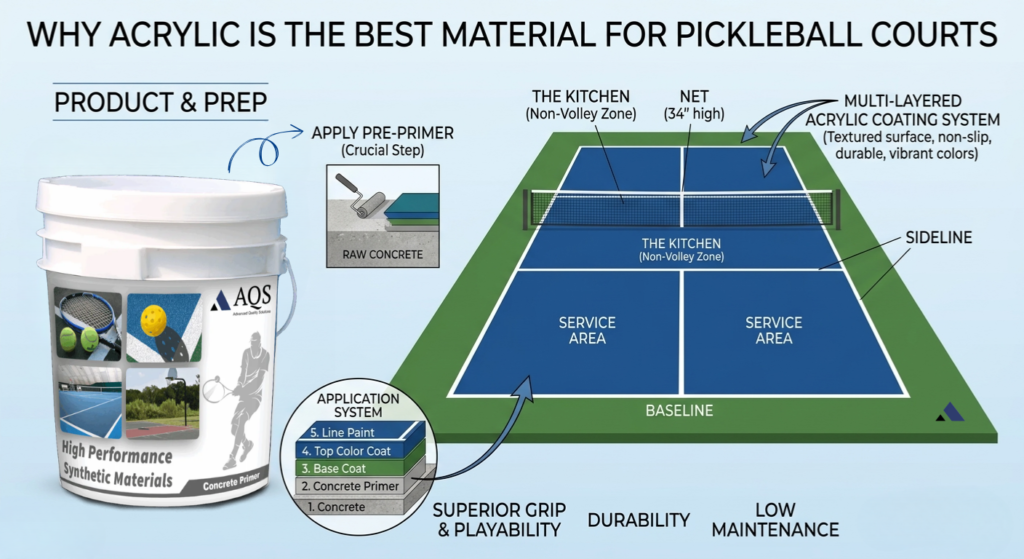
Surface Materials and Their Impact on Court Performance
The surface you choose for your pickleball court directly affects ball bounce, player safety, and long-term maintenance costs. Each material performs differently based on India’s varied climate zones.
- Acrylic Hard Court provides the most consistent ball bounce and suits year-round outdoor use in most Indian cities. The textured surface offers reliable grip even in light rain. Acrylic courts require resurfacing every 5–7 years under heavy use.
- Polypropylene Interlocking Tiles offer excellent drainage and quick installation. They absorb moderate impact, reducing joint stress for older players. The PFI approved this material for club-level and community play in its 2026 guidelines. Individual tiles replace easily when damaged, reducing lifecycle costs significantly.
- Rubber Cushion Surface delivers superior shock absorption, making it ideal for indoor facilities catering to senior players and youth programs. Ball bounce remains slightly lower than on acrylic, requiring adjustment in shot selection and footwork.
- Concrete Base with Paint Coating serves as the most budget-friendly option for schools and community centers. Proper surface sealing and anti-slip paint application ensure safe play. However, concrete transmits more impact force to joints, making it less suitable for daily heavy-use facilities.
Transform Your Sports Facility Today!
Contact us for high-quality synthetic sports flooring material and elevate your space!
Common Mistakes When Building or Marking a Pickleball Court
Many first-time court builders make measurement errors that compromise play quality and safety. Awareness of these mistakes prevents costly rework.
The most frequent error involves placing the net at the wrong distance from the baseline. Players must measure from the baseline to the net post at exactly 22 feet on each side. Many builders measure only one side and assume the net sits perfectly centered, resulting in unequal service court depths.
Another common mistake is drawing kitchen lines at 6 feet or 8 feet instead of the correct 7 feet from the net. This error significantly changes game strategy and creates confusion during competitive play. Always measure kitchen lines from the base of the net post, not from the center of the net.
Ignoring the buffer zone around the court creates safety hazards. Players diving for wide shots or running to return deep lobs need at least 10 feet of clearance behind each baseline and 5 feet beyond each sideline. Courts built against walls or fences within these buffer zones cause injuries during aggressive play.
Pickleball Court Dimensions in Metric Units (India Reference)
India officially uses the metric system. The following table converts all standard pickleball court dimensions to meters and centimeters for construction planning.
| Dimension | Feet | Meters | Centimeters |
| Court Length | 44 ft | 13.41 m | 1341 cm |
| Court Width | 20 ft | 6.10 m | 610 cm |
| Kitchen Depth | 7 ft | 2.13 m | 213 cm |
| Net Height (Center) | 34 in | 0.86 m | 86 cm |
| Net Height (Sideline) | 36 in | 0.91 m | 91 cm |
| Service Court Width | 10 ft | 3.05 m | 305 cm |
| Service Court Length | 15 ft | 4.57 m | 457 cm |
| Recommended Total Length | 64 ft | 19.51 m | 1951 cm |
| Recommended Total Width | 30 ft | 9.14 m | 914 cm |
| Line Width | 2 in | 5.08 cm | 5 cm |
Calculate Your Sports Court Dimensions!
Contact us for Quickly measure and calculate accurate sports court dimensions with this easy-to-use tool!
Final Thoughts
The size of a pickleball court – 20 feet wide and 44 feet long – may seem compact compared to tennis, but every inch of that space carries strategic meaning. From the 7-foot kitchen zone that controls net play to the 34-inch center net height that invites low drives, understanding these dimensions transforms how you build your game. India’s pickleball community in 2026 is growing faster than ever, with the Pickleball Federation of India setting clear infrastructure standards that make court construction accessible at every budget level. Whether you build an acrylic outdoor court at a premium housing society or convert a badminton court at a school, these dimensions remain your non-negotiable foundation. Measure correctly, mark precisely, and play confidently.
Frequently Asked Questions
A standard pickleball court measures 20 feet wide and 44 feet long, covering a total area of 880 square feet.
Yes, a standard pickleball court and a badminton doubles court share identical dimensions of 44 feet × 20 feet.
You need a minimum of 30 feet wide and 64 feet long, which includes the 5-foot side buffers and 10-foot end buffers for player safety.
The kitchen (non-volley zone) line sits exactly 7 feet from the net on each side of the court.
The net height at the center of a pickleball court measures 34 inches (0.86 meters).
Yes, a single tennis court can accommodate up to four full-sized pickleball courts within its boundaries.