Summary Box
| Volleyball Court Measurement | Details |
| Official Court Size | 18m × 9m (59 ft × 29.5 ft) |
| Total Area with Run-off | 23m × 15m (75.5 ft × 49 ft) |
| Net Height (Men/Women) | 2.43m / 2.24m (7’11.6″ / 7’4.6″) |
| Flooring Cost | ₹120-₹280 per sq ft |
| Total Installation Cost | ₹5,00,000 to ₹18,00,000 |
| Best Material | Acrylic-concrete or maple wood |
| Installation Time | 3-8 weeks |
Introduction
Volleyball court measurement is the foundation of a properly functioning sports facility. Whether you operate a residential society court, school gymnasium, or professional tournament venue, accurate measurements determine player performance, safety, and the long-term success of your investment. This comprehensive guide explores every dimension, specification, and practical consideration for building a regulation volleyball court in India during 2026. Volleyball has experienced explosive growth across Indian schools, colleges, corporate campuses, and residential communities over the past five years. The All India Volleyball Association reports over 2,000 active volleyball courts across India, with approximately 150,000+ registered players competing at various levels. States like Maharashtra, Karnataka, Tamil Nadu, Delhi, and Gujarat lead in volleyball infrastructure development and player participation rates. As the sport continues expanding, accurate knowledge of volleyball court measurement becomes essential for anyone planning to construct, renovate, or manage a volleyball facility.
India’s sports ministry has prioritised volleyball as a grassroots development sport, allocating funds through state sports authorities for court construction in schools and coaching centres. This policy support, combined with rising awareness about volleyball’s physical and mental health benefits, creates tremendous opportunities for facility owners and operators. Understanding proper volleyball court measurement ensures compliance with international standards while maximizing your facility’s revenue potential and player satisfaction.
Volleyball Court Dimensions Official Specifications and Standards
Understanding the Playing Area
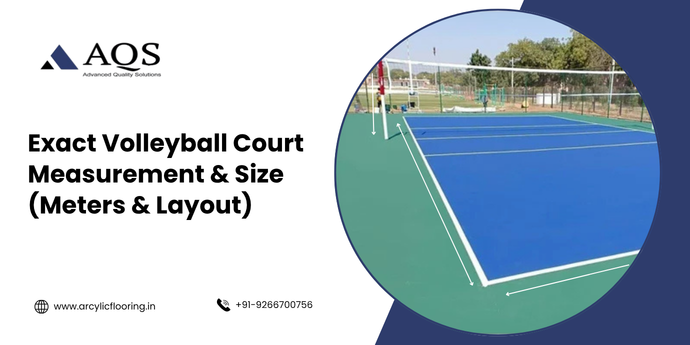
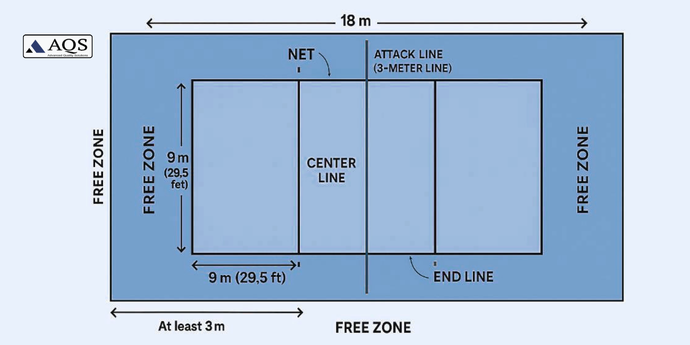
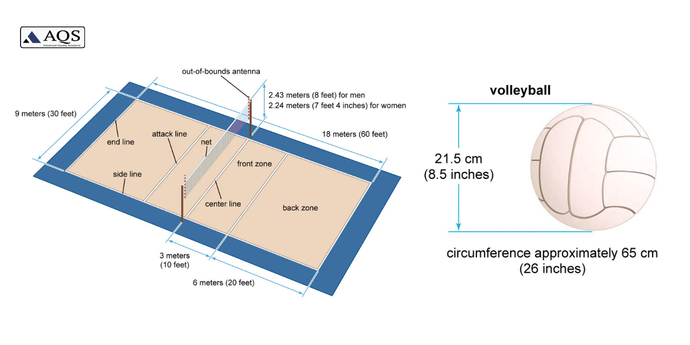
The official International Volleyball Federation (FIVB) mandates specific volleyball court measurement standards that apply universally. The playing court itself measures exactly 18 metres long by 9 metres wide (59 feet by 29.5 feet). This rectangular playing area divides into two equal halves of 9 metres × 9 metres, separated by the centre line. The net posts anchor at exact positions 3 metres outside the court on each end line, creating a specific geometric configuration that remains identical worldwide from professional tournaments to school gymnasium courts.
The attack line (or 3-metre line) marks a critical strategic boundary, positioned exactly 3 metres from the centre line on each side. This line divides the front court from the back court and determines which players can attack the net legitimately. Players standing behind the attack line can jump and contact the ball above net height after it has crossed the plane, while violations result in side-out or point penalties depending on match context. The precision of attack line measurement directly impacts game flow and officiating consistency.
Complete Volleyball Court Measurement Table
| Court Component | Metres | Feet | Centimetres |
| Court Length | 18 m | 59 ft | 1,800 cm |
| Court Width | 9 m | 29.5 ft | 900 cm |
| Net Height (Men) | 2.43 m | 7’11.6″ | 243 cm |
| Net Height (Women) | 2.24 m | 7’4.6″ | 224 cm |
| Attack Line Distance | 3 m | 9.8 ft | 300 cm |
| Free Zone Width | 3 m min | 9.8 ft | 300 cm |
Calculate Your Sports Court Dimensions!
Contact us for Quickly measure and calculate accurate sports court dimensions with this easy-to-use tool!
Understanding the Free Zone
The free zone extends a minimum of 3 metres on all sides of the court, measured from the end line and side lines outward. This buffer zone provides essential safety clearance for player movement during defensive plays, out-of-bounds pursuits, and emergency dives. Competitive tournaments demand a 5-8 metre free zone for optimal sightlines and spectator safety. The free zone must be level, free from obstructions, and clearly marked with contrasting boundary lines or tape to ensure players and officials maintain spatial awareness during high-intensity gameplay.
Many Indian facility builders initially underestimate the free zone requirement, resulting in cramped courts where players cannot safely chase loose balls or execute diving defence. This limitation reduces player safety, compromises game quality, and creates liability concerns. A properly planned volleyball court requires total facility dimensions of approximately 23 metres by 15 metres (75.5 feet by 49 feet) to accommodate the 18m × 9m playing court plus minimum 3-metre free zones on all sides.
Volleyball Court Flooring Material Options and Specifications
Overview of Flooring Materials
Volleyball court flooring selection represents the most critical decision in construction, directly impacting player performance, safety, durability, and total installation cost. The surface type determines ball bounce characteristics, shock absorption, traction, and resistance to wear from thousands of dynamic movements including jumping, sliding, and rapid direction changes. Professional tournaments demand specific flooring materials that meet FIVB certification requirements, while recreational facilities have broader material options adapted to local climate and budget constraints.
Acrylic-Coated Concrete Flooring
Acrylic-coated concrete represents the most popular and cost-effective volleyball court flooring option throughout India. Contractors pour reinforced cement concrete (RCC) base at 100-150mm thickness, allow 28-day curing, then apply multiple protective acrylic surface coats. The acrylic coating provides UV resistance essential for outdoor courts, creates consistent ball bounce, delivers excellent traction for dynamic footwork, and requires moderate maintenance. Initial installation costs range from ₹120-₹180 per square foot, making acrylic-concrete the preferred choice for schools, clubs, and recreational facilities across India. Acrylic flooring delivers superior performance in India’s harsh climate conditions. Summer heat up to 45°C, monsoon moisture, and intense UV radiation challenge less-durable surfaces, yet quality acrylic coatings withstand these stresses while maintaining consistent playing characteristics. The surface remains playable even in high humidity typical of coastal regions, though proper drainage system design becomes critical. Courts built with acrylic-concrete flooring consistently achieve 8-12 year lifespan with standard maintenance protocols.
Wooden Flooring Systems
The Wooden flooring, primarily using Canadian or European hardwoods like maple, represents the premium volleyball court flooring option preferred for professional facilities, major tournaments, and elite training academies. Wooden courts provide superior shock absorption, reduce joint stress during repetitive jumping, and deliver responsive ball bounce that many elite players prefer. However, wooden flooring carries significantly higher installation costs (₹350-₹600 per square foot), demands specialised climate control in tropical India, and requires rigorous maintenance including periodic sanding and refinishing. Professional wooden courts incorporate multi-layer construction including sub-flooring, shock-absorbing underlayment, hardwood strips, and protective finish systems. The total thickness often exceeds 50mm, and proper installation demands experienced craftspeople familiar with wood expansion-contraction dynamics. In India’s variable humidity environment, wooden courts require dedicated climate control systems costing an additional ₹2,00,000-₹5,00,000 annually, making wooden flooring primarily limited to major sports complexes and university facilities with substantial budgets.
Polyurethane and Synthetic Surfaces
Polyurethane-coated surfaces represent an intermediate option combining advantages of acrylic and wooden systems. These synthetic surfaces offer exceptional durability, consistent ball response, excellent shock absorption, and strong UV resistance. Costs range from ₹200-₹350 per square foot, positioning polyurethane between budget-conscious acrylic options and premium wooden floors. Many modern sports complexes in India increasingly favour polyurethane for multi-sport facilities where volleyball courts share space with basketball, badminton, or indoor cricket. Polyurethane surfaces demand less climate control than wooden courts while delivering performance characteristics closer to professional standards. The material resists moisture penetration, withstands India’s temperature extremes, and maintains consistent playing characteristics across multiple years with regular cleaning and maintenance. Tournament-quality polyurethane courts can achieve certification for national and international competitions, making this option increasingly popular for state-level sports academies and premium facility operators.
Modular Interlocking Tiles
Modular interlocking tiles made from polypropylene or recycled rubber represent emerging flooring options suitable for temporary courts, rooftop installations, and facilities requiring quick setup without permanent construction. These tiles interlock without adhesive, allowing installation in 1-2 days without concrete base preparation. Costs range from ₹150-₹250 per square foot including all tiles and installation. The tiles remain removable and reusable, making them ideal for schools or facilities uncertain about permanent court commitment. While modular tiles offer installation speed and flexibility, ball bounce characteristics differ from regulation courts, making them primarily suitable for recreational play and beginner training. Professional tournaments and competitive matches require FIVB-certified surfaces, which currently excludes most modular tile systems. However, technological improvements continue enhancing modular tile performance, and several Indian manufacturers now produce FIVB-approved systems suitable for tournament play.
Volleyball Court Flooring Material Comparison Table
| Flooring Type | Cost/sq ft | Total Cost | Durability | Best For |
| Acrylic+Concrete | ₹120-180 | ₹19.5L-29.2L | 8-12 years | Schools, Clubs |
| Wooden (Maple) | ₹350-600 | ₹56.8L-97.4L | 15-20 years | Professional |
| Polyurethane | ₹200-350 | ₹32.5L-56.8L | 12-15 years | Tournament |
| Modular Tiles | ₹150-250 | ₹24.4L-40.6L | 6-10 years | Temporary |
Volleyball Court Installation Cost in India
Understanding Total Installation Investment
Building a regulation volleyball court in India involves numerous cost components beyond the flooring surface. Site preparation, structural elements, flooring systems, markings, net systems, fencing, lighting, drainage infrastructure, and safety elements collectively determine total project cost. Installation costs vary significantly based on geographic location, facility type (indoor vs. outdoor), site conditions, and material choices. Experienced facility planners budget between ₹5,00,000 and ₹18,00,000 for complete professional installations meeting international standards. This comprehensive breakdown ensures you understand every cost component and can plan accurate budgets with confidence.
Detailed Cost Breakdown Components
| Cost Component | Estimated Cost (₹) | Notes |
| Site Survey & Testing | ₹15,000-40,000 | Essential for drainage assessment |
| Site Clearing & Levelling | ₹40,000-1,00,000 | Varies with terrain slope |
| RCC Concrete Base | ₹2,50,000-4,50,000 | 100-150mm thickness M20 grade |
| Acrylic Surface System | ₹1,50,000-2,50,000 | 3-4 coats with primer |
| Line Marking & Painting | ₹40,000-70,000 | FIVB-compliant specifications |
| Professional Net System | ₹25,000-80,000 | FIVB-certified net with posts |
| Perimeter Fencing | ₹1,00,000-2,00,000 | 10 ft height chain-link all sides |
| LED Floodlighting | ₹1,50,000-3,50,000 | 6-8 poles, 300+ lux minimum |
| Drainage System | ₹30,000-70,000 | Critical for monsoon areas |
| Professional Labour | ₹80,000-2,00,000 | Varies by project scope |
| Municipal Permits | ₹15,000-60,000 | Location-dependent regulatory |
Geographic Cost Variations Across Indian Cities
| City / Region | Estimated Total Cost | Primary Cost Driver |
| Mumbai & MMR | ₹12L-20L | High labour, premium real estate |
| Delhi NCR | ₹10L-18L | Competitive market dynamics |
| Bengaluru | ₹9L-16L | Growing demand, competitive |
| Hyderabad | ₹8L-14L | Emerging market, moderate costs |
| Pune | ₹7.5L-13L | Active sports community |
| Chennai | ₹8L-14L | Coastal climate adds complexity |
| Tier-2 Cities | ₹5.5L-9.5L | Lower labour costs |
| Tier-3 & Rural | ₹4.5L-8L | Transport premium |
Transform Your Sports Facility Today!
Contact us for high-quality synthetic sports flooring material and elevate your space!
Volleyball Court Installation Cost Factors Affecting Your Investment
Location and Geographic Considerations
Geographic location represents the single largest cost variable beyond material selection. Metropolitan areas demand premium pricing reflecting elevated labour costs, stricter regulatory compliance, and competitive contractor markets. Mumbai and Delhi NCR projects typically cost 30-40% more than equivalent facilities in tier-2 cities. Coastal regions like Chennai and Kochi face unique drainage complexity, increasing base construction costs by ₹50,000-₹1,50,000 due to required moisture management systems. Rural areas offer lower labour rates but offset these savings with increased material transportation costs and limited contractor expertise, requiring importing specialised professionals.
Indoor vs. Outdoor Construction Complexity
Outdoor courts represent the most cost-effective option, requiring primarily flooring, boundary marking, and net systems. Indoor courts demand significantly more infrastructure: roofing structures costing ₹50,000-₹2,50,000 for steel framework and materials, ceiling construction enabling proper lighting installation, specialised ventilation systems managing humidity in tropical India (₹40,000-₹1,20,000), and integrated electrical systems for permanent lighting integration. Indoor facilities typically cost 2-3 times more than equivalent outdoor courts, though they enable year-round operation unaffected by monsoon seasons or excessive heat.
Site Conditions and Pre-Existing Infrastructure
Flat, well-drained sites with existing electrical connections cost least to develop. Sloping terrain requires extensive grading and fill, adding ₹50,000-₹2,00,000 depending on slope severity. Waterlogged or clay-dominant sites demand underground perimeter drains and soil replacement (₹1,00,000-₹4,00,000). Rooftop courts on existing buildings require structural engineering verification and load assessment (₹50,000-₹2,00,000), ensuring the roof system withstands dynamic volleyball loads. Pre-existing foundations from older facilities can sometimes be reused, reducing base costs significantly, but require professional evaluation to confirm structural adequacy for modern requirements.
Contractor Experience and Warranty Provisions
Experienced, FIVB-certified contractors charge 20-30% more than budget contractors but deliver superior results with enforceable warranty protection. A quality contractor provides 5-year material warranty, 2-year labour warranty, and certifies FIVB compliance in writing. Budget contractors offering suspiciously low quotes often compromise on base thickness, acrylic coating count, or drainage design-problems that become catastrophically expensive after the contract completes. Verified contractor references and portfolio reviews prevent expensive mistakes that could require full resurfacing within 2-3 years, ultimately costing ₹3,00,000-₹6,00,000 in unnecessary repairs.
Case Study Volleyball Court Development in a Metropolitan Institution
Project Overview: Delhi Sports Academy Complex Expansion
Institution: Premier Delhi Sports Academy
Location: South Delhi, Chhatarpur Extension
Project Duration: June 2024 December 2024 (7 months)
Total Investment: ₹18,50,000 for two professional courts
Background and Challenges
The Delhi Sports Academy operated for 15 years with only one outdoor concrete badminton court partially used for recreational volleyball. Growing demand from 200+ enrolled volleyball students exceeded available facility capacity, forcing the academy to rent external courts for training (monthly overhead ₹50,000). Leadership recognised volleyball infrastructure development as critical for programme expansion and revenue growth. Initial site assessment revealed several challenges: existing ground sloped approximately 8 degrees requiring significant grading, existing poorly-maintained asphalt creating contamination concerns, underground water saturation during monsoon requiring comprehensive drainage design, and proximity to existing buildings limiting free zone dimensions to 3.5 metres minimum.
Results and ROI Performance
Post-completion operational data (6-month period) demonstrated strong success. Increased enrolment expanded from 200 students baseline to 340 students within 4 months (70% growth). Court utilisation reached 85-90% occupancy during peak hours (5-8 PM weekdays, 8 AM-6 PM weekends). Revenue generation included: recreational memberships (220 students × ₹800/month = ₹1,76,000/month), competitive training batches (60 students × ₹2,000/month = ₹1,20,000/month), and tournament hosting (₹40,000/month). Total monthly revenue reached ₹3,36,000 against operating costs of ₹44,000, delivering net monthly profit of ₹2,92,000 (annual ₹35,04,000). The facility achieved complete payback period in just 6.3 months, accelerating subsequent expansion plans dramatically.
Volleyball Court Measurement Maintenance and Long-Term Management
Regular Maintenance Schedule and Cost Management
Professional volleyball courts demand systematic maintenance preserving measurement accuracy, flooring integrity, and overall facility functionality. Quarterly deep cleaning with pressure washing removes accumulated dust, algae, and contaminants affecting ball dynamics (cost: ₹4,000-₹8,000 per court per quarter). Annual line re-marking maintains bright, visible boundary markers essential for accurate officiating (cost: ₹15,000-₹25,000 annually). Every 3-5 years, acrylic surfaces require top-coat reapplication restoring UV protection and ball bounce characteristics (cost: ₹1,00,000-₹1,50,000). Wooden flooring demands professional refinishing every 5-7 years (cost: ₹2,00,000-₹3,50,000). Proper maintenance directly extends court lifespan from 8-10 years to 12-15 years, making regular investment a highly cost-effective long-term strategy.
Measurement Verification and Compliance Certification
Facilities hosting official tournaments must maintain current FIVB measurement certification, renewed annually through certified inspectors. Certification fees range from ₹5,000-₹15,000 but represent essential expenses ensuring tournament qualification and liability protection. Inspectors verify exact court dimensions using laser measuring systems, confirm line width and position accuracy, test net height and tension specifications, and document findings in official compliance records. Any measurement deviations discovered during certification require correction within specified timeframes-delays risk tournament disqualification and reputation damage that affects facility revenue negatively.
Quick Decision Framework Choosing Your Volleyball Court Solution
- Need a recreational facility for school? → Acrylic-concrete flooring, minimum 3m free zone, LED lighting optional
- Planning tournament hosting? → Polyurethane or wooden flooring, 5m+ free zone, professional LED lighting, annual FIVB certification
- Budget-conscious community project? → Acrylic-concrete, modular tile option, basic lighting, ₹5-8 lakh investment
- Premium club or academy? → Wooden or polyurethane flooring, professional lighting, tournament-grade specification, ₹15-25 lakh investment
- Multi-sport facility? → Polyurethane synthetic surface, 4m+ free zone, 300+ lux lighting, shared amenities
Conclusion
Volleyball court measurement represents far more than academic precision-it directly impacts player safety, game integrity, facility revenue potential, and long-term asset value. Whether planning a school gymnasium, residential society facility, or professional training academy, understanding exact dimensions, flooring options, installation processes, and maintenance requirements transforms your project from guesswork into systematic, professional execution.
India’s rapidly expanding volleyball community creates tremendous opportunities for facility developers, yet the market also penalises poor planning through premature facility failure, regulatory non-compliance, and lost revenue from tournament disqualification. This comprehensive guide provides knowledge and decision frameworks ensuring your volleyball court investment delivers athletic excellence, financial returns, and lasting community impact for decades. Start with proper site evaluation, engage certified contractors familiar with FIVB standards, invest in quality flooring systems appropriate for India’s climate, and commit to systematic maintenance from day one. Your volleyball facility will become a community asset generating health, skill development, competitive opportunities, and revenue returns that justify the initial investment many times over.
Frequently Asked Questions
The official playing court measures exactly 18 metres long by 9 metres wide, with net posts positioned 3 metres outside the court on each end line.
Professional facilities require approximately 23 metres by 15 metres total space (including 3-5 metre free zones on all sides), totalling roughly 345 square metres.
Men’s net height measures 2.43 metres (7’11.6″), while women’s net height is 2.24 metres (7’4.6″) at the centre.
Acrylic-coated concrete delivers the optimal balance of cost (₹120-180/sq ft), durability (8-12 years), and weather resistance for India’s tropical monsoons and intense summer heat.
Professional installation requires 6-8 weeks total including site preparation, concrete curing (28 days mandatory), surface coating, and finishing work.
The attack line marks the boundary 3 metres from the centre line on each side, dividing front court from back court and determining which players can legally attack above net height.