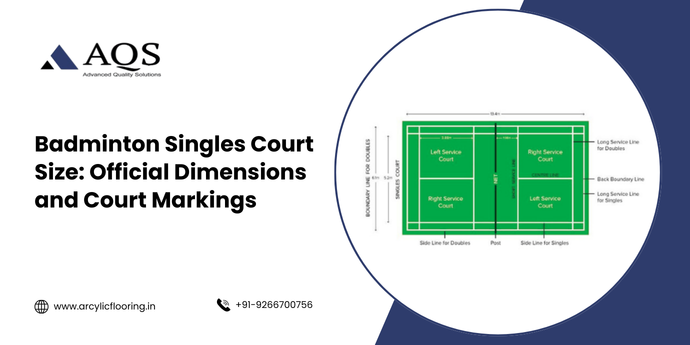
Understanding the exact specifications of a badminton singles court is critical for players, coaches, architects, and facility builders alike. Whether you are setting up a brand new indoor facility, resurfacing an existing court with professional-grade materials, or simply training for competitive play, knowing the official court dimensions helps ensure accuracy, safety, and compliance with Badminton World Federation (BWF) standards. A properly measured badminton singles court not only meets regulatory requirements but also provides optimal playing conditions for performance and injury prevention.
The badminton singles court is a precisely defined playing area that differs from a doubles court in width but shares the same length. These dimensions are not arbitrary – they are engineered to test the full range of a player’s speed, agility, reach, and strategy. Knowing every line, zone, and measurement on the court gives players and facility owners a powerful edge in training, construction, and compliance. This comprehensive guide covers every detail of the badminton singles court, from official BWF measurements to surface materials, court markings, and construction standards.
Table of contents
- Badminton Singles Court: Official Dimensions at a Glance
- Official Badminton Singles Court Dimensions Explained
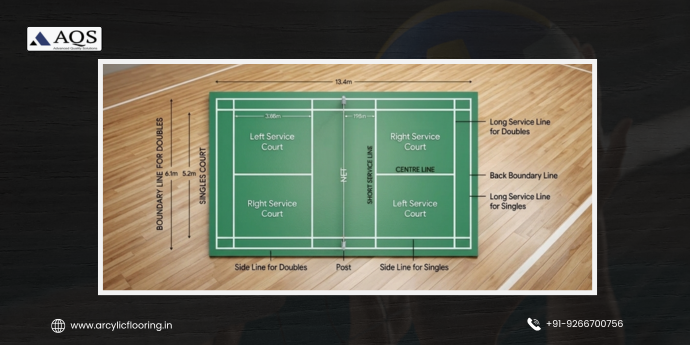
- Badminton Singles Court Line Markings and Their Functions
- Badminton Singles Court Layout: Zones and Divisions
- Badminton Court Surface Materials and Construction Standards
- Court Surface Construction Layers: Application Guide
- Net Post Placement and Net Specifications
- Overhead Clearance and Lighting Requirements
- Comparison: Badminton Singles Court vs Doubles Court Dimensions
- Badminton Court Marking: Step-by-Step Guide
- Choosing the Right Badminton Court Surface Color
- Frequently Asked Questions (FAQs)
Badminton Singles Court: Official Dimensions at a Glance
Before diving into detailed explanations, here is a quick reference table that summarizes the most important dimensions of an official badminton singles court as per BWF regulations. These measurements apply to all competitive badminton matches played under international standards, including the Olympics, All England Championships, and other BWF-sanctioned tournaments.
| Measurement | Metric (meters) | Imperial (feet/inches) |
| Court Length (both sides) | 13.40 m | 43 ft 11 in |
| Singles Court Width | 5.18 m | 17 ft 0 in |
| Doubles Court Width | 6.10 m | 20 ft 0 in |
| Net Height at Centre | 1.524 m | 5 ft 0 in |
| Net Height at Posts | 1.55 m | 5 ft 1 in |
| Short Service Line (from net) | 1.98 m | 6 ft 6 in |
| Long Service Line – Singles | 0.76 m from back boundary | 2 ft 6 in |
| Back Boundary to Service Line | 3.88 m | 12 ft 9 in |
| Service Court Width – Singles | 2.59 m | 8 ft 6 in |
| Clear Height Requirement | Minimum 9.00 m | 29 ft 6 in |
Official Badminton Singles Court Dimensions Explained
Court Length and Width for Singles Play
The total length of a badminton court is 13.40 meters (43 feet 11 inches) from one back boundary line to the other. This measurement is shared between both singles and doubles formats. However, the defining difference is the width. For a badminton singles court, the official width is 5.18 meters (17 feet), which is narrower than the 6.10-meter doubles court. The two outer tramlines along the sides of the court are not used in singles play, making those side corridors inactive zones. Players must ensure all shots land within the 5.18-meter width during singles rallies or the shuttle is called out.
Upgrade Your Sports Court Today
Get premium synthetic acrylic flooring designed for durability, grip, and performance.
Get Free ConsultationNet Position and Net Height
The net is positioned at the exact center of the court, dividing it into two equal halves of 6.70 meters each. According to BWF regulations, the net height at the center of the court must measure exactly 1.524 meters (5 feet). At the posts, which are positioned on the doubles sidelines, the net height rises slightly to 1.55 meters (5 feet 1 inch). It is important to note that the posts must be placed on the doubles sideline, regardless of whether a singles or doubles match is being played. The net must be taut, made of dark, fine cord with uniform mesh, and should have a white tape top binding.
Singles Long Service Line and Back Boundary
One of the most misunderstood elements of the badminton singles court is the service rules in relation to the back boundary. In singles, the long service line for service is the back boundary line itself – meaning the server must land the shuttle behind the short service line and before (or on) the back boundary line. The back boundary line is located 0.76 meters (2 feet 6 inches) in front of the long service line used in doubles. This narrower service zone in singles demands more precision in both serving and receiving positions, making footwork and court coverage even more critical.
Badminton Singles Court Line Markings and Their Functions
Every line on the badminton singles court has a specific purpose and must be clearly visible during play. The lines are part of the court – meaning if a shuttle lands on a line, it is considered IN play. All court lines should be 40mm (approximately 1.5 inches) wide and marked in white or yellow color for maximum visibility against the court surface. Understanding each line helps players make accurate calls and helps facility builders mark courts correctly during construction or resurfacing.
| Line Name | Location | Purpose in Singles |
| Back Boundary Line | Outermost line at each end | Defines the court’s back edge; also acts as long service line in singles |
| Long Service Line (Doubles) | 0.76 m from back boundary | NOT used in singles service but marks doubles service boundary |
| Short Service Line | 1.98 m from net on each side | Service must land beyond this line |
| Centre Line | Runs from short service line to back boundary | Divides left and right service courts |
| Singles Sideline | Inner vertical line on each side | Defines the 5.18 m wide singles court boundary |
| Doubles Sideline | Outermost vertical line on each side | Not used in singles play; used for doubles width |
| Net Line | Centreline below the net | Marks the centre of the court under the net |
Badminton Singles Court Layout: Zones and Divisions
Left and Right Service Courts
The badminton singles court is divided into distinct service zones on each side of the net. On each half of the court, the centre line divides the playing area into a right service court and a left service court. At the start of a game and when the server has an even number of points, serving takes place from the right service court. When the server has an odd number of points, serving is done from the left service court. The service must land in the diagonally opposite service court – meaning a serve from the right court must land in the opponent’s right service court, and vice versa.
Forecourt, Midcourt, and Rearcourt Zones
Though not officially marked by lines, professional players and coaches divide the badminton singles court into three horizontal zones: the forecourt (area near the net), the midcourt (middle area), and the rearcourt (area near the back boundary). The forecourt extends from the net to the short service line, approximately 1.98 meters. The midcourt spans from the short service line to roughly the middle of the service box. The rearcourt covers the area from midcourt to the back boundary. Understanding these zones helps singles players develop tactical court coverage, attack from the rearcourt, and defend at the net.
Badminton Court Surface Materials and Construction Standards
Recommended Flooring Types for Badminton Singles Courts
The surface of a badminton singles court has a direct impact on player safety, shuttle speed, and overall playing experience. The Badminton World Federation recommends wooden sprung floors for indoor competitive courts, particularly maple hardwood, as they offer the right balance of shock absorption and responsiveness. However, in India and many Asian countries, synthetic acrylic and concrete-based surfaces are widely used for both indoor and outdoor courts. Each surface type has specific construction requirements and must meet minimum standards for slip resistance, ball rebound, and joint flexibility.
Concrete Primer: The Foundation of a Durable Court
When constructing or resurfacing a badminton court on a concrete base, the application of a quality Concrete Primer is the most essential first step. A Concrete Primer penetrates the porous concrete substrate, binds loose particles, seals minor surface cracks, and creates a stable bonding layer for subsequent coatings. Without proper priming, acrylic or cushion layers may peel, blister, or delaminate under heavy foot traffic and extreme temperature changes. For professional badminton court construction in India, high-quality solvent-based or water-based concrete primers are recommended, applied in at least one to two coats depending on the surface porosity and age of the concrete slab.
Transform Your Sports Facility Today!
Contact us for high-quality synthetic sports flooring material and elevate your space!
Acrylic Resurfacer: Leveling and Smoothing the Court Base
After the Concrete Primer has cured, the next critical layer is the Acrylic Resurfacer. An Acrylic Resurfacer is a thick, polymer-modified acrylic compound designed to fill micro-surface irregularities, minor cracks, and uneven areas in the concrete or asphalt base. It creates a level, clean, and cohesive surface that is essential for the accurate application of colour coats and line markings. For badminton courts, the resurfacer also improves the adhesion of topcoats and contributes to the overall durability of the playing surface. Typically, two to three passes of Acrylic Resurfacer are applied in a crisscross pattern to ensure uniform coverage and proper leveling across the entire 5.18 x 13.40 meter singles court area.
Cushion Coat: Comfort and Performance Layer
The Cushion Coat is a specialized elastomeric acrylic coating applied after the resurfacer to provide shock absorption, reduce player fatigue, and enhance the playing experience on hard-surface badminton courts. Cushion Coat layers contain rubber granules or foam-like particles that create a slightly textured, resilient surface that reduces joint stress during intensive training and competitive play. For a regulation badminton singles court, at least two to four coats of Cushion Coat are recommended, depending on the desired cushioning level. A harder cushion profile (fewer coats) suits competitive play, while a softer profile (more coats) is preferred for recreational or training courts where players spend extended hours.
Court Surface Construction Layers: Application Guide
Here is a systematic breakdown of the recommended application sequence for building a professional badminton singles court surface using industry-standard materials. Following this sequence ensures the court meets durability, safety, and performance standards required for competitive play.
| Layer No. | Material | Purpose | Recommended Coats |
| Layer 1 | Concrete Primer | Penetrates and seals concrete base, improves bonding | 1–2 coats |
| Layer 2 | Acrylic Resurfacer | Fills cracks, levels surface irregularities | 2–3 coats (crisscross) |
| Layer 3 | Cushion Coat | Provides shock absorption and elasticity | 2–4 coats (as required) |
| Layer 4 | Acrylic Colour Coat | Provides playing surface colour (green/blue) | 2 coats |
| Layer 5 | Line Marking Paint | Marks all court lines in white or yellow | 2 coats per line |
| Layer 6 | Acrylic Top Coat (optional) | UV protection and surface texture | 1–2 coats |
Upgrade Your Sports Court Today
Get premium synthetic acrylic flooring designed for durability, grip, and performance.
Get Free ConsultationNet Post Placement and Net Specifications
The net posts on a badminton singles court must be positioned firmly on the doubles sidelines, even during singles play. This is a key BWF rule that many recreational players misunderstand. The posts should be 1.55 meters high and must not interfere with the net’s cord or banding. The net itself should be 760mm (0.76 meters) deep and stretch the full width of the court (6.10 meters from post to post). The mesh of the net should be between 15mm and 20mm, dark in color, and the top edge must be covered with a 75mm wide white tape folded over a cord or cable that runs through the tape. The net should have zero sag at the centre.
Also Read: Badminton Net Height – Official Measurements, Rules & Court Setup Guide
Overhead Clearance and Lighting Requirements
For a badminton singles court to meet professional standards, the facility must have a minimum overhead clearance of 9.00 meters from the floor surface to the lowest obstruction above the court, including roof beams, light fixtures, ventilation ducts, or any structural element. This clearance is essential because high-trajectory clears and smashes require significant overhead space. Many professional-grade indoor badminton halls in India and internationally provide clearances of 10 to 12 meters for elite tournament conditions. Courts with lower ceilings may be used for casual play but are not suitable for competitive matches under BWF or national federation guidelines.
Lighting is equally critical for a badminton singles court. BWF recommends a minimum illuminance of 500 lux for club-level play and up to 2000 lux for televised professional matches. Lights should be positioned to eliminate glare from the players’ field of vision, especially in the overhead trajectory that shuttles follow during high clears. LED floodlight systems are now the preferred choice for modern badminton facilities because they provide uniform, high-intensity, glare-free illumination while being energy efficient.
Comparison: Badminton Singles Court vs Doubles Court Dimensions
| Feature | Singles Court | Doubles Court |
| Court Width | 5.18 m (17 ft) | 6.10 m (20 ft) |
| Court Length | 13.40 m (43 ft 11 in) | 13.40 m (43 ft 11 in) |
| Long Service Line | Back boundary line | 0.76 m from back boundary |
| Side Tramlines Used? | No (inner sideline only) | Yes (both outer sidelines) |
| Service Court Width | 2.59 m each side | 3.05 m each side |
| Service from? | Alternate sides based on score | Right side only (0-0 and even) |
| Net Height (Centre) | 1.524 m | 1.524 m |
| Net Height (Posts) | 1.55 m | 1.55 m |
Badminton Court Marking: Step-by-Step Guide
Tools and Materials Required for Line Marking
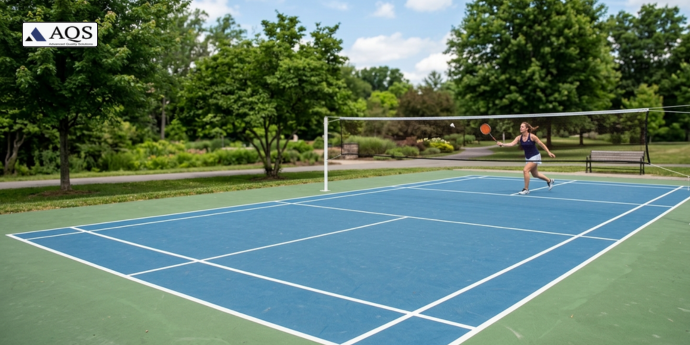
Accurate line marking is a critical step in completing a badminton singles court. You will need a steel measuring tape (at least 15 meters long), a chalk line or string line, right-angle squares for perfect 90-degree corners, a line marking machine or brush, and court-approved white or yellow line marking paint. The marking process should only begin after the Cushion Coat layer has fully cured – typically 24 to 48 hours after the final coat application. Rushing line marking over uncured surface coatings can lead to smearing, bleeding of paint under the tape edges, and imprecise lines that affect play quality.
Sequence of Court Line Marking
Begin by establishing the four corners of the doubles court boundary (6.10 m x 13.40 m) using precise measurements and a string line. Then mark the net line at the center (6.70 m from each back boundary). From the net line, measure 1.98 m toward each back boundary and mark the short service lines. Next, draw the center line from the short service line to the back boundary, dividing each service box into right and left halves. Finally, mark the singles sidelines 5.18 m apart (measuring inward 0.46 m from each doubles sideline). For singles-only courts, only the singles sidelines, back boundary, short service line, and center line need to be marked.
Calculate Your Sports Court Dimensions!
Contact us for Quickly measure and calculate accurate sports court dimensions with this easy-to-use tool!
Choosing the Right Badminton Court Surface Color
For professional badminton singles courts, green is the most commonly used court color because it provides excellent contrast with the white shuttle and white court lines, reducing visual fatigue for players during extended rallies. Blue is the second most popular option and is widely used in Olympic and BWF Super Series events because it offers a high visual contrast for television broadcast and spectator viewing. Red and terracotta colors are less common and generally not recommended for competitive play because they can reduce shuttle visibility. The court color should also complement the color of the Cushion Coat system applied to ensure a uniform, professionally finished appearance.
Conclusion
A regulation badminton singles court is a precisely engineered playing space that demands accuracy in every dimension, from its 5.18-meter width to the 1.524-meter net height at center. Every line marking, service zone, and surface layer plays a meaningful role in the quality, safety, and compliance of the facility. For facility builders and court contractors, choosing the right surface system – including a quality Concrete Primer for base sealing, Acrylic Resurfacer for leveling, and Cushion Coat for player comfort – is as important as getting the dimensions right. Whether you are building a brand new indoor badminton center or renovating an existing court to meet BWF standards, following the official guidelines covered in this article ensures a court that performs at the highest level and lasts for years to come.
Frequently Asked Questions (FAQs)
The official badminton singles court measures 13.40 meters long and 5.18 meters wide as per BWF regulations.
The singles court is 5.18 meters wide, while the doubles court is 6.10 meters wide – a difference of 0.92 meters on the combined sides.
The net height at the center of the badminton court is exactly 1.524 meters (5 feet) as per official BWF standards.
Cushion Coat is an elastomeric acrylic coating that provides shock absorption and reduces joint fatigue for players on hard-surface badminton courts.
Concrete Primer seals the concrete base, binds loose particles, and creates a proper bonding layer to prevent peeling of upper coatings.