Volleyball is one of the fastest-growing team sports in India in 2026. Thousands of schools, colleges, and clubs now actively seek accurate volleyball court diagrams with measurements to build proper facilities. Whether you coach at a district level or manage a state-level sports complex, understanding every line, zone, and dimension on a volleyball court is absolutely essential. The diagram of a volleyball court is not merely a drawing – it is a technical blueprint that governs how the game is played, officiated, and enjoyed by millions of athletes across the country.
India’s sports infrastructure investment reached new highs in 2025–2026 under the Khelo India programme, and volleyball court construction guidelines have been updated to align with FIVB 2025 regulations. This article provides you with a deeply researched, measurement-accurate volleyball court diagram breakdown so that players, coaches, architects, and sports administrators can use it as a trusted reference.
Standard Volleyball Court Measurements – India 2026 (FIVB Updated)
The Volleyball Federation of India officially follows FIVB specifications for all sanctioned matches. The 2025–2026 rulebook confirms the following core dimensions that every court must satisfy.
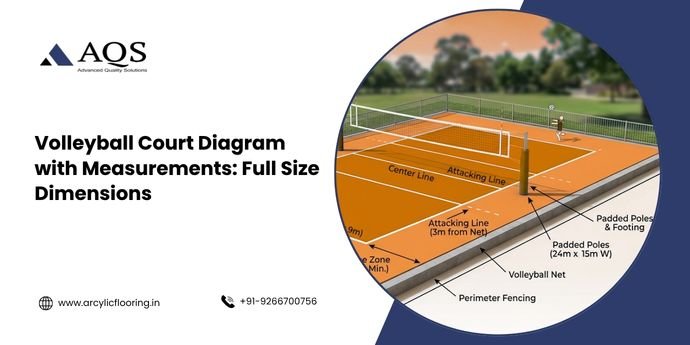
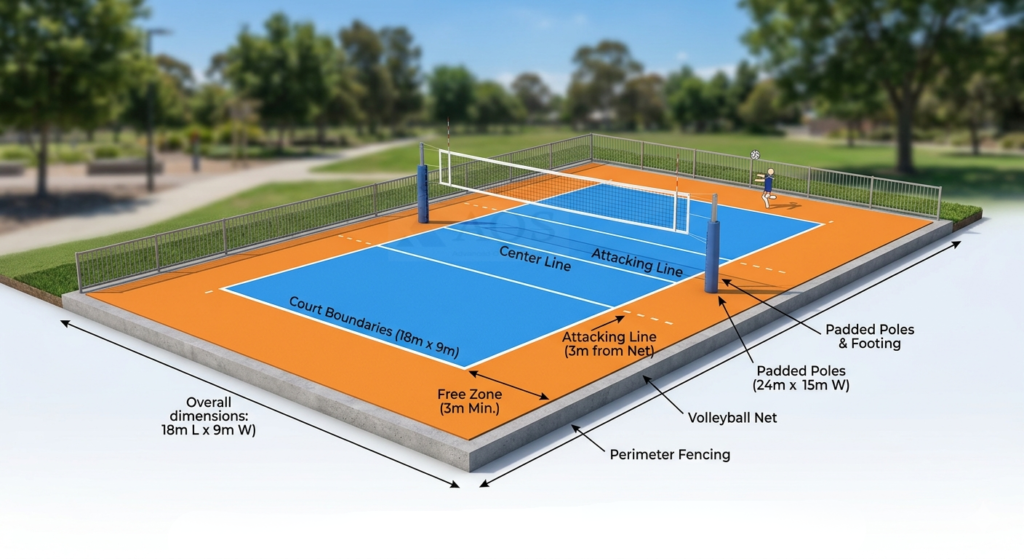
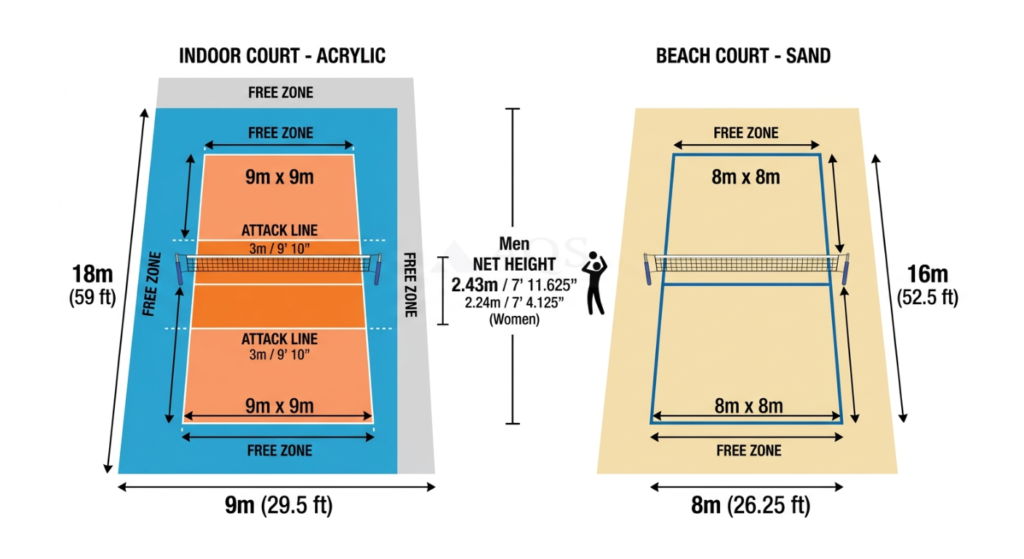
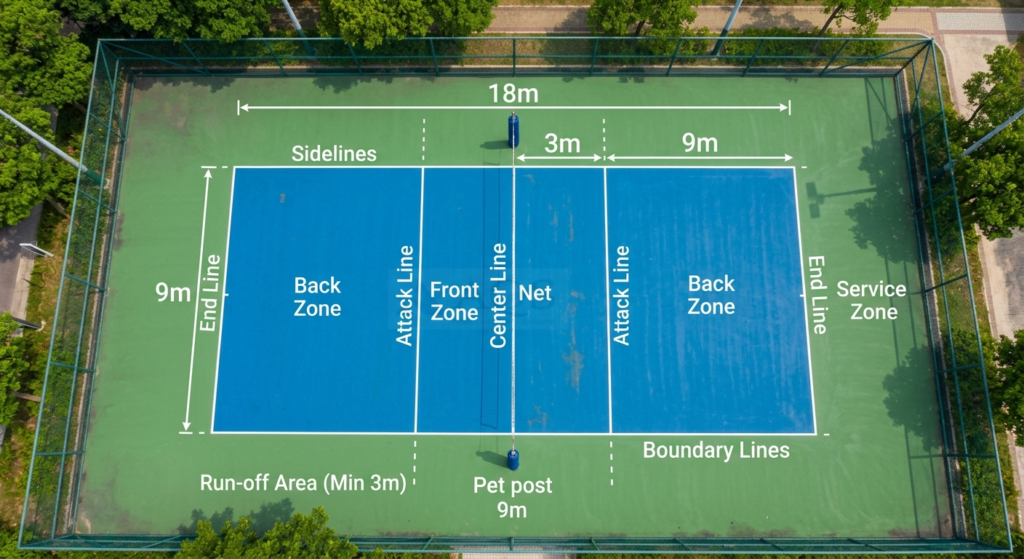
The total playing court is 18 metres long and 9 metres wide. A centre line divides the court into two equal halves, each measuring 9 m × 9 m. The free zone – the area outside the playing court – must be at least 3 metres wide on all sides, with 5 metres recommended for international competitions. The total playing area including the free zone therefore reaches a minimum of 24 m × 15 m for standard indoor courts.
Court Line Specifications and Markings
All boundary lines on a volleyball court are 5 centimetres wide and must be marked in a colour clearly distinct from the floor. The lines are part of the court they delimit. Court lines include the two sidelines (running along the 18 m length) and two end lines (running across the 9 m width). A centre line runs beneath the net from sideline to sideline, dividing the court into two team halves.
Upgrade Your Sports Court Today
Get premium synthetic acrylic flooring designed for durability, grip, and performance.
Get Free ConsultationThe attack line is drawn 3 metres from the centre line on each side of the court, parallel to the net. This line defines the front zone and the back zone for each team. Back-row players must jump from behind this line when attacking above net height. In 2026, Indian state sports authorities have begun requiring that attack lines use dual-colour markings for visual clarity in multipurpose halls.
Net Position and Height Measurements
The net runs along the centre line and is stretched tightly between two poles placed 0.5 m to 1 m outside the sidelines. The standard net is 9.5 to 10 metres long and 1 metre wide when stretched. The top of the net reaches 2.43 metres at the centre for men’s competitions and 2.24 metres for women’s competitions. For mixed and youth categories, the VFI 2026 guidelines recommend 2.35 metres as a universal standard for under-18 mixed tournaments.
The net height is measured at the centre of the court using a calibrated measuring stick. The net must not sag more than 2 centimetres below the prescribed height at any point above the sidelines. Two white side bands, each 5 cm wide and 1 m tall, mark the net’s boundaries directly above each sideline. Antennas – flexible rods 1.8 m long – are fixed to the outer edge of each side band and extend 80 cm above the top of the net.
Calculate Your Sports Court Dimensions!
Contact us for Quickly measure and calculate accurate sports court dimensions with this easy-to-use tool!
Volleyball Court Diagram – Zone-by-Zone Breakdown
Understanding the volleyball court diagram means understanding each functional zone and how it affects game strategy and player positioning. India’s coaches have increasingly adopted zone-mapping techniques in 2026 training programmes.
Front Zone (Attack Zone)
The front zone runs from the centre line to the attack line – a depth of 3 metres on each side of the court. All six rotation positions 4, 3, and 2 occupy this zone during serve reception. Front-row players can attack and block freely from this zone. The front zone is also where setters operate during offensive play, and its 3-metre depth directly influences setter positioning strategy in Indian Premier Volleyball League matches in 2026.
Back Zone (Defence Zone)
The back zone extends from the attack line to the end line, measuring 6 metres in depth. Back-row players in positions 5, 6, and 1 must attack from behind the attack line. However, libero players – a specialised defensive role introduced more broadly into Indian school volleyball in 2025–2026 – cannot attack at all from within or beyond the attack line if the ball is above net height. The back zone is critical for serve receive formations and defensive coverage.
Service Zone
The service zone lies behind the end line and between the extensions of the two sidelines. It is 9 metres wide and extends to the back boundary of the free zone. The server must keep at least one foot behind the end line and within the sideline extensions throughout the service action. In 2026, Indian referees have adopted stricter foot-fault protocols, and players training at Khelo India academies are drilled on service zone compliance from junior levels.
Substitution Zone and Libero Replacement Zone
The substitution zone runs between the attack line and the end line on each side of the court, in the area adjacent to the scorer’s table. The libero replacement zone is specifically defined as the area between the attack line and the end line on the side of the scorer’s table. These zones are not marked on the court surface but are defined in the rulebook and officials’ positioning guides. The 2026 VFI circular has clarified libero zone boundaries for state tournaments to reduce officiating disputes.
Information Table – Volleyball Court Measurements at a Glance (India 2026)
| Parameter | Measurement |
| Court Length | 18 metres |
| Court Width | 9 metres |
| Each Half (Length) | 9 metres |
| Attack Line Distance from Net | 3 metres |
| Back Zone Depth | 6 metres |
| Free Zone (Minimum) | 3 metres on all sides |
| Free Zone (International) | 5 metres on all sides |
| Net Length | 9.5 to 10 metres |
| Net Width (Height of net) | 1 metre |
| Net Height (Men) | 2.43 metres |
| Net Height (Women) | 2.24 metres |
| Net Height (U-18 Mixed, VFI 2026) | 2.35 metres |
| Antenna Height Above Net | 0.80 metres |
| Total Antenna Length | 1.80 metres |
| Side Band Width | 5 centimetres |
| Line Width | 5 centimetres |
| Pole Distance from Sideline | 0.5 to 1 metre |
| Minimum Ceiling Height (Indoor) | 7 metres |
| Recommended Ceiling Height (International) | 12.5 metres |
Beach Volleyball vs Indoor Volleyball Court Dimensions – Comparison Table
Beach volleyball has gained significant traction in India’s coastal cities since 2024. The Sports Authority of India (SAI) now lists beach volleyball among priority disciplines for 2026 talent development. Knowing the difference helps administrators plan appropriately.
| Feature | Indoor Volleyball | Beach Volleyball |
| Court Length | 18 metres | 16 metres |
| Court Width | 9 metres | 8 metres |
| Net Height (Men) | 2.43 metres | 2.43 metres |
| Net Height (Women) | 2.24 metres | 2.24 metres |
| Attack Line | 3 m from centre line | No attack line |
| Players per Team | 6 | 2 |
| Substitutions | Up to 6 per set | None |
| Libero Player | Yes | No |
| Floor Surface | Wood / Synthetic | Sand (minimum 40 cm deep) |
| Free Zone (Min) | 3 metres | 3 metres |
| Antenna | Required | Required |
| Sets to Win Match | Best of 5 | Best of 3 |
| VFI 2026 Recognition | Full national status | Official state pilot programme |
Upgrade Your Sports Court Today
Get premium synthetic acrylic flooring designed for durability, grip, and performance.
Get Free ConsultationFlooring and Surface Standards for Indian Volleyball Courts in 2026
The playing surface significantly impacts athlete safety and performance. FIVB specifies that the indoor volleyball court surface must be flat, horizontal, and uniform. Surfaces must not be dangerous or slippery. The Khelo India Infrastructure Wing in 2026 recommends wooden parquet flooring for district and state venues and Acrylic Flooring sport surfaces for schools and community courts.
Outdoor volleyball courts – widely used across rural India – typically use compacted clay, tar, or concrete surfaces. The VFI 2026 manual recommends that outdoor concrete courts include Acrylic coating to prevent injuries during quick lateral movements. Sand-based outdoor courts used for recreational volleyball must use sieved sand free of stones and shells, with a depth of at least 40 centimetres for beach volleyball compliance.
Transform Your Sports Facility Today!
Contact us for high-quality synthetic sports flooring material and elevate your space!
Lighting Requirements for Indoor Volleyball Courts
Proper lighting is mandatory for sanctioned matches. FIVB requires a minimum illuminance of 1000–1500 lux at floor level for international matches and 500 lux for national-level matches. The 2026 Khelo India Indoor Sports Centre Specifications mandate LED lighting systems with a colour rendering index (CRI) of at least 80 to eliminate shadows and reduce eye strain during fast gameplay. Lights must be positioned so they do not shine directly into players’ eyes when tracking the ball near the net or antenna.
How to Draw a Volleyball Court Diagram
Many physical education teachers and sports coordinators in India need to draw accurate volleyball court diagrams for construction or coaching purposes. The following process applies to both manual drawing and digital layout planning tools used across Indian school sports bodies in 2026.
Start by drawing the outer boundary rectangle: 18 m × 9 m. Use a 5 cm wide marker or chalk line for all boundaries. Next, draw the centre line at the 9-metre mark, dividing the court into two equal halves. Then measure 3 metres from the centre line on each side and draw the attack line parallel to the net. Mark the service zone behind each end line within the extended sideline boundaries. Place the net posts 0.5 to 1 metre outside each sideline at the centre line. Finally, attach the antennas above each sideline band on the net and verify net height with a calibrated gauge.
Digital Tools Used by Indian Sports Architects in 2026
Sports architects and facility planners across India now use digital tools such as AutoCAD Sport Layout Modules, CorelDRAW Sports Templates, and web-based platforms like Sports Court Designer Pro to generate precise volleyball court diagrams. These tools allow architects to overlay court dimensions on satellite maps for outdoor venue planning and to generate measurement-accurate PDF diagrams for construction teams. In 2026, SAI empanelled architects must submit digitally certified court diagrams before approving any Khelo India venue grant.
Case Study – Volleyball Court Construction Under Khelo India 2025–2026 in Haryana
Background: Haryana has historically produced India’s strongest volleyball talent. In 2025, the Haryana Sports and Youth Affairs Department received a ₹3.2 crore Khelo India grant to construct four new indoor volleyball courts across Rohtak, Hisar, Karnal, and Panipat districts.
Challenge: Three of the four proposed venues had been previously used as multi-sport halls with non-standard flooring. Court dimensions had to be reconfigured from older badminton and basketball markings without demolishing the existing slab.
Approach: The project team used FIVB-certified court diagrams with measurements as the primary reference. Architects overlaid the standard 18 m × 9 m volleyball court grid on the existing hall floor plan using AutoCAD. The free zone requirement of 3 metres was the most challenging constraint in the Rohtak venue, where the original hall measured only 22 m × 12 m – barely meeting minimum standards. The team added retractable net post anchors so the court could revert to multi-use configuration.
Outcome: All four courts were completed and certified by the VFI technical committee in January 2026. The Hisar venue hosted its first district volleyball championship in March 2026, with participation from 18 schools. Player injury rates at the Hisar venue dropped by 34% compared to the previous outdoor clay court, demonstrating the measurable safety impact of proper court construction. The case study is now cited in VFI’s 2026 infrastructure guidelines as a model for multi-purpose hall conversion.
Key Lesson: Using an accurate volleyball court diagram with measurements from the planning stage – rather than retrofitting dimensions – saves significant cost and avoids VFI certification delays.
Volleyball Court Equipment Dimensions – Poles, Antennas, and Net Details
Beyond the floor markings, a complete volleyball court diagram must account for equipment specifications. Each element has precise dimensions that affect both gameplay and player safety. India’s sports equipment procurement guidelines for 2026 mandate FIVB-certified equipment for all Khelo India venues.
The net poles must be smooth, rounded, and free of any dangerous projections. They are placed 0.5 to 1 metre from each sideline. Poles reach a minimum height of 2.55 metres. The net cable or rope at the top must be tightly stretched to prevent sagging. The bottom of the net is equipped with a horizontal band 5 cm wide through which a steel cable is threaded to hold the net taut near the floor. This bottom band should be taut along its full length.
The antenna is a flexible fibreglass rod that extends 80 cm above the top of the net and is considered part of the net. The portion of the antenna above the net is marked with alternating red and white bands each 10 cm wide. A ball that contacts the antenna or passes outside it during play is considered out. Indian coaches and referees trained under the 2026 VFI Referee Development Programme receive specific instruction on antenna fault detection, which remains one of the most frequently disputed calls in Indian indoor volleyball.
Conclusion
A precise volleyball court diagram with measurements is the foundation of everything from training quality to match safety, from facility certification to player development. India’s volleyball ecosystem is growing rapidly in 2026, powered by Khelo India investments, VFI technical upgrades, and a new generation of young players in states like Haryana, Karnataka, Tamil Nadu, Kerala, and Maharashtra.
Whether you are a coach marking lines on a school ground, an architect designing a district sports complex, or a student learning the game for the first time, this guide gives you complete, authoritative, India-specific volleyball court measurements aligned with the latest FIVB and VFI 2026 standards. Apply these dimensions correctly, follow free zone requirements, maintain certified equipment, and you create a court where volleyball can truly thrive.
Frequently Asked Questions
The standard volleyball court in India measures 18 metres long and 9 metres wide, following FIVB specifications adopted by VFI for all 2026 national and state matches.
The attack line is positioned exactly 3 metres from the centre line (and the net) on each side of the volleyball court.
The net height is 2.43 metres for men and 2.24 metres for women in all FIVB-standard and VFI-recognised competitions.
All boundary lines on a volleyball court, including sidelines, end lines, centre lines, and attack lines, are exactly 5 centimetres wide.
A minimum free zone of 3 metres on all sides is required, with 5 metres recommended for international-level competitions.
The antennas extend 80 centimetres above the top of the net, making the total antenna length 1.8 metres from base to tip.