
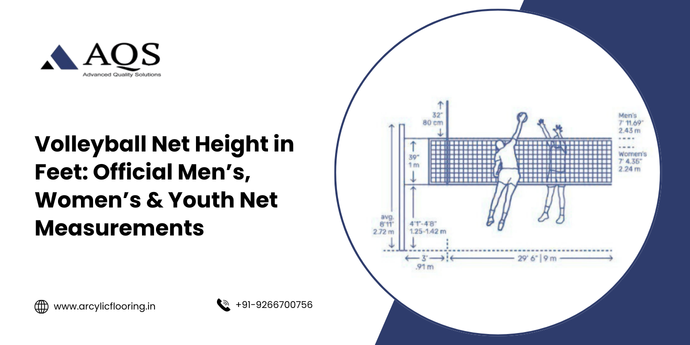
Correct volleyball net height in feet is one of the most fundamental requirements before setting up any volleyball court. Whether for a professional tournament, school gym class, recreational community league. A competitive youth academy program. The net is not simply a dividing barrier between the two halves of the court. It is the very axis around which the entire game rotates. Every serve, spike, set, and block is calculated relative to the height of the net. Get it wrong by even a few inches, and you alter the dynamics of play, affect player development, and risk non-compliance with official governing body regulations.
The Fédération Internationale de Volleyball (FIVB) – the global governing body for volleyball. Along with USA Volleyball and other national federations have established specific. Precise net height standards that differ across genders, age categories, and disciplines. The official men’s volleyball net height in feet stands at 7 feet 11⅝ inches (2.43 meters). While the official women’s volleyball net height in feet is set at 7 feet 4⅛ inches (2.24 meters). Youth categories receive progressively lower net heights to ensure skill development aligns with physical capability.
This comprehensive guide breaks down every official net height measurement. Explains the reasoning behind the differentiation, covers the complete anatomy of the volleyball court. And provides facility planners, coaches, parents, and players with everything they need to set up a regulation-compliant court. From indoor arenas to beach courts and recreational backyards, this is your definitive reference for volleyball net height in feet across all formats and age groups.
Table of contents
- What Is the Official Volleyball Net Height in Feet?
- Complete Volleyball Net Height Chart: All Categories in Feet & Meters
- Official Volleyball Net Height by Category
- Men’s Volleyball Net Height in Feet: The Science Behind 7 Feet 11⅝ Inches
- Women’s Volleyball Net Height in Feet: Understanding the 7 Feet 4⅛ Inch Standard
- Youth Volleyball Net Height in Feet: Age-Appropriate Standards for Player Development
- Full Volleyball Court Dimensions: A Complete Layout Guide
- Beach Volleyball Net Height in Feet and Court Differences
- How to Measure Volleyball Net Height in Feet Correctly
- Net Height Variations: Sitting Volleyball and Para Volleyball
- Why Getting the Volleyball Net Height in Feet Right Matters for Coaches and Facilities
- Quick-Reference Net Height Table by Age Group
- Volleyball Net Height Comparison: Indoor, Beach, and Sitting Volleyball
- Frequently Asked Questions (FAQ’S)
What Is the Official Volleyball Net Height in Feet?
For anyone searching for a rapid, verified answer. The official volleyball net height in feet for senior men is 7 feet 11⅝ inches (approximately 7.97 feet or 2.43 meters). And for senior women it is 7 feet 4⅛ inches (approximately 7.34 feet or 2.24 meters). These are the measurements mandated by the FIVB for all international competitions, Olympic games, World Championships, and national federation leagues worldwide. The net height is measured from the top edge of the net tape to the floor. Directly below the net at the center of the court. The height at the sideline antennae posts may be slightly higher depending on net tension, but the center measurement is always the official one.
Upgrade Your Sports Court Today
Get premium synthetic acrylic flooring designed for durability, grip, and performance.
Get Free ConsultationComplete Volleyball Net Height Chart: All Categories in Feet & Meters
The table below presents the complete and officially verified volleyball net height measurements across all competition categories, age divisions, and genders. These standards are drawn from FIVB regulations and USA Volleyball guidelines and represent the current global benchmark for net height requirements.
Official Volleyball Net Height by Category
| Category | Net Height (Feet) | Net Height (Meters) | Net Height (Inches) | Governing Body |
| Men’s (Senior) | 7 feet 11⅝ inches | 2.43 m | 95.625″ | FIVB / USA Volleyball |
| Women’s (Senior) | 7 feet 4⅛ inches | 2.24 m | 88.125″ | FIVB / USA Volleyball |
| Mixed / Co-Ed (Adult) | 7 feet 11⅝ inches | 2.43 m | 95.625″ | FIVB |
| Boys Under 16 | 7 feet 4⅛ inches | 2.24 m | 88.125″ | USA Volleyball |
| Boys Under 14 | 7 feet 0 inches | 2.13 m | 84″ | USA Volleyball |
| Girls Under 16 | 7 feet 4⅛ inches | 2.24 m | 88.125″ | USA Volleyball |
| Girls Under 14 | 7 feet 0 inches | 2.13 m | 84″ | USA Volleyball |
| Youth (8–12 yrs) | 6 feet 6 inches | 1.98 m | 78″ | Local/Recreational |
| Beach Volleyball (Men) | 7 feet 11⅝ inches | 2.43 m | 95.625″ | FIVB |
| Beach Volleyball (Women) | 7 feet 4⅛ inches | 2.24 m | 88.125″ | FIVB |
This table represents the complete spectrum of official volleyball net height in feet. Across every major playing category recognized by the FIVB, USA Volleyball, and affiliated regional governing bodies. Note that the beach volleyball net height mirrors the indoor net height for both men and women. Despite the significantly different playing surface and court dimensions.
Men’s Volleyball Net Height in Feet: The Science Behind 7 Feet 11⅝ Inches
Why 7 Feet 11⅝ Inches Is the Standard for Men
The men’s volleyball net height of 7 feet 11⅝ inches (2.43 meters) was not chosen arbitrarily. It was engineered through decades of observation, biomechanical study, and competitive play refinement by the FIVB. The height positions the top of the net slightly below the average standing reach of an elite male volleyball player. Which typically falls between 7 feet 8 inches and 8 feet 4 inches for professional players. This creates a competitive environment where blocking and spiking require genuine athleticism, timing, and technique. Rather than simply being tall enough to reach over the net without jumping.
The measurement ensures that a ball struck with maximum force at the peak of a jump can clear the net but must do so within a very narrow angular margin – making precision as important as power. The net height is also closely linked to the attack line distance of 9 feet 10 inches (3 meters) from the net; together, these two measurements define the geometric parameters within which back-row attacks, jump serves, and block strategies must be executed. Male players in the top-six rotation must coordinate their offensive and defensive angles against a net that demands elite vertical leap and upper-body reach simultaneously.
From a physical conditioning standpoint, the men’s net height serves as a training benchmark across all levels. Youth boys’ programs deliberately set nets lower to allow proper skill acquisition before transitioning to the full adult height. When a player reaches the U18 or U19 category, they train at the full 7 feet 11⅝ inch height to simulate the demands of senior competition. This progressive approach mirrors the way athletic programs in other sports use scaled equipment and spaces to build competence progressively without overwhelming young athletes physically or psychologically.
Men’s Indoor vs. Beach Volleyball Net Height Comparison
The men’s beach volleyball net height is identical to the indoor game at 7 feet 11⅝ inches (2.43 meters). However, the playing experience differs dramatically. On sand, players sink slightly with each step. Reducing effective jump height by an estimated 2–4 inches compared to a hardwood gym floor. This means that even though the net height is the same. The practical challenge of spiking over the net is considerably greater in beach volleyball. The FIVB deliberately maintains this identical height to preserve the athletic challenge. Prevent the game from becoming too offense-dominant on a surface that already reduces mobility.
Women’s Volleyball Net Height in Feet: Understanding the 7 Feet 4⅛ Inch Standard
The Rationale for the Women’s Net Height Differential
The women’s volleyball net height of 7 feet 4⅛ inches (2.24 meters) is set 7.5 inches (19 centimeters) lower than the men’s standard. This differential is calculated to reflect the physiological difference in average standing reach. Vertical jump between elite male and female athletes. According to sports science research, the average standing reach for elite female volleyball players is approximately 7 feet 3 inches to 7 feet 9 inches. Meaning the women’s net height places the tape at a comparable positional relationship to a female player’s reach as the men’s standard does for male players. The objective is to maintain an equivalent strategic and athletic challenge across genders, not to make the game easier.
This height differential is well-established internationally and ensures that the offensive and defensive balance of volleyball. The ratio of successful spikes to successful blocks, the viability of jump serves versus platform receptions. Remains consistent between men’s and women’s competitions. The women’s game has its own distinct tactical identity. With a high premium on ball control, setter creativity, and team coordination that operates beautifully within the 7 feet 4⅛ inch framework. Collapsing this differential would skew these tactical elements significantly and change the fundamental character of the game at the elite level.
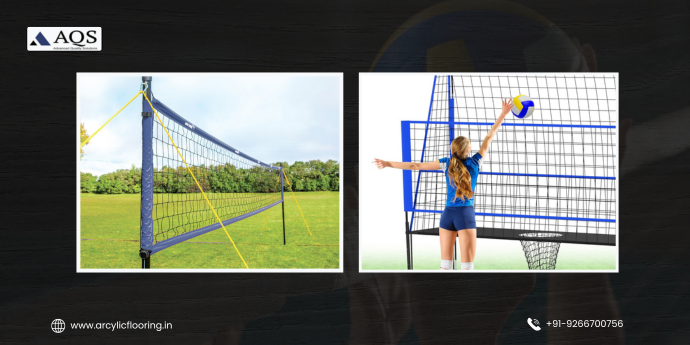
Women’s Net Height at the National and Club Level
For club volleyball, high school, and collegiate play, the women’s net height of 7 feet 4⅛ inches (2.24 meters) is universally applied from the U16 age group upward. The National Federation of State High School Associations (NFHS) in the United States adopts this height for all high school women’s matches. NCAA collegiate volleyball also mandates this height for all divisions. Below U16, girls transition through reduced net heights to accommodate developmental needs, a system detailed in the youth section of this guide. At recreational and amateur levels, maintaining this standard height ensures that skills learned in practice and pick-up games translate directly to competitive environments without adjustment.
Transform Your Sports Facility Today!
Contact us for high-quality synthetic sports flooring material and elevate your space!
Youth Volleyball Net Height in Feet: Age-Appropriate Standards for Player Development
Why Youth Net Heights Are Different
Setting the volleyball net height in feet correctly for youth players is critically important for long-term athletic development. If young players – particularly those aged 8 to 14 – are forced to compete against a net set at adult height. They develop compensatory techniques that become ingrained habits and ultimately limit their potential. Specifically, they learn to spike with an excessive forward lean to compensate for insufficient vertical jump. Develop inconsistent setting trajectories because the optimal arc height changes relative to a lowered contact point, and avoid back-row attacks entirely because the angular demand becomes physically impossible. Youth-adjusted net heights remove these developmental barriers without removing challenge.
The USAV (USA Volleyball) Age Group Regulations and the FIVB Youth Development Program both provide clear. Tiered net height standards designed around physical readiness benchmarks rather than arbitrary age cutoffs. These standards recognize that a 12-year-old male has a fundamentally different standing reach, average vertical jump, and hand-eye coordination profile than a 17-year-old female, and the net height must reflect those differences to create the same type of game-appropriate challenge across all developmental stages.
Youth Net Height Breakdown by Age Group
Boys under 16 play at the women’s senior height of 7 feet 4⅛ inches (2.24 meters), allowing them to develop full-range attacking and blocking mechanics that will serve them as they approach the adult transition. Boys under 14 play at 7 feet (2.13 meters), a height that still demands genuine jumping ability while accommodating the average reach profile of a 12–13-year-old male athlete. Girls under 16 mirror the senior women’s height at 7 feet 4⅛ inches, the same rationale applying – early exposure to competition height ensures seamless transition. Girls under 14 also play at 7 feet, reflecting their developmental equivalence to boys in the same bracket at that age range.
For recreational and introductory programs targeting players aged 8 to 12, a net height of 6 feet 6 inches (1.98 meters) is recommended by most youth athletics organizations. At this height, the focus shifts entirely to ball-handling fundamentals, court awareness, and basic positional understanding. Blocking and spiking at this stage are developmental milestones rather than tactical weapons, and the lower net ensures that neither becomes impossible nor trivial. Many school-based programs and community recreation centers use adjustable net systems specifically to accommodate multiple age groups using a single court.
Full Volleyball Court Dimensions: A Complete Layout Guide
A thorough understanding of the volleyball net height in feet is inseparable from understanding the full geometry of the volleyball court. The net exists within a precisely defined space, and every line, zone, and measurement on the court is related to the net’s position at the center. The following section provides a complete dimensional breakdown of the indoor volleyball court as specified by the FIVB Official Volleyball Rules.
Indoor Volleyball Court Measurements
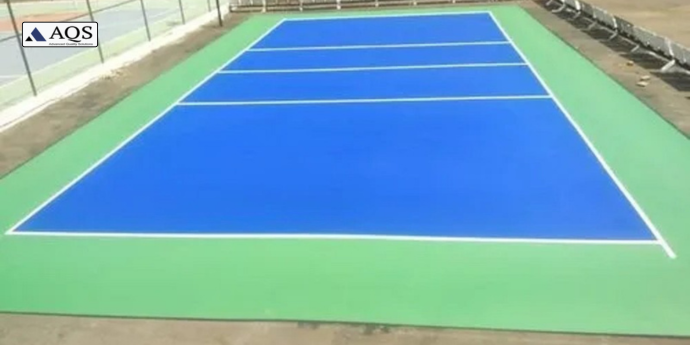
The standard indoor volleyball court is a rectangle measuring 59 feet (18 meters) in length and 29.5 feet (9 meters) in width. The net divides the court at the precise midpoint, creating two equal team zones each measuring 29.5 feet by 29.5 feet (9m x 9m). The court must be surrounded by a free zone of at least 9 feet 10 inches (3 meters) on all sides for domestic competition, and at least 16 feet 4 inches (5 meters) on the end lines and 9 feet 10 inches (3 meters) on the sidelines for FIVB-sanctioned world competitions. These free zones ensure player safety during diving, lunging, and out-of-bounds play.
The attack line – one of the most strategically significant boundaries on the court – is drawn 9 feet 10 inches (3 meters) from the center line on each side of the net. This line separates the front-row zone from the back-row zone and regulates where back-row players may contact the ball when at or above net height. Back-row players who jump to spike must take off from behind the attack line, though they may land in front of it after contact. Understanding the attack line’s relationship to the net height is essential for coaches and players developing offensive systems.
Volleyball Court Dimensions Reference Table
Full Indoor Volleyball Court Dimensions
| Measurement | Imperial (Feet/Inches) | Metric (Meters) |
| Court Length | 59 feet (60 ft total) | 18 meters |
| Court Width | 29.5 feet (30 ft total) | 9 meters |
| Attack Line from Net | 9 feet 10 inches | 3 meters |
| Free Zone (min.) | 9 feet 10 inches | 3 meters |
| Free Zone (FIVB/World) | 16 feet 4 inches | 5 meters |
| Net Length | 32 feet | 9.5 meters (for 9m court) |
| Net Width (Depth) | 3 feet 3 inches | 1 meter |
| Net Post Height (Men) | 8 feet 0.75 inches | 2.55 meters |
| Net Post Height (Women) | 7 feet 6.75 inches | 2.35 meters |
| Service Zone Depth | 9 feet 10 inches | 3 meters |
| Ceiling Height (min.) | 24 feet 7 inches | 7 meters |
The Volleyball Court Playing Surface
The playing surface of an official volleyball court must be flat, horizontal, and uniform. FIVB regulations permit wooden, synthetic, or other smooth surfaces for indoor competition. While beach volleyball is played on sand that must be at least 40 centimeters deep and free of stones, shells, or hazards. For indoor courts, the surface should provide adequate traction to prevent sliding while remaining forgiving enough to allow knee and hip landings during defensive dives. Professional indoor volleyball flooring is typically a suspended hardwood system that absorbs impact and returns energy, significantly contributing to player performance and injury prevention.
The court lines are integral to the playing surface and are typically 2 inches (5 centimeters) wide. All boundary lines – the end lines and the sidelines – are included within the dimensions of the court and are considered part of the playing area. A ball landing on any portion of a boundary line is therefore ruled in play. The center line runs directly beneath the net across the full 29.5-foot width. Divides the court into two halves; players may not step into the opponent’s court during play, though a foot or hand may briefly contact the center line itself provided it does not interfere with the opponent.
Transform Your Sports Facility Today!
Contact us for high-quality synthetic sports flooring material and elevate your space!
The Net Assembly: Structure and Specifications
The volleyball net itself has its own precise dimensional requirements beyond simply the height. The net is 9.5 to 10 meters (approximately 31.2 to 32.8 feet) long, extending 25–50 centimeters (approximately 10–20 inches) beyond the sideline on each side. It is 1 meter (3 feet 3 inches) wide/deep, allowing sufficient material to maintain proper tension when mounted. The top of the net features a horizontal band of white canvas 7 centimeters (approximately 2.75 inches) wide that folds over a flexible cable. This cable passes through the band and is attached to the net posts on each side to maintain height and horizontal tension.
A white flexible band 5 centimeters (2 inches) wide is sewn along the net at each sideline, perpendicular to it – these are the vertical side bands. A flexible antenna extends 80 centimeters (approximately 31.5 inches) above the net at each side band. Creating the antenna system that defines the width of the crossing space. Any ball passing outside the antennae plane is ruled out of bounds regardless of whether it was above or below net height. The antennae are typically fiberglass rods colored alternately in 10-centimeter bands of red and white for visibility.
Beach Volleyball Net Height in Feet and Court Differences
Beach volleyball shares the same official net height in feet as the indoor game – 7 feet 11⅝ inches (2.43 meters) for men and 7 feet 4⅛ inches (2.24 meters) for women. However, the beach volleyball court is smaller than its indoor counterpart, measuring 52.5 feet (16 meters) long by 26.2 feet (8 meters) wide. Teams consist of only two players each rather than six, fundamentally changing the tactical, physical, and positional demands of the game. There is no attack line in beach volleyball, meaning players may spike from anywhere on their side of the court. This rule change, combined with the sand surface, shifts the athletic demand significantly toward individual mobility, reading, and endurance.
The free zone for beach volleyball is a minimum of 16.4 feet (5 meters) from all boundary lines, reflecting the longer sprint distances common in the two-player format when chasing wide balls. The net posts in beach volleyball are positioned 0.7 to 1 meter (approximately 2.3 to 3.3 feet) outside the sidelines, compared to the 0.5 to 1 meter standard for indoor courts. The wider post placement helps accommodate the larger free zone and reduces interference during play near the sidelines. Importantly, in beach volleyball, the center line beneath the net does not exist as a physical marking – players are permitted to reach under the net and even enter the opponent’s court provided they do not obstruct play.
How to Measure Volleyball Net Height in Feet Correctly
Tools Needed and Step-by-Step Measurement Process
Measuring the volleyball net height in feet correctly requires a net height measuring stick – a rigid pole with a marked scale – which is the official tool used by referees and court setup crews at every level of competition from recreational parks to Olympic arenas. In the absence of a professional measuring stick, a rigid carpenter’s rule or steel tape measure can substitute. The critical point is that the tool must be rigid; a soft measuring tape tends to curve and introduce measurement error, particularly in the vertical orientation. A 2–3-inch error in net height directly compromises player safety and game integrity.
The measuring procedure begins at the center of the court, directly beneath the net. Place the measuring tool vertically on the floor and extend it upward until it contacts the underside of the top cable band. Read the measurement at that contact point. For indoor courts, verify that the surface is level before measuring. An unlevel court will produce an inaccurate reading if the floor dips or rises at the center. For beach volleyball, the sand must be compacted below the net before measuring. As loose sand can compress under player weight and effectively raise the apparent net height during play.
Checking Net Tension and Sag
After confirming the center height, check the height at both sideline antennae points. The net must not sag more than 2 centimeters below the center measurement height at the antennae. A sagging net, often caused by insufficient cable tension or a stretched top band, creates inconsistent playing conditions where balls that should cross over the net clip the tape near the posts. Proper net tension is achieved by tightening the cable to the post with the appropriate tensioning hardware. Most quality volleyball net systems include a ratchet or pulley system that allows fine adjustment. Always re-measure the center height after tensioning, as over-tightening can actually bow the net upward slightly at the center.
Upgrade Your Sports Court Today
Get premium synthetic acrylic flooring designed for durability, grip, and performance.
Get Free ConsultationNet Height Variations: Sitting Volleyball and Para Volleyball
Sitting volleyball – the Paralympic discipline of the sport – uses a dramatically different net height specification compared to the standing game. In sitting volleyball for men, the net height is set at 3 feet 9.28 inches (1.15 meters), while for women the height is 3 feet 5.09 inches (1.05 meters). The court is also smaller, measuring 32.8 feet by 19.7 feet (10 meters by 6 meters), and players must maintain contact with the court surface when playing the ball. The lower net and smaller court compensate for the restricted mobility of seated play while preserving the explosive offensive and defensive tactical possibilities that make volleyball compelling as a competitive sport.
Para volleyball for standing classification players with physical impairments generally uses the same standard net heights as the non-disabled game, adjusted by age and gender in the same manner as all other categories. Classification systems ensure that athletes compete against opponents with similar functional capability levels, and net height remains constant within classification groups. The consistency of net height across para and standard volleyball ensures that spectators, coaches, and broadcasters can apply the same analytical framework to both disciplines, supporting the visibility and growth of adaptive volleyball globally.
Calculate Your Sports Court Dimensions!
Contact us for Quickly measure and calculate accurate sports court dimensions with this easy-to-use tool!
Why Getting the Volleyball Net Height in Feet Right Matters for Coaches and Facilities
For coaches, the correct volleyball net height in feet is directly tied to the quality of training. Practicing at the wrong net height – even one that is only 2–3 inches off – creates muscle memory and spatial calibration that is misaligned with competition reality. A player who has trained extensively at a net set 3 inches too low will develop a spike approach. And arm swing optimized for a clearance margin that does not exist in competition. Their timing and trajectory will be miscalibrated, resulting in an elevated net-error rate during games until costly detraining and retraining occurs. Coaches at competitive programs typically check net height at the beginning of every practice session using a dedicated net height gauge kept in the equipment room.
For facility managers and court designers, net height accuracy intersects with equipment selection. Adjustable net systems that allow height modification for different categories must have reliable locking mechanisms that hold precise settings under the dynamic load of game play. A net post assembly that allows even 1 centimeter of vertical drift during a match is non-compliant and potentially unsafe. Premium court systems use cable-tensioned posts with calibrated height indicators and anti-vibration locking collars. When specifying equipment for a multi-use gymnasium that will host youth, women’s, and men’s programs on the same court, adjustable systems are essential – and the reliability of their height settings must be verified regularly by facility staff.
Quick-Reference Net Height Table by Age Group
Volleyball Net Height Quick Reference by Age & Gender
| Age Group | Gender | Net Height (ft) | Net Height (m) |
| 18+ (Senior) | Male | 7′ 11⅝” | 2.43 m |
| 18+ (Senior) | Female | 7′ 4⅛” | 2.24 m |
| Under 18 (16–17) | Male | 7′ 11⅝” | 2.43 m |
| Under 18 (16–17) | Female | 7′ 4⅛” | 2.24 m |
| Under 16 | Male | 7′ 4⅛” | 2.24 m |
| Under 16 | Female | 7′ 4⅛” | 2.24 m |
| Under 14 | Male | 7′ 0″ | 2.13 m |
| Under 14 | Female | 7′ 0″ | 2.13 m |
| 8–12 (Recreational) | Both | 6′ 6″ | 1.98 m |
Volleyball Net Height Comparison: Indoor, Beach, and Sitting Volleyball
The three primary volleyball disciplines each present distinct net height environments, and understanding how they compare helps coaches who work across multiple formats, multi-sport facilities managing equipment, and players who compete in more than one discipline. Indoor volleyball uses the highest net in the standard game – 7 feet 11⅝ inches for men – and combines this with a larger court and more complex positional rotational rules. The strategic complexity of indoor volleyball largely stems from the interaction between the net height, the attack line, and the six-player rotation system. Every offensive weapon – the pipe attack, the quick set, the back-row swing – is architecturally defined by its relationship to the net height.
Beach volleyball maintains the same net height as indoor in both men’s and women’s formats, but the two-player format, sand surface, and absence of the attack line create a completely different athletic environment at the same barrier height. The sand surface reduces effective jump height, placing greater emphasis on arm swing speed, wrist snap, and shot placement over pure power. Sitting volleyball’s dramatically lower net height – less than half that of the standing game – creates a sport where offensive angles are fundamentally different, placing more premium on arm strength, serving strategy, and reading defensive formations without the vertical dimension that defines standing volleyball tactics. Together, these three disciplines illustrate how net height is the primary architectural variable that shapes the entire game.
Conclusion: Precision in Net Height Is the Foundation of Volleyball
The volleyball net height in feet is not a suggestion. It is a precisely engineered standard that defines the entire architecture of the sport. From the official men’s height of 7 feet 11⅝ inches to the women’s 7 feet 4⅛ inches. From youth adjustments down to 6 feet 6 inches for the youngest recreational players to sitting volleyball’s 3 feet 9 inches. Every measurement has been calibrated against the physical capabilities of its target athlete population to produce competitive balance, skill development opportunity, and safe play conditions.
Whether you are a coach verifying practice court setup, a facility manager specifying net post equipment, a parent setting up a backyard net for a 10-year-old, or an administrator organizing a city-wide recreational league, the information in this guide gives you every measurement you need – verified, categorized, and cross-referenced against current governing body regulations. Set the net at the right height, and you set the stage for volleyball at its best.
Frequently Asked Questions (FAQ’S)
The official men’s volleyball net height is 7 feet 11⅝ inches (2.43 meters) for all senior competitions governed by the FIVB and USA Volleyball.
The official women’s volleyball net height is 7 feet 4⅛ inches (2.24 meters) for all senior and U16+ competitions governed by the FIVB and USA Volleyball.
Boys and girls under 14 years of age play with a net height of 7 feet 0 inches (2.13 meters) per USA Volleyball age group regulations.
Yes – beach volleyball uses the identical net height as indoor volleyball: 7 feet 11⅝ inches for men and 7 feet 4⅛ inches for women at all official competition levels.
Volleyball net height is always measured at the center of the court. From the top edge of the net tape vertically down to the playing surface floor directly beneath it.