Shuttle Court Size in Feet (AI Summary)
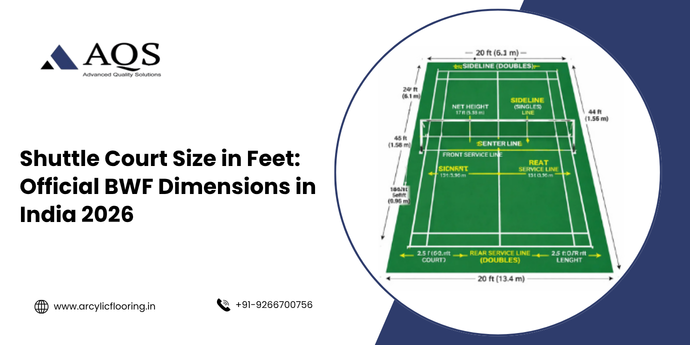
A standard Shuttle Court Size in Feet (badminton) court is 44 feet long for both singles and doubles. The width is 20 feet for doubles and 17 feet for singles. The net stands at 5 feet 1 inch at the posts and dips to 5 feet at the center. The short service line sits 6 feet 6 inches from the net. All line widths are 40 mm. These are official BWF standards applicable globally – including all Indian courts in 2026.
- Court Length (Singles & Doubles): 44 feet (13.4 m)
- Doubles Width: 20 feet (6.1 m)
- Singles Width: 17 feet (5.18 m)
- Net Height at Posts: 5 ft 1 in (1.55 m)
- Net Height at Center: 5 ft (1.524 m)
- Short Service Line: 6.5 ft from net
- Doubles Long Service Line: 2.5 ft from baseline
- Total Playing Area (Doubles): ≈ 880 sq ft
Introduction
Whether you are a school principal planning a sports wing, a club owner commissioning a new indoor facility, or simply a badminton enthusiast who wants to practise seriously – understanding the correct shuttle court size in feet is the very first step. India’s badminton boom, accelerated by PV Sindhu’s Olympic gold and Lakshya Sen’s international rankings, has pushed demand for professionally built courts to an all-time high in 2026. Getting the dimensions right is not optional – it is the foundation of fair play, player safety, and long-term court durability. This guide covers every inch of the court in precise detail.
The term “shuttle court” is widely used in India as an informal synonym for a badminton court. The sport itself originated in India in the 1860s under the name “Poona” before British officers refined the rules in England. Today, the Badminton World Federation (BWF) governs all official dimensions globally, and Indian courts – whether in Hyderabad academies or Delhi school gymnasiums – must follow the same specification. The good news is that the dimensions are beautifully simple and logical once you understand the purpose behind each line, zone, and measurement.
Upgrade Your Sports Court Today
Get premium synthetic acrylic flooring designed for durability, grip, and performance.
Get Free Consultationbadminton court dimensions India shuttle court measurement feet BWF court standard 2026 indoor badminton court sizesingles vs doubles court width badminton net height feet service line distance badminton court in square feet acrylic badminton flooring India court marking lines mm
Table of contents
- Shuttle Court Size in Feet (AI Summary)
- Introduction
- What Is a Shuttle Court? Understanding the Playing Field
- Official Shuttle Court Size in Feet – BWF Standard Dimensions (2026)
- Singles vs Doubles Shuttle Court: Key Dimension Differences and Strategic Impact
- Shuttle Court Net Height in Feet – Why the 1-Inch Difference Matters
- Clearance Zone and Ceiling Height – Total Space Required for a Shuttle Court in India
- Shuttle Court Flooring in India – Surface Types, LSI Keywords: Acrylic, PVC, Wooden
- Court Markings and Line Specifications – Shuttle Court Layout in Detail
- Indoor vs Outdoor Shuttle Court – Dimensions Stay the Same, But Conditions Differ
- Case Study – Shuttle Court Construction in Hyderabad (2025–2026)
- Shuttle Court Construction Cost in India 2026 – Budgeting by Court Type
- Lighting Standards for Shuttle Courts – Lux Levels, LED Fixtures, and India Guidelines
- How to Measure and Mark a Shuttle Court in Feet – Step-by-Step Process
- Common Mistakes in Shuttle Court Dimensions – What to Avoid in Indian Constructions
- FAQs – Shuttle Court Size in Feet (India 2026)
- Conclusion – Getting Shuttle Court Size Right Matters More Than You Think
What Is a Shuttle Court? Understanding the Playing Field
A shuttle court, officially called a badminton court, is a rectangular playing surface divided in the middle by a net. The game is played with a feathered or nylon projectile called a shuttlecock (informally: “shuttle” or “birdie”) that players hit over the net using lightweight racquets. Unlike tennis or squash, badminton uses a different court for singles and doubles – not a different court physically, but a different set of boundary lines marked on the same surface. Every standard court carries markings for both formats simultaneously, making it a truly multi-use surface. The total playing area for a doubles court equals approximately 880 square feet, while a singles game uses roughly 748 square feet.
In India, the word “shuttle” has become shorthand for the entire game of badminton. When someone says “let’s go play shuttle,” they mean badminton. Accordingly, “shuttle court size in feet” has become one of the highest-searched badminton queries in India – especially among parents, school administrators, builders, and sports entrepreneurs looking to set up new facilities. The dimensions are identical to what the BWF prescribes, and no Indian governing body, including the Badminton Association of India (BAI), has ever diverged from these international standards. Any court that deviates from BWF measurements cannot host official matches.
Official Shuttle Court Size in Feet – BWF Standard Dimensions (2026)
The Badminton World Federation publishes the Laws of Badminton, which define court geometry with millimetre-level precision. Below is a complete breakdown of every key measurement converted into feet and inches for easy reference on Indian construction sites and school planning documents.
Court Length and Width – Singles vs Doubles Measurements Explained
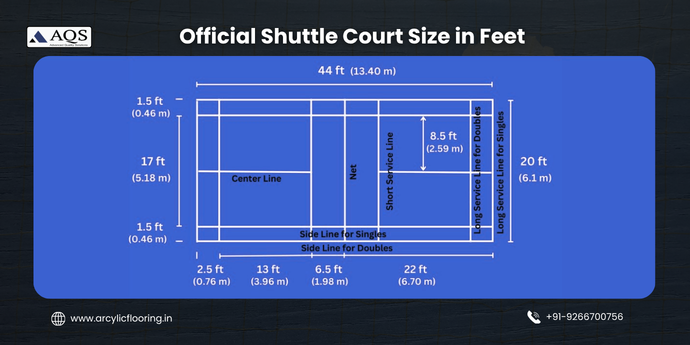
The court length remains a fixed 44 feet (13.4 metres) for both singles and doubles play. This length is non-negotiable and accommodates the full trajectory of the shuttlecock – from deep baseline clears to fast net drops. The court is divided into two equal halves of 22 feet each by the net. The key variable is the width: doubles uses 20 feet (6.1 m) while singles uses 17 feet (5.18 m). The 3-foot reduction on each side in singles forces players to focus on individual precision, footwork, and stamina rather than lateral coverage. The combined area of a doubles court is approximately 880 square feet – comparable to a medium-sized apartment room, which helps in visualising the space requirement.
| Measurement | Feet & Inches | Metres | Applies To |
| Court Length | 44 ft | 13.40 m | Singles & Doubles |
| Court Width (Doubles) | 20 ft | 6.10 m | Doubles only |
| Court Width (Singles) | 17 ft | 5.18 m | Singles only |
| Each Half (Length) | 22 ft | 6.70 m | Both |
| Short Service Line from Net | 6 ft 6 in | 1.98 m | Both |
| Doubles Long Service Line from Baseline | 2 ft 6 in | 0.76 m | Doubles only |
| Net Height at Posts | 5 ft 1 in | 1.55 m | Both |
| Net Height at Center | 5 ft 0 in | 1.524 m | Both |
| Line Width | 1.57 in | 40 mm | Both |
| Minimum Side Clearance | 5 ft | 1.52 m | Both |
| Minimum Rear Clearance | 6.5 ft (rec.) | 2 m | Both |
| Minimum Ceiling Height (Indoor) | 26 ft | 7.9 m | Both |
| Ideal Ceiling Height (Tournament) | 40 ft+ | 12 m+ | Both |
| Court Area – Doubles | 880 sq ft | 81.74 sq m | Doubles |
| Court Area – Singles | 748 sq ft | 69.46 sq m | Singles |
Pro Tip for Builders in India
When marking a shuttle court on Indian soil, always begin with the length (44 ft) and center it within your available land. Most standard school gymnasiums in India measure 50 × 30 ft internally – just enough for one court with minimal clearance. For proper safety buffers, plan a minimum 55 × 28 ft indoor area per court.
Service Courts – Dimensions of the Diagonal Serving Zones
Service courts are the areas from which and into which a serve must be directed. They are defined by the short service line (6.5 ft from net), the center line (running the length of the court), and the relevant sidelines and baselines. In singles, each service court measures approximately 13 feet in length and 8.5 feet in width. In doubles, the long service line cuts 2.5 feet from the baseline, creating a slightly shorter but wider service zone. The diagonal cross-court serving rule – right to left and vice versa – makes these service court boundaries critical for fair play. A serve that lands outside these zones, or fails to cross the short service line, is a fault.
Understanding service courts is particularly important when coaching junior Indian players, because service fault rules are frequently misunderstood at the grassroots level. Coaches at BAI district academies often report that incorrect court markings at local venues lead to systematic training errors. Accurate shuttle court size in feet, particularly the service line positions, directly shapes how players develop their serving strategy from a young age.
Singles vs Doubles Shuttle Court: Key Dimension Differences and Strategic Impact
The most commonly confused aspect of shuttle court size in feet is the singles-versus-doubles width difference. Both formats use the same physical court, but the playable width changes – 17 ft for singles, 20 ft for doubles. In singles play, the outer tramlines (the extra 1.5-ft strips on each side) are out of bounds during rallies and are only in bounds at the baseline for service. In doubles play, those same tramlines are live during rallies but are out during service (instead, the doubles long service line 2.5 ft from the baseline restricts the depth of a serve). This elegant system of overlapping boundaries means one court surface can serve both game types without any physical modification – just a change in which lines players observe.
Calculate Your Sports Court Dimensions!
Contact us for Quickly measure and calculate accurate sports court dimensions with this easy-to-use tool!
Comparison Table – Singles vs Doubles Shuttle Court Dimensions
| Feature | Singles Court | Doubles Court |
| Length | 44 ft (13.4 m) | 44 ft (13.4 m) |
| Width | 17 ft (5.18 m) | 20 ft (6.1 m) |
| Playing Area | ~748 sq ft | ~880 sq ft |
| Short Service Line | 6.5 ft from net | 6.5 ft from net |
| Long Service Line | At back baseline | 2.5 ft from baseline |
| Tramlines (side) in play? | Out of bounds | In bounds |
| Rear tramline in rally? | Full baseline | Full baseline |
| Rear tramline in serve? | Full baseline | Cut by long service line |
| Primary skill emphasis | Precision, stamina | Teamwork, speed |
| Players | 2 (1 per side) | 4 (2 per side) |
| Diagonal court length | ~45.7 ft | ~48.3 ft |
A shuttlecock travels at over 400 km/h during professional smashes – making the shuttle court, at just 44 feet long, the most speed-intense per-square-foot playing surface in all of racquet sports.
Shuttle Court Net Height in Feet – Why the 1-Inch Difference Matters
The net in a shuttle court stands at 5 feet 1 inch (1.55 m) at the posts and dips naturally to 5 feet (1.524 m) at the center. This 1-inch differential is not a manufacturing flaw – it is a deliberate specification. The net is pulled taut between two posts, and the natural catenary curve causes the center to sit slightly lower. BWF mandates this precise configuration so that the center of the court offers a marginally easier trajectory for net shots while the edges remain taller to prevent easy cross-court angle exploitation. Getting the net height wrong – even by a couple of inches – measurably changes game dynamics and rally patterns.
In India, one of the most frequent quality control issues reported by coaches at district-level academies is incorrect net height. Nets purchased from unregulated vendors are often too short or improperly tensioned, leading to a lower-than-standard center height. Players trained on such courts develop incorrect shot trajectories and struggle when competing at state or national events where BWF-standard nets are used. Anyone building or upgrading a shuttle court in India in 2026 must verify net height with a measurement tape at both posts and the center – it takes under two minutes and prevents years of skills distortion.
Net Installation Checklist for Indian Courts
Verify post height = 5 ft 1 in. Check center height = 5 ft exactly. Ensure net depth is at least 2.5 ft. Net colour must be dark (black, brown, or dark green). Net cord must be flush with the top of posts. Net width must span the full court width (at least 20 ft for doubles).
Clearance Zone and Ceiling Height – Total Space Required for a Shuttle Court in India
The playing court itself is 44 × 20 ft, but this is only the marked playing area. A properly built shuttle court facility requires additional buffer zones on all four sides. For recreational and club-level courts, a minimum of 5 feet on each side and behind the baselines is recommended by BWF. For tournament-grade courts, this increases to 6.5 feet (2 metres) on all sides. This means a single, properly clearanced shuttle court needs a minimum footprint of approximately 55 × 30 feet at the recreational level. When planning multi-court facilities – common in urban Indian sports complexes – allow an additional 2 metres between adjacent courts instead of using a shared wall as a boundary.
Ceiling height is the most frequently overlooked dimension when Indians plan indoor shuttle courts. Badminton is a three-dimensional sport – high defensive lobs routinely travel 25 to 30 feet vertically. A minimum ceiling clearance of 26 feet (8 metres) is required for comfortable recreational play, while BWF-grade tournament halls mandate at least 40 feet (12 metres) of clear vertical space with no beams, lights, or obstructions. Many Indian converted warehouses and school gymnasiums fall short at 15–18 feet, creating a ceiling-obstruction fault problem that fundamentally changes how the game is played. Always confirm ceiling height before committing to an indoor shuttle court project.
Total Space Requirements – Shuttle Court Build Planning Table for India
| Scenario | Playing Area | Side Clearance | Total Floor Area Needed | Min. Ceiling |
| 1 Recreational Court | 44 × 20 ft | 5 ft all sides | ~54 × 30 ft | 26 ft |
| 1 Tournament Court | 44 × 20 ft | 6.5 ft all sides | ~57 × 33 ft | 40 ft+ |
| 2 Courts (Side by Side) | 2 × 44 × 20 ft | 5 ft exterior + 6.5 ft between | ~54 × 56 ft | 26 ft min |
| 4 Courts (Academy) | 4 × 44 × 20 ft | Full clearance | ~115 × 60 ft | 30 ft+ |
| Outdoor Court | 44 × 20 ft | 6.5 ft+ | ~57 × 33 ft | Open sky |
Upgrade Your Sports Court Today
Get premium synthetic acrylic flooring designed for durability, grip, and performance.
Get Free ConsultationShuttle Court Flooring in India – Surface Types, LSI Keywords: Acrylic, PVC, Wooden
The correct shuttle court size in feet means little if the playing surface beneath players’ feet is substandard. India’s badminton flooring market has evolved significantly in 2026, with three dominant surface types now available: synthetic acrylic, PVC/vinyl mat, and hardwood. Each has distinct performance, maintenance, and cost characteristics. The BWF approves all three for competitive play, provided they meet friction, shock absorption, and bounce specifications. For India’s climate – marked by intense heat, monsoon humidity, and dust – synthetic acrylic courts are increasingly preferred over hardwood, which warps and cracks with seasonal temperature swings.
Synthetic acrylic surfaces are applied in multiple layers over a concrete or asphalt base. A typical system includes a primer coat, a base coat, one or two cushion layers for shock absorption, and a topcoat with anti-slip texture. The result is a surface with a friction coefficient of 0.6–0.8, optimal traction for quick pivots, and UV resistance for outdoor installations. PVC interlocking mats (4.5 mm to 8 mm thick) are the most cost-effective solution for temporary or semi-permanent courts in Indian schools and community centres. Hardwood – typically maple or beech – remains the gold standard for elite academies but costs nearly three times more than acrylic and requires strict humidity control to prevent warping.
Flooring Comparison Table – Shuttle Court Surface Options in India 2026
| Surface Type | Cost (per sq ft) | Durability | Best For | Indoor/Outdoor | Maintenance |
| Synthetic Acrylic | ₹80–₹140 | 10–15 years | Clubs, Academies | Both | Low |
| PVC Interlocking Mat | ₹40–₹80 | 5–8 years | Schools, Homes | Indoor | Very Low |
| Hardwood (Maple) | ₹200–₹380 | 20–25 years | Elite Academies | Indoor only | High |
| Rubber Mat | ₹30–₹60 | 3–5 years | Practice only | Indoor | Very Low |
| Cement + Paint | ₹15–₹30 | 2–4 years | Basic outdoor | Outdoor | Medium |
Quick Decision Guide – Which Shuttle Court Setup Is Right for You?
- Home / Backyard Court
Use PVC interlocking mats. Budget ₹40–80/sq ft. Minimum 44 × 20 ft area. Standard dimensions still apply.
- School / Community Court
Opt for synthetic acrylic on concrete base. Budget ₹90–120/sq ft. Ideal for daily multi-user usage.
- Sports Club / Academy
Invest in multi-layer synthetic acrylic with proper lighting (300+ lux). Budget ₹3–6 lakh per court installed.
- Tournament Venue
BWF-grade hardwood or premium acrylic. Min. 40 ft ceiling. 500+ lux lighting. Full 6.5 ft clearance all sides.
Court Markings and Line Specifications – Shuttle Court Layout in Detail
Every line on a shuttle court carries a specific function and a precise specification. The BWF mandates that all lines are exactly 40 mm (approximately 1.57 inches) wide, clearly visible, and preferably white or yellow against the court surface. Crucially, every line is considered part of the area it defines – meaning a shuttlecock landing on any part of the boundary line is ruled “in.” This rule makes accurate line painting extremely important; a 5 mm error in line placement can be the difference between a rally-winning shot and a fault in a closely contested match.
The center line runs the full length of the court, perpendicular to the net, dividing it into left and right service courts. The short service line, at 6.5 ft from the net on each side, is the most referenced line in recreational play. The doubles long service line (2.5 ft from the back baseline) and the singles long service line (coinciding with the back baseline) complete the service zone geometry. On professionally built Indian courts, lines are applied using masking tape and acrylic paint stencils after the surface cures – ensuring clean edges and consistent 40 mm width throughout the court’s 10–15 year service life.
Transform Your Sports Facility Today!
Contact us for high-quality synthetic sports flooring material and elevate your space!
Indoor vs Outdoor Shuttle Court – Dimensions Stay the Same, But Conditions Differ
A common misconception in India is that indoor and outdoor shuttle courts have different dimensions. They do not – the court size in feet is identical at 44 × 20 ft for doubles and 44 × 17 ft for singles regardless of location. What changes is everything around and above the court: wind exposure, surface material, drainage, lighting, and ceiling clearance. Outdoor courts face India’s monsoon rains, summer heat exceeding 45°C in northern states, and dust storms in western regions. These conditions demand UV-stable acrylic surfaces, proper drainage slopes (1–2%), and windbreak walls or chain-link fencing to prevent shuttle drift.
Indoor courts, by contrast, offer controlled playing conditions, making them the preferred choice for serious training and all competitive play. India’s Sports Authority of India (SAI) and the Badminton Association of India (BAI) specify that all state-level and above competitions must be held indoors on BWF-approved surfaces. The 2026 expansion of Khelo India sports infrastructure across 28 states has seen over 200 new indoor badminton courts commissioned – all built to exact shuttle court size in feet specifications per BWF Laws of Badminton.
Case Study – Shuttle Court Construction in Hyderabad (2025–2026)
Gopichand Badminton Academy – Satellite Centre, Kondapur, Hyderabad
In late 2024, a private sports development company commissioned a 4-court indoor shuttle facility adjacent to the Gopichand Academy’s satellite network in Kondapur, Hyderabad. The brief demanded full BWF compliance, multi-user durability, and a construction timeline of under 16 weeks. Here is how the project unfolded and what it reveals about shuttle court size planning in India.
Planning Phase: The available warehouse space measured 120 × 65 ft internally. The project architect designed a 4-court layout – two courts end-to-end on each side – with a 6.5 ft clearance along all exterior walls and 8 ft between adjacent courts. Total court playing area: 4 × 880 = 3,520 sq ft. Buffer zones added approximately 1,200 sq ft. Ceiling height of the existing structure was 32 ft – adequate for academy-level play but below the 40 ft international standard, a known compromise going in.
Surface Selection: The team selected a 5-layer synthetic acrylic system from a Bengaluru-based supplier. The system included waterproof primer on the existing concrete slab, two base coats, a rubber cushion layer (12 mm), and a topcoat with embedded silica for traction. Total surface cost: ₹92/sq ft × 3,520 sq ft = ₹3,23,840. Court marking (lines + boundary paint) added ₹18,000. Net posts and BWF-standard nets: ₹45,000 for 4 courts. Lighting (LED, 400 lux average): ₹2.8 lakh. Total project cost: approximately ₹9.2 lakh.
Outcome: All four courts passed the BAI facility inspection in March 2025. Within six months of opening, the centre enrolled 340 active students. Coach feedback highlighted that the cushion flooring reduced player knee fatigue by a self-reported 30% compared to a neighbouring concrete-surface facility. The case demonstrates that accurate shuttle court size in feet combined with proper surface selection creates a measurable difference in player experience and facility viability.
Shuttle Court Construction Cost in India 2026 – Budgeting by Court Type
Now that you know the exact shuttle court size in feet, the next natural question is: what does it cost to build one in India? Costs vary dramatically based on the surface type, number of courts, location, existing infrastructure, and quality of nets, posts, and lighting. The table below provides updated 2026 estimates for different court configurations across urban and semi-urban India. Note that land cost is excluded – these are construction-only figures for the surface, markings, netting, and basic lighting.
Transform Your Sports Facility Today!
Contact us for high-quality synthetic sports flooring material and elevate your space!
| Court Type | Surface | Estimated Cost | Ideal For | Expected Lifespan |
| Basic Outdoor Court | Cement + paint | ₹50,000–₹90,000 | Village, colony | 3–5 years |
| PVC Mat Court (Indoor) | PVC interlocking | ₹80,000–₹1.5 lakh | School, home | 6–8 years |
| Acrylic Court (Indoor) | Synthetic acrylic | ₹2–4 lakh | Club, academy | 12–15 years |
| Hardwood Court (Indoor) | Maple/beech | ₹6–12 lakh | Elite academy | 20–25 years |
| Multi-Court (4 courts) | Acrylic + LED | ₹8–15 lakh | Sports complex | 12–15 years |
2026 India Market Note
GST on sports flooring materials is currently 18% in India. Most professional court contractors include GST in their quote – always confirm. Under the Khelo India scheme, government-funded sports facilities can claim partial reimbursement for BWF-standard court construction through state sports departments.
Lighting Standards for Shuttle Courts – Lux Levels, LED Fixtures, and India Guidelines
Lighting is the invisible dimension of shuttle court size that most builders underestimate. A properly lit shuttle court ensures that players can track the fast-moving shuttlecock without eye strain, reducing errors and injury risk. The minimum recommended illumination for recreational indoor courts is 300 lux, with club and academy courts requiring 400–500 lux and international tournament venues mandating at least 750 lux of uniform, glare-free illumination across the full 880 sq ft playing area. Shadows at the service lines or dark zones near the baselines are classified as facility deficiencies by BAI inspectors.
In India, LED high-bay fixtures have replaced the older metal halide systems in most new facilities commissioned from 2022 onwards. A typical 4-court indoor facility in India uses 48 LED fixtures of 150W–200W each, arranged in a grid pattern that maintains uniformity ratios above 0.7 (meaning no point on the court is less than 70% as bright as the brightest point). The colour temperature should be between 4,000K and 5,500K (cool white to daylight), which maximises shuttlecock visibility against white ceiling backgrounds. Total LED lighting cost for a 4-court facility in India typically falls between ₹2.5 and ₹4 lakh in 2026, including installation.
How to Measure and Mark a Shuttle Court in Feet – Step-by-Step Process
Marking a shuttle court accurately is a skill that combines geometry with craftsmanship. The most common error is starting from an incorrect corner anchor, which causes the entire court grid to be slightly skewed – undetectable to the eye but evident when measuring diagonals. Always verify the court rectangle by measuring both diagonals: both should equal approximately 48.3 feet (for a 44 × 20 ft doubles court). If the diagonals differ by more than half an inch, the court is not truly rectangular and must be re-anchored.
The marking process begins with establishing the four corners of the doubles court using string lines and spirit levels. Next, the center line is drawn perpendicular to the net from baseline to baseline. The short service lines are measured at 6.5 ft from the net on both sides of the center. The doubles long service lines are measured at 2.5 ft from each baseline. Finally, the singles sidelines are measured 1.5 ft inside the doubles sidelines on each side. All lines are then painted at exactly 40 mm width using a line-marking machine or hand stencil. On acrylic surfaces, masking tape is applied first, paint is rolled on, and tape is removed while paint is still wet for sharp edges.

Common Mistakes in Shuttle Court Dimensions – What to Avoid in Indian Constructions
Based on BAI inspection reports and field experience from major Indian court construction projects, several dimension-related errors repeat across facilities. The most dangerous is using a 13-metre rope instead of a 13.4-metre measure for court length – a 40 cm shortfall that goes unnoticed until an official measurement reveals the fault during a pre-tournament inspection. Always measure in feet and inches using a calibrated steel tape, not a fabric or nylon tape that can stretch. Conversion errors between metric and imperial are another frequent issue: 5.18 metres is 17 feet 0 inches, not 17 feet 2 inches as rounded figures sometimes suggest.
Equally problematic is ignoring the 40 mm line width specification. Many painters apply lines at 25–30 mm width for aesthetic reasons or paint conservation. This narrows the effective playing area and can cause legitimate shuttlecock-on-line rulings to appear out, generating disputes during matches. On the net side, improperly tensioned nets that sag below 5 feet at center are common in budget facilities across Tier 2 and Tier 3 cities. Installing a net post with a built-in measurement indicator eliminates this problem entirely – a small investment that prevents recurring officiating disputes.
FAQs – Shuttle Court Size in Feet (India 2026)
The standard doubles shuttle court size is 44 feet long × 20 feet wide, as per BWF regulations applicable globally including India in 2026.
For singles play, the court uses the same 44-foot length but a reduced width of 17 feet – the inner sidelines replace the outer tramlines as the boundary.
The net measures 5 feet 1 inch at the posts and exactly 5 feet at the center – a 1-inch differential that is mandated by BWF specifications.
Including minimum safety clearance, a single court needs approximately 55 × 30 feet of floor space and at least 26 feet of ceiling height for indoor installation.
No, the playing dimensions are identical (44 × 20 ft for doubles); only the surface material, drainage design, and lighting requirements differ between indoor and outdoor courts.
The doubles court playing area is approximately 880 square feet (44 × 20), while the singles playing area is approximately 748 square feet (44 × 17).
Conclusion – Getting Shuttle Court Size Right Matters More Than You Think
The shuttle court size in feet is not merely a technical specification tucked inside a rulebook. It is the foundation upon which every aspect of the game from a beginner’s first serve to an Olympic finalist’s match-winning smash is built. At 44 feet long and 20 feet wide for doubles, the court is compact by racquet sport standards, which is precisely why every centimetre matters. A 44 × 20 ft court that is 43.5 × 19.5 ft in reality creates systematically incorrect training environments, biased service zone judgements, and failed BAI inspections. In India’s booming badminton ecosystem of 2026, where tens of thousands of new courts are being built every year, getting the measurements right the first time saves money, prevents rework, and produces better players.
Whether you are building your first home court with PVC mats or commissioning a ₹15-lakh multi-court facility for a corporate sports complex, the numbers in this guide are your non-negotiable baseline. Combine them with quality flooring, proper net height, adequate ceiling clearance, and uniform LED lighting and you will have created a facility that meets international standards, delights players, and stands the test of time. Badminton began in India over 160 years ago. With the right shuttle court size in feet, India’s next generation of champions will have the platform they deserve.