Summary Box
What Is the Best Pickleball Court Flooring Materials?
Synthetic acrylic flooring applied over a reinforced concrete or asphalt base is the best pickleball court flooring material for Indian conditions in 2026. It delivers consistent ball bounce, UV resistance, superior traction, and a lifespan of 8–12 years. Costs range from ₹250–₹450 per sq. ft. for acrylic surfaces, with full court construction between ₹5–₹12 lakh for outdoor setups.
- Best Material: Synthetic Acrylic (multi-layer)
- Cost: ₹250–₹450 per sq. ft.
- Lifespan: 8–12 years with maintenance
- Base: M25 Concrete or Asphalt
- Court Size: 20 ft × 44 ft (standard)
- Climate Suitability: All Indian regions
Introduction
Pickleball has transformed from a backyard pastime into one of India’s fastest-growing competitive sports. Schools, housing societies, corporate campuses, and government sports complexes across Delhi, Mumbai, Bengaluru, and Hyderabad actively build dedicated courts. Choosing the right pickleball court flooring material directly determines player safety, ball bounce consistency, maintenance costs, and the court’s total lifespan. India’s extreme climate diversity – from Rajasthan’s scorching summers to Kerala’s monsoon humidity – places unique demands on every surface material. Selecting the wrong flooring leads to cracked surfaces, poor grip, and frequent expensive repairs that eat into long-term ROI.
This 2026-updated guide covers every pickleball court surface option available in India, including acrylic systems, modular PP tiles, asphalt bases, cushioned surfaces, and temporary solutions. You will find detailed cost breakdowns, a comparison table, expert tips for climate-specific selection, a real-world case study, a quick decision guide, and six concise FAQs built for Google AI Overview ranking.
What Pickleball Court Flooring Demands
Pickleball places specific biomechanical demands on a playing surface that differ from tennis or badminton. Players execute rapid lateral movements, quick stops, directional pivots, and frequent low-angle lunges during every rally. The sport uses a perforated polymer ball that travels faster and closer to the ground than tennis balls, requiring the floor to deliver precise, consistent bounce every time.
Upgrade Your Sports Court Today
Get premium synthetic acrylic flooring designed for durability, grip, and performance.
Get Free ConsultationA high-quality pickleball court flooring material must deliver superior traction to prevent slipping, consistent ball response for competitive play, shock absorption to reduce knee and ankle joint stress, UV and heat resistance for India’s outdoor conditions, drainage efficiency for monsoon-heavy regions, and long-term color vibrancy for visibility of court lines. Any surface failing even one of these parameters reduces player experience and increases injury risk during intense competitive play.
Expert Insight (India 2026)
Multi-layer synthetic acrylic flooring applied on M25 concrete is the gold standard for Indian pickleball courts – it addresses heat, rain, humidity, and UV radiation all in one durable system.
Types of Pickleball Court Flooring Materials Available in India
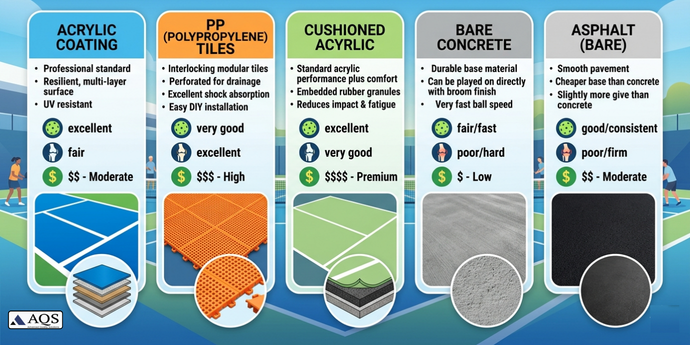
India’s sports infrastructure market now offers five primary pickleball court surface categories. Each comes with distinct performance advantages, cost implications, and suitability based on location, budget, and usage intensity. Understanding each option helps facility owners and builders make an informed, future-proof investment decision.
1. Synthetic Acrylic Flooring – The Industry Standard Surface
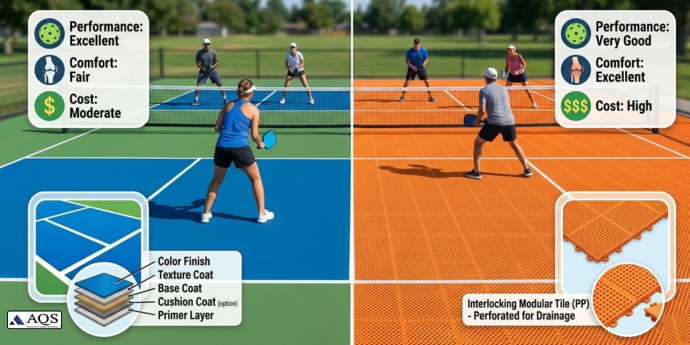
Synthetic acrylic flooring dominates the Indian pickleball court market in 2026 because it delivers the best combination of performance, longevity, and value. Manufacturers apply multiple acrylic polymer coats directly over a prepared concrete or asphalt base. A standard five-layer system includes one primer coat, two resurfacer coats, one color filler layer, and one textured topcoat with machine-applied line markings. Premium eight-layer cushioned acrylic systems add additional rubber-based shock absorption layers beneath the color coat, significantly reducing joint fatigue during extended play sessions and tournament events.
Acrylic surfaces provide UV stability that prevents color fading under India’s intense solar radiation, excellent water drainage through micro-textured surfaces, and ASTM-compliant ball bounce for tournament-level competition. Indian manufacturers like AQS & Topflooring produce ITF-classified acrylic flooring systems specifically formulated for India’s weather extremes, combining high-quality acrylic binders, pigments, and graded silica for maximum grip and durability.
2. Modular Polypropylene (PP) Interlocking Tiles
Modular polypropylene tiles have gained significant traction in India’s residential, school, and temporary event pickleball court segment. These interlocking tiles click together without adhesive or specialized labor, making installation fast, reversible, and cost-effective. PP tiles carry ITF Category 5 (Fast Court) certification and undergo testing by international labs like LABOSPORTS, confirming their suitability for competitive play. They suit rooftop courts, indoor sports halls, and temporary tournament setups where permanent installation remains impractical or cost-prohibitive. However, PP tiles lack the seamless, professional appearance of acrylic surfaces and can shift under extreme heat or heavy foot traffic if sub-base leveling is inadequate.
3. Concrete Base with Acrylic Topcoat – Best for Permanent Courts
M25-grade reinforced concrete poured to 4–6 inches over a compacted gravel sub-base forms the strongest foundation for permanent pickleball courts. Concrete delivers near-zero long-term deformation, a structural lifespan exceeding 25 years, and zero susceptibility to rutting or subsidence under heavy play. On its own, bare concrete is unsuitable for pickleball – it is abrasive, slippery when wet, and causes rapid ball degradation. Facilities always apply multi-layer acrylic topcoats over cured concrete to produce the final playing surface. This combination represents the most durable pickleball court material system for high-traffic commercial installations, schools, and government sports complexes across India.
4. Asphalt Base with Acrylic Surface Coating
Asphalt-base courts cost less upfront than concrete but carry higher long-term maintenance requirements due to thermal expansion cracking in Indian summers and monsoon moisture absorption. Contractors use dense-graded bituminous macadam as the base, then apply acrylic resurfacer coats to seal and texture the playing surface. Asphalt works effectively for budget-constrained outdoor courts in mild-climate regions like Pune or Mysore. However, in Rajasthan, Gujarat, or other high-heat zones, asphalt tends to soften and deform, requiring more frequent resurfacing than concrete-based alternatives.
5. Cushioned and Cushion-Plus Acrylic Systems (Premium Segment)
Cushioned acrylic systems incorporate rubber granule-based underlayers between the base coat and color surface to deliver superior shock absorption compared to standard acrylic systems. These premium systems target senior player academies, physiotherapy-conscious sports clubs, and five-star hospitality facilities that prioritize player joint health. Cushion-Plus systems reduce impact by 20–35% compared to standard acrylic, according to independent biomechanics testing data. The installed cost runs 30–50% higher than standard acrylic but delivers measurable long-term health benefits for players aged 45 and above who represent a fast-growing pickleball demographic in Indian metros.
Pickleball Court Flooring Material Comparison: Key Information Table
| Flooring Type | Cost (₹/sq.ft) | Lifespan | Maintenance | Best Use Case | Climate Suitability |
| Synthetic Acrylic (Standard, 5-layer) | ₹250–₹350 | 8–10 years | Low | Clubs, schools, societies | All India |
| Cushioned Acrylic (8-layer) | ₹350–₹450 | 10–12 years | Low–Medium | Premium clubs, senior centers | All India |
| Modular PP Interlocking Tiles | ₹180–₹280 | 5–8 years | Very Low | Rooftops, indoor, temporary | Indoor/Mild |
| Concrete Base + Acrylic | ₹300–₹450 | 10–15 years | Low | Government, commercial, permanent | All India |
| Asphalt Base + Acrylic | ₹200–₹300 | 6–9 years | Medium | Budget outdoor courts | Mild climates |
| Plain Concrete (uncoated) | ₹80–₹120 | Varies | High (ball damage) | Not recommended for play | Not recommended |
Full Comparison Table: Pickleball vs Other Sports Court Flooring (2026)
| Feature / Parameter | Pickleball Acrylic | Tennis Acrylic | Badminton Synthetic | Basketball Acrylic |
| Ball Bounce Consistency | ✔ High | ✔ High | ~ Medium | ✔ High |
| UV Resistance | ✔ Excellent | ✔ Excellent | ✖ Limited | ✔ Good |
| Shock Absorption (Premium) | ✔ 20–35% | ~ 15–25% | ✔ High | ~ 10–20% |
| Suitable for Outdoor India | ✔ Yes | ✔ Yes | ✖ No | ✔ Yes |
| Cost per sq.ft (₹) | ₹250–₹450 | ₹300–₹550 | ₹150–₹350 | ₹250–₹450 |
| Multi-Sport Convertibility | ✔ Yes | ~ Limited | ✖ No | ~ Limited |
| Maintenance Interval | 3–5 years resurface | 3–5 years | Annual check | 3–4 years |
Regional Pickleball Court Flooring Cost Breakdown: City-Wise
Pickleball court flooring installation costs vary significantly across Indian cities due to differences in labor rates, material transportation logistics, contractor competition density, and local civil work requirements. Metro cities like Mumbai, Delhi, and Bengaluru consistently command 20–40% cost premiums compared to Tier 2 cities like Indore, Coimbatore, or Nagpur where labor rates remain considerably lower. Understanding this geographic cost variation allows facility planners to set realistic budgets aligned with their location.
| City / Region | Standard Acrylic (₹/sq.ft) | Full Court Cost (Outdoor) | Full Court Cost (Indoor) |
| Mumbai | ₹380–₹450 | ₹8–₹12 lakh | ₹18–₹28 lakh |
| Delhi / NCR | ₹360–₹430 | ₹7.5–₹11 lakh | ₹16–₹25 lakh |
| Bengaluru | ₹340–₹420 | ₹7–₹10.5 lakh | ₹15–₹23 lakh |
| Pune | ₹300–₹380 | ₹6.5–₹9.5 lakh | ₹13–₹20 lakh |
| Hyderabad / Chennai | ₹300–₹380 | ₹6–₹9 lakh | ₹12–₹19 lakh |
| Tier 2 Cities (Indore, Nagpur, etc.) | ₹250–₹320 | ₹5–₹7.5 lakh | ₹10–₹15 lakh |
Upgrade Your Sports Court Today
Get premium synthetic acrylic flooring designed for durability, grip, and performance.
Get Free ConsultationHow Multi-Layer Acrylic Systems Work: Pickleball Surface Construction Process
Professional pickleball court contractors follow a precise multi-stage application process to achieve tournament-grade playing surfaces. They begin with thorough base preparation – grinding the concrete or asphalt surface to remove all loose material, oil contamination, and existing coating residue. Workers then apply a penetrating primer coat that bonds the acrylic system chemically to the base, preventing delamination under thermal cycling and moisture stress.
After primer curing, contractors apply two resurfacer coats filled with fine silica sand to fill micro-cracks and level surface undulations to within 3mm per 3-meter straightedge tolerance. The cushion coat follows on premium systems, containing rubber granules in an acrylic binder to create the shock-absorbing underlayer. Workers then apply one or two color topcoats using roller or spray equipment, embedding graded silica into the wet coat for grip texture calibration. Finally, machine-applied thermoplastic or acrylic-based line marking completes the ITF/AIPA-compliant court layout with precise boundary, kitchen, and centreline measurements.
Climate-Specific Flooring Selection for Indian Pickleball Courts
India’s geographic diversity creates dramatically different environmental stresses on pickleball court flooring. North Indian plains experience 45°C+ summers combined with sub-5°C winters, causing significant thermal expansion and contraction cycles that stress surface adhesion bonds. Concrete bases with high-quality acrylic systems handle these cycles far better than asphalt, which softens and deforms above 55°C surface temperature – a threshold regularly exceeded on exposed Delhi rooftops in June.
Coastal cities like Mumbai, Chennai, and Kochi combine high humidity with salt-laden air that accelerates surface degradation on inferior acrylic formulations. Facility owners in these regions should specify marine-grade acrylic topcoats with anti-fungal additives and superior waterproofing characteristics. Northeast India’s extreme rainfall requires courts designed with 1–1.5% cross-slope gradients and perimeter drainage channels to prevent ponding that causes surface delamination over time.
Real-World Case Study
Delhi Sports Society: Rooftop to Tournament-Grade Pickleball Court
A premium gated community in South Delhi’s Vasant Kunj sector commissioned a dedicated pickleball court in January 2025. The society faced a space constraint – only a 3,200 sq. ft. rooftop terrace was available. The project team selected AQS synthetic acrylic system over modular PP tiles after evaluating long-term durability and aesthetic requirements.
- Total project cost (including waterproofing & LED lighting) : ₹9.2L
- Complete installation timeline : 18 days
- Resident players using the court monthly : 340+
Challenge: The rooftop required specialized waterproofing membrane installation before acrylic application to prevent water ingress to floors below. The team applied a 2mm elastomeric waterproofing membrane, then a 6-layer acrylic system with UV-stable topcoat. Sixteen months post-installation, the surface shows zero delamination and retains original color vibrancy despite Delhi’s extreme temperature cycling. The society now hosts inter-complex tournaments attracting 80+ players monthly – validating the ROI of choosing premium acrylic over budget alternatives.
Key Factors That Affect Pickleball Court Flooring Material Selection
Six primary factors drive the optimal material choice for any Indian pickleball court project. Base condition determines whether contractors can apply acrylic directly or must pour new concrete – an existing stable concrete slab saves ₹1.5–₹2.5 lakh in base construction costs. Traffic intensity matters significantly because high-traffic commercial courts with 100+ daily player-hours require eight-layer cushioned systems, while residential courts with moderate use perform well with standard five-layer acrylic. Budget ceiling determines whether concrete or asphalt base is viable, directly influencing long-term maintenance intervals. Geographic climate zone dictates topcoat formulation and base material choice as discussed above. Indoor versus outdoor positioning changes drainage, UV, and thermal requirements fundamentally. Finally, multi-sport convertibility – a growing demand in Indian schools and housing societies – requires planning court layout to accommodate badminton, basketball, or volleyball line overlays on the same acrylic surface.
Maintenance Best Practices for Pickleball Court Flooring Materials
Even the best pickleball court flooring materials requires disciplined maintenance to achieve its rated lifespan. Facility managers should sweep courts daily with soft-bristle brushes to remove grit and sand particles that act as abrasives, accelerating surface wear under repeated foot traffic. They should wash courts monthly with mild pH-neutral detergent solutions and rinse thoroughly to prevent alkaline or acidic chemical buildup that degrades acrylic binders over time.
Facility teams should inspect courts quarterly for hairline cracks, surface peeling, or drainage blockages, addressing minor defects immediately to prevent water ingress that causes major delamination. Professional resurfacing – applying a fresh color topcoat – is recommended every 3–5 years depending on traffic intensity and climate exposure. This resurfacing process costs approximately 15–25% of the original installation cost but extends court life by 4–6 additional years, dramatically improving the total lifecycle ROI of the initial flooring investment.
Top Pickleball Court Flooring Materials Manufacturers & Suppliers in India 2026
India’s specialized sports flooring market now supports several established manufacturers producing ITF-classified acrylic systems specifically designed for Indian climate conditions and regulatory requirements. AQS holds a strong position as an ITF-classified synthetic acrylic sports flooring material manufacturer with dedicated pickleball court systems for clubs, schools, and residential communities. Topfloor Sports Infra supplies its proprietary ACRYTOP system with certified performance data for both concrete and asphalt base applications across major Indian cities. Pacecourt specializes in India-wide city-specific cost-optimized solutions with transparent pricing breakdowns for Tier 1 through Tier 3 markets. Bharat Natural offers PP tile solutions with ITF certification for buyers prioritizing rapid installation and reversibility over permanent surface systems.
Final Verdict
The pickleball court flooring materials decision shapes every aspect of facility performance from player safety and game quality to maintenance costs and long-term asset value. Synthetic multi-layer acrylic flooring applied on M25 concrete base remains the definitive choice for Indian outdoor courts in 2026, supported by its climate adaptability, ASTM compliance, 8–12 year lifespan, and clear cost-per-year ROI advantage over all competing surface types.
Facility owners should specify cushioned eight-layer systems for premium clubs, senior academies, and tournament venues where player joint health and competitive standards drive purchasing decisions. Budget-conscious residential societies and schools can achieve excellent results with standard five-layer acrylic on concrete base systems in the ₹250–₹350 per sq. ft. range. Modular PP tiles serve rooftop, indoor, and temporary event courts effectively. Always engage ITF-classified manufacturers with India-specific climate formulations, documented project portfolios, and post-installation technical support to maximize the return on every rupee invested in your pickleball court flooring infrastructure.
Frequently Asked Questions
Multi-layer synthetic acrylic flooring on an M25 concrete base is the best outdoor pickleball court flooring materials in India, offering UV resistance, consistent bounce, and an 8-12 year lifespan.
Acrylic pickleball court flooring costs ₹250-₹450 per sq. ft. in 2026, with full outdoor court construction ranging from ₹5 lakh to ₹12 lakh depending on city and specifications.
How long does synthetic acrylic pickleball court flooring last?
A well-installed synthetic acrylic pickleball court surface lasts 8-12 years with regular maintenance and professional resurfacing every 3–5 years.
Modular PP tiles work well for semi-permanent indoor and rooftop courts but are not recommended for high-traffic permanent outdoor courts exposed to extreme Indian heat.
M25 concrete base with UV-stable cushioned acrylic topcoat is mandatory for hot-climate zones like Rajasthan asphalt softens above 55°C surface temperature and deforms under load.
Both use synthetic acrylic systems, but pickleball courts use slightly softer texture formulations optimized for lateral movement and lower-impact gameplay compared to tennis court surfaces.