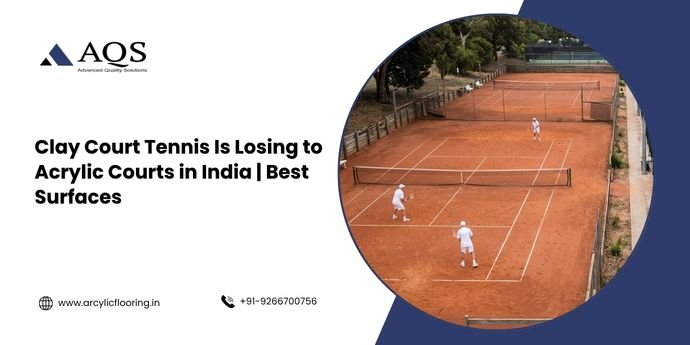
Clay court tennis refers to tennis played on a surface made from crushed brick, shale, stone, or similar granular materials. The surface creates a slower game because the ball bounces higher and loses more speed upon impact. Players who love baseline rallies and defensive play traditionally prefer clay court tennis. Roland Garros in Paris is the world’s most famous clay court tennis tournament, making this surface legendary in professional sports history.
However, clay court tennis comes with serious limitations that most players and facility owners underestimate. The surface absorbs water rapidly and becomes unplayable after rainfall. India’s monsoon season makes clay court tennis facilities sit idle for months every year. Maintenance demands are extremely high, requiring regular watering, rolling, and line repainting to keep clay courts in playable condition.
In 2026, India’s tennis infrastructure is undergoing a major transformation. Sports facility developers, school administrators, and housing societies are actively replacing clay court tennis surfaces with modern acrylic flooring courts. This shift is not accidental – it reflects real data on performance, cost, and long-term value for Indian climate conditions.
Understanding the Clay Court Tennis Surface – Properties and Performance
How Clay Court Tennis Surfaces Are Constructed in India
A traditional clay court tennis surface in India uses red brick aggregate as its base layer. Workers compact this material tightly and add a binding agent on top. The finished surface produces a consistent but slow playing speed. Most clay court tennis facilities in India require full reconstruction every five to seven years due to weather degradation.
Indian clay courts specifically struggle with Delhi’s extreme summers and Mumbai’s heavy monsoon rainfall. The surface cracks under temperature extremes and turns to mud during rain. Facility owners lose significant playing time and revenue every single year managing clay court tennis surface problems.
Upgrade Your Sports Court Today
Get premium synthetic acrylic flooring designed for durability, grip, and performance.
Get Free ConsultationBall Bounce Dynamics on Clay Court Tennis Surfaces
Clay court tennis produces a high, slow bounce that gives players more reaction time. The ball grips the surface and kicks upward at an angle. This characteristic favors topspin players and physically fit athletes who can sustain long baseline rallies. Rafael Nadal built his entire career around clay court tennis mastery, demonstrating how much technique the surface rewards.
The friction coefficient of a standard clay court tennis surface ranges between 0.70 and 0.78. This measurement means the ball slows down significantly upon contact. Players must generate more power to drive winners through the court. Acrylic surfaces, by comparison, maintain a more predictable and consistent friction coefficient regardless of temperature or humidity.
Acrylic Flooring Courts – The Superior Alternative to Clay Court Tennis in 2026
What Makes Acrylic Sports Flooring the Best Tennis Court Surface Today
Acrylic sports flooring is a multi-layer coating system applied over a concrete or asphalt base. The system includes a cushioning layer, multiple color coats, and a textured finish that controls ball speed and player traction. Acrylic courts are the standard surface at the US Open and Australian Open, making them globally trusted and performance-verified.
Acrylic flooring courts give facility owners complete control over playing speed. Manufacturers apply more or fewer acrylic granules in the top coat to create slow, medium, or fast surfaces. This flexibility means one acrylic court can serve both recreational players and competitive athletes without any reconstruction.
Why Acrylic Flooring Outperforms Clay Court Tennis for Indian Conditions
India’s climate is the single biggest reason facility owners are switching from clay court tennis to acrylic courts in 2026. Acrylic surfaces drain water quickly and return to playable condition within 30 minutes of rain stopping. Clay court tennis facilities require 24 to 48 hours to dry after moderate rainfall before play can safely resume.
Temperature resilience is another critical advantage. Acrylic courts withstand temperatures from -10°C to 60°C without cracking or surface degradation. Indian summers in cities like Nagpur and Jaipur regularly push past 45°C, which destroys clay court tennis surfaces within a few seasons.
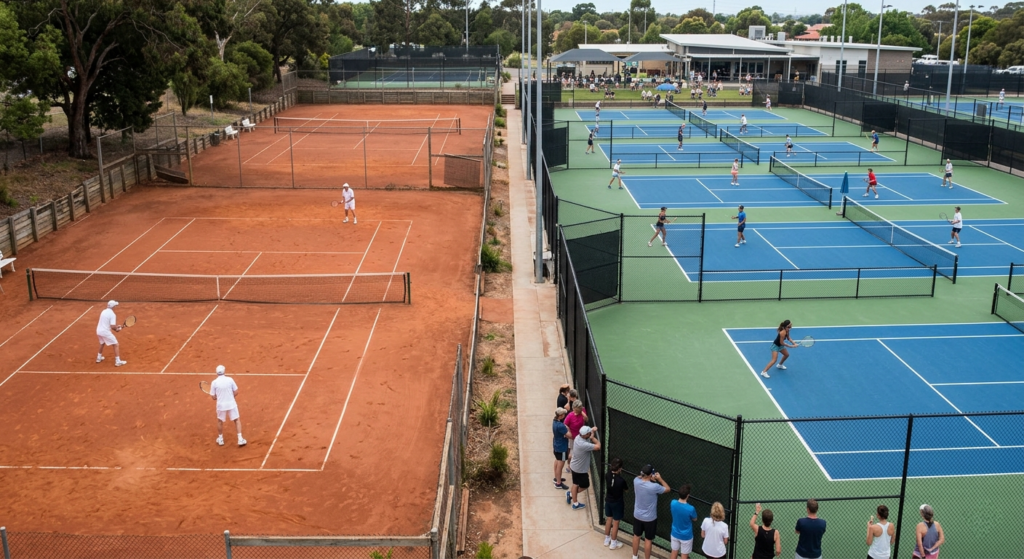
Clay Court Tennis vs Acrylic Flooring – Complete Comparison Table 2026
| Feature | Clay Court Tennis | Acrylic Flooring Court |
| Ball Bounce Speed | Slow and high | Medium to fast, consistent |
| Weather Dependency | Unplayable after rain | Playable within 30 minutes of rain |
| Annual Maintenance Cost (India) | ₹3,00,000 – ₹6,00,000 | ₹40,000 – ₹80,000 |
| Surface Lifespan | 5–7 years | 10–15 years |
| Construction Cost per Court | ₹8,00,000 – ₹12,00,000 | ₹10,00,000 – ₹18,00,000 |
| Playing Hours Lost to Rain (Annual) | 600–900 hours | Less than 50 hours |
| Shoe Wear Rate | High (slides damage surface) | Moderate and predictable |
| Line Marking Durability | Requires repainting monthly | Lasts 2–3 years per coat |
| Player Joint Impact | Low (natural cushioning) | Low to medium (cushion layer available) |
| Customizable Speed | No | Yes |
| Suitable for Indian Climate | Poor | Excellent |
| UV Resistance | Low | High (UV-stable pigments) |
Full Comparison Updated Information About Clay Court Tennis vs Acrylic Flooring Click Here!!
Detailed Cost Analysis – Clay Court Tennis vs Acrylic Court Investment in India
First-Year Cost Breakdown for Clay Court Tennis Facilities
Building a standard clay court tennis facility in India costs between ₹8 lakh and ₹12 lakh per court. This figure covers excavation, brick aggregate layering, compaction, drainage installation, and line marking. However, this is never the final cost. Within the first year, facility owners spend an additional ₹2 lakh to ₹4 lakh on watering equipment, rolling machinery, and soil amendments.
Clay court tennis also demands skilled maintenance workers who understand surface preparation. Finding qualified clay court groundskeepers in India is increasingly difficult as the profession shrinks. Labour costs for clay court tennis maintenance in metro cities have risen 35% since 2023 according to industry estimates from the All India Tennis Association.
Long-Term Financial Advantage of Acrylic Flooring Over Clay Court Tennis
An acrylic flooring court costs more upfront – typically ₹10 lakh to ₹18 lakh depending on cushioning specification and court size. However, the annual maintenance cost drops dramatically to ₹40,000 to ₹80,000 per court. This figure covers periodic cleaning, minor crack sealing, and repainting every three years.
Over a 10-year period, an acrylic court costs approximately ₹12 lakh less to maintain than a clay court tennis surface of identical size. This saving excludes the revenue recovered from extra playing hours that clay court tennis facilities lose to weather. A club with 4 courts gains back roughly 2,400 to 3,600 playing hours annually by switching from clay to acrylic surfaces.
Key Technical Specifications – Acrylic Flooring Court Construction Standards in India 2026
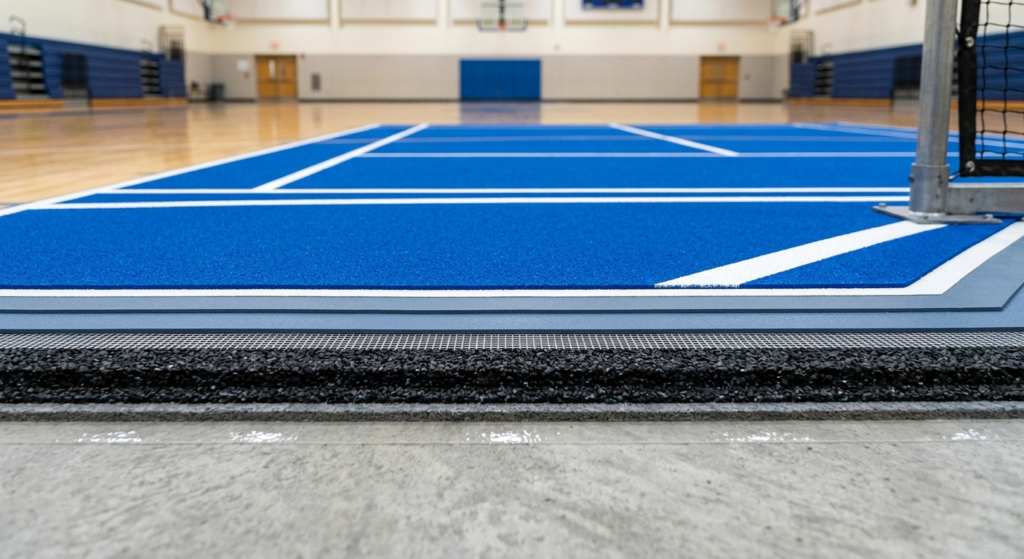
Layer-by-Layer Construction of an Acrylic Tennis Court
| Layer | Material | Thickness | Purpose |
| Sub-base | Compacted gravel or stone aggregate | 150–200 mm | Drainage and load distribution |
| Base Course | Asphalt or concrete | 75–100 mm | Structural stability |
| Resurfacing Coat | Acrylic patch binder | 2–3 mm | Smoothing and leveling |
| Cushion Layer | Rubber granule-acrylic mix | 3–6 mm (optional) | Shock absorption |
| Color Coats | Acrylic pigment coats (2–3 layers) | 1–2 mm each | UV protection and aesthetics |
| Textured Top Coat | Acrylic with silica sand | 0.5–1 mm | Ball speed control and grip |
| Line Marking | Acrylic paint | 0.2 mm | Court demarcation |
This layered system creates a surface that is structurally sound, visually clear, and consistent under all weather conditions. Each layer serves a specific engineering purpose that clay court tennis surfaces simply cannot replicate with natural materials.
Upgrade Your Sports Court Today
Get premium synthetic acrylic flooring designed for durability, grip, and performance.
Get Free ConsultationITF-Approved Surface Speed Ratings for Acrylic Courts
The International Tennis Federation classifies court surfaces into five pace categories from Category 1 (slow) to Category 5 (very fast). Standard clay court tennis surfaces fall in Category 1. Most acrylic courts manufactured in India in 2026 are built to Category 2 (medium-slow) or Category 3 (medium) specifications, offering the best balance between baseline play and net attack opportunities.
Indian manufacturers like Mondo India, Courtech Sports, and Gujarat-based acrylic coating companies now produce ITF-approved surfaces. The AITA (All India Tennis Association) updated its 2026 facility guidelines to recommend Category 2 acrylic surfaces for all new club and academy constructions across the country.
Case Study – Delhi Sports Academy Switches from Clay Court Tennis to Acrylic in 2025
Facility Name: Greenfield Tennis Academy, Dwarka, New Delhi Court Count: 6 courts (previously all clay court tennis) Conversion Year: 2025 Investment: ₹72 lakh total (₹12 lakh per court average)
Greenfield Tennis Academy operated six clay court tennis courts for over a decade. Every monsoon season, the facility closed for approximately 3 months due to waterlogging and surface damage. Annual maintenance costs averaged ₹24 lakh for all six courts combined. The academy enrolled 180 students but could not guarantee consistent court availability during peak junior training seasons.
In early 2025, the management converted all six clay court tennis surfaces to ITF Category 2 cushioned acrylic courts. Construction took 8 weeks with zero demolition of existing fencing or lighting infrastructure. The acrylic surface was laid directly over a new asphalt base after the clay was removed and compacted.
Results after 12 months of acrylic court operation:
- Annual maintenance cost dropped from ₹24 lakh to ₹3.8 lakh (84% reduction)
- Playing hours increased by 2,100 hours annually due to weather resilience
- Student enrollment grew from 180 to 310 students within one year
- Court booking revenue increased by 67% due to expanded availability
- Zero clay court tennis surface repairs or emergency maintenance calls
The academy director, Mr. Rajiv Sharma, stated that the switch from clay court tennis to acrylic transformed the facility’s financial model entirely. The investment paid back within 3.5 years based on revenue growth alone.
Environmental Impact – Clay Court Tennis vs Acrylic Flooring Sustainability
Water Consumption in Clay Court Tennis Maintenance
Clay court tennis surfaces require daily watering to prevent cracking and maintain proper ball bounce. A single standard clay court needs 3,000 to 5,000 litres of water per day during dry seasons. Six clay courts at a facility consume more water annually than 15 average Indian households. This massive water demand makes clay court tennis environmentally unsustainable in water-stressed regions like Rajasthan, Maharashtra, and Karnataka.
Acrylic courts require no daily watering whatsoever. The only water used is during occasional pressure washing, which happens two to four times per year. This reduction represents a 99% decrease in tennis court water consumption when facilities replace clay court tennis surfaces with acrylic alternatives.
Material Longevity and Waste Reduction in Acrylic Court Systems
Clay court tennis surfaces generate significant waste material during their 5 to 7-year replacement cycles. Each replacement requires hauling away 40 to 60 tonnes of degraded clay aggregate per court. Acrylic courts simply receive a fresh top coat every 8 to 10 years, generating almost no construction waste.
Acrylic flooring manufacturers in India increasingly use recycled rubber granules in their cushion layers. This practice diverts waste tyres from landfills and converts them into high-performance shock absorption layers. Environmental certification bodies in India now classify cushioned acrylic courts as a sustainable sports surface option for green building projects.
Health and Player Safety – Comparing Clay Court Tennis and Acrylic Surfaces
Joint Stress Comparison Across Different Tennis Court Surfaces
| Surface Type | Impact Force (G-force) | Ankle Injury Risk | Knee Stress Index | Recovery Time After Play |
| Clay Court Tennis | 1.8–2.2G | Low | Low | Short |
| Standard Acrylic | 2.4–2.8G | Medium | Medium | Moderate |
| Cushioned Acrylic | 1.9–2.3G | Low-Medium | Low-Medium | Short |
| Grass Court | 1.6–2.0G | High (slipping) | Low | Short |
| Hard Concrete (no coating) | 3.2–3.8G | High | High | Long |
Cushioned acrylic courts match clay court tennis surfaces very closely in impact force measurements. The rubber cushion layer absorbs shock at a level nearly identical to natural clay. Players transitioning from clay court tennis to cushioned acrylic courts report minimal adjustment time and comparable comfort during extended training sessions.
Physiotherapists at major Indian sports hospitals in 2026 recommend cushioned acrylic courts as the safest all-weather alternative to clay court tennis. The surface provides predictable traction that prevents the dangerous sliding injuries common on wet clay or over-watered clay court tennis surfaces.
Installation Timeline – Building an Acrylic Court Faster Than Clay Court Tennis Infrastructure
| Project Phase | Clay Court Tennis | Acrylic Flooring Court |
| Site Preparation | 7–10 days | 5–7 days |
| Base Layer Construction | 14–21 days | 10–14 days |
| Surface Application | 7–10 days | 5–7 days |
| Curing and Drying Time | 21–30 days (clay settling) | 5–7 days (acrylic curing) |
| Line Marking and Finishing | 3–5 days | 2–3 days |
| Total Construction Time | 52–76 days | 27–38 days |
Proper Define
Acrylic courts complete construction roughly 40% faster than equivalent clay court tennis infrastructure. This speed advantage matters enormously for commercial facilities where every offline day represents lost revenue. Schools and institutions also benefit from faster installation during vacation periods.
Top Acrylic Tennis Court Manufacturers and Suppliers in India 2026
India’s acrylic court industry has grown significantly as demand shifts away from clay court tennis. Several reliable suppliers now operate nationally with certified installation teams.
Leading suppliers as of 2026 include:
- AQS provides standard acrylic systems with full ITF certification. Their cushioned surfaces are popular with AITA-affiliated academies.
- Courtech Sports operates in Delhi, Mumbai, and Bangalore, offering turnkey acrylic court construction from base preparation through final line marking.
- Sportmaster Asia supplies the globally trusted Sportmaster acrylic system across South and Southeast Asia, with active projects in Chennai, Hyderabad, and Pune.
- ACE Sport Surfaces India focuses on budget-conscious acrylic court systems suitable for schools and smaller housing society tennis courts replacing clay court tennis infrastructure.
Each supplier provides a standard 5-year surface warranty that covers delamination, colour fading, and cracking under normal use conditions. No clay court tennis supplier in India offers any comparable performance guarantee.
Final Verdict
Clay court tennis holds a permanent place in tennis history and professional sport. However, for facility owners, schools, clubs, and academies operating in India in 2026, the practical choice is clearly acrylic flooring. The data on maintenance costs, weather resilience, player safety, and long-term financial return all favour acrylic courts decisively over clay court tennis infrastructure.
India’s tennis growth story in 2026 runs on acrylic courts. From Tier-1 metros to emerging Tier-2 cities like Indore, Coimbatore, and Ludhiana, new tennis facilities are choosing acrylic over clay court tennis surfaces at an accelerating rate. The AITA’s updated facility standards, growing player demand for consistent surfaces, and the sharp decline in clay court maintenance expertise all push this transition forward.
If you currently operate a clay court tennis facility, the conversion to acrylic is not a question of preference it is a question of when. Every year of delay costs revenue, wastes water, and limits your facility’s growth potential. Acrylic flooring courts represent the present and future of tennis infrastructure in India.
Frequently Asked Questions
Not necessarily – cushioned acrylic courts offer comparable joint comfort with far greater availability and consistency, making them equally suitable for beginners.
Acrylic courts last 10 to 15 years versus 5 to 7 years for clay court tennis surfaces under Indian weather conditions.
Yes – most clay court tennis facilities can be converted to acrylic by removing the clay layer and applying a new asphalt base before acrylic coating.
No – acrylic courts produce faster play with lower bounces, which rewards aggressive net play more than the slow, high-bounce dynamics of clay court tennis.
Acrylic courts need cleaning twice yearly and recoating every 8 to 10 years, whereas clay court tennis surfaces need daily watering and monthly maintenance.
Yes – the AITA updated its 2026 guidelines to fully approve ITF-certified acrylic surfaces for all official state and national junior tournaments in India.