Basketball is one of the fastest-growing sports in India. Thousands of new courts are being constructed across schools, residential societies, sports academies, and municipal parks every year. Understanding the correct basketball court size in metres is the first and most critical step before any construction or renovation begins.
Whether you are a school administrator, a sports facility manager, or a private investor, getting the dimensions right ensures fair play, player safety, and long-term return on investment. In 2026, India has seen a significant shift from traditional clay and concrete surfaces to advanced acrylic flooring systems, which deliver superior bounce consistency, UV resistance, and professional-grade performance.
This article covers every dimension, surface type, comparison, and regulation you need to know. It also includes a real-world case study, comparison tables to help you make informed decisions.
Table of contents
- Official Basketball Court Size in Metres – FIBA and BFI 2026 Standards
- Key Zone Measurements on a Basketball Court in Metres
- Half-Court Basketball Dimensions in Metres – India School and Residential Standard
- Acrylic Flooring vs Clay Court – Which Is Better for Basketball in India 2026?
- Types of Acrylic Flooring Systems Used in Basketball Courts India 2026
- Basketball Court Construction Cost in India 2026 – Size-Wise Breakdown
- Case Study – Acrylic Basketball Court Construction in Pune, Maharashtra 2025–2026
- How to Mark a Basketball Court Correctly in Metres – Step-by-Step Line Layout
- Basketball Court Dimensions for Schools and Residential Societies
- Frequently Asked Questions
- Conclusion
Official Basketball Court Size in Metres – FIBA and BFI 2026 Standards
The international governing body, FIBA (Fédération Internationale de Basketball), sets the global standard for basketball court dimensions. The Basketball Federation of India (BFI) officially follows these FIBA guidelines for all national and state-level tournaments in 2026.
Full-Size Basketball Court Dimensions in Metres
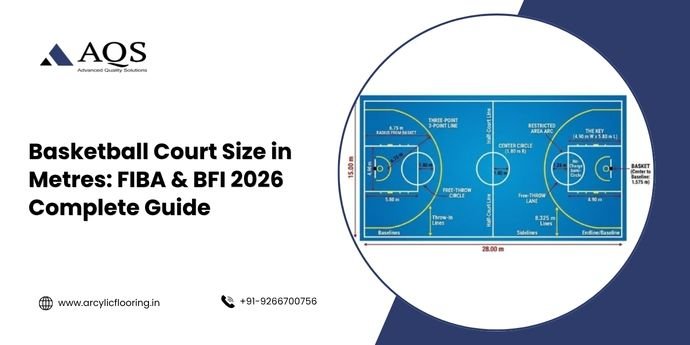
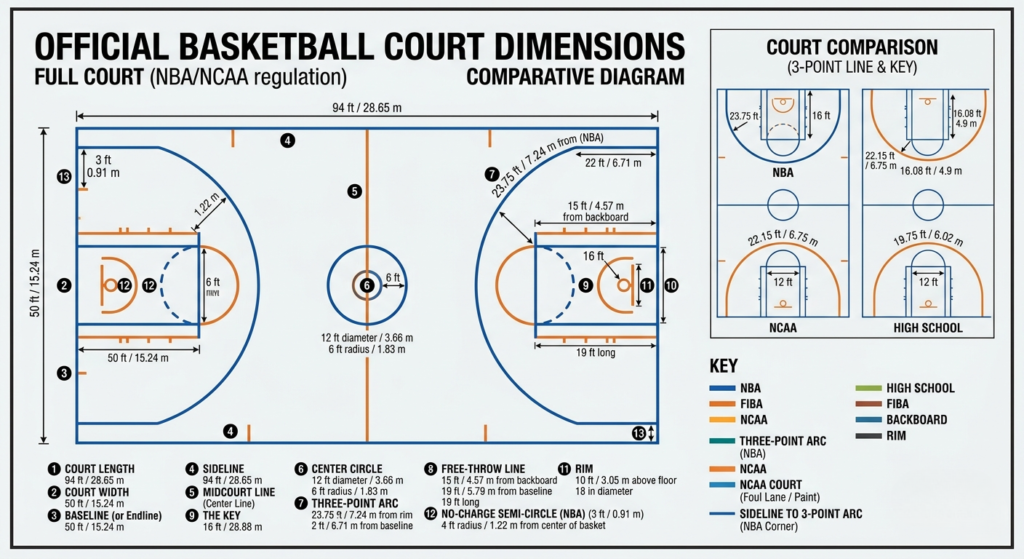
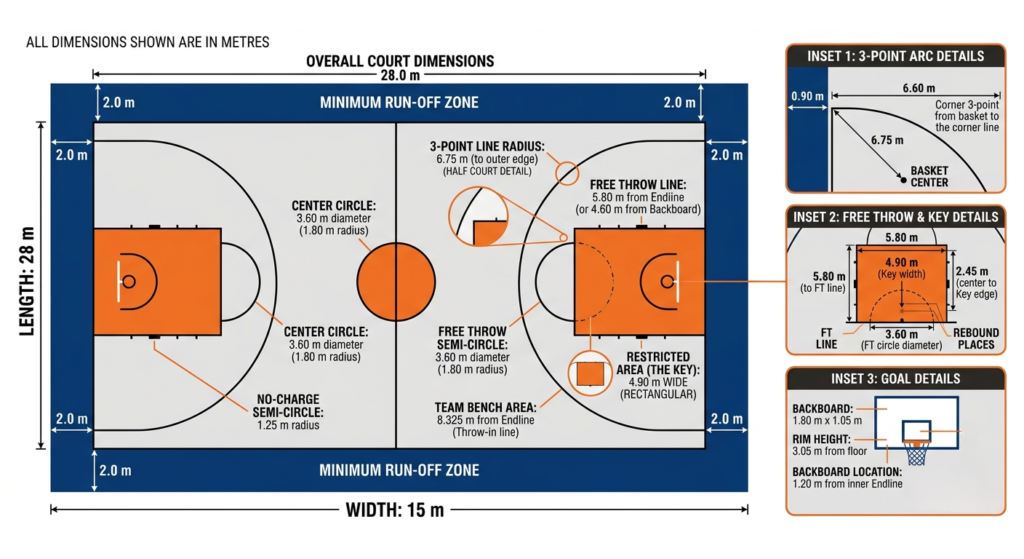
A regulation full-size court used in professional, national, and FIBA-approved competitions measures exactly 28 metres in length and 15 metres in width. This gives a total playing area of 420 square metres. The court boundary lines, called end lines and sidelines, define this rectangle. All measurements are taken from the inner edge of the boundary lines.
Upgrade Your Sports Court Today
Get premium synthetic acrylic flooring designed for durability, grip, and performance.
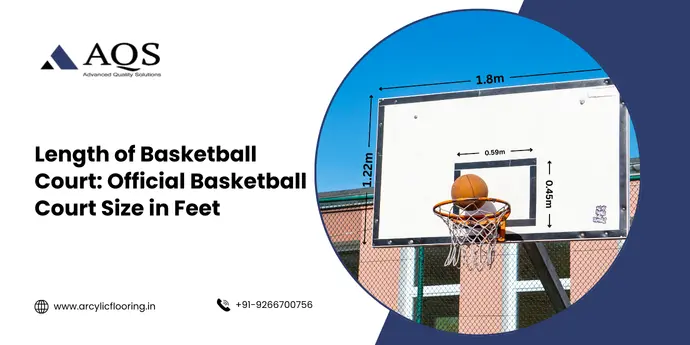
Get Free ConsultationThe basketball rim (hoop) sits exactly 3.05 metres above the floor at both ends. The backboard extends 1.05 metres above the rim and measures 1.83 metres wide by 1.07 metres tall. These dimensions are non-negotiable in any FIBA or BFI-approved facility across India.
Key Zone Measurements on a Basketball Court in Metres
Understanding individual zone measurements is essential for court marking. Below is a breakdown of every critical measurement on a standard basketball court.
- The Three-Second Lane (Paint Area / Key): The restricted lane (key) measures 5.80 metres wide and extends from the baseline to the free-throw line. This zone is critical for post play and lane violation rules.
- Free-Throw Line Distance: The free-throw line sits exactly 5.80 metres from the face of the backboard and 4.225 metres from the basket centre. Players shoot all free throws from behind this line.
- Three-Point Arc Distance: Under current FIBA 2026 rules, the three-point arc is 6.75 metres from the centre of the basket at the top of the arc and 6.60 metres at the corners (where it becomes a straight line parallel to the sideline). This distance was updated from the old 6.25 metres rule and now applies to all BFI competitions in India.
- Centre Circle Radius: The centre circle in the middle of the court has a radius of 1.80 metres. Jump balls and tip-offs are conducted within this circle.
- Restricted Area Arc: A small semi-circle of 1.25 metres radius is drawn under each basket. This arc determines charging versus blocking fouls for defenders.
Basketball Court Dimensions Information Table – 2026 FIBA/BFI Standards
| Court Component | Measurement (Metres) |
| Full Court Length | 28.00 m |
| Full Court Width | 15.00 m |
| Total Playing Area | 420 sq m |
| Three-Point Line (Top Arc) | 6.75 m from basket centre |
| Three-Point Line (Corner) | 6.60 m from basket centre |
| Free-Throw Line Distance | 5.80 m from backboard face |
| Key (Paint) Width | 4.90 m (lane lines, inner) |
| Restricted Area Arc | 1.25 m radius |
| Centre Circle Radius | 1.80 m |
| Basket Height | 3.05 m above floor |
| Backboard Width | 1.83 m |
| Backboard Height | 1.07 m |
| Rim Diameter | 0.45 m |
| Boundary Line Width | 0.05 m (5 cm) |
Half-Court Basketball Dimensions in Metres – India School and Residential Standard
Many schools, housing societies, and community spaces in India install half-courts due to space constraints and budget considerations. A standard half-court uses exactly half the full-court length, giving dimensions of 14 metres long and 15 metres wide. This 210 square metre space accommodates 3-on-3 basketball, which is now an Olympic sport and increasingly popular in Indian cities.
The BFI 3×3 basketball regulations also follow FIBA 3×3 standards. The court for 3×3 measures 15 metres wide and 11 metres long, slightly different from a simple half-court. All zone measurements – three-point line, key, and restricted arc – remain identical to full-court measurements.
Calculate Your Sports Court Dimensions!
Contact us for Quickly measure and calculate accurate sports court dimensions with this easy-to-use tool!
Minimum and Maximum Court Size Variations in Metres
Not every facility can build a regulation 28 x 15 metre court. FIBA provides flexibility for recreational and school-level courts. The minimum acceptable court size for non-competitive play is 24 metres long and 13 metres wide. However, BFI does not approve courts smaller than this for any official match.
For indoor facilities with overhead clearance requirements, the minimum ceiling height above the court must be 7.00 metres. Outdoor courts do not have this restriction, but sun shading or canopy structures must maintain this clearance directly above play zones.
Acrylic Flooring vs Clay Court – Which Is Better for Basketball in India 2026?
This is the most critical decision in basketball court construction today. In 2026, acrylic flooring systems have become the dominant choice across India for professional academies, residential complexes, and municipal sports facilities. Here is a deep, honest comparison.
Why Acrylic Flooring Dominates Basketball Court Construction in India
Acrylic flooring for basketball courts is a multi-layer synthetic surface applied over a concrete or asphalt base. It consists of silica sand, acrylic resin, and rubber granules that form a textured, shock-absorbing layer. The result is a surface that is consistent, durable, weather-resistant, and highly playable under Indian climate conditions.
- Ball Bounce Consistency: Acrylic courts deliver a uniform ball rebound rate of 90–95%, which meets FIBA’s requirement of no less than 90% ball bounce consistency. Clay courts, by contrast, become irregular after rain, heavy use, or seasonal temperature changes. Players on clay courts experience unpredictable bounce patterns that directly harm skill development.
- Joint and Knee Safety: Acrylic surfaces with rubber underlayers provide measurable shock absorption of 25–45%, reducing impact stress on knees, ankles, and hips. Clay courts offer almost zero shock absorption and are prone to hard packing in dry weather, creating injury risks for players landing from jumps.
- Maintenance in Indian Climate: India’s climate ranges from extreme heat in Rajasthan to heavy monsoon rainfall in Kerala and Maharashtra. Acrylic courts dry within 20–30 minutes after rain, allowing play to resume quickly. Clay courts become muddy, slippery, and unusable for 24–48 hours after even moderate rainfall.
- Lifespan and Cost Efficiency: A quality acrylic basketball court in India lasts 8–12 years with minimal maintenance. Clay courts typically require resurfacing every 2–3 years and regular watering, levelling, and line repainting. Over a 10-year period, the total cost of ownership for clay is significantly higher than acrylic.
- Colour Customisation and Line Marking: Acrylic courts accept permanent, UV-resistant colour coatings in any combination. Sports academies across India now build multi-sport acrylic courts using colour zones for basketball, badminton, and volleyball simultaneously. Clay courts cannot support permanent multi-sport markings.
Transform Your Sports Facility Today!
Contact us for high-quality synthetic sports flooring material and elevate your space!
Comprehensive Comparison Table – Acrylic Flooring vs Clay Court for Basketball 2026
| Feature | Acrylic Flooring | Clay Court |
| Ball Bounce Consistency | 90–95% (FIBA compliant) | 60–75% (irregular) |
| Shock Absorption | 25–45% | Near zero |
| Drying Time After Rain | 20–30 minutes | 24–48 hours |
| Lifespan | 8–12 years | 2–3 years (resurfacing) |
| Maintenance Cost (Annual) | Low (₹15,000–₹30,000) | High (₹50,000–₹1,00,000) |
| UV & Weather Resistance | Excellent | Poor to moderate |
| Multi-sport Use | Yes (colour zoning) | No |
| FIBA/BFI Approval | Yes | No (for official matches) |
| Player Injury Risk | Low | Moderate to high |
| Installation Cost (per sq m) | ₹600–₹1,200 | ₹200–₹350 |
| 10-Year Total Cost | Lower | Higher |
| Colour Customisation | Full range available | None |
| Suitable for India Climate | Excellent | Poor (monsoon regions) |
Types of Acrylic Flooring Systems Used in Basketball Courts India 2026
Not all acrylic courts are the same. Three primary systems are currently in use across India.
Cushioned Acrylic System
This premium system includes a rubber cushion base layer beneath the acrylic top coat. It provides the highest shock absorption and is preferred by professional academies, state sports complexes, and NBA-affiliated training centres in India. The total thickness ranges from 8–14 mm.
Hard Acrylic System
Applied directly over concrete or asphalt without a cushion layer, hard acrylic courts offer excellent durability and low maintenance at a lower installation cost. This system is the most common choice for municipal parks, school playgrounds, and housing society courts across India in 2026.
Textured Acrylic with Anti-Slip Coating
Designed specifically for outdoor courts in high-humidity regions like coastal India, this system uses silica-embedded textures to maximise grip even in light rain or morning dew. It combines safety with the full performance benefits of standard acrylic flooring.
Upgrade Your Sports Court Today
Get premium synthetic acrylic flooring designed for durability, grip, and performance.
Get Free ConsultationBasketball Court Construction Cost in India 2026 – Size-Wise Breakdown
Understanding costs by court size helps facility planners budget accurately. Prices below reflect 2026 market rates across major Indian cities including Delhi, Mumbai, Bengaluru, Hyderabad, and Chennai.
Cost Estimation Table by Court Type and Flooring – India 2026
| Court Type | Size (Metres) | Acrylic Flooring Cost | Clay Court Cost |
| Full FIBA Court | 28 x 15 m | ₹25,00,000–₹50,00,000 | ₹8,00,000–₹15,00,000 |
| Half Court | 14 x 15 m | ₹13,00,000–₹25,00,000 | ₹4,00,000–₹7,50,000 |
| 3×3 FIBA Court | 15 x 11 m | ₹10,00,000–₹20,00,000 | ₹3,50,000–₹6,00,000 |
| Mini Court (School) | 24 x 13 m | ₹19,00,000–₹37,00,000 | ₹6,00,000–₹11,00,000 |
Costs include surface preparation, base layer, acrylic coating, line marking, and basketball post installation. Lighting, fencing, and seating are additional.
Case Study – Acrylic Basketball Court Construction in Pune, Maharashtra 2025–2026
Facility Name: Surya Sports Academy, Pune Project Type: Outdoor Full-Size Basketball Court Court Size: 28 metres x 15 metres (FIBA standard) Surface Chosen: Cushioned Acrylic Flooring System Base Layer: 100 mm reinforced concrete Project Duration: 6 weeks Total Project Cost: ₹38,00,000
Background: Surya Sports Academy in Pune had been operating on a clay surface court since 2019. During the 2024 monsoon season, the clay court became completely unusable for three months, forcing students to train on a local concrete court at a nearby school. This disruption led the management to evaluate permanent surface upgrades.
The Decision: After consulting with three certified sports surface contractors and reviewing BFI guidelines, the academy chose a cushioned acrylic system. The system included a 100 mm concrete base, a 10 mm rubber cushion layer, and three coats of acrylic with a UV-stable colour topcoat in orange and dark blue.
Results After One Year of Use (2026):
- Court remained playable throughout the 2025 monsoon season with only 22-minute average drying time after heavy rain.
- Player injury incidents (sprains and falls) dropped by 62% compared to the previous clay surface.
- The court now hosts state-level 3×3 tournaments, generating additional revenue for the academy.
- Annual maintenance cost reduced from ₹72,000 (clay) to ₹18,000 (acrylic).
- Student enrollment increased by 34% in the first year after the court upgrade.
Key Takeaway
The Surya Sports Academy case confirms that transitioning from clay to acrylic basketball court surface delivers measurable improvements in safety, usability, and financial performance within the first year of operation.
How to Mark a Basketball Court Correctly in Metres – Step-by-Step Line Layout
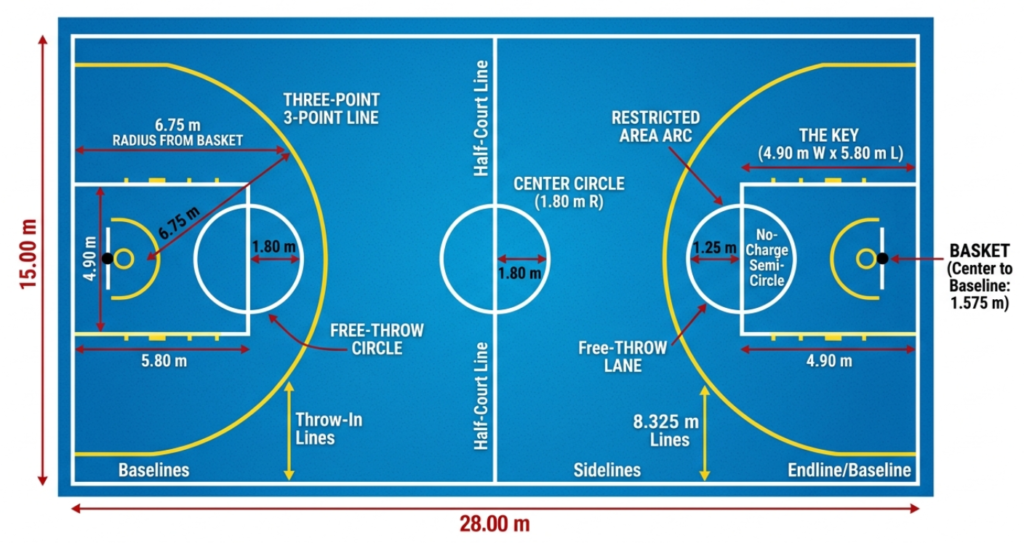
Accurate court marking ensures legal play and a professional appearance. Below is the correct marking sequence for a full 28 x 15 metre basketball court.
Line Width and Colour Standards for Basketball Courts India
All boundary and zone lines on a basketball court must be 5 centimetres (0.05 metres) wide. FIBA specifies that all lines must be the same colour and must contrast clearly with the court surface colour. In India, most acrylic courts use white lines on an orange, blue, or green base for maximum visibility.
- Boundary Rectangle: Mark the outer boundary first: 28 m length x 15 m width. Use chalk lines or laser levels for precision before applying paint.
- Centre Line: Draw the midcourt line connecting both sidelines at exactly 14 metres from each baseline.
- Centre Circle: From the exact midcourt centre point, draw a circle with a 1.80 metre radius.
- Three-Point Arcs: From the centre of each basket, measure 6.75 metres for the arc top and 6.60 metres at corners. The corner straight sections run parallel to the sidelines.
- Key Areas: Mark both paint zones: 5.80 metres from baseline and 4.90 metres wide (inner lane lines).
- Free-Throw Lines and Circles: The free-throw line runs across the key at 5.80 metres from the backboard face. The free-throw circle has a 1.80 metre radius from the free-throw line midpoint.
- Restricted Arcs and Backboard Markers: Paint the restricted arc at 1.25 metres below each basket. Add the no-charge semi-circle and optional backboard markings.
Basketball Court Dimensions for Schools and Residential Societies
The All India School Games Federation (SGFI) and BFI both recommend specific court dimensions for school competitions. For SGFI-sanctioned matches, courts must measure a minimum of 26 metres x 14 metres. Schools with space limitations may use 24 x 13 metres for practice and interschool tournaments below district level.
Residential societies in Tier 1 and Tier 2 Indian cities increasingly install half-courts (14 x 15 metres) with hard acrylic surfaces. These courts require a minimum plot size of approximately 18 x 20 metres to include the court plus 2-metre safety margins on all sides. Society courts with proper acrylic flooring also serve as multi-sport surfaces for badminton and futsal.
Calculate Your Sports Court Dimensions!
Contact us for Quickly measure and calculate accurate sports court dimensions with this easy-to-use tool!
Frequently Asked Questions
A standard FIBA basketball court measures 28 metres long and 15 metres wide.
The minimum acceptable court size for school competitions in India is 24 metres long and 13 metres wide.
Yes, acrylic flooring provides superior ball bounce, shock absorption, weather resistance, and lower long-term maintenance costs compared to clay courts.
The three-point arc is 6.75 metres from the basket centre at the top and 6.60 metres at the corners under current FIBA 2026 rules.
A full-size acrylic basketball court (28 x 15 metres) costs approximately ₹25,00,000 to ₹50,00,000 depending on the system type, base preparation, and location.
A quality acrylic basketball court in India lasts 8 to 12 years with minimal annual maintenance under typical Indian weather conditions.
Conclusion
Getting the basketball court size in metres right before construction begins is not just about compliance – it is about creating a facility that players enjoy, coaches trust, and investors benefit from for over a decade. In 2026, India’s sports infrastructure is growing faster than ever. Schools, academies, housing societies, and municipal bodies are all investing in dedicated basketball facilities.
The data, case studies, and comparisons in this article confirm that acrylic flooring is the superior choice over clay courts for every measurable factor – safety, playability, weather resistance, lifespan, and total cost of ownership. Whether you are building a full 28 x 15 metre professional court or a compact 14 x 15 metre half-court for a residential society, choosing an acrylic surface is a decision that pays dividends from the very first game.
Follow FIBA and BFI 2026 standards, invest in quality acrylic surfaces, and use the dimension tables and marking guide in this article to build a basketball court that meets every official requirement and serves players well for years to come.